









- Which customer acquisition channels will be affected by cross-border marketing trends in 2026?Sep 06, 2026View details
- Which homogenization risks should be considered in an analysis of the AI-powered website building industry?Aug 30, 2026View details
- How Will AI Marketing Trends 2026 Change Advertising Budget AllocationAug 28, 2026View details
- Is the EV SSL certificate market shrinking or upgrading? How should companies assess certificate procurement?Aug 11, 2026View details
- Why the old AMP SEO 2020 practices no longer work and what has changed in current optimization prioritiesAug 02, 2026View details
- How to Choose Topics for an Industry News Section to Attract More Organic Search TrafficJul 29, 2026View details
What information should a company prepare before requesting a free website design quote to avoid repeated communication?
When many companies submit a request a free website design quote, they may appear to be asking for a price, but the real obstacle is often incomplete information rather than cost. The service provider asks a round of questions, the company supplements the information, and the proposal is revised repeatedly. What is ultimately consumed is not just the time spent exchanging a few emails, but also the project schedule, internal decision-making efficiency, and even the launch window.
If you are responsible for a website project, do not rush to ask suppliers to prepare a proposal. Clarifying the objectives, business scope, content readiness, launch schedule, and collaboration boundaries is often more useful than requesting quotes from several more vendors. The accuracy of a quote often depends on how much useful information you provide at the early stage.
Why does requesting a quote so often lead to repeated communication?
A common situation is this: a company first sends a message saying, “We want to build a corporate website. Please send us a quote,” and then attaches links to several competitors’ websites. It may appear that the requirements have been provided, but this type of information is far from sufficient.
A website quote is not like buying a standardized component. A website is a business vehicle. This is especially true for marketing websites, international trade websites, multilingual websites, and independent websites. The number of pages, language versions, form logic, content migration, SEO fundamentals, and interfaces for subsequent advertising campaigns all directly affect the schedule and cost. If you do not clarify these points first, the supplier can only make assumptions based on experience. The more assumptions made, the higher the probability of rework later.
In short: if you want to reduce back-and-forth confirmation, first explain clearly “what problem the website needs to solve,” rather than only asking “how much does it cost to build a website?”
Prepare these 6 types of core information before requesting a request a free website design quote
This is the most important part. If the project manager can organize the following information internally in advance, the quality of the first communication will usually improve significantly.
1. Project objectives: Is this a presentation website, or will it also be responsible for lead generation?
This is the first key distinction. Some companies want to upgrade their corporate image, some want to convert overseas inquiries, and others want to support Google SEO, advertising landing pages, or social media traffic acquisition. Different objectives require different website structures, page logic, and content depth.
For example, for a manufacturing company’s international trade website, the focus may be product categories, application scenarios, certificates, inquiry paths, and multilingual versions. For a brand globalization project, the focus may shift to the brand story, content experience, payment process, and integration with marketing automation. If the objective is unclear, the quote will inevitably be unstable.
2. Page and function scope: Do not just say “use this website as a reference”
A reference website can be helpful, but it cannot replace a requirements description. At a minimum, you should organize the following information:
- How many pages are expected; which are fixed pages, and which are expandable pages such as product detail pages or case study detail pages
- Whether multilingual support is required
- Whether product filtering, inquiry forms, a download center, a news system, a recruitment module, maps, membership, or e-commerce functions are required
- Whether the website needs to connect with a CRM, ERP, WhatsApp, email systems, or advertising tracking codes
Many companies initially say, “Let’s keep it simple for now,” but later add form routing, document downloads, regional distributor applications, and lead tracking. These additions are the most likely to cause budget disputes. You do not need to prepare a technical document at the early stage, but you should explain the business actions clearly.
3. Content readiness: A website is not just a design draft
The aspect most easily underestimated during a project is actually content. Who will provide the company introduction, product specifications, case images, qualification documents, FAQs, and brand materials? Can the existing materials be used directly? Are Chinese and English versions available? If these questions are not confirmed in advance, even the best development schedule may be delayed.
Many project managers in engineering companies assume that “the design company should provide the content,” but the actual situation is often that design can improve the wording but cannot replace the company’s provision of first-hand business information. Especially for technical products, industrial equipment, and international trade categories, without internal cooperation it is difficult to create website content that is both professional and conversion-oriented.
4. Budget range: You do not necessarily need to state your bottom price, but you should provide a range
Many people worry that revealing their budget first will put them at a disadvantage, so they ask several suppliers to submit blind quotes. The result is usually not a more realistic price, but several proposals based on completely different criteria: one supplier quotes for a template website, another for a customized website, one assumes that content and basic SEO are excluded, and another lists later maintenance as a separate item.
A more effective approach is to provide an approximate range, such as “Please prepare one approach for a basic version and another for a marketing version.” This allows the supplier to understand how resources should be configured. A budget is not first and foremost a negotiation card; it is a tool for filtering communication costs.
5. Launch schedule: Do you need the official launch, or should you first release a usable version?
A common misunderstanding in project management is treating “planned launch” as “complete delivery of all requirements.” If you have an exhibition, investment promotion event, advertising milestone, or quarterly assessment, it is best to clarify whether everything must be completed by a specific date, or whether the core pages can go live first, with case studies, blogs, multilingual content, or e-commerce modules added later.
This decision directly affects the quotation method. Some projects are suitable for full one-time delivery, while others are better delivered in stages. Breaking the schedule into phases may actually save time and budget.
6. Internal decision-makers and collaborators: Who makes the final decision, submits requirements, and performs acceptance?
This is an item many companies overlook, but it has a significant impact on efficiency. A website project may involve the business owner, marketing, sales, technical, legal, and even overseas business teams. Without a clearly designated contact person, the feedback received by the supplier may conflict each time.
The project manager should confirm three things in advance: who gives final approval on the page direction, who provides the materials, and who confirms the launch. As long as these three responsibilities are clear, communication generally will not get out of control.
What really affects quotation accuracy is not only “what to build,” but also “how to build it”
In practice, when companies request a free website design quote, what they most often overlook is not the number of pages, but the implementation method.
For example, even when building the same type of corporate website, some are quickly developed on a mature SaaS system, while others are deeply customized. Some focus on presentation, while others need to take SEO indexing, advertising conversion, and future content expansion into account from the beginning. Different implementation paths result in different levels of maintenance difficulty, delivery speed, and marketing adaptability.
For service providers such as 易营宝 that have long focused on integrated “website development + marketing,” the approach usually does not stop at page design. It also considers traffic acquisition, indexing fundamentals, conversion paths, and subsequent operations. For international trade companies, manufacturing factories, cross-border sellers, and brands expanding overseas, this integrated perspective is closer to real business needs, because launching the website is only the starting point. The project must subsequently address SEO, advertising, social media, and visibility in AI search.
However, there is also an important consideration: if you currently only need a very lightweight temporary presentation page and have no long-term promotion plan, an overly complex solution may not be suitable. Getting the minimum viable version running first may be more practical.
Several common misconceptions that project managers should avoid in advance
Misconception 1: Request a quote first and organize the requirements later.
The order is reversed. The less clear the requirements, the more the quote resembles a trial price and the less useful it is for actual decision-making.
Misconception 2: Treat a “reference website” as a complete set of requirements.
A reference website can only indicate aesthetic preferences. It cannot explain your business processes, target markets, or content structure.
Misconception 3: Focus only on the homepage appearance and ignore subsequent maintenance.
After the website goes live, you will still need to update information, publish news, upload products, and receive leads. Whether the backend is easy to use is just as important as whether the frontend looks good.
Misconception 4: Ignore compliance and pre-launch requirements.
If the website is intended for access within China, ICP filing is generally an unavoidable step. The specific requirements must be verified according to the entity type, website purpose, and local review rules. Confirming the ICP filing, domain name, and server ownership at the early stage can prevent many unnecessary complications. Services such as domestic ICP filing service accounts are suitable for companies unfamiliar with the filing process that want assistance with material pre-review, information submission, verification coordination, and review follow-up. Whether a commercial ICP license is required, or whether a filing change or access transfer applies, must be determined according to the actual business situation and official requirements.
A concise information checklist you can send directly to the service provider
If you do not want to explain everything from the beginning each time, you can first prepare an internal summary. One page is enough:
- Company and business overview: What do you sell, who do you serve, and where are your core markets?
- Website objectives: Brand presentation, inquiry generation, SEO growth, advertising conversion, or multiple objectives
- Website type: Corporate website, marketing website, multilingual website, e-commerce site, landing page, etc.
- Functional requirements: Forms, product library, downloads, blog, payment, third-party integrations, etc.
- Current materials: Whether copy, images, videos, and product data are ready
- Timeline requirements: When you hope to receive a proposal and when you want to launch
- Budget range: To help the supplier match a solution within a reasonable range
- Communication mechanism: Who communicates, who approves, and who performs acceptance
This checklist is not intended to be “professional”; it is intended to be actionable. Once this information is in place, the request a free website design quote provided by the service provider will be closer to the actual cost, rather than simply a figure designed to encourage you to continue the conversation.
To put it plainly: the better prepared a company is before requesting a quote, the easier it is to obtain a proposal that can directly enter the evaluation stage. Especially for projects that need to balance website development, promotion, and subsequent growth, clearly explaining the business objectives and implementation boundaries in advance can move the project forward more effectively than repeatedly asking, “What is the lowest price?” When you actually submit a request a free website design quote, communication will be much easier and the proposal will be more useful as a reference.
Frequently Asked Questions
Do I need to prepare a complete requirements document before requesting a free website design quote?
Not necessarily. A complete document is certainly better, but you should at least provide the objectives, functional scope, current content status, and timeline requirements. Otherwise, it is difficult to prepare an accurate quote.
Can I talk to service providers first if I do not have a clear budget?
Yes, but it is recommended that you provide an approximate range or indicate the desired version. Otherwise, different suppliers may quote based on completely different assumptions, making horizontal comparison less meaningful.
Can design work begin if the content materials are not ready?
You can begin with the framework and information architecture, but if the content is delayed for too long, both page quality and the launch schedule will be affected.
What information should be prepared for an international trade website that differs from an ordinary corporate website before requesting a quote?
An international trade website usually requires additional information about target markets, language versions, inquiry paths, basic SEO requirements, and subsequent advertising plans. All of these factors affect the depth of the proposal.
Should ICP filing issues be raised before requesting a quote?
It is recommended that they be raised in advance. Especially for access within China, ICP filing, server, and entity information can affect the launch schedule and may sometimes delay the project more easily than the design itself.
Image Placeholder Checklist
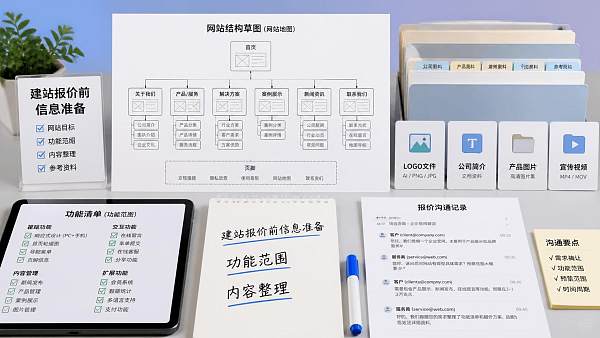
img_01: Recommended placement between “Content Readiness” and “Information Checklist”; the image may show a flowchart of the information preparation process before requesting a website quote or an illustration of a project materials checklist; alt copy: Illustration of the information checklist companies should prepare before requesting a website design quote
Recommended Internal Link Anchor Text
Anchor text: Multilingual website development solution / Recommended page type or topic to link to: Multilingual corporate website solutions page
Anchor text: How to build an international trade marketing website / Recommended page type or topic to link to: International trade website development guide
Anchor text: Basic Google SEO configuration / Recommended page type or topic to link to: SEO services introduction page
Anchor text: Corporate website ICP filing process / Recommended page type or topic to link to: ICP filing service explanation page
Anchor text: Pre-launch checklist for an independent website / Recommended page type or topic to link to: Operations knowledge base article page
Recommended External Authoritative Sources
Government regulatory agency pages: Explanations of filing requirements related to the MIIT system and internet information service administration rules
Official search engine documentation: Google Search Central documentation on crawling, indexing, and website technical fundamentals
Industry research materials: Reports from industry associations in the fields of cross-border e-commerce or corporate digital marketing
Related Articles



Related Products
 Yiyingbao SaaS Intelligent Website Building and Marketing SystemYiyingbao SaaS Intelligent Website Building and Marketing System, AI-powered no-code website building, rapid creation of multilingual B2B international websites in 10 minutes, global server acceleration, AI-powered SEO optimization, helping businesses connect efficiently with global markets. The perfect integration of technology and operation makes building an international trade website remarkably simple
 AI+SEM Intelligent Advertising Marketing SystemAI+SEM drives intelligent ad creation, empowering full-funnel precision advertising marketing. The system automatically generates weekly/monthly reports, AI recommends keywords and target countries, monitors core metrics in real-time with intelligent alerts, and enables one-click high-conversion ad solutions to help quickly acquire customers and improve ROI.
 AI+SEO Dual-Engine System Optimization ServicesYiyingbao’s AI+SEO dual-engine optimization system helps foreign trade enterprises acquire high-quality organic traffic through AI-powered keyword research, content generation, and comprehensive technical optimization, significantly improving search rankings and conversion rates.
 AI+SNS Social Media Marketing SystemYingbao AI+SNS Social Media Marketing System - Precision social capture for the social media era. Supports one-click content synchronization across major platforms like Facebook and LinkedIn. AI intelligently rewrites posts for enhanced relevance. 24/7 AI customer service and user profiling analysis empower businesses to efficiently expand into global markets.
 AI+SEO营销解决方案易营宝AI+SEO营销解决方案,通过AI批量写作、智能生成TDK、精准关键词扩词等功能,全面优化网站SEO效果,提升流量与转化率。助力企业构建高效智能网站新生态。
 AI+SEM Advertising Marketing SolutionsAI+SEM Advertising Marketing Solution leverages AI technology to deeply empower SEM ad campaigns. It automatically generates weekly/monthly reports using AI, presenting account data across multiple dimensions for comprehensive insights into campaign performance and trends. The system precisely recommends keywords and target countries, intelligently generates high-conversion ad copy, and enables one-click activation of efficient campaign plans to help businesses rapidly acquire customers. Simultaneously, it monitors core metrics in real time, intelligently identifies abnormal fluctuations, and issues timely alerts to ensure stable, high-return advertising results.
 Domain Name ServicesEasyWin provides professional domain name services, including intelligent queries, one-stop registration, brand protection, and full lifecycle management, helping businesses build a digital brand image.
 EasyOperate B2C Cross-Border E-Commerce Platform & Independent WebsiteEasyStore B2C Cross-border E-commerce Independent Store is an intelligent website building and cross-border e-commerce integrated solution independently developed by EasyStore Information Technology (Beijing) Co., Ltd. The system is specially designed for small and medium-sized as well as large export enterprises, integrating 'website building, operation, marketing, advertising, and conversion' into one, helping enterprises quickly establish cross-border e-commerce independent stores to achieve brand globalization and global sales growth.
The platform supports multiple languages, multiple currencies, and multi-channel marketing, with built-in AI intelligent translation and SEO optimization systems, suitable for mainstream markets such as Southeast Asia, Europe and America, Latin America, and the Middle East, assisting Chinese manufacturing enterprises in efficiently deploying international e-commerce strategies. SSL证书易营宝提供专业SSL安全证书服务,包括单域名和泛域名证书,确保网站数据传输加密、身份验证和完整性保护,助力企业建立安全可信的在线业务环境。









