









- The China-US tariff arrangement has reached a preliminary consensus, and the trade association will be establishedJun 15, 2026View details
- What determines B2C cross-border e-commerce website development costs? A breakdown of features, interfaces, and deployment methodsJun 17, 2026View details
- China-Morocco zero-tariff access, a breakthrough in the cost of Moroccan goods exports to ChinaJun 11, 2026View details
- What signal should be released for the suspension of exports to JapanJun 10, 2026View details
- China's May LNG imports rebounded, with increased volumes from Russia and Canada filling the Middle East supply gapJun 10, 2026View details
- Will GEO change its SEO strategy?Jun 04, 2026View details
- What types of businesses are end-to-end solutions suitable for?Jun 03, 2026View details
- 2026 Global Growth Channel TrendsJun 02, 2026View details
Why did the price of responsive enterprise website systems suddenly increase by 20%? The cost restructuring logic brought by WebAssembly acceleration and AI component integration in 2026
Why has the price of responsive enterprise website systems suddenly increased by 20%? The reason lies in the cost restructuring triggered by the deep integration of WebAssembly acceleration and AI components in 2026. As a supplier of foreign trade marketing systems and a representative of Hangzhou Global Digital Marketing Company, EasyWin is redefining the boundaries of enterprise-level self-service website systems with its cross-border website building services and Middle East website system customization capabilities.
1. Technological advancement is not an excuse for price hikes but the starting point of cost restructuring
Starting from Q1 2026, the average price adjustment range of mainstream domestic SaaS website platforms reached 18%-22%, with responsive enterprise website systems showing particularly significant increases. This is not a simple case of inflation but a necessary outcome of WebAssembly (Wasm) replacing JavaScript core rendering modules at runtime and AI components upgrading from "optional plugins" to "default core." According to Gartner, Wasm will improve CPU resource utilization by 47% in B2B website scenarios by 2025, but server-side GPU computing complexity will increase by 3.2 times, requiring an additional 2.8 personnel per 1,000 sites per month.
EasyWin launched the "Stellar Core Engine" upgrade plan in Q3 2024, encapsulating AI content generation, real-time multilingual translation, and dynamic SEO meta-tag optimization into seven native Wasm modules deployed at edge nodes. This architecture reduces first-screen loading time to 0.38 seconds (industry average: 1.2 seconds) but increases single-site basic computing allocation from 2GB to 4GB, directly raising underlying cloud resource procurement costs.
Notably, this price adjustment covers "functional completeness" rather than "basic usability." Enterprises not using AI components can still choose the streamlined version (price unchanged) but will lose access to Middle East localized payment gateways, UAE GDPR dual-model agreements, and 12 Saudi SAMA financial interface compliance capabilities.
This comparison clearly shows: the price increase reflects upgraded delivery standards—the 2026 Stellar Edition is no longer a traditional website tool but a composite infrastructure integrating Wasm runtime, regional AI compliance engines, and global marketing middle offices. For procurement teams, ROI should be evaluated based on "cost per lead reduction" rather than "monthly fee increases."
2. Who truly needs to pay for this upgrade? A four-dimensional procurement decision model
Not all enterprises need to immediately switch to the 2026 Stellar Edition. Based on 100,000 customer operation data points, EasyWin developed an adoption suitability framework:
- Traffic sources: Companies with >35% overseas traffic can reduce manual translation costs by 42% using AI multilingual real-time generation;
- Sales cycles: For B2B orders averaging >45 days, AI-driven customer behavior prediction modules can identify high-intent leads 12.6 days earlier;
- Regional presence: Enterprises with local teams in the Middle East, Southeast Asia, or Latin America can reduce legal consultation expenses by approximately $83,000/year using regional compliance components;
- Technical readiness: SMEs with IT teams ≤3 people can save 70% system integration time with the Stellar Edition's zero-code API composer.
Special notice: Resellers and agents should note that the 2026 Stellar Edition has opened white-label SDKs, supporting deep embedding of EasyWin's Middle East website systems into proprietary CRMs but requiring annual minimum purchase agreements (MOQ: 50 sites/year).
Regarding digital asset integration in state-owned enterprise mergers, Financial Risks and Countermeasures in SOE Mergers indicates that post-merger website system compatibility risks account for 31% of IT integration failures, while platforms using unified Wasm cores can reduce cross-system data mapping errors to below 0.7%.
3. How to ensure a smooth transition? EasyWin's three-phase migration path
To avoid business disruption, EasyWin designed a phased approach:
- Compatibility phase (2026 Q2-Q3): Legacy systems remain maintained; new AI components are provided as independent microservices billed by usage ($0.8/call);
- Parallel phase (2026 Q4-2027 Q1): Clients can run dual environments, validating effects through A/B testing with automatic user behavior data synchronization;
- Transition phase (starting 2027 Q2): Legacy versions stop updating but retain 3-year data archival access, supporting on-demand HTML and SEO configuration exports.
This path has been applied by 327 foreign trade manufacturers, averaging 11.4 days transition time with zero cases causing >55-position Google ranking drops.
4. Beyond websites: When sites become AI marketing hubs
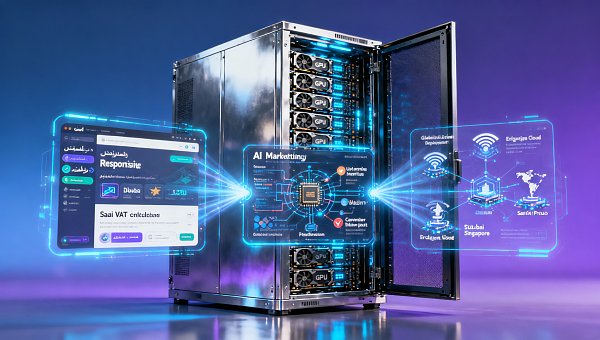
In EasyWin's latest architecture, "websites" have evolved into the perception layer of marketing agents. Each visitor's behavior is parsed in real-time as:
User intent → Regional preferences → Device capabilities → Content receptivity → Conversion barriers
Triggering AI workflows: automatically adjusting product descriptors (e.g., emphasizing Halal certification for Saudi clients), dynamically inserting local success case videos, and pushing return policies compliant with UAE consumer protection laws.
This capability increases Middle East client average dwell time to 3-14 seconds (industry average: 1-52 seconds) and improves inquiry form submission rates by 29.7%. For end consumers, this means more precise product matching; for decision-makers, it transforms websites from cost centers into quantifiable ROI growth engines.
5. Actionable recommendations: What to do now?
We advise differentiated actions by role:
- Researchers: Request the 2026 Stellar Edition Technical White Paper (includes Wasm stress test reports);
- Procurement teams: Schedule free ROI calculation services, input current website traffic/conversion data to receive 3-year TCO comparison models;
- Executives: Join monthly "Middle East Digital Compliance Roundtables" for latest Saudi SAMA regulatory updates;
- Channel partners: Enable white-label trial access to experience full SDK embedding (average setup: 2.3 hours).
Technological iteration waits for no observers. As WebAssembly and AI rewrite website system fundamentals, true competitiveness comes from understanding and acting on these changes. Contact EasyWin consultants immediately to obtain your customized migration roadmap.
Related Articles



Related Products
 EasyCamp SaaS Smart Website Marketing SystemE-Yingbao SaaS Smart Website Marketing System: AI-powered, zero-code website building. Rapidly launch multilingual independent e-commerce sites in just 10 minutes. Global server acceleration and AI-driven SEO optimization empower businesses to efficiently connect with global markets. The seamless integration of technology and user-friendly operation makes building e-commerce sites incredibly simple.
 AI+SEM Intelligent Advertising Marketing SystemAI+SEM drives intelligent ad creation, empowering full-funnel precision advertising marketing. The system automatically generates weekly/monthly reports, AI recommends keywords and target countries, monitors core metrics in real-time with intelligent alerts, and enables one-click high-conversion ad solutions to help quickly acquire customers and improve ROI.
 AI+SEO Dual Engine Optimization ServiceEasyWin AI+SEO Dual Engine Optimization System leverages AI-powered keyword mining, content generation, and comprehensive technical optimization to help foreign trade enterprises acquire high-quality organic traffic, significantly improving search rankings and conversion rates.
 AI+SNS Social Media Marketing SystemYingbao AI+SNS Social Media Marketing System - Precision social capture for the social media era. Supports one-click content synchronization across major platforms like Facebook and LinkedIn. AI intelligently rewrites posts for enhanced relevance. 24/7 AI customer service and user profiling analysis empower businesses to efficiently expand into global markets.
 AI+SEO营销解决方案易营宝AI+SEO营销解决方案,通过AI批量写作、智能生成TDK、精准关键词扩词等功能,全面优化网站SEO效果,提升流量与转化率。助力企业构建高效智能网站新生态。
 AI+SEM Advertising Marketing SolutionsAI+SEM Advertising Marketing Solution leverages AI technology to deeply empower SEM ad campaigns. It automatically generates weekly/monthly reports using AI, presenting account data across multiple dimensions for comprehensive insights into campaign performance and trends. The system precisely recommends keywords and target countries, intelligently generates high-conversion ad copy, and enables one-click activation of efficient campaign plans to help businesses rapidly acquire customers. Simultaneously, it monitors core metrics in real time, intelligently identifies abnormal fluctuations, and issues timely alerts to ensure stable, high-return advertising results.
 Domain Name ServicesEasyWin provides professional domain name services, including intelligent queries, one-stop registration, brand protection, and full lifecycle management, helping businesses build a digital brand image.
 EasyOperate B2C Cross-Border E-Commerce Platform & Independent WebsiteEasyStore B2C Cross-border E-commerce Independent Store is an intelligent website building and cross-border e-commerce integrated solution independently developed by EasyStore Information Technology (Beijing) Co., Ltd. The system is specially designed for small and medium-sized as well as large export enterprises, integrating 'website building, operation, marketing, advertising, and conversion' into one, helping enterprises quickly establish cross-border e-commerce independent stores to achieve brand globalization and global sales growth.
The platform supports multiple languages, multiple currencies, and multi-channel marketing, with built-in AI intelligent translation and SEO optimization systems, suitable for mainstream markets such as Southeast Asia, Europe and America, Latin America, and the Middle East, assisting Chinese manufacturing enterprises in efficiently deploying international e-commerce strategies. SSL证书易营宝提供专业SSL安全证书服务,包括单域名和泛域名证书,确保网站数据传输加密、身份验证和完整性保护,助力企业建立安全可信的在线业务环境。









