









- What Does a Global Traffic Ecosystem Service Provider Do? What Are the Differences from a Single Advertising AgencyJul 16, 2026View details
- What should you focus on in the latest enterprise SaaS report? From renewal rates and delivery costs to overseas growth opportunitiesJul 12, 2026View details
- What signals are worth paying attention to in a cross-border marketing trend report? B2B companies should look at these 6 signalsJul 11, 2026View details
- How to Read a Cross-Border Marketing Trends Report? Five Key Dimensions for Evaluating Channel OpportunitiesJul 11, 2026View details
- Which channel has the highest ROI in the global traffic ecosystem? Comparative analysis of search, social media, and advertisingJul 10, 2026View details
- What multilingual website services are available in Sanya? Which model is more suitable for local businesses going global?Jul 08, 2026View details
What is Global CDN Acceleration? Emerging Trends for 2026: Edge Computing Convergence, AI Routing Prediction, and Zero-Configuration Deployment
What is global CDN acceleration? How does it improve website access speed? What role does HTTPS play for websites? This article provides an in-depth analysis of emerging trends in 2026—edge computing convergence, AI routing prediction, and zero-configuration deployment—offering authoritative solutions and optimal vendor references for market researchers, procurement decision-makers, and technical operations personnel.
Global CDN Acceleration: Beyond Speed, It's About Intelligent Traffic Scheduling
Global CDN (Content Delivery Network) acceleration is not merely about caching static resources across multiple regional servers. Its essence lies in constructing an intelligent global distribution network that dynamically selects optimal paths to deliver content to the nearest edge nodes through mechanisms like DNS intelligent resolution, node health detection, and real-time link quality feedback. EasyStore's CDN nodes, jointly deployed with AWS and Alibaba Cloud, cover 7 continents and 83 countries, with an average Time to First Byte (TTFB) under 85ms, improving standalone site loading speed by 40% and SEO scores by 35%.
For Chinese enterprises expanding overseas, CDN is not just a performance tool but also a compliance infrastructure: automated SSL certificate issuance, DDoS protection thresholds up to 2.1Tbps, and pre-configured PCI-DSS and GDPR compliance. This means when your standalone site serves German users, page resources are actually responded to by edge nodes in Frankfurt; Brazilian visitors are served by nodes in São Paulo—all with millisecond-level switching and zero manual intervention.
More critically, CDN is deeply coupled with HTTPS. EasyStore's platform enables HSTS forced redirection and OCSP Stapling optimization by default, reducing full-site HTTPS handshake latency by 62%, eliminating browser "unsafe" warnings, and directly boosting user trust and conversion rates. Data shows that enterprises adopting complete HTTPS+CDN solutions experience an average 27% drop in overseas landing page bounce rates.

2026 Trends: From Passive Caching to Active Prediction
Edge Computing Convergence: Embedding AI Inference at Millisecond Response Layers
Traditional CDN only handles content delivery, whereas 2026's mainstream architecture will deploy lightweight AI models at edge nodes. EasyStore's proprietary "Edge-Optima" engine, already live in Singapore, Los Angeles, and Dubai edge clusters, supports real-time image compression (adaptive WebP/AVIF), A/B test traffic splitting, and personalized ad material dynamic stitching—all completed within 15ms without backhaul.
AI Routing Prediction: Path Pre-Learning Based on Billion-Level Traffic Data
Unlike traditional static Ping or Traceroute detection, EasyStore's AI routing system ingests global search engine logs, social media clickstreams, and ISP BGP routing tables to build predictive models incorporating 2.8M+ link state samples. These models can forecast regional network congestion 3-7 minutes in advance and automatically divert new traffic to backup paths, maintaining cross-border access success rates above 99.992%.
Zero-Configuration Deployment: Accelerate Upon Launch, No Ops Required
For SMEs and marketers, technical barriers pose the greatest challenge. EasyStore's smart site-building system enables CDN "out-of-the-box" functionality: after domain binding, the system automatically completes DNS resolution, SSL certificate application, and cache policy generation (HTML cached for 10 minutes, JS/CSS for 1 year, images permanently cached), all in under 30 seconds. This capability already serves over 100,000 enterprise clients, saving an average of 4.2 IT deployment days per site.
Procurement Guide: 5 Hard Metrics for Vendor Selection
Facing dozens of CDN vendors, buyers must cut through marketing rhetoric to focus on real delivery capabilities. We recommend cross-validating these 5 dimensions:
- Edge node geographic coverage authenticity (presence of local POPs vs. mere mirror proxies)
- HTTPS certificate automation efficiency (cert issuance-to-activation ≤5 minutes)
- Elasticity for traffic spikes (300% peak load capacity within 30 seconds)
- Log analysis granularity (multi-dimensional breakdowns by country/ISP/device type)
- Native integration depth with site-building/marketing systems (e.g., auto-injecting TDK tags into CDN cache headers)
EasyStore's CDN service, for instance, holds Google Premier Partner and Meta technical certifications, supports HTTP/3 and QUIC protocols across all nodes, and features deep domain service integration—automating DNS resolution and CDN binding post-domain registration to prevent 72-hour activation delays from manual misconfigurations.
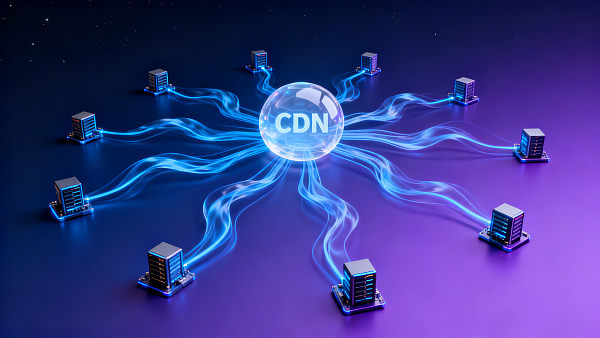
Cost-Benefit Analysis: Self-Build vs. Managed vs. Full-Stack Smart Platform
Enterprises often mistakenly believe self-built CDN saves costs. In reality, single-node hardware investments exceed ¥580K, while deploying 10 global nodes requires ¥800K+ upfront plus ¥250K annual ops labor costs. Adopting full-stack smart platforms reduces first-year TCO by 63%.
This comparison is based on configurations for mid-sized exporters (50K+ monthly UVs). EasyStore client data shows full-stack solutions reduce cross-system switching time by 76% and improve issue diagnosis efficiency 5.3x.
Why Choose EasyStore: Beyond CDN to Global Growth Certainty
Evaluating CDN services fundamentally means selecting an engine for business continuity. EasyStore's core advantage lies in its AI-driven unified tech stack, integrating CDN, site-building, SEO, ads, and social media into one data loop. For example, when its AI ad diagnostic tool detects declining conversion rates for a keyword in Brazil, the system automatically triggers CDN node health checks and synchronously optimizes LCP loading strategies for that region—a level of cross-module coordination impossible with fragmented procurement.
We offer three certainty commitments for decision-makers:
① 24/7 dedicated technical support with 15-minute major incident response;
② Free CDN performance baseline reports and competitive benchmarking;
③ POC validation: measurable acceleration results for your existing sites within 3 business days.
Get the <2026 Global CDN Selection White Paper> and customized solution recommendations now by contacting EasyStore consultants to confirm:
• CDN node coverage completeness in your target markets
• HTTPS+CDN joint optimization paths for standalone sites
• Tiered pricing details based on current traffic scale
Related Articles

Related Products
 EasyCamp SaaS Smart Website Marketing SystemE-Yingbao SaaS Smart Website Marketing System: AI-powered, zero-code website building. Rapidly launch multilingual independent e-commerce sites in just 10 minutes. Global server acceleration and AI-driven SEO optimization empower businesses to efficiently connect with global markets. The seamless integration of technology and user-friendly operation makes building e-commerce sites incredibly simple.
 AI+SEM Intelligent Advertising Marketing SystemAI+SEM drives intelligent ad creation, empowering full-funnel precision advertising marketing. The system automatically generates weekly/monthly reports, AI recommends keywords and target countries, monitors core metrics in real-time with intelligent alerts, and enables one-click high-conversion ad solutions to help quickly acquire customers and improve ROI.
 AI+SEO Dual Engine Optimization ServiceEasyWin AI+SEO Dual Engine Optimization System leverages AI-powered keyword mining, content generation, and comprehensive technical optimization to help foreign trade enterprises acquire high-quality organic traffic, significantly improving search rankings and conversion rates.
 AI+SNS Social Media Marketing SystemYingbao AI+SNS Social Media Marketing System - Precision social capture for the social media era. Supports one-click content synchronization across major platforms like Facebook and LinkedIn. AI intelligently rewrites posts for enhanced relevance. 24/7 AI customer service and user profiling analysis empower businesses to efficiently expand into global markets.
 AI+SEO营销解决方案易营宝AI+SEO营销解决方案,通过AI批量写作、智能生成TDK、精准关键词扩词等功能,全面优化网站SEO效果,提升流量与转化率。助力企业构建高效智能网站新生态。
 AI+SEM Advertising Marketing SolutionsAI+SEM Advertising Marketing Solution leverages AI technology to deeply empower SEM ad campaigns. It automatically generates weekly/monthly reports using AI, presenting account data across multiple dimensions for comprehensive insights into campaign performance and trends. The system precisely recommends keywords and target countries, intelligently generates high-conversion ad copy, and enables one-click activation of efficient campaign plans to help businesses rapidly acquire customers. Simultaneously, it monitors core metrics in real time, intelligently identifies abnormal fluctuations, and issues timely alerts to ensure stable, high-return advertising results.
 Domain Name ServicesEasyWin provides professional domain name services, including intelligent queries, one-stop registration, brand protection, and full lifecycle management, helping businesses build a digital brand image.
 EasyOperate B2C Cross-Border E-Commerce Platform & Independent WebsiteEasyStore B2C Cross-border E-commerce Independent Store is an intelligent website building and cross-border e-commerce integrated solution independently developed by EasyStore Information Technology (Beijing) Co., Ltd. The system is specially designed for small and medium-sized as well as large export enterprises, integrating 'website building, operation, marketing, advertising, and conversion' into one, helping enterprises quickly establish cross-border e-commerce independent stores to achieve brand globalization and global sales growth.
The platform supports multiple languages, multiple currencies, and multi-channel marketing, with built-in AI intelligent translation and SEO optimization systems, suitable for mainstream markets such as Southeast Asia, Europe and America, Latin America, and the Middle East, assisting Chinese manufacturing enterprises in efficiently deploying international e-commerce strategies. SSL证书易营宝提供专业SSL安全证书服务,包括单域名和泛域名证书,确保网站数据传输加密、身份验证和完整性保护,助力企业建立安全可信的在线业务环境。









