









- The China-US tariff arrangement has reached a preliminary consensus, and the trade association will be establishedJun 15, 2026View details
- China-Morocco zero-tariff access, a breakthrough in the cost of Moroccan goods exports to ChinaJun 11, 2026View details
- What signal should be released for the suspension of exports to JapanJun 10, 2026View details
- China's May LNG imports rebounded, with increased volumes from Russia and Canada filling the Middle East supply gapJun 10, 2026View details
- Will GEO change its SEO strategy?Jun 04, 2026View details
- What types of businesses are end-to-end solutions suitable for?Jun 03, 2026View details
- 2026 Global Growth Channel TrendsJun 02, 2026View details
- Changes in Search Engine Ranking Factors in 2026Jun 06, 2026View details
Will Website Design Pricing Increase in 2026
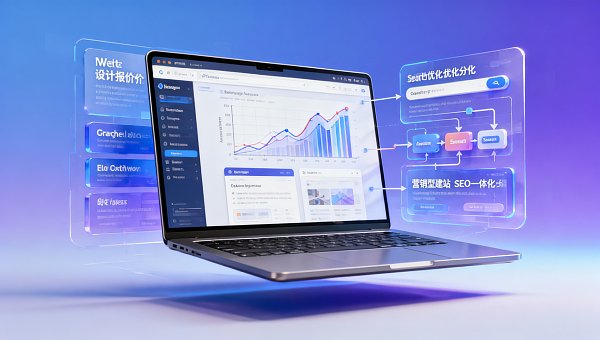
Website design pricing in 2026 is unlikely to "rise sharply across the board", but a more obvious polarization will emerge: template-based and standardized website building prices may continue to decline, while the overall investment in customized, high-conversion, multilingual, SEO-friendly websites is more likely to increase. For business decision-makers, the real question is not "Will website design prices go up", but rather "What types of websites will become more expensive, why, and how should I judge whether my project is worth it". Influenced by AI website building, the widespread adoption of website design templates, rising requirements for search engine optimization services, and overseas markets placing greater emphasis on multilingual and localized experiences, enterprise website development costs in 2026 will increasingly depend on business objectives rather than simply on the number of pages.
Will website design pricing increase in 2026? Conclusion first: it will diverge, not rise uniformly
If you are searching for "Will website design pricing go up in 2026", what you usually really care about are three things: whether the budget should be raised in advance, whether doing it now is more cost-effective, and how to avoid spending money on a website that generates no conversions.
From an industry trend perspective, changes in website design pricing in 2026 will not simply mean "everything gets more expensive". More accurately, different types of websites are moving along different pricing curves:
- Basic showcase websites: prices may remain stable or even decline. This is because AI website building tools, mature templates, and modular systems are compressing the cost of basic production.
- Marketing websites: prices are more likely to rise. This is because businesses no longer only want something that "looks fine", but also need customer acquisition, conversion performance, SEO structure, and data tracking.
- Multilingual foreign trade websites: pricing is generally under upward pressure. The reason is that translation, localized content architecture, adaptation to search habits in different countries, server deployment, and compliance requirements are more complex.
- Highly customized functional websites: these have the highest likelihood of price increases. When functions such as membership systems, inquiry distribution, CRM integration, marketing automation, and API connectivity are involved, labor and testing costs remain high.
That is to say, whether website design pricing will rise in 2026 does not center on the word "website", but on "what result you want". The closer a website is tied to business growth goals, the harder it is to procure it based solely on low-price logic.
What businesses care about most is not the price itself, but what the price actually includes
When many businesses ask for quotations, they only ask, "How much does it cost to make a website", and the quotes they receive may range from a few thousand yuan to more than one hundred thousand yuan. Such a large gap is not only due to different pricing strategies among service providers, but more importantly because the scope of work covered by the quotations is completely different.
In 2026, the key factors affecting website design pricing mainly include:
1. Is it "designing a website" or "building a customer acquisition system"
Low-priced websites usually solve the problem of simply getting online: there is a homepage, product pages, and contact information. But mid- to high-priced projects place more emphasis on whether visitors can quickly understand your advantages, whether they are willing to leave their information, whether search engines can crawl the site effectively, and whether subsequent marketing data can be tracked.
If the solution includes user journey design, conversion copy planning, SEO information architecture, inquiry form optimization, tracking analytics, and landing page integration, then this is no longer simply a "web design fee".
2. The price gap between template websites and custom websites will continue to widen
Website design templates will still be very popular in 2026, especially for startups, single-product showcases, short-term campaign pages, and channel testing projects. Their advantages are fast launch, low cost, and simple maintenance.
But the problems are also obvious: severe homogenization, weak brand recognition, limited scalability, and often insufficient SEO details. For businesses that need long-term operations, advertising campaigns, and organic search traffic accumulation, the early affordability of a template website may later be "paid back" through redesigns, SEO fixes, and reworking the content structure.
3. SEO friendliness has shifted from a bonus item to a basic requirement
In the past, many businesses purchased websites and SEO optimization services separately, building the website first and optimizing later. But now more and more projects must consider the following already during the website building stage:
- Whether the URL structure is clear
- Whether titles, descriptions, and H tags are properly set
- Whether page loading speed meets standards
- Whether the mobile experience is stable
- Whether it supports content expansion and continuous category growth
- Whether multilingual pages can be correctly indexed
Once these elements are not handled well in the early stage, the cost of later corrections is often much higher. Therefore, website development teams with search engine optimization service capabilities usually quote higher than purely visual design vendors.
4. AI has reduced some costs, but it has also raised new requirements
AI has indeed made some processes more efficient, such as prototype generation, first-draft copywriting, basic image processing, code-assisted development, and batch content organization, which compresses some basic production costs.
But at the same time, AI has also led businesses to place higher demands on websites: your website cannot just be something that is "made", it must also establish credibility and differentiation amid large amounts of homogeneous content. This means the importance of strategy, brand expression, content structure, and conversion logic has instead increased. What will become cheaper in the future is repetitive labor; what will remain expensive is the capability that truly creates differentiation.
Why multilingual websites and marketing websites are more likely to become more expensive in 2026
For businesses pursuing domestic growth and global expansion, websites are no longer static business cards, but front-end gateways for coordination among brand, sales, and marketing. Multilingual websites in particular are more likely to become one of the most obvious sectors with rising pricing in 2026.
The main reasons are as follows:
- Translation is not the same as localization: different language versions must not only be accurate, but also align with local users' expression habits and search preferences.
- SEO structure is more complex: keyword strategies, hreflang settings, directory structures, and content distribution methods for different countries/regions all require professional handling.
- Higher requirements for servers and access speed: the overseas browsing experience directly affects bounce rates and inquiry conversion.
- Greater difficulty in content management: the more languages there are, the higher the cost of updates, maintenance, review, and version synchronization.
This is also why more and more businesses are choosing integrated website + marketing service solutions instead of simply finding a team to finish the pages and stop there. For businesses that truly value growth results, the coordination among website development, SEO, content, advertising, and social media often matters more than any single low-cost item.
How should businesses judge whether a quotation is reasonable when building a website in 2026
Rather than getting stuck on whether prices will rise, it is more important to establish your own set of evaluation criteria. The following questions are suitable for business decision-makers, operations managers, and executors to use directly when comparing quotations.
1. Whether the quotation corresponds to a clear objective
If your goal is brand presentation, then focus on visual consistency, content completeness, and maintenance convenience; if your goal is inquiry growth, then focus on landing page design, conversion paths, SEO foundations, and data tracking.
Different goals inevitably mean different reasonable pricing ranges. Comparing quotations without goals is often the easiest way to get distorted results.
2. Whether the proposal clearly explains the delivery boundaries
A truly professional website service provider will clearly specify:
- Number of pages and page types
- Whether the design is original
- Whether it is adapted for mobile phones and tablets
- Whether it includes basic SEO setup
- Whether it supports multiple languages
- Whether it includes content upload
- Whether it integrates forms, CRM, online customer service, and analytics tools
- After-sales maintenance period and response mechanism
If the quotation only gives a total price without clear boundaries, the probability of additional charges later is usually very high.
3. Whether it can support subsequent operations, not just launch delivery
Many problems only begin to surface after a website goes live: the backend is hard to use, content updates are difficult, page changes repeatedly require outsourcing, the SEO structure cannot be adjusted, and form data cannot be managed. These problems directly increase operating costs.
Therefore, after-sales maintenance personnel and execution teams in particular should pay attention to practical usability issues such as backend permissions, content editing convenience, data export capabilities, and logging and backup mechanisms.
4. Whether a low price is actually transferring risk
A low price itself is not the problem. The question is whether the low price means:
- Using a template but presenting it as custom
- Not providing source code or migration capability
- Lacking basic security configuration
- No speed optimization
- Charging excessively high fees for subsequent maintenance
- No basic SEO structure
The budget seemingly saved upfront may later be offset by higher operating costs.
Which businesses are better suited to plan ahead in 2025 instead of waiting until 2026
If you belong to one of the following types of businesses, it is usually more advisable to plan in advance:
- Businesses preparing for overseas promotion or expansion into multilingual markets
- Businesses planning to strengthen SEO and content marketing in 2026
- Businesses whose current websites are outdated, have poor mobile experience, or difficult backend maintenance
- Businesses preparing to combine advertising, social media marketing, and automated customer acquisition
- Businesses with distributors, dealers, or agents that need unified brand materials and a centralized partner recruitment entry point
The reason is simple: a truly usable website involves not only the development cycle, but also early positioning, content organization, visual confirmation, technical coordination, testing, launch, and subsequent optimization. The closer you start to your business peak season, the easier it is to rush the launch and ultimately affect results.
In many digital transformation projects, website construction is often not an isolated action, but part of organizational management, business processes, and information collaboration. For example, when some institutions and organizations promote digital governance upgrades, they also pay attention to platform-based management capabilities and service process efficiency, similar to the core logic reflected in content such as Strategic Analysis of Digital Transformation in Human Resource Management for Public Institutions in the Intelligent Era: digital tool development must serve management efficiency and business collaboration, rather than remaining only at the surface level of informatization.
Under the website design pricing trend in 2026, how to choose service providers more reliably
Facing pricing divergence, businesses can prioritize these four capabilities when selecting vendors:
1. Whether they balance technology and marketing
A team that only knows how to build pages but does not understand marketing is likely to deliver a website that is "good-looking but not useful". A service provider truly suitable for growth-oriented businesses should be able to connect website building, search engine optimization services, content strategy, and conversion design.
2. Whether they have localization and multi-market experience
If you operate across regions, whether the service provider understands differences in local markets determines the website's subsequent performance. Language, aesthetics, content structure, and access environment cannot be solved by simple copying.
3. Whether they value long-term operational capability
A website going live is only the beginning. A mature service team should be capable of subsequent iteration, content support, data analysis, performance optimization, and security maintenance.
4. Whether they can provide a practical growth path
A good proposal will not just tell you "we will make it very high-end", but will clearly explain how the website will take on traffic, support search rankings, increase inquiries, and work together with social media and advertising campaigns.
For businesses hoping to build their website as marketing infrastructure, this kind of integrated capability is more worthy of attention than a one-time design quotation. That is also why many businesses, when evaluating website development budgets, no longer view the website as a standalone cost, but as part of an overall digital growth investment. If the business itself is in a stage of management upgrading, process digitization, or information system restructuring, it can also refer to digital development approaches such as Strategic Analysis of Digital Transformation in Human Resource Management for Public Institutions in the Intelligent Era to judge project value from the perspective of "whether the system supports long-term efficiency improvement".
Summary: website design pricing in 2026 is not simply getting more expensive, but "result-oriented projects" are becoming more valuable
Returning to the original question: will website design pricing increase in 2026? The answer is that basic website building may not rise significantly, and may even become cheaper; but for websites involving brand differentiation, SEO-friendly structure, multilingual deployment, marketing conversion, and system integration, the likelihood of rising prices is very high.
For businesses, the most important thing is not to chase the market average price, but to first clarify whether you need a "launch-oriented website" or a "growth-oriented website". The former emphasizes efficiency and cost, while the latter emphasizes long-term effectiveness and return on investment. As long as the objective is clear, the level of the quotation is no longer a vague anxiety, but a business decision that can be judged as reasonable or not.
If you are preparing a website development budget for 2026, it is recommended to sort out your business goals, user journey, content structure, and follow-up promotion plan as early as possible. In this way, even if market prices fluctuate, you can still use more mature standards to choose the right solution, rather than passively wavering only between low prices and high prices.
Related Articles



Related Products
 EasyCamp SaaS Smart Website Marketing SystemE-Yingbao SaaS Smart Website Marketing System: AI-powered, zero-code website building. Rapidly launch multilingual independent e-commerce sites in just 10 minutes. Global server acceleration and AI-driven SEO optimization empower businesses to efficiently connect with global markets. The seamless integration of technology and user-friendly operation makes building e-commerce sites incredibly simple.
 AI+SEM Intelligent Advertising Marketing SystemAI+SEM drives intelligent ad creation, empowering full-funnel precision advertising marketing. The system automatically generates weekly/monthly reports, AI recommends keywords and target countries, monitors core metrics in real-time with intelligent alerts, and enables one-click high-conversion ad solutions to help quickly acquire customers and improve ROI.
 AI+SEO Dual Engine Optimization ServiceEasyWin AI+SEO Dual Engine Optimization System leverages AI-powered keyword mining, content generation, and comprehensive technical optimization to help foreign trade enterprises acquire high-quality organic traffic, significantly improving search rankings and conversion rates.
 AI+SNS Social Media Marketing SystemYingbao AI+SNS Social Media Marketing System - Precision social capture for the social media era. Supports one-click content synchronization across major platforms like Facebook and LinkedIn. AI intelligently rewrites posts for enhanced relevance. 24/7 AI customer service and user profiling analysis empower businesses to efficiently expand into global markets.
 AI+SEO营销解决方案易营宝AI+SEO营销解决方案,通过AI批量写作、智能生成TDK、精准关键词扩词等功能,全面优化网站SEO效果,提升流量与转化率。助力企业构建高效智能网站新生态。
 AI+SEM Advertising Marketing SolutionsAI+SEM Advertising Marketing Solution leverages AI technology to deeply empower SEM ad campaigns. It automatically generates weekly/monthly reports using AI, presenting account data across multiple dimensions for comprehensive insights into campaign performance and trends. The system precisely recommends keywords and target countries, intelligently generates high-conversion ad copy, and enables one-click activation of efficient campaign plans to help businesses rapidly acquire customers. Simultaneously, it monitors core metrics in real time, intelligently identifies abnormal fluctuations, and issues timely alerts to ensure stable, high-return advertising results.
 Domain Name ServicesEasyWin provides professional domain name services, including intelligent queries, one-stop registration, brand protection, and full lifecycle management, helping businesses build a digital brand image.
 EasyOperate B2C Cross-Border E-Commerce Platform & Independent WebsiteEasyStore B2C Cross-border E-commerce Independent Store is an intelligent website building and cross-border e-commerce integrated solution independently developed by EasyStore Information Technology (Beijing) Co., Ltd. The system is specially designed for small and medium-sized as well as large export enterprises, integrating 'website building, operation, marketing, advertising, and conversion' into one, helping enterprises quickly establish cross-border e-commerce independent stores to achieve brand globalization and global sales growth.
The platform supports multiple languages, multiple currencies, and multi-channel marketing, with built-in AI intelligent translation and SEO optimization systems, suitable for mainstream markets such as Southeast Asia, Europe and America, Latin America, and the Middle East, assisting Chinese manufacturing enterprises in efficiently deploying international e-commerce strategies. SSL证书易营宝提供专业SSL安全证书服务,包括单域名和泛域名证书,确保网站数据传输加密、身份验证和完整性保护,助力企业建立安全可信的在线业务环境。









