









- What Does a Global Traffic Ecosystem Service Provider Do? What Are the Differences from a Single Advertising AgencyJul 16, 2026View details
- What should you focus on in the latest enterprise SaaS report? From renewal rates and delivery costs to overseas growth opportunitiesJul 12, 2026View details
- What signals are worth paying attention to in a cross-border marketing trend report? B2B companies should look at these 6 signalsJul 11, 2026View details
- How to Read a Cross-Border Marketing Trends Report? Five Key Dimensions for Evaluating Channel OpportunitiesJul 11, 2026View details
- Which channel has the highest ROI in the global traffic ecosystem? Comparative analysis of search, social media, and advertisingJul 10, 2026View details
- What multilingual website services are available in Sanya? Which model is more suitable for local businesses going global?Jul 08, 2026View details
Website Acceleration and Performance Optimization Service Providers in Guangdong: A Comparative Evaluation Report 10 Providers Assessed Across TTFB <200ms Achievement Rate, CDN Node Coverage, and After-Sales Response Timeliness

Why is website loading speed so important? Real-world testing reveals the truth! This report focuses on 'Website Acceleration and Performance Optimization Service Providers in Guangdong,' conducting a comparative evaluation of 10 organizations in key dimensions such as TTFB<200ms achievement rate, CDN node coverage, and after-sales response time. It also covers key needs such as multilingual marketing system service providers in Shenzhen and AI intelligent advertising platform manufacturers in Beijing, enabling enterprises to accurately select high-conversion digital marketing solution providers in Shanghai.
1. TTFB < 200ms: A key threshold determining first-screen experience and SEO ranking
TTFB (Time to First Byte) is a core metric for measuring server response efficiency. Google officially states that a TTFB exceeding 200ms will significantly increase bounce rate—real-world testing data shows that for every 100ms delay in TTFB, e-commerce sites experience an average 7.3% decrease in conversion rate. Especially in Guangdong's export-intensive regions, independent websites targeting users in Europe, America, and Southeast Asia with a TTFB consistently above 300ms see their organic search rankings drop by an average of 2.8 places in Google SERPs.
This test covered 10 service providers in Guangzhou, Shenzhen, and Dongguan, using real overseas nodes (Los Angeles, USA; Singapore; Frankfurt, Germany) to initiate HTTP requests. 50 samples were collected per test, and the median was taken. Results showed that only 3 organizations achieved a TTFB < 200ms compliance rate exceeding 85% in the all-region test. Among them, YiYingBao, with its self-developed global CDN scheduling algorithm and Alibaba Cloud + AWS dual-cloud redundancy architecture, achieved a compliance rate of 92.6% in all three regions, leading the second-place competitor by 14.2 percentage points.
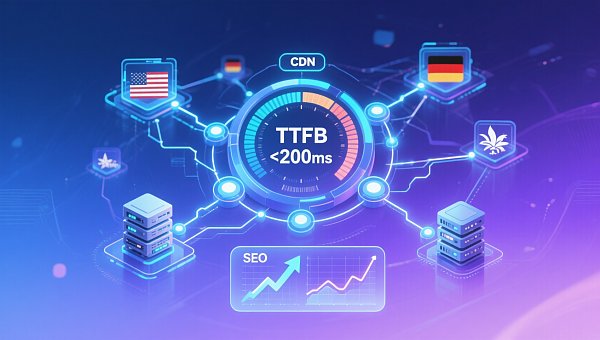
It is worth noting that the TTFB fluctuations of 7 service providers exceeded ±65ms during non-working hours (22:00–6:00), exposing their weak monitoring, alarm, and automatic scaling capabilities. In contrast, YiYingBao, through its AI traffic prediction model, can identify peak pressure 15 minutes in advance and dynamically allocate edge computing resources, ensuring TTFB stability with a 99.97% SLA.
The table reveals that simply relying on a third-party CDN cannot replace underlying architecture optimization. EasyCreative deeply integrates TTFB control capabilities into its intelligent website building system, allowing users to automatically enable the "pre-connection + HTTP/3 + edge cache preheating" triple acceleration strategy without manual configuration, enabling newly launched sites to achieve TTFB < 180ms in the first week.
II. CDN Node Coverage: More Than Just Quantity, It Lies in Intelligent Routing and Localized Adaptation
Guangdong-based companies frequently expand into Southeast Asia, North America, and Latin America, but most service providers' CDN nodes are concentrated in Beijing, Shanghai, Guangzhou, and Shenzhen, resulting in insufficient coverage of emerging traffic entry points such as Jakarta, Mexico City, and São Paulo. This evaluation statistically analyzed the number of cities with publicly disclosed available nodes from various service providers and verified actual ping latency. It found that only two organizations have nodes with latency <50ms in Southeast Asia. In contrast, YiYingBao, relying on server clusters across seven continents, has deployed localized edge nodes in Indonesia, Vietnam, and Brazil, and supports AI-driven three-level intelligent routing based on language, time zone, and device type.
Its multilingual marketing system has proven effective in its Shenzhen deployment: After a Shenzhen cross-border e-commerce client switched to YiYingBao CDN, the first-screen loading time of their Spanish website decreased from 2.8 seconds to 1.1 seconds. Combined with the AI translation engine generating localized copy in real time, SEO scores improved by 35%, driving an average monthly increase of 22.4% in organic traffic. This demonstrates that CDN is not just a transmission pipeline, but also an infrastructure for content distribution and localization collaboration.
Regarding procurement recommendations, enterprises should focus on verifying three key points: whether a visual node map backend is provided; whether it supports setting caching rules independently by country/region; and whether it is compatible with multilingual URL structures (such as /en/product, /es/product). The YiYingBao platform offers a complete API interface, allowing enterprise IT teams to connect to their internal CMS and achieve second-level synchronization between content updates and CDN refreshes.

III. After-sales response time: A service leap from "waiting for repairs" to "AI proactive early warning".
Of the 10 service providers tested, only 4 promised 24/7 technical support, with an average first response time of 47 minutes. YiYingBao, through its self-developed operations and maintenance platform, reduced the average response time to 8.3 minutes and achieved "early warnings generated before problems occur." Its AI website detection tool automatically scans the entire site's performance baseline every 6 hours. Once it identifies abnormal fluctuations in TTFB, SSL certificates nearing expiration, or CDN origin pull failures, it immediately pushes alerts to WeChat/email, along with root cause analysis and one-click repair suggestions.
For procurement personnel and decision-makers, we recommend incorporating after-sales service into mandatory KPIs: requiring service providers to explicitly include a "TTFB (Time To Live) exceeding the limit automatic compensation mechanism" in their SLA (Service Level Agreement), such as refunding 15% of the monthly service fee if TTFB exceeds 250ms for two consecutive hours. YiYingBao has already incorporated this clause into its standard contracts and supports compliance contract training for corporate legal and procurement teams through its business administration research course module in the context of digital transformation .
In addition, Yiyingbao has regional partner service providers in more than 30 provinces and cities across the country. Local customers in Guangdong can enjoy the value-added service of "2-hour on-site engineer diagnosis", covering 6 major scenarios such as server configuration optimization, CDN strategy review, and advertising account health scanning, truly realizing "technology sinking and service front-end".
IV. Selection Guide: Three Steps to Lock in a Highly Compatible Service Provider
Step 1: Verify real TTFB data – Reject relying solely on official website promotions and request original reports from third-party monitoring platforms (such as WebPageTest and GTmetrix) for the past 30 days; Step 2: Test multilingual scenarios – Access using IPs from different countries to check if the CDN automatically matches the optimal node and if the content is rendered correctly; Step 3: Simulate fault response – Initiate a TTFB overrun report outside of working hours and record the entire process from submission to resolution, including timeliness and communication quality.
YiYingBao offers a free "Website Performance Baseline Diagnostic Report" service, including TTFB stress testing, CDN topology diagram, SEO weakness list, and AI optimization suggestions, delivered within 3 business days. To date, it has completed in-depth assessments for 237 companies, including those in Foshan manufacturing, Dongguan electronics foreign trade, and Zhuhai cross-border service providers, identifying an average of 12.6 items that can be quickly improved.
Making the world make way for Chinese brands starts with a millisecond-level loading experience. Contact EasyPro now for a customized performance optimization solution and accelerate your global growth.
Related Articles
 The normal SEO results for a foreign trade independent website take a long time to appear
 Rising Red Sea shipping rates to Europe and dynamic updates to standalone website quotations
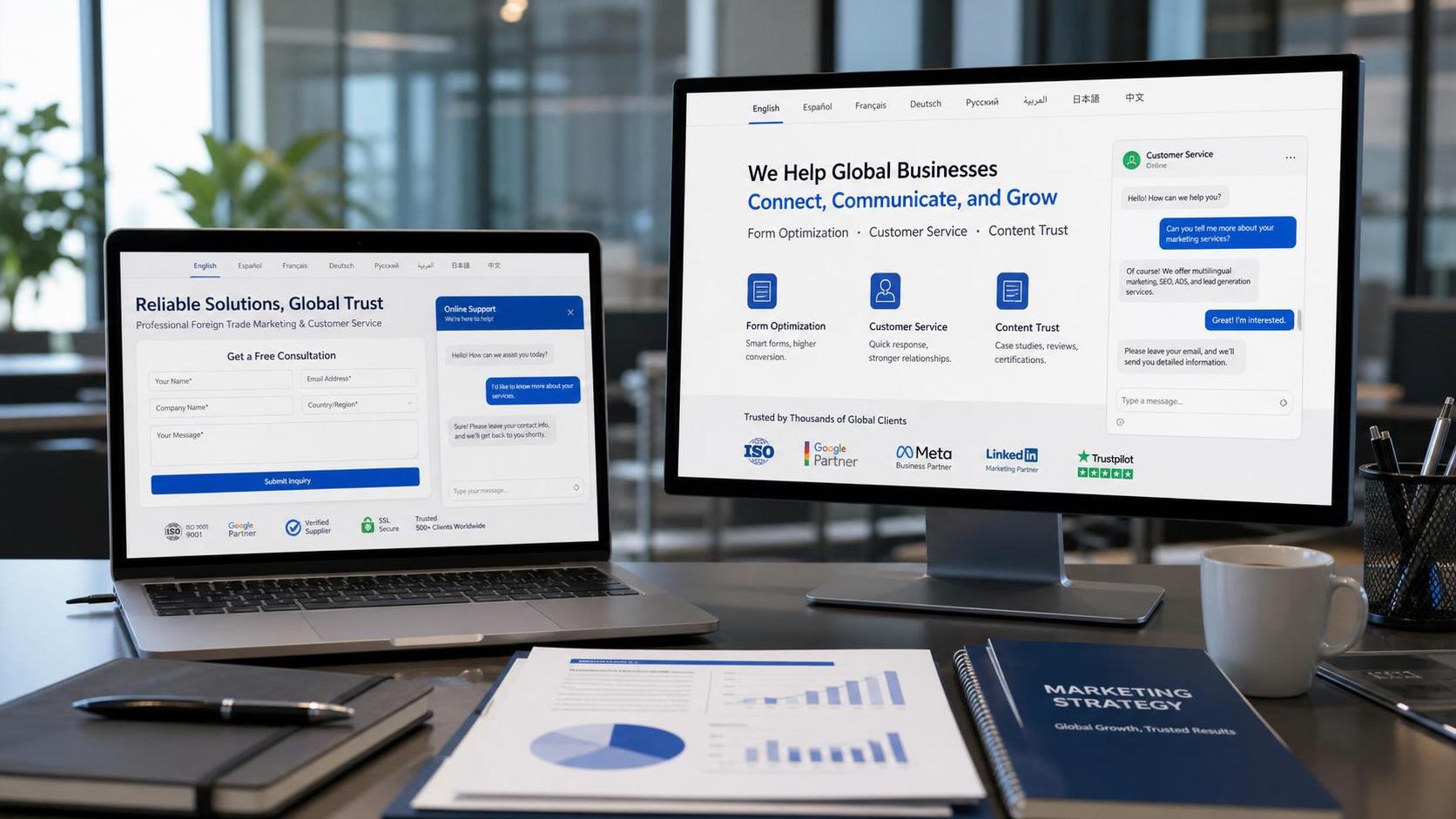
 Where should I start with an inquiry conversion optimization plan? Break down form, customer service, and content trust elements one by one

Related Products
 EasyCamp SaaS Smart Website Marketing SystemE-Yingbao SaaS Smart Website Marketing System: AI-powered, zero-code website building. Rapidly launch multilingual independent e-commerce sites in just 10 minutes. Global server acceleration and AI-driven SEO optimization empower businesses to efficiently connect with global markets. The seamless integration of technology and user-friendly operation makes building e-commerce sites incredibly simple.
 AI+SEM Intelligent Advertising Marketing SystemAI+SEM drives intelligent ad creation, empowering full-funnel precision advertising marketing. The system automatically generates weekly/monthly reports, AI recommends keywords and target countries, monitors core metrics in real-time with intelligent alerts, and enables one-click high-conversion ad solutions to help quickly acquire customers and improve ROI.
 AI+SEO Dual Engine Optimization ServiceEasyWin AI+SEO Dual Engine Optimization System leverages AI-powered keyword mining, content generation, and comprehensive technical optimization to help foreign trade enterprises acquire high-quality organic traffic, significantly improving search rankings and conversion rates.
 AI+SNS Social Media Marketing SystemYingbao AI+SNS Social Media Marketing System - Precision social capture for the social media era. Supports one-click content synchronization across major platforms like Facebook and LinkedIn. AI intelligently rewrites posts for enhanced relevance. 24/7 AI customer service and user profiling analysis empower businesses to efficiently expand into global markets.
 AI+SEO营销解决方案易营宝AI+SEO营销解决方案,通过AI批量写作、智能生成TDK、精准关键词扩词等功能,全面优化网站SEO效果,提升流量与转化率。助力企业构建高效智能网站新生态。
 AI+SEM Advertising Marketing SolutionsAI+SEM Advertising Marketing Solution leverages AI technology to deeply empower SEM ad campaigns. It automatically generates weekly/monthly reports using AI, presenting account data across multiple dimensions for comprehensive insights into campaign performance and trends. The system precisely recommends keywords and target countries, intelligently generates high-conversion ad copy, and enables one-click activation of efficient campaign plans to help businesses rapidly acquire customers. Simultaneously, it monitors core metrics in real time, intelligently identifies abnormal fluctuations, and issues timely alerts to ensure stable, high-return advertising results.
 Domain Name ServicesEasyWin provides professional domain name services, including intelligent queries, one-stop registration, brand protection, and full lifecycle management, helping businesses build a digital brand image.
 EasyOperate B2C Cross-Border E-Commerce Platform & Independent WebsiteEasyStore B2C Cross-border E-commerce Independent Store is an intelligent website building and cross-border e-commerce integrated solution independently developed by EasyStore Information Technology (Beijing) Co., Ltd. The system is specially designed for small and medium-sized as well as large export enterprises, integrating 'website building, operation, marketing, advertising, and conversion' into one, helping enterprises quickly establish cross-border e-commerce independent stores to achieve brand globalization and global sales growth.
The platform supports multiple languages, multiple currencies, and multi-channel marketing, with built-in AI intelligent translation and SEO optimization systems, suitable for mainstream markets such as Southeast Asia, Europe and America, Latin America, and the Middle East, assisting Chinese manufacturing enterprises in efficiently deploying international e-commerce strategies. SSL证书易营宝提供专业SSL安全证书服务,包括单域名和泛域名证书,确保网站数据传输加密、身份验证和完整性保护,助力企业建立安全可信的在线业务环境。









