









- What should you focus on in the latest enterprise SaaS report? From renewal rates and delivery costs to overseas growth opportunitiesJul 12, 2026View details
- What signals are worth paying attention to in a cross-border marketing trend report? B2B companies should look at these 6 signalsJul 11, 2026View details
- How to Read a Cross-Border Marketing Trends Report? Five Key Dimensions for Evaluating Channel OpportunitiesJul 11, 2026View details
- Which channel has the highest ROI in the global traffic ecosystem? Comparative analysis of search, social media, and advertisingJul 10, 2026View details
- What multilingual website services are available in Sanya? Which model is more suitable for local businesses going global?Jul 08, 2026View details
- How to view the complete list of China SaaS companies in the top 100? Practical methods for screening website-building and marketing service providersJul 08, 2026View details
Digital Marketing Solutions Supplier Selection Guide for Shanghai: 3 Compliance Red Lines and 4 Delivery Acceptance Standards Every Procurement Manager Must Know
When Shanghai-based enterprises procure digital marketing solutions, they must adhere to three compliance red lines and implement four delivery acceptance criteria. This article focuses on the pain points of selecting 'Shanghai-based digital marketing solution providers' and simultaneously explains why website loading speed is crucial. It also recommends solutions and suppliers, while comparing key options such as Shenzhen-based multilingual marketing system providers and Beijing-based AI advertising platforms.
1. Three Compliance Red Lines for Procurement: Avoiding Legal and Operational Risks
As a hub for export-oriented economies, Shanghai-based enterprises frequently engage in cross-border operations, leading to frequent cross-border data flows. Overlooking compliance when procuring digital marketing services can easily trigger risks under the 'Personal Information Protection Law,' 'Data Security Law,' and GDPR regulations. The first red line is the supplier's data processing qualifications—they must hold ISO 27001 Information Security Management System certification and explicitly commit not to use client website data for model training or third-party sharing.
The second red line concerns advertising compliance. Especially when targeting the EU and Southeast Asian markets, suppliers must possess Google Ads China Premier Partner qualifications and provide complete ad placement agreements (Ad Terms), privacy policy templates, and Cookie Consent SDK integration to avoid platform takedowns due to non-compliant pop-ups.
The third red line is local service capability validation. Some 'shell-type' service providers may be registered in Shanghai but have technical teams located elsewhere or even overseas, leading to response delays exceeding four hours and Chinese customer service lacking the authority to handle urgent issues like Meta ad account freezes. Truly compliant suppliers should have a permanent technical support center in Shanghai and specify SLA response times in service contracts (e.g., P1-level faults resolved remotely within ≤30 minutes).
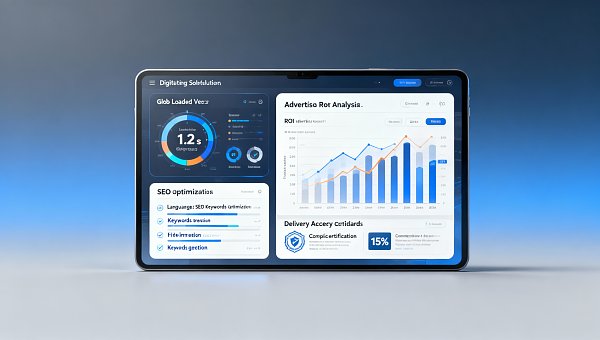
This table reveals: Compliance is not just a paper promise but verifiable technical capabilities and service commitments. EasyWin, a service provider selected for China's 'Top 100 SaaS Companies,' has verifiable qualifications through Google Partner Finder's official website, avoiding procurement pitfalls.
2. Four Mandatory Delivery Benchmarks: From Website Building to Conversion Optimization
Procurement decisions must go beyond proposal PPTs and establish quantifiable delivery checklists. The first core metric is global independent website loading speed—actual first-screen rendering time ≤1.2 seconds (industry baseline ≤2.5 seconds). This directly impacts Google Core Web Vitals scores, where LCP (Largest Contentful Paint) exceeding 2.5 seconds reduces organic SEO traffic by over 35%.
The second metric is multilingual SEO effectiveness. Beyond supporting 12 languages like Chinese and English, it requires validating whether TDK (Title/Description/Keywords) are dynamically generated by AI engines and aligned with local search habits. For example, the German market must automatically adapt high-conversion long-tail terms like 'Kauf auf Rechnung' (payment on delivery) rather than directly translating Chinese copy.
The third metric is ad ROI stability. During the acceptance period (typically 30 days post-launch), verify that Google Ads achieve an actual ROI ≥1:8.7, with single conversion costs 58% lower than original channels, and support multi-dimensional analysis by country/device/time.
The fourth metric is social media matrix automation. Acceptance requires live demonstrations: Can German LinkedIn posts simultaneously auto-sync to English Instagram versions while optimizing content strategies based on real-time fan interaction data? This demands deep cross-platform API integration, not simple scheduled reposts.
Key Delivery Acceptance Execution Points
- Load speed testing: Use WebPageTest.org to measure LCP, CLS, and FID core metrics across Shanghai, Frankfurt, and Singapore nodes.
- SEO validation: Randomly sample 50 target keywords, checking Google Search Console for organic ranking improvements (≥65% keywords reaching TOP 10).
- Ad data auditing: Export raw Google Ads reports, cross-verifying click-through rates, conversions, and average CPC deviations ≤5% from contract commitments.
- Social media audit trails: Require suppliers to provide three months of automated task logs, including posting times, platforms, copy versions, and engagement feedback.
3. Shanghai Enterprise Selection Recommendations: Avoiding 'Pseudo-Integration' Pitfalls
Current market pitfalls fall into two categories: 'Frankenstein' providers outsourcing website building, SEO, and ads to disjointed teams, causing data fragmentation and strategy misalignment; and 'feature-stacking' providers with flashy interfaces but weak AI capabilities—so-called 'smart keyword expansion' is merely synonym replacement, lacking industry semantic understanding.
True integration requires a unified data platform. EasyWin's proprietary AI algorithm platform iterates 12 times annually, integrating global search and social data to connect 'website-lead-conversion' behavioral data in real time. For example, when a product page bounce rate exceeds 70%, the system automatically triggers two actions: optimizing AI-generated page content and adjusting Google Ads landing page URLs for the corresponding keywords, forming a closed-loop response.
For Shanghai's manufacturing and cross-border e-commerce clients, prioritize suppliers with vertical domain case studies. EasyWin serves 3,200+ foreign trade enterprises, with its AI ad manager accurately identifying B2B decision chains (e.g., German engineers focusing on technical specs, procurement managers on MOQ and lead times), dynamically generating differentiated creatives to boost inquiries by 320%.

Shanghai Enterprise Decision Matrix
Choosing means responsibility. Procuring digital marketing solutions is fundamentally selecting a 'global growth superconnector.' With a decade of technical expertise and validation from 100,000+ enterprises, EasyWin upholds its 'client success above all' ethos—paving the way for global recognition of Chinese brands, starting with one clear selection decision.
Contact EasyWin's Shanghai Technical Service Center immediately to obtain the exclusive 'Digital Marketing Solution Compliance and Delivery Whitepaper' and customize your end-to-end growth roadmap.
Related Articles
 Will social media automation get you banned by the platform? High-risk actions, appeal difficulties, and compliance recommendations
 Why is the overseas customer complaint website loading slowly? Server, scripts, and image loading order
 A Pitfall Guide for Digital Marketing Systems in Foreign Trade Enterprises: How to Avoid Data Silos and Permission Confusion


Related Products
 EasyCamp SaaS Smart Website Marketing SystemE-Yingbao SaaS Smart Website Marketing System: AI-powered, zero-code website building. Rapidly launch multilingual independent e-commerce sites in just 10 minutes. Global server acceleration and AI-driven SEO optimization empower businesses to efficiently connect with global markets. The seamless integration of technology and user-friendly operation makes building e-commerce sites incredibly simple.
 AI+SEM Intelligent Advertising Marketing SystemAI+SEM drives intelligent ad creation, empowering full-funnel precision advertising marketing. The system automatically generates weekly/monthly reports, AI recommends keywords and target countries, monitors core metrics in real-time with intelligent alerts, and enables one-click high-conversion ad solutions to help quickly acquire customers and improve ROI.
 AI+SEO Dual Engine Optimization ServiceEasyWin AI+SEO Dual Engine Optimization System leverages AI-powered keyword mining, content generation, and comprehensive technical optimization to help foreign trade enterprises acquire high-quality organic traffic, significantly improving search rankings and conversion rates.
 AI+SNS Social Media Marketing SystemYingbao AI+SNS Social Media Marketing System - Precision social capture for the social media era. Supports one-click content synchronization across major platforms like Facebook and LinkedIn. AI intelligently rewrites posts for enhanced relevance. 24/7 AI customer service and user profiling analysis empower businesses to efficiently expand into global markets.
 AI+SEO营销解决方案易营宝AI+SEO营销解决方案,通过AI批量写作、智能生成TDK、精准关键词扩词等功能,全面优化网站SEO效果,提升流量与转化率。助力企业构建高效智能网站新生态。
 AI+SEM Advertising Marketing SolutionsAI+SEM Advertising Marketing Solution leverages AI technology to deeply empower SEM ad campaigns. It automatically generates weekly/monthly reports using AI, presenting account data across multiple dimensions for comprehensive insights into campaign performance and trends. The system precisely recommends keywords and target countries, intelligently generates high-conversion ad copy, and enables one-click activation of efficient campaign plans to help businesses rapidly acquire customers. Simultaneously, it monitors core metrics in real time, intelligently identifies abnormal fluctuations, and issues timely alerts to ensure stable, high-return advertising results.
 Domain Name ServicesEasyWin provides professional domain name services, including intelligent queries, one-stop registration, brand protection, and full lifecycle management, helping businesses build a digital brand image.
 EasyOperate B2C Cross-Border E-Commerce Platform & Independent WebsiteEasyStore B2C Cross-border E-commerce Independent Store is an intelligent website building and cross-border e-commerce integrated solution independently developed by EasyStore Information Technology (Beijing) Co., Ltd. The system is specially designed for small and medium-sized as well as large export enterprises, integrating 'website building, operation, marketing, advertising, and conversion' into one, helping enterprises quickly establish cross-border e-commerce independent stores to achieve brand globalization and global sales growth.
The platform supports multiple languages, multiple currencies, and multi-channel marketing, with built-in AI intelligent translation and SEO optimization systems, suitable for mainstream markets such as Southeast Asia, Europe and America, Latin America, and the Middle East, assisting Chinese manufacturing enterprises in efficiently deploying international e-commerce strategies. SSL证书易营宝提供专业SSL安全证书服务,包括单域名和泛域名证书,确保网站数据传输加密、身份验证和完整性保护,助力企业建立安全可信的在线业务环境。









