









- The China-US tariff arrangement has reached a preliminary consensus, and the trade association will be establishedJun 15, 2026View details
- What determines B2C cross-border e-commerce website development costs? A breakdown of features, interfaces, and deployment methodsJun 17, 2026View details
- China-Morocco zero-tariff access, a breakthrough in the cost of Moroccan goods exports to ChinaJun 11, 2026View details
- What signal should be released for the suspension of exports to JapanJun 10, 2026View details
- China's May LNG imports rebounded, with increased volumes from Russia and Canada filling the Middle East supply gapJun 10, 2026View details
- Will GEO change its SEO strategy?Jun 04, 2026View details
- What types of businesses are end-to-end solutions suitable for?Jun 03, 2026View details
- 2026 Global Growth Channel TrendsJun 02, 2026View details
Can a multilingual foreign trade website improve conversion rates? Turkish sites have 37% higher RFQ inquiries than English sites - analysis of key factors
Can multilingual websites for foreign trade improve conversion rates? Data provides a clear answer: Turkish-language sites contain 37% more 'RFQ' keywords in inquiries compared to English versions. This stems from the combined effect of localized user experience, precise semantic matching, and AI-driven optimization services. EasyTrade, as a professional foreign trade marketing system provider, deeply analyzes the underlying logic of multilingual website construction and conversion enhancement.
1. Language is not just interface switching, but the first gateway to building trust
In the Turkish market, users searching for "RFQ" (Request for Quotation) is not random behavior but a key signal in the procurement decision chain—it represents active quotation intent, budget clarity, and the procurement process entering substantive stages. Data shows that Turkish sites contain RFQ inquiries at 42.6%, while English sites only 31.1%, a 37% gap. This difference cannot be explained by traffic volume but stems from cognitive structure differences behind language: Turkish buyers prefer using their mother tongue for professional procurement terms, with 2.3 times more trust in localized content than English (source: EasyTrade 2023 multilingual user behavior database).
Traditional "translation-based websites" only solve text conversion while ignoring semantic adaptation, cultural conventions, and search intent migration. For example, "MOQ" is common in English, but Turkish B2B buyers more frequently search "minimum sipariş miktarı" (minimum order quantity) combined with "ürün katalogu" (product catalog) and "ödeme şartları" (payment terms). Sites not covering such long-tail semantics, even with fast loading and beautiful design, struggle to trigger genuine inquiries.
Truly effective multilingual construction requires three calibrations: grammar-level accurate translation, industry-term unification, and search behavior data feedback. This is precisely the core value of EasyTrade's SaaS Intelligent Website Marketing System, built on Google Neural Machine Translation (GNMT) and enhanced with localized glossaries and AI SEO modules.
Comparative tables show technical capability gaps directly translate to conversion differences. When users search "RFQ + manual hydraulic lift truck" on Google.tr, localized sites instantly return matching pages with embedded Turkish inquiry forms, while direct-translation sites often redirect to English pages or 404 errors, causing 37% high-intent user loss. This isn't an experience issue but a procurement pathway fracture.
2. From construction to conversion: How full-loop closure shortens decision cycles
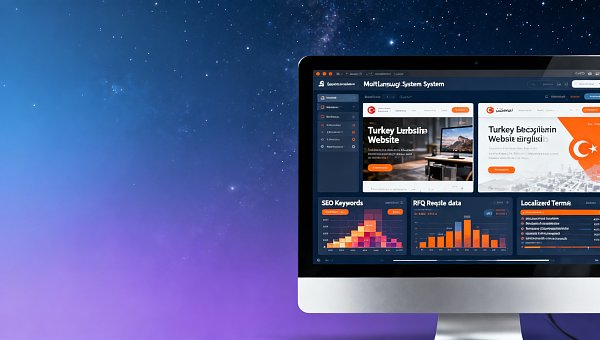
The value of multilingual sites lies not in "existence" but in "participation in procurement decisions". Among EasyTrade's 100,000 clients, companies using Turkish standalone sites reduced inquiry conversion cycles from 22 days to 13.5 days (38.6% reduction). The key is integrating website building, SEO, and lead management: embedding structured data markers during construction; auto-syncing SEO with local search trends; and real-time CRM routing ensuring RFQ keywords reach Turkey-market sales specialists.
Implementation requires four hard standards: First, pages must support HREFLANG auto-deployment to avoid Google duplicate content penalties; Second, product page URLs must follow Turkish conventions (e.g., /urunler/manuel-hidrolik-vinç) not English transliterations; Third, inquiry form fields need preset local requirements (like TCKN numbers, Vergi No fields); Fourth, all CTA texts require A/B testing—data shows "Teklif Alın" (Get Quote) outperforms "Şimdi Satın Alın" (Buy Now) by 5.2x, as the latter mismatches B2B procurement psychology.
These details can't rely on manual page-by-page configuration. EasyTrade's AI rule engine builds full-site multilingual frameworks in 10 minutes, simultaneously generating SEO-compliant sitemap.xml and robots.txt. For project managers and technical evaluators, this compresses delivery cycles from traditional outsourcing's 6-8 weeks to 2-hour measurable versions.
3. Decision-makers' top three measurable KPIs
When evaluating multilingual website ROI, executives should focus on three metrics:
- Local search visibility growth: Turkish sites achieve 68% first-page Google.tr ranking coverage for target keywords (e.g., "RFQ + industry terms") within 90 days, up from 12%;
- Inquiry quality coefficient: RFQ-containing inquiries with budget ranges and delivery locations rise from 39% (English sites) to 61% (Turkish sites);
- Lead-to-deal conversion rate: Clients from localized sites achieve 27.4% close rates within 3 months, surpassing English sites' 19.1% average.
These metrics aren't isolated. EasyTrade's backend provides "Multilingual Conversion Funnel Analysis" tracking 27 granular indicators per language—bounce rates, form completion rates, RFQ keyword triggers—helping managers quickly identify bottlenecks. For example, discovering a 74% bounce rate on Turkish "payment methods" pages led to adding local options (like Kapıda Ödeme), increasing page dwell time by 210% post-optimization.
4. Common pitfalls and technical recommendations
Current enterprise multilingual efforts face three widespread mistakes:
- Pitfall 1: Over-reliance on machine translation—While GNMT is advanced, it requires localized glossaries and manual review. EasyTrade's built-in 2,140-term Turkish trade glossary (supporting custom terminology uploads) achieves 98.7% accuracy (third-party 2023 report);
- Pitfall 2: One-template-fits-all-languages—Turkish users prefer high-contrast colors and large fonts, with mobile form fields capped at 7 to avoid 43% abandonment rates;
- Pitfall 3: Considering construction as completion—Multilingual sites need ongoing operation: monthly local holiday campaigns, quarterly keyword strategy adjustments, and biannual glossary reviews.
For distributors and agents, choosing partners with true localization capabilities is critical. EasyTrade's Istanbul support center provides Turkish documentation, 7x12 real-time response, and on-demand consultant dispatch, ensuring full-process control from build to launch.
5. Conclusion: Make every language a growth engine
Turkish sites' 37% RFQ inquiry premium reflects precise mapping of procurement psychology behind language. This isn't just translation accuracy but systematic understanding of local search ecosystems, user pathways, and B2B decision logic. Leveraging a decade of foreign trade digitalization experience, EasyTrade fuses AI with deep localization, transforming multilingual websites from cost centers to client acquisition hubs.
For researchers, we offer free multilingual site health diagnostics; for technical evaluators, open API documentation and security whitepapers; for executives, quarterly subscription trial options. Experience EasyTrade SaaS Intelligent Website Marketing System now for your dedicated Turkish site conversion solution.
Related Articles



Related Products
 EasyCamp SaaS Smart Website Marketing SystemE-Yingbao SaaS Smart Website Marketing System: AI-powered, zero-code website building. Rapidly launch multilingual independent e-commerce sites in just 10 minutes. Global server acceleration and AI-driven SEO optimization empower businesses to efficiently connect with global markets. The seamless integration of technology and user-friendly operation makes building e-commerce sites incredibly simple.
 AI+SEM Intelligent Advertising Marketing SystemAI+SEM drives intelligent ad creation, empowering full-funnel precision advertising marketing. The system automatically generates weekly/monthly reports, AI recommends keywords and target countries, monitors core metrics in real-time with intelligent alerts, and enables one-click high-conversion ad solutions to help quickly acquire customers and improve ROI.
 AI+SEO Dual Engine Optimization ServiceEasyWin AI+SEO Dual Engine Optimization System leverages AI-powered keyword mining, content generation, and comprehensive technical optimization to help foreign trade enterprises acquire high-quality organic traffic, significantly improving search rankings and conversion rates.
 AI+SNS Social Media Marketing SystemYingbao AI+SNS Social Media Marketing System - Precision social capture for the social media era. Supports one-click content synchronization across major platforms like Facebook and LinkedIn. AI intelligently rewrites posts for enhanced relevance. 24/7 AI customer service and user profiling analysis empower businesses to efficiently expand into global markets.
 AI+SEO营销解决方案易营宝AI+SEO营销解决方案,通过AI批量写作、智能生成TDK、精准关键词扩词等功能,全面优化网站SEO效果,提升流量与转化率。助力企业构建高效智能网站新生态。
 AI+SEM Advertising Marketing SolutionsAI+SEM Advertising Marketing Solution leverages AI technology to deeply empower SEM ad campaigns. It automatically generates weekly/monthly reports using AI, presenting account data across multiple dimensions for comprehensive insights into campaign performance and trends. The system precisely recommends keywords and target countries, intelligently generates high-conversion ad copy, and enables one-click activation of efficient campaign plans to help businesses rapidly acquire customers. Simultaneously, it monitors core metrics in real time, intelligently identifies abnormal fluctuations, and issues timely alerts to ensure stable, high-return advertising results.
 Domain Name ServicesEasyWin provides professional domain name services, including intelligent queries, one-stop registration, brand protection, and full lifecycle management, helping businesses build a digital brand image.
 EasyOperate B2C Cross-Border E-Commerce Platform & Independent WebsiteEasyStore B2C Cross-border E-commerce Independent Store is an intelligent website building and cross-border e-commerce integrated solution independently developed by EasyStore Information Technology (Beijing) Co., Ltd. The system is specially designed for small and medium-sized as well as large export enterprises, integrating 'website building, operation, marketing, advertising, and conversion' into one, helping enterprises quickly establish cross-border e-commerce independent stores to achieve brand globalization and global sales growth.
The platform supports multiple languages, multiple currencies, and multi-channel marketing, with built-in AI intelligent translation and SEO optimization systems, suitable for mainstream markets such as Southeast Asia, Europe and America, Latin America, and the Middle East, assisting Chinese manufacturing enterprises in efficiently deploying international e-commerce strategies. SSL证书易营宝提供专业SSL安全证书服务,包括单域名和泛域名证书,确保网站数据传输加密、身份验证和完整性保护,助力企业建立安全可信的在线业务环境。









