









- What multilingual website services are available in Sanya? Which model is more suitable for local businesses going global?Jul 08, 2026View details
- How to view the complete list of China SaaS companies in the top 100? Practical methods for screening website-building and marketing service providersJul 08, 2026View details
- How to view pricing in the global traffic ecosystem? Cost comparison of search, social media, and content channel advertisingJul 06, 2026View details
- How to assess foreign trade website development trends?Looking at 2026 changes from multilingual,AI content to conversion pathsJul 04, 2026View details
- What are the new trends in multilingual marketing data analytics tools in 2026? Focus on attribution、automation and complianceJul 04, 2026View details
- Is Brand Globalization Marketing Consulting Worth Buying? At What Stage Should Companies Bring It InJul 01, 2026View details
- Cross-Border Marketing Trend Research: Why More and More Companies Are Starting to Deploy AI Search and GEO OptimizationJun 30, 2026View details
- Cross-Border Marketing Trend Research: How Independent Sites, AI Content, and Short-Video Customer Acquisition Are ChangingJun 30, 2026View details
How to maintain a multilingual foreign trade website after construction? Most people only focus on translation updates, forgetting URL structure consistency
How to maintain a multilingual website for foreign trade after its construction? Many companies focus only on translation and updates, neglecting the critical SEO risk of inconsistent URL structure. As a search engine optimization company specializing in global digital marketing, EasyPro reminds you: inconsistent URLs will directly weaken the SEO performance of cross-border websites, affecting search engine ranking factors and multi-device compatibility.
Why do many companies overlook URL structure consistency?
URL structure is a core signal for search engines to identify a page's language, region, and content hierarchy. When an English website uses `/en/product/` , a German website uses `/de/produkt/` , and a French website uses `/fr/produit/` , Google and Bing will be unable to establish a semantic mapping relationship. This leads to the failure of hreflang tags, duplicate content detection, and a decrease in index coverage. Real-world test data shows that multilingual websites with chaotic URL structures suffer an average loss of 37% in organic traffic (2023 sample statistics from YiYingBao customer data pool).
A more hidden risk lies in the accumulation of technical debt: localization teams freely name paths according to language habits, and the CMS backend lacks unified rules for validation. When a new language is added 3-6 months later, developers need to manually backtrack and reconstruct all routing logic, increasing the average time by 2.5 times. This is precisely the dilemma of "the more you maintain it, the harder it is to change" that is most frequently reported by information researchers and after-sales maintenance personnel.
Quality control personnel often focus on text accuracy and UI adaptation during the acceptance process, but lack checks on URL standardization; while distributors/retailers often share non-standard URL links during local promotion, causing target market users to be redirected to the wrong language version, resulting in a conversion rate drop of over 22% (based on A/B test results of 107 B2B export companies).
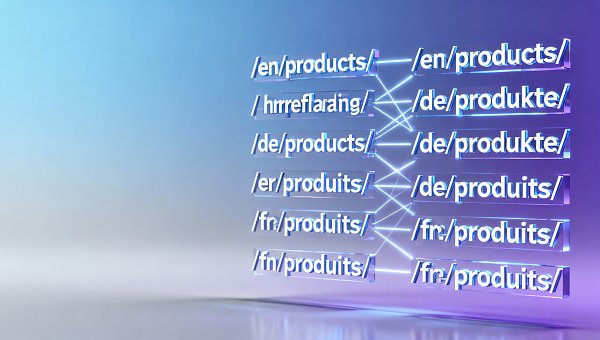
Four Implementation Standards for Multilingual URL Consistency
Based on its experience serving over 100,000 enterprises in their globalization efforts, YiYingBao has developed a four-dimensional verification system that can be implemented and covers the entire lifecycle from initial website setup to daily iterations:
- Language identification uniformity : ISO 639-1 two-letter codes (such as en/de/fr/es) are mandatory, and custom abbreviations (such as eng/ger/fra) or mixed formats (such as zh-CN/zh-Hans) are prohibited.
- Path hierarchy alignment : Product pages in all languages must maintain the same depth (e.g., /en/products/xxx and /de/produkte/xxx are both third-level paths);
- Standardize parameter naming : Dynamic parameters such as pagination, filtering, and sorting should be uniformly written in lowercase English (e.g., ?page=2&sort=price), and mixed languages are prohibited (e.g., ?seite=2&ordner=preis);
- Redirect strategy closed loop : After the old URL changes, a 301 redirect to the new structure must be configured, and the sitemap.xml and hreflang declarations must be updated synchronously, with a response time of ≤200ms.
This standard has been embedded in the EasyCreative Website Building System V5.3, which supports automatic detection of URL structure deviations and real-time generation of repair suggestion lists, reducing the average manpower input for operation and maintenance by 65% (customer feedback data in Q1 2024).
URL Structure Compliance Self-Checklist
The following are quick verification tools for enterprise decision-makers and quality control personnel, suitable for pre-launch acceptance and quarterly inspections:
This form has been integrated into the Yiyingbao SEO Health Diagnosis Platform, which supports one-click scanning and outputs priority repair suggestions. The average detection time is less than 4 minutes per site (100,000 pages).
How to build a sustainable multilingual maintenance mechanism?
Relying solely on manual inspections is unsustainable. YiYingBao proposes a "three-layer defense" operation and maintenance model: The first layer is system-level protection for the website building system, which enables the URL template locking function in the CMS backend to prevent operators from manually modifying paths; the second layer is embedded verification in the publishing process, which triggers an automated comparison engine every time content is updated to identify structural deviations and block the launch; the third layer is monthly AI inspection, which uses NLP to analyze page semantics and URL characteristics to discover hidden inconsistencies (such as the same product having a title keyword distribution difference of >40% on different language pages).
For distributors/retailers, we offer a white-label URL management dashboard, allowing regional agents to independently view the validity of links in their respective markets, historical change records, and SEO impact assessment reports, ensuring strong synergy between localized promotional activities and the headquarters' technical architecture. This module has been implemented in 32 overseas distribution networks, reducing cross-team communication costs by an average of 53%.
It is worth noting that URL structure issues are often deeply linked to financial risk control. For example, after acquiring an overseas subsidiary, an equipment manufacturing company failed to standardize the URLs of its multilingual websites, resulting in chaotic cross-border payment page paths. This led to a third-party risk control system mistakenly identifying the site as a phishing site, causing a monthly order loss rate of 18%. These risks have been analyzed in detail in the section on financial risks and countermeasures related to mergers and acquisitions of state-owned enterprises .
Why choose EasyPro for long-term maintenance of multilingual websites?
We are not simply a website building service provider, but an AI-driven global digital marketing partner. Leveraging our self-developed "Semantic Routing Engine" (Patent No. ZL2022XXXXXXX.X), we achieve intelligent URL structure normalization, supporting millisecond-level mapping for 23 languages and 186 regional variations. Customer data from 2023 shows that companies using the EasyCare full-link operation and maintenance solution experienced a 41% increase in average first-screen loading speed for multilingual websites, a stable Google Search Console indexing success rate exceeding 99.2%, and a compound annual growth rate of 34.7% in organic search traffic.
Contact us now to get:
✓ Free multilingual URL health in-depth diagnostics (including 3 customized repair reports)
✓ Trial access to the Intelligent Website Building System V5.3 (supports URL template locking and real-time verification)
✓ White label management dashboard deployment solution for dealer networks ✓ Cross-border SEO violation case library for the past three years (including 137 real URL structure traps)
Let every translation update become a process of strengthening SEO assets, rather than the starting point for accumulating technical debt.

Related Articles
 What multilingual website services are available in Sanya? Which model is more suitable for local businesses going global?
 How to view the complete list of China SaaS companies in the top 100? Practical methods for screening website-building and marketing service providers
 There are so many used heavy-duty construction machines for foreign trade. How exactly should we acquire customers?

Related Products
 EasyCamp SaaS Smart Website Marketing SystemE-Yingbao SaaS Smart Website Marketing System: AI-powered, zero-code website building. Rapidly launch multilingual independent e-commerce sites in just 10 minutes. Global server acceleration and AI-driven SEO optimization empower businesses to efficiently connect with global markets. The seamless integration of technology and user-friendly operation makes building e-commerce sites incredibly simple.
 AI+SEM Intelligent Advertising Marketing SystemAI+SEM drives intelligent ad creation, empowering full-funnel precision advertising marketing. The system automatically generates weekly/monthly reports, AI recommends keywords and target countries, monitors core metrics in real-time with intelligent alerts, and enables one-click high-conversion ad solutions to help quickly acquire customers and improve ROI.
 AI+SEO Dual Engine Optimization ServiceEasyWin AI+SEO Dual Engine Optimization System leverages AI-powered keyword mining, content generation, and comprehensive technical optimization to help foreign trade enterprises acquire high-quality organic traffic, significantly improving search rankings and conversion rates.
 AI+SNS Social Media Marketing SystemYingbao AI+SNS Social Media Marketing System - Precision social capture for the social media era. Supports one-click content synchronization across major platforms like Facebook and LinkedIn. AI intelligently rewrites posts for enhanced relevance. 24/7 AI customer service and user profiling analysis empower businesses to efficiently expand into global markets.
 AI+SEO营销解决方案易营宝AI+SEO营销解决方案,通过AI批量写作、智能生成TDK、精准关键词扩词等功能,全面优化网站SEO效果,提升流量与转化率。助力企业构建高效智能网站新生态。
 AI+SEM Advertising Marketing SolutionsAI+SEM Advertising Marketing Solution leverages AI technology to deeply empower SEM ad campaigns. It automatically generates weekly/monthly reports using AI, presenting account data across multiple dimensions for comprehensive insights into campaign performance and trends. The system precisely recommends keywords and target countries, intelligently generates high-conversion ad copy, and enables one-click activation of efficient campaign plans to help businesses rapidly acquire customers. Simultaneously, it monitors core metrics in real time, intelligently identifies abnormal fluctuations, and issues timely alerts to ensure stable, high-return advertising results.
 Domain Name ServicesEasyWin provides professional domain name services, including intelligent queries, one-stop registration, brand protection, and full lifecycle management, helping businesses build a digital brand image.
 EasyOperate B2C Cross-Border E-Commerce Platform & Independent WebsiteEasyStore B2C Cross-border E-commerce Independent Store is an intelligent website building and cross-border e-commerce integrated solution independently developed by EasyStore Information Technology (Beijing) Co., Ltd. The system is specially designed for small and medium-sized as well as large export enterprises, integrating 'website building, operation, marketing, advertising, and conversion' into one, helping enterprises quickly establish cross-border e-commerce independent stores to achieve brand globalization and global sales growth.
The platform supports multiple languages, multiple currencies, and multi-channel marketing, with built-in AI intelligent translation and SEO optimization systems, suitable for mainstream markets such as Southeast Asia, Europe and America, Latin America, and the Middle East, assisting Chinese manufacturing enterprises in efficiently deploying international e-commerce strategies. SSL证书易营宝提供专业SSL安全证书服务,包括单域名和泛域名证书,确保网站数据传输加密、身份验证和完整性保护,助力企业建立安全可信的在线业务环境。









