









- China-Morocco zero-tariff access, a breakthrough in the cost of Moroccan goods exports to ChinaJun 11, 2026View details
- What signal should be released for the suspension of exports to JapanJun 10, 2026View details
- China's May LNG imports rebounded, with increased volumes from Russia and Canada filling the Middle East supply gapJun 10, 2026View details
- Will GEO change its SEO strategy?Jun 04, 2026View details
- What types of businesses are end-to-end solutions suitable for?Jun 03, 2026View details
- 2026 Global Growth Channel TrendsJun 02, 2026View details
- Changes in Search Engine Ranking Factors in 2026Jun 06, 2026View details
- Which stages is the brand visibility enhancement service suitable forMay 29, 2026View details
What channels are included in overseas digital marketing? SEO, advertising, and social media campaigns explained in one article
What Is Overseas Digital Marketing Really Doing, and Why Is It So Hard to Do Without a Website
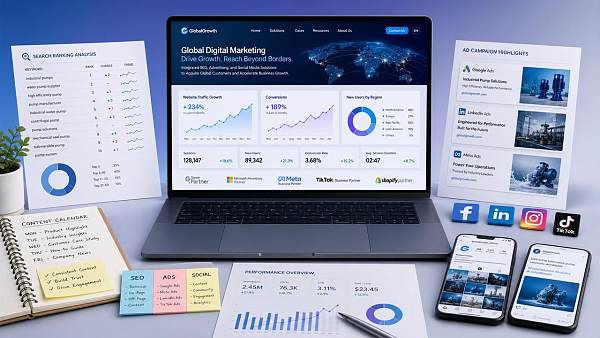
Overseas digital marketing is not just about running ads on overseas platforms. More accurately, it is an integrated customer acquisition system built around independent websites, content, traffic, and conversion.
Many people initially focus on the distribution channels, but in actual implementation, the website is often the core that carries results. Without a clear website structure, even more traffic can easily be lost.
This is also why "website + marketing services integration" is attracting more and more attention. Channels are responsible for bringing in target customers, while the website is responsible for helping customers understand, trust, and leave inquiries. The two are indispensable.
Using Yiyingbao as an example, such platforms are usually not just about website building or promotion alone. Instead, they integrate intelligent website building, SEO optimization, ad placement, social media operations, and AI search visibility into one connected workflow, with the goal of making overseas digital marketing truly promotable, indexable, and convertible.
What Are the Common Overseas Digital Marketing Channels, and What Do They Include
If we break it down from the perspective of customer acquisition logic, common overseas digital marketing channels can be roughly divided into four categories: search channels, advertising channels, social channels, and content channels. They do not replace one another; rather, each承担 different tasks.
- Search channels: Mainly Google SEO and GEO optimization, focusing on organic exposure and long-term inquiry accumulation.
- Advertising channels: Including Google Ads, Facebook Ads, and more, emphasizing faster clicks and leads.
- Social channels: Such as overseas social media operations and short-form video content distribution, suitable for brand reach and interaction.
- Content channels: Including website content, multilingual pages, case studies, white papers, and more, used to strengthen trust and conversion.
Simply put, SEO is more like a "slow variable," advertising is more like a "fast variable," and social media is responsible for expanding awareness and building relationships. Truly mature overseas digital marketing often combines these channels.
If you are still trying to understand the business logic behind different channels, reading some cross-domain research can also be helpful, for example Green tax system helps enterprise innovation and industrial upgrading issue research, which is not a marketing material, but it is very inspiring in terms of how "policy, industry, and corporate decision-making interact."
SEO, Advertising Placement, Social Media Operations, Which Should You Do First
There is no single answer to this question; the key depends on whether your goal is market validation or long-term growth.
If the website has just launched and the product pages are still in the polishing stage, advertising is usually used first to test the market. The reason is straightforward: ad feedback is faster, and it is easier to see as early as possible which regions, keywords, and pages are more likely to convert.
But if you only run ads and do not do SEO, the cost of acquiring customers often keeps rising. The value of SEO lies in continuously accumulating search assets, especially for business scenarios with longer purchase decision cycles and a need for continuous content education.
Social media operations are often misunderstood as simply "posting content is enough." In fact, they are more suitable for brand reach, retargeting coordination, and trust reinforcement. Many customers first encounter a brand through ads or search, and what ultimately determines whether they take the next step is often whether they see the social channels being updated consistently.
A more common approach is to first build a conversion-ready website, then use ads for validation, and then simultaneously deploy SEO and social media. In this way, the pace of overseas digital marketing will be more stable.
Which Scenarios Are More Suitable for Integrated Marketing Rather Than Betting on Just One Channel
Betting on just one channel may seem simple, but it carries significant risk. Platform rules, click costs, search rankings, and the content distribution environment can all change, making single-channel dependence more passive for customer acquisition.
The following scenarios are more suitable for integrated overseas digital marketing.
- When expanding into multilingual markets simultaneously, website, search, and advertising need to work together.
- When the product decision cycle is relatively long, SEO content and social content are needed to continuously build trust.
- When you want to balance inquiries and brand building, just running competitive ads is often not enough, and social media and content need to fill the gap.
- When user habits differ significantly across regions, localized pages and local advertising strategies are needed.
The value of platforms like Yiyingbao is reflected in the ability to unify planning from the website foundation to channel execution. When the website is built, it already takes into account indexing logic, conversion paths, and ad landing needs, so there will not be a later situation where the pages look fine but are not suitable for promotion.
Especially when multiple markets such as North America, Europe, Southeast Asia, and Japan and Korea are being developed in parallel, localized messaging, page load speed, form design, and inquiry tracking methods will directly affect overseas digital marketing performance.
What Mistakes Are Most Easily Overlooked in Overseas Digital Marketing
The mistake is usually not in whether there are ads, but in "why there is no conversion after advertising." Many problems seem to be channel issues, but the root cause is actually the website and content.
First, separate website building from promotion
If the website does not have keyword-oriented layout, does not have a clear action entry point, and lacks mobile optimization, even good advertising will have difficulty producing stable results. Overseas digital marketing is not about finishing the website first and then thinking about promotion; it should be built with promotional logic from the very beginning.
Second, focus only on traffic and ignore lead quality
An increase in traffic does not mean effective growth. What really matters is keyword match quality, page dwell time, inquiry form completion rate, and the actual conversion differences brought by different countries.
Third, underestimate the role of content
Many industries are not about "one look and they place an order," but rather compare first and validate later. At this stage, case study pages, application scenario pages, technical Q&A, and industry articles all affect judgment.
Fourth, ignore data feedback loops
If advertising, SEO, social media, and website data are disconnected from each other, it becomes difficult to know which channel is truly effective. A more mature approach is to let the website system, advertising system, and SEO optimization system form a closed loop.
If You Are Just Starting the Layout, How Should You Judge Priorities
You can first ask yourself four questions: Is there a website that can carry traffic, is the target market clear, does the content support search and conversion, and is the budget more inclined toward short-term testing or long-term accumulation.
If there are still two or more unclear points among these four questions, do not rush to scale up the budget. First get the foundation in place; usually that is more important than blindly expanding volume.
- First check the website: whether it supports multilingual content, mobile devices, form tracking, and page indexing.
- Then determine the channel mix: high-intent markets can prioritize advertising, while long-cycle markets should do SEO simultaneously.
- Supplement content assets: product pages, case study pages, FAQ pages, and landing pages should each have clear responsibilities.
- Establish a feedback mechanism: at least review keywords, clicks, inquiries, and conversion paths weekly.
When some teams conduct strategy research, they also refer to materials like Green tax system helps enterprise innovation and industrial upgrading issue research. The purpose is not to directly copy them, but to draw on their analytical approach to the relationship between policy, investment, and long-term returns.
Back to actual operations, overseas digital marketing is not mysterious. The key is to first define the goal, then choose the right channels, and let the website, content, and data work in coordination. In this way, whether you are doing SEO optimization, advertising placement, or social media operations, the investment is more likely to accumulate into long-term growth.
If the next step is to begin execution, it is recommended to first sort out the existing website foundation, target regions, content gaps, and budget rhythm, and then compare the channel mix that is most suitable. The clearer the criteria for judgment, the less likely overseas digital marketing is to take detours.
Related Articles



Related Products
 EasyCamp SaaS Smart Website Marketing SystemE-Yingbao SaaS Smart Website Marketing System: AI-powered, zero-code website building. Rapidly launch multilingual independent e-commerce sites in just 10 minutes. Global server acceleration and AI-driven SEO optimization empower businesses to efficiently connect with global markets. The seamless integration of technology and user-friendly operation makes building e-commerce sites incredibly simple.
 AI+SEM Intelligent Advertising Marketing SystemAI+SEM drives intelligent ad creation, empowering full-funnel precision advertising marketing. The system automatically generates weekly/monthly reports, AI recommends keywords and target countries, monitors core metrics in real-time with intelligent alerts, and enables one-click high-conversion ad solutions to help quickly acquire customers and improve ROI.
 AI+SEO Dual Engine Optimization ServiceEasyWin AI+SEO Dual Engine Optimization System leverages AI-powered keyword mining, content generation, and comprehensive technical optimization to help foreign trade enterprises acquire high-quality organic traffic, significantly improving search rankings and conversion rates.
 AI+SNS Social Media Marketing SystemYingbao AI+SNS Social Media Marketing System - Precision social capture for the social media era. Supports one-click content synchronization across major platforms like Facebook and LinkedIn. AI intelligently rewrites posts for enhanced relevance. 24/7 AI customer service and user profiling analysis empower businesses to efficiently expand into global markets.
 AI+SEO营销解决方案易营宝AI+SEO营销解决方案,通过AI批量写作、智能生成TDK、精准关键词扩词等功能,全面优化网站SEO效果,提升流量与转化率。助力企业构建高效智能网站新生态。
 AI+SEM Advertising Marketing SolutionsAI+SEM Advertising Marketing Solution leverages AI technology to deeply empower SEM ad campaigns. It automatically generates weekly/monthly reports using AI, presenting account data across multiple dimensions for comprehensive insights into campaign performance and trends. The system precisely recommends keywords and target countries, intelligently generates high-conversion ad copy, and enables one-click activation of efficient campaign plans to help businesses rapidly acquire customers. Simultaneously, it monitors core metrics in real time, intelligently identifies abnormal fluctuations, and issues timely alerts to ensure stable, high-return advertising results.
 Domain Name ServicesEasyWin provides professional domain name services, including intelligent queries, one-stop registration, brand protection, and full lifecycle management, helping businesses build a digital brand image.
 EasyOperate B2C Cross-Border E-Commerce Platform & Independent WebsiteEasyStore B2C Cross-border E-commerce Independent Store is an intelligent website building and cross-border e-commerce integrated solution independently developed by EasyStore Information Technology (Beijing) Co., Ltd. The system is specially designed for small and medium-sized as well as large export enterprises, integrating 'website building, operation, marketing, advertising, and conversion' into one, helping enterprises quickly establish cross-border e-commerce independent stores to achieve brand globalization and global sales growth.
The platform supports multiple languages, multiple currencies, and multi-channel marketing, with built-in AI intelligent translation and SEO optimization systems, suitable for mainstream markets such as Southeast Asia, Europe and America, Latin America, and the Middle East, assisting Chinese manufacturing enterprises in efficiently deploying international e-commerce strategies. SSL证书易营宝提供专业SSL安全证书服务,包括单域名和泛域名证书,确保网站数据传输加密、身份验证和完整性保护,助力企业建立安全可信的在线业务环境。









