









- How to view pricing in the global traffic ecosystem? Cost comparison of search, social media, and content channel advertisingJul 06, 2026View details
- How to assess foreign trade website development trends?Looking at 2026 changes from multilingual,AI content to conversion pathsJul 04, 2026View details
- What are the new trends in multilingual marketing data analytics tools in 2026? Focus on attribution、automation and complianceJul 04, 2026View details
- Is Brand Globalization Marketing Consulting Worth Buying? At What Stage Should Companies Bring It InJul 01, 2026View details
- Cross-Border Marketing Trend Research: Why More and More Companies Are Starting to Deploy AI Search and GEO OptimizationJun 30, 2026View details
- Cross-Border Marketing Trend Research: How Independent Sites, AI Content, and Short-Video Customer Acquisition Are ChangingJun 30, 2026View details
- How Can a Brand Updates Page Be Made More SEO-Friendly? Analysis of Update Frequency, Content Structure, and Internal Linking StrategyJun 28, 2026View details
- What stages does the cross-border services ecosystem include? How do website building, promotion, payment, and compliance work togetherJun 22, 2026View details
Is Long-Form or Short-Form Content Better for YouTube Video Marketing
In YouTube video marketing, long-form videos are suitable for building professional trust, while short-form videos are more effective for rapid customer acquisition and increasing exposure. For project managers and engineering leads, the real judgment is not whether longer videos are better or shorter videos are better, but whether the content goal, audience stage, traffic entry point, and conversion path are aligned. For companies advancing website development, SEO optimization, social media marketing, and advertising in coordination, video length is essentially a choice between traffic structure and business efficiency.
The Core Decision Logic of YouTube Video Marketing
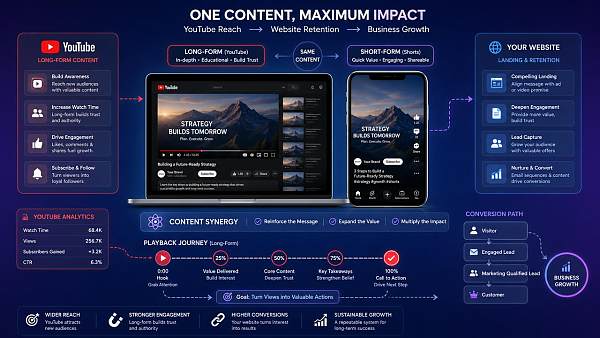
YouTube video marketing is not just about uploading content. It involves topic selection, keyword placement, thumbnail click-through rate, watch time, engagement rate, off-site landing pages, and final inquiry conversion. Long-form and short-form videos are simply different content formats, and they serve different stages of marketing.
Generally speaking, short-form videos are more suitable for the cold-start stage. They can quickly test topic directions, expand reach, and compete for platform recommendations through a lower viewing threshold. Long-form videos are more suitable for mid- to late-stage nurturing, helping potential customers understand solution value, build professional awareness, and enhance brand credibility.
If a company itself provides an integrated website + marketing service solution, then YouTube video marketing cannot be viewed in isolation. Video content needs to form a closed loop with official website landing pages, the SEO content system, inquiry forms, case study displays, and advertising remarketing in order to truly deliver growth value.
Current Industry Trends in Content Selection
In recent years, YouTube video marketing has shown a clear dual-track trend. On one hand, short-form videos serve as traffic entry points. On the other hand, long-form videos take on education and conversion. The platform algorithm places greater emphasis on user retention and continuous viewing, so companies can neither focus only on exposure nor become obsessed only with in-depth content.
- Short-form videos are more likely to gain initial distribution and are suitable for trend-based entry points and high-frequency testing.
- Long-form videos are better suited to carrying tutorials, case studies, reviews, and solution explanations.
- Search-driven traffic usually favors medium- to long-form video content with a complete structure.
- Brand accounts often need a combination of long and short videos, rather than choosing one over the other.
From a search performance perspective, content focused on problem-solving, process explanation, and experience sharing is more suitable for long-form videos. This is because such content can cover more long-tail keywords and is also more conducive to building semantic relevance with website articles, product pages, and service pages, thereby improving overall SEO performance.
Value Differences Between Long-Form and Short-Form Videos in Business
To decide which type to choose for YouTube video marketing, the first step is to look at what problem the company hopes to solve. Different goals correspond to different video strategies. The comparison below is more suitable as a reference for practical decision-making.
If the content mainly revolves around service processes, technical principles, case breakdowns, media buying methods, or website redesign logic, then long-form videos can demonstrate capability more fully. They can explain not only “what to do,” but also “why it should be done this way,” which is exactly the level of content depth needed for high-ticket service conversion.
The advantage of short-form videos lies in communication efficiency. They can break down complex services into understandable segments, such as headline optimization techniques, common landing page mistakes, and misconceptions in ad budget allocation. This kind of content is easier to consume quickly and is also more effective at driving traffic to subsequent long-form videos.
Content Pairing Methods in Integrated Website and Marketing Scenarios
For service teams providing smart website building, SEO optimization, social media marketing, and advertising, the most effective approach to YouTube video marketing is to build around a complete funnel, rather than treating video as an isolated task of the content department.
- Use short-form videos to test topics and identify content directions with high click-through potential.
- Expand high-response topics into long-form videos for systematic explanation.
- Embed long-form videos into official website topic pages to increase dwell time.
- Combine them with SEO article keyword layouts to improve search coverage.
- Carry out advertising remarketing outreach to audiences who have watched the videos.
This structure is especially suitable for businesses with complex and lengthy decision-making chains. Because when users first see a short-form video, they may only become aware that a problem exists; after watching a long-form video, they begin comparing solutions; and only after entering the website may they further submit their requirements. Therefore, YouTube video marketing becomes an important trust touchpoint before website conversion.
When designing content topics, it is also possible to draw on expression methods across fields. For example, when discussing data management, process standardization, or digital transformation, you may refer to the structured expression logic of topics such as Reflections on Advancing the Digitalization of Financial Management in Public Institutions in the Context of Big Data, breaking abstract issues into background, goals, processes, and results, which is more conducive to clear video storytelling.
Typical Content Types Suitable for Long-Form or Short-Form Videos
To make YouTube video marketing easier to execute, you can first determine video length by content type rather than by personal shooting preference. Below are common ways to categorize them.
- Suitable for short-form videos: industry alerts, feature highlights, common misconceptions, trending commentary, and quick tips.
- Suitable for long-form videos: case reviews, service processes, strategy analysis, tool tutorials, and thematic training.
- Suitable for mixed deployment: product introductions, brand stories, customer Q&A, and methodology breakdowns.
If the content itself requires charts, steps, or data support, it is recommended to prioritize long-form videos. This is because such content depends on context, and short-form videos tend to leave only the conclusion, making it difficult to convey the method. Conversely, if the content has only one core point, short-form videos are often more efficient.
Key Recommendations and Precautions in Practical Execution
First, do not oversimplify YouTube video marketing as merely a matter of length selection. What truly affects results are topic hit rate, retention in the first thirty seconds, title keywords, thumbnail expression, video structure, and end-of-video guidance.
Second, short-form videos should not only aim for views; they need follow-through. Users can be guided to long-form videos, official website topic pages, or downloadable materials. Traffic without a follow-up path is very difficult to turn into business assets.
Third, long-form videos should not pursue length for its own sake. Effective YouTube video marketing emphasizes information density. If a problem can be explained clearly in eight minutes, there is no need to stretch it to twenty minutes. The closer it is to search intent, the easier it is to generate effective viewing.
Fourth, content should be analyzed in linkage with website data. You should observe visit duration, bounce rate, form conversion, and consultation path brought by the video. Only then can you know whether short-form videos bring more leads or long-form videos bring higher-quality leads.
Fifth, the topic system can appropriately draw on cross-industry references. Content such as Reflections on Advancing the Digitalization of Financial Management in Public Institutions in the Context of Big Data emphasizes system building and process optimization, and in fact is also applicable to marketing content planning, helping videos move from fragmented expression toward systematic expression.
Execution Direction Toward Growth Goals
Overall, there is no absolutely fixed answer as to what is more suitable in YouTube video marketing. Short-form videos are suitable for expanding awareness, while long-form videos are suitable for deepening trust. For integrated website + marketing service businesses, the optimal strategy is usually to use short videos to drive long videos, use long videos to promote conversion, use the website for follow-through, and use data for iteration.
If you are currently at the initial stage of content development, you can first use short-form videos to validate topics and then gradually build a long-form video content library; if you already have stable traffic, you should place greater emphasis on the coordination between long-form videos and official website landing pages, SEO articles, and case pages, amplifying both search value and inquiry value.
Truly effective YouTube video marketing is not about following video-length trends, but about designing the content structure around the target users’ decision-making process. Only by connecting exposure, understanding, trust, and conversion into a closed loop can video become part of sustained growth.
Related Articles



Related Products
 EasyCamp SaaS Smart Website Marketing SystemE-Yingbao SaaS Smart Website Marketing System: AI-powered, zero-code website building. Rapidly launch multilingual independent e-commerce sites in just 10 minutes. Global server acceleration and AI-driven SEO optimization empower businesses to efficiently connect with global markets. The seamless integration of technology and user-friendly operation makes building e-commerce sites incredibly simple.
 AI+SEM Intelligent Advertising Marketing SystemAI+SEM drives intelligent ad creation, empowering full-funnel precision advertising marketing. The system automatically generates weekly/monthly reports, AI recommends keywords and target countries, monitors core metrics in real-time with intelligent alerts, and enables one-click high-conversion ad solutions to help quickly acquire customers and improve ROI.
 AI+SEO Dual Engine Optimization ServiceEasyWin AI+SEO Dual Engine Optimization System leverages AI-powered keyword mining, content generation, and comprehensive technical optimization to help foreign trade enterprises acquire high-quality organic traffic, significantly improving search rankings and conversion rates.
 AI+SNS Social Media Marketing SystemYingbao AI+SNS Social Media Marketing System - Precision social capture for the social media era. Supports one-click content synchronization across major platforms like Facebook and LinkedIn. AI intelligently rewrites posts for enhanced relevance. 24/7 AI customer service and user profiling analysis empower businesses to efficiently expand into global markets.
 AI+SEO营销解决方案易营宝AI+SEO营销解决方案,通过AI批量写作、智能生成TDK、精准关键词扩词等功能,全面优化网站SEO效果,提升流量与转化率。助力企业构建高效智能网站新生态。
 AI+SEM Advertising Marketing SolutionsAI+SEM Advertising Marketing Solution leverages AI technology to deeply empower SEM ad campaigns. It automatically generates weekly/monthly reports using AI, presenting account data across multiple dimensions for comprehensive insights into campaign performance and trends. The system precisely recommends keywords and target countries, intelligently generates high-conversion ad copy, and enables one-click activation of efficient campaign plans to help businesses rapidly acquire customers. Simultaneously, it monitors core metrics in real time, intelligently identifies abnormal fluctuations, and issues timely alerts to ensure stable, high-return advertising results.
 Domain Name ServicesEasyWin provides professional domain name services, including intelligent queries, one-stop registration, brand protection, and full lifecycle management, helping businesses build a digital brand image.
 EasyOperate B2C Cross-Border E-Commerce Platform & Independent WebsiteEasyStore B2C Cross-border E-commerce Independent Store is an intelligent website building and cross-border e-commerce integrated solution independently developed by EasyStore Information Technology (Beijing) Co., Ltd. The system is specially designed for small and medium-sized as well as large export enterprises, integrating 'website building, operation, marketing, advertising, and conversion' into one, helping enterprises quickly establish cross-border e-commerce independent stores to achieve brand globalization and global sales growth.
The platform supports multiple languages, multiple currencies, and multi-channel marketing, with built-in AI intelligent translation and SEO optimization systems, suitable for mainstream markets such as Southeast Asia, Europe and America, Latin America, and the Middle East, assisting Chinese manufacturing enterprises in efficiently deploying international e-commerce strategies. SSL证书易营宝提供专业SSL安全证书服务,包括单域名和泛域名证书,确保网站数据传输加密、身份验证和完整性保护,助力企业建立安全可信的在线业务环境。









