









- What multilingual website services are available in Sanya? Which model is more suitable for local businesses going global?Jul 08, 2026View details
- How to view the complete list of China SaaS companies in the top 100? Practical methods for screening website-building and marketing service providersJul 08, 2026View details
- How to view pricing in the global traffic ecosystem? Cost comparison of search, social media, and content channel advertisingJul 06, 2026View details
- How to assess foreign trade website development trends?Looking at 2026 changes from multilingual,AI content to conversion pathsJul 04, 2026View details
- What are the new trends in multilingual marketing data analytics tools in 2026? Focus on attribution、automation and complianceJul 04, 2026View details
- Is Brand Globalization Marketing Consulting Worth Buying? At What Stage Should Companies Bring It InJul 01, 2026View details
- Cross-Border Marketing Trend Research: Why More and More Companies Are Starting to Deploy AI Search and GEO OptimizationJun 30, 2026View details
- Cross-Border Marketing Trend Research: How Independent Sites, AI Content, and Short-Video Customer Acquisition Are ChangingJun 30, 2026View details
How to Evaluate ROI in YouTube Advertising
The evaluation criteria for YouTube advertising are shifting from “traffic” to “growth quality”
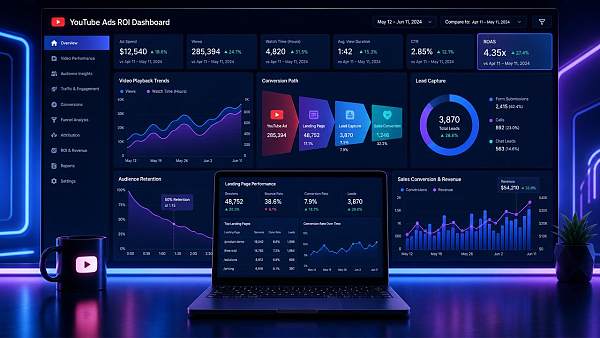
How should the return on investment of YouTube advertising be evaluated? For business evaluators, it is not enough to look only at clicks and impressions; it is also necessary to consider conversion cost, customer value, and attribution paths in order to truly assess whether the campaign is worth continued investment.
Under the trend of integrating websites and marketing services, YouTube advertising is no longer a standalone traffic-buying action, but an important link connecting brand reach, official website conversion, lead nurturing, and sales conversion.
If effectiveness is judged only by “how much money was spent, how many clicks were generated”, high-quality traffic is often underestimated, and low-quality impressions may also be misjudged, causing deviations in budget allocation.
The current change is very clear: YouTube advertising has entered a stage of refined return assessment
In the past, many companies placed greater emphasis on impressions, view rate, and click-through rate, because these metrics are intuitive, provide quick feedback, and are suitable for rapidly verifying whether creative assets are attractive.
But now, traffic costs continue to fluctuate, user decision-making paths are longer, cross-device behavior is more complex, and data from a single platform is no longer sufficient to support a complete evaluation.
Especially for companies that rely on their official websites for customer acquisition, whether YouTube advertising is effective must return to the core question of “whether it brings real business opportunities, valid inquiries, and sustainable revenue”.
This also means that return on investment is no longer just a financial metric, but a comprehensive result of collaboration among marketing, website, and sales.
Why is judging return on investment becoming increasingly difficult? There are four driving factors behind it
- After watching a video, users may not convert immediately; they often conduct a second search for the brand or visit the website directly.
- Different advertising objectives vary greatly, and brand exposure campaigns and lead generation campaigns cannot be compared using the same set of standards.
- The quality of the official website landing page has a major impact; landing page loading speed, form design, and content relevance all affect final conversions.
- The speed of sales follow-up and the ability to qualify leads determine whether advertising traffic can truly turn into revenue.
To evaluate the return on investment of YouTube advertising, first distinguish between “surface metrics” and “outcome metrics”
Surface metrics are mainly used to determine whether the ad has been seen and whether it has attracted users to continue learning more, such as impressions, view rate, click-through rate, and average watch time.
These metrics are valuable, but they can only indicate that the creative and targeting may be effective; they cannot directly prove that YouTube advertising has already generated positive returns.
What truly determines return on investment is outcome metrics, including cost per qualified lead, opportunity conversion rate, sales cycle, customer lifetime value, and final payment contribution.
Therefore, the evaluation sequence should be upgraded from “whether there is traffic” to “whether it is effective traffic”, and finally to “whether it can generate verifiable revenue”.
Five key outcome metrics recommended for priority tracking
- Cost per qualified lead: not the cost per form submission, but the cost of real leads after initial screening.
- Lead-to-opportunity conversion rate: measures the depth of intent brought by YouTube advertising.
- Opportunity-to-deal conversion rate: determines whether the traffic matches business objectives.
- Customer lifetime value: suitable for repurchase-based, subscription-based, and long-term service businesses.
- Overall return cycle: avoids misjudging short-term losses when there is actual long-term profitability.
The impact on different business stages is not limited to the advertising account itself
For integrated website building and marketing services, the return on investment of YouTube advertising is often jointly affected by front-end content, mid-funnel pages, and back-end conversion.
Front-end creative determines whether users are willing to stay, the mid-funnel official website determines whether they are willing to inquire further, and back-end sales determines whether leads can turn into orders. If any one link is weak, overall returns will be dragged down.
This is also why more and more companies are beginning to adopt an integrated approach combining website building, SEO optimization, content operations, and advertising, rather than viewing reports from a single platform in isolation.
For example, if the increase in searches driven by video ads is supported by a weak branded landing page on the official website, the impact that should originally be attributed to YouTube advertising may be underestimated in the data.
What companies should truly focus on is not “cheap traffic”, but a “high-quality conversion chain”
To determine whether YouTube advertising is worth continued investment, it is recommended to prioritize the following core points rather than focusing only on individual numbers in the backend.
- Whether the creative and landing page are aligned, to avoid “users click in and immediately drop off”.
- Whether conversion goals are tiered, distinguishing between lead capture, inquiries, appointments, and closed deals.
- Whether the attribution window is reasonable, to avoid data distortion caused by being too short.
- Whether the website supports data tracking and whether deeper behaviors can be tracked.
- Whether sales feedback flows back to the advertising side for optimizing audiences and creative.
In some complex businesses, evaluation logic and resource integration are equally important. Research on solutions such as integration and operational optimization strategies for mergers and acquisitions of property management companies essentially also emphasizes viewing investment, integration, and returns from a unified perspective, which aligns with the underlying logic of judging marketing ROI.
For subsequent evaluation of YouTube advertising performance, this phased approach can be used
If this closed-loop system has not yet been established, it is recommended not to rush into expanding the budget first, because most YouTube advertising issues are not that “the platform does not work”, but that the evaluation mechanism is incomplete.
Yiyingbao Information Technology (Beijing) Co., Ltd. has long focused on the coordinated development of intelligent website building, SEO optimization, social media marketing, and advertising. Its core value lies in incorporating fragmented traffic into a unified growth chain for measurement, rather than only optimizing surface-level data.
What is more worthwhile to do next is to move ROI evaluation forward to the campaign design stage
Many companies review return on investment only after YouTube advertising has ended, and by then they have often already missed the best optimization window. A more effective approach is to define objectives, attribution methods, page paths, and sales handoff rules before launching the campaign.
Specifically, you can start with three steps: first clarify transaction goals, then set intermediate conversion metrics, and finally connect website and advertising data to form a sustainable evaluation standard.
When YouTube advertising is incorporated into a complete business perspective, return on investment is no longer just a single outcome number, but becomes an important basis for budget allocation, content direction, and channel strategy.
If the goal is to continuously improve campaign certainty, the focus is not on pursuing a one-time traffic surge, but on establishing an evaluation system that can steadily identify high-quality traffic, real conversions, and long-term value.
Related Articles
 What multilingual website services are available in Sanya? Which model is more suitable for local businesses going global?
 How to view the complete list of China SaaS companies in the top 100? Practical methods for screening website-building and marketing service providers
 There are so many used heavy-duty construction machines for foreign trade. How exactly should we acquire customers?



Related Products
 EasyCamp SaaS Smart Website Marketing SystemE-Yingbao SaaS Smart Website Marketing System: AI-powered, zero-code website building. Rapidly launch multilingual independent e-commerce sites in just 10 minutes. Global server acceleration and AI-driven SEO optimization empower businesses to efficiently connect with global markets. The seamless integration of technology and user-friendly operation makes building e-commerce sites incredibly simple.
 AI+SEM Intelligent Advertising Marketing SystemAI+SEM drives intelligent ad creation, empowering full-funnel precision advertising marketing. The system automatically generates weekly/monthly reports, AI recommends keywords and target countries, monitors core metrics in real-time with intelligent alerts, and enables one-click high-conversion ad solutions to help quickly acquire customers and improve ROI.
 AI+SEO Dual Engine Optimization ServiceEasyWin AI+SEO Dual Engine Optimization System leverages AI-powered keyword mining, content generation, and comprehensive technical optimization to help foreign trade enterprises acquire high-quality organic traffic, significantly improving search rankings and conversion rates.
 AI+SNS Social Media Marketing SystemYingbao AI+SNS Social Media Marketing System - Precision social capture for the social media era. Supports one-click content synchronization across major platforms like Facebook and LinkedIn. AI intelligently rewrites posts for enhanced relevance. 24/7 AI customer service and user profiling analysis empower businesses to efficiently expand into global markets.
 AI+SEO营销解决方案易营宝AI+SEO营销解决方案,通过AI批量写作、智能生成TDK、精准关键词扩词等功能,全面优化网站SEO效果,提升流量与转化率。助力企业构建高效智能网站新生态。
 AI+SEM Advertising Marketing SolutionsAI+SEM Advertising Marketing Solution leverages AI technology to deeply empower SEM ad campaigns. It automatically generates weekly/monthly reports using AI, presenting account data across multiple dimensions for comprehensive insights into campaign performance and trends. The system precisely recommends keywords and target countries, intelligently generates high-conversion ad copy, and enables one-click activation of efficient campaign plans to help businesses rapidly acquire customers. Simultaneously, it monitors core metrics in real time, intelligently identifies abnormal fluctuations, and issues timely alerts to ensure stable, high-return advertising results.
 Domain Name ServicesEasyWin provides professional domain name services, including intelligent queries, one-stop registration, brand protection, and full lifecycle management, helping businesses build a digital brand image.
 EasyOperate B2C Cross-Border E-Commerce Platform & Independent WebsiteEasyStore B2C Cross-border E-commerce Independent Store is an intelligent website building and cross-border e-commerce integrated solution independently developed by EasyStore Information Technology (Beijing) Co., Ltd. The system is specially designed for small and medium-sized as well as large export enterprises, integrating 'website building, operation, marketing, advertising, and conversion' into one, helping enterprises quickly establish cross-border e-commerce independent stores to achieve brand globalization and global sales growth.
The platform supports multiple languages, multiple currencies, and multi-channel marketing, with built-in AI intelligent translation and SEO optimization systems, suitable for mainstream markets such as Southeast Asia, Europe and America, Latin America, and the Middle East, assisting Chinese manufacturing enterprises in efficiently deploying international e-commerce strategies. SSL证书易营宝提供专业SSL安全证书服务,包括单域名和泛域名证书,确保网站数据传输加密、身份验证和完整性保护,助力企业建立安全可信的在线业务环境。









