









- What multilingual website services are available in Sanya? Which model is more suitable for local businesses going global?Jul 08, 2026View details
- How to view the complete list of China SaaS companies in the top 100? Practical methods for screening website-building and marketing service providersJul 08, 2026View details
- How to view pricing in the global traffic ecosystem? Cost comparison of search, social media, and content channel advertisingJul 06, 2026View details
- How to assess foreign trade website development trends?Looking at 2026 changes from multilingual,AI content to conversion pathsJul 04, 2026View details
- What are the new trends in multilingual marketing data analytics tools in 2026? Focus on attribution、automation and complianceJul 04, 2026View details
- Is Brand Globalization Marketing Consulting Worth Buying? At What Stage Should Companies Bring It InJul 01, 2026View details
- Cross-Border Marketing Trend Research: Why More and More Companies Are Starting to Deploy AI Search and GEO OptimizationJun 30, 2026View details
- Cross-Border Marketing Trend Research: How Independent Sites, AI Content, and Short-Video Customer Acquisition Are ChangingJun 30, 2026View details
How Facebook Marketing Strategies Can Respond to Traffic Fluctuations
Traffic fluctuations have become the norm, and companies increasingly need to drive growth with data and cadence. This article will focus on Facebook marketing strategy, analyzing how companies can respond to traffic volatility, stabilize customer acquisition performance, and improve long-term conversions.
For business decision-makers, the real challenge is not merely that traffic drops by 20% on a given day or lead costs rise by 30%, but whether the marketing system can still maintain stable customer acquisition when platform distribution, audience interests, ad bidding, and on-site conversion all change at the same time.
Under the trend of integrating website and marketing services, Facebook marketing strategy cannot remain only at the media buying level, but should work in coordination with website building, content, data tracking, conversion paths, and remarketing mechanisms. E-Marketing Information Technology (Beijing) Co., Ltd. has been deeply engaged in global digital marketing for more than a decade. Leveraging artificial intelligence and big data capabilities, it provides companies with full-funnel support from traffic acquisition to on-site conversion, which is precisely the key foundation for coping with volatility cycles.
Why traffic volatility has become the norm in Facebook marketing
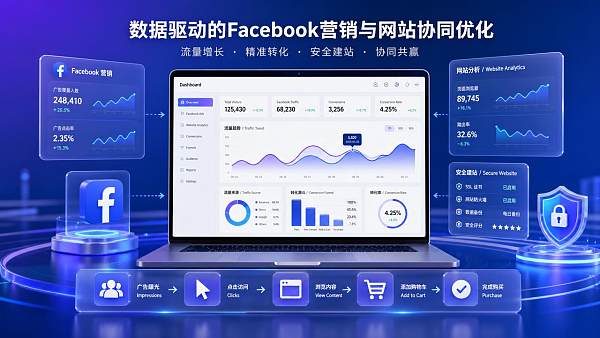
When executing a Facebook marketing strategy, companies often attribute problems to “creative fatigue” or “insufficient budget”, but in reality, traffic volatility usually comes from the overlap of 4 dimensions: platform algorithm adjustments, increased audience overlap, changes in the bidding environment, and declining on-site conversion efficiency. If you only watch clicks, you will often misjudge the root cause.
Volatility is not an anomaly, but a cyclical variable in operations
In standard B2B advertising, after an ad set runs continuously for 7—14 days, click-through rate, frequency, and conversion rate often begin to diverge noticeably. When frequency exceeds 2.5 to 3.5, the target audience’s response to the creative usually begins to weaken; if the landing page load speed exceeds 3 seconds, the bounce rate will also rise rapidly.
This means that Facebook marketing strategy should not be built on “one-time traffic spikes”, but on “continuous calibration”. If a company lacks stable website conversion support, event tracking, and remarketing audience pools, it will be difficult to turn short-term volatility into long-term assets.
The 3 most common misjudgments companies make
- Looking only at surface-level data: focusing only on impressions and clicks while ignoring valid sessions, form completion rates, and sales lead quality.
- Adjusting only ads but not pages: constantly changing creatives when ad costs rise, while failing to optimize website structure, trust elements, and submission paths.
- Seeking only short-term returns: increasing or decreasing budget temporarily by the day, without a testing cycle of more than 30 days or a tiered media buying strategy.
The table below helps companies quickly identify the source of volatility and avoid investing more budget in the wrong stage.
From a management perspective, traffic volatility is not the scary part; what is scary is that a company does not break the problem down and manage the 4 chains of “traffic side, page side, data side, and sales side” separately. Only by establishing a systems perspective can a Facebook marketing strategy avoid being thrown off rhythm by a single fluctuation.
An actionable response framework: from media buying to coordinated website optimization
When facing volatility, what companies need more is an execution framework that is repeatable, trackable, and iterative. In practice, it is recommended to break Facebook marketing strategy into 3 levels: traffic acquisition, conversion handling, and data feedback. Set at least 2 core metrics for each level, review them weekly, and optimize them monthly.
Step 1: Split the budget into a “testing pool” and a “scaling pool”
When traffic declines, many companies directly cut budget, but a more reasonable approach is to allocate 20%—30% of the budget to the testing pool and 70%—80% to the scaling pool. The testing pool is used to validate new audiences, new creatives, and new landing pages, while the scaling pool carries combinations that have already been validated, preventing overall performance from being dragged down by immature creatives.
Recommended testing cadence to monitor
- Creative testing: update 1 round every 7 days, preparing at least 3 visual directions.
- Copy testing: design 2—4 version sets around pain points, benefit points, and proof points.
- Page testing: iterate button copy, form length, and above-the-fold structure once every 14 days.
Step 2: Improve landing page stability and reduce wasted invalid traffic
Many companies optimize the advertising side in great detail, but their official website support is weak, ultimately resulting in clicks without inquiries. The value of integrating website and marketing services lies in incorporating site performance, content persuasiveness, and data collection into the growth system at the same time. For cross-border corporate websites, membership systems, API interfaces, and e-commerce pages, HTTPS is no longer a bonus feature, but a fundamental requirement.
For example, in site security and trust building, SSL certificates can be used to improve the basic page environment. For corporate websites, e-commerce platforms, and membership systems, such security components usually use the SHA-256 encryption algorithm and 2048-bit keys, and support HSTS and OCSP stapling technology, helping strengthen identity authenticity verification, data transmission encryption, and content integrity protection.
When users enter a page from a Facebook ad, if the browser displays a security warning, the redirect chain is incomplete, or mixed content issues are not fixed, conversion loss often occurs within the first 3 seconds above the fold. Through automatic CSR generation, automatic domain ownership validation, automatic certificate deployment to servers, and automatic redirection configuration from HTTP to HTTPS, companies can reduce the technical maintenance threshold and also prevent marketing campaigns from being held back by infrastructure.
The table below can serve as a brief checklist for companies to evaluate website conversion support capabilities, helping decision-makers determine whether traffic volatility is coming from the page side.
From the perspective of conversion results, every optimization on the advertising side ultimately has to be realized on the website side. If a company already has a website building system, it is more suitable for operating multiple sites in parallel to prioritize a security solution that supports one-click installation, automatic deployment, and centralized management of multiple certificates.
Step 3: Let data flow back to form sustainable remarketing
A mature Facebook marketing strategy does not only pursue the first conversion, but also places greater importance on secondary touchpoints and sales follow-up. It is recommended that companies establish at least 3 audience pools: visitors within 7 days who did not convert, high-intent browsing audiences within 30 days, and existing customers and old leads within 90 days. Different pools should use different creatives and bidding logic, and efficiency is usually higher than relying on a single cold traffic campaign.
If a company can connect advertising data, on-site behavioral data, and CRM lead status, it can further determine whether “high clicks, low close rate” is occurring in the marketing stage or the sales stage. For B2B projects with a decision cycle of 30—90 days, this closed loop is particularly important.
How business decision-makers can evaluate whether a strategy is truly effective
To determine whether a Facebook marketing strategy is effective, you cannot look only at exposure in a single period; instead, you need to establish tiered metrics. It is recommended to evaluate from at least 4 dimensions: traffic quality, conversion efficiency, sales coordination, and infrastructure stability. Only when all 4 meet the standard at the same time does the customer acquisition system have the ability to withstand volatility.
4 groups of metrics companies are advised to track consistently
- Traffic metrics: click-through rate, frequency, and landing page view rate, reviewed once a week.
- Conversion metrics: form submission rate, valid lead rate, and appointment rate, with trends reviewed every 7—14 days.
- Sales metrics: follow-up timeliness, opportunity conversion rate, and proportion of invalid leads, calibrated monthly.
- Website metrics: page speed, HTTPS coverage rate, and number of abnormal bounce pages, checked at least once a month.
Avoid 3 common decision-making biases
Looking only at short-term ROI
For businesses with high average order value and long decision cycles, no deal closed within 7 days does not mean the campaign failed. A more appropriate observation window is often 30 days, 60 days, or even 90 days, especially for corporate procurement projects involving multi-role approval.
Ignoring website security and trust details
When overseas users have doubts about a website’s credibility, conversion can still be hindered even if the ad is highly attractive. For pages involving registration, payment, and API calls, security and loading experience directly affect conversion quality. This is especially true in scenarios where mobile traffic accounts for more than 50%, where technical details become amplified.
Treating platform volatility as the only cause
A truly mature growth system treats Facebook as only one of the traffic entry points, not the sole lever. Official website SEO, social media content accumulation, ad remarketing, email follow-up, and sales conversion should together form a combined approach. In this way, even if one channel experiences short-term fluctuations, the overall lead pool still has room for buffering.
For companies looking to expand overseas markets, what is more worth investing in is not one-time scaling, but building a stable digital customer acquisition foundation. Relying on its coordinated capabilities in intelligent website building, SEO optimization, social media marketing, and ad placement, E-Marketing can help companies complete foundational setup and the first round of optimization within 7—30 days, and continuously iterate traffic and conversion performance in subsequent cycles.
Traffic volatility cannot be completely avoided, but companies can absolutely reduce uncertainty through a more mature Facebook marketing strategy. The core is not whether a particular ad goes viral, but whether the budget is tiered, whether the pages are stable, whether the data forms a closed loop, and whether the website has a foundation of security and trust.
If you are evaluating investment in overseas customer acquisition, or hope to optimize website conversion support, ad placement, and security infrastructure at the same time, now is the right time to reassess your growth chain. You are welcome to contact us now to obtain a customized solution better suited to your business stage and learn more about implementation details and solutions.
Related Articles
 What multilingual website services are available in Sanya? Which model is more suitable for local businesses going global?
 How to view the complete list of China SaaS companies in the top 100? Practical methods for screening website-building and marketing service providers
 There are so many used heavy-duty construction machines for foreign trade. How exactly should we acquire customers?

Related Products
 EasyCamp SaaS Smart Website Marketing SystemE-Yingbao SaaS Smart Website Marketing System: AI-powered, zero-code website building. Rapidly launch multilingual independent e-commerce sites in just 10 minutes. Global server acceleration and AI-driven SEO optimization empower businesses to efficiently connect with global markets. The seamless integration of technology and user-friendly operation makes building e-commerce sites incredibly simple.
 AI+SEM Intelligent Advertising Marketing SystemAI+SEM drives intelligent ad creation, empowering full-funnel precision advertising marketing. The system automatically generates weekly/monthly reports, AI recommends keywords and target countries, monitors core metrics in real-time with intelligent alerts, and enables one-click high-conversion ad solutions to help quickly acquire customers and improve ROI.
 AI+SEO Dual Engine Optimization ServiceEasyWin AI+SEO Dual Engine Optimization System leverages AI-powered keyword mining, content generation, and comprehensive technical optimization to help foreign trade enterprises acquire high-quality organic traffic, significantly improving search rankings and conversion rates.
 AI+SNS Social Media Marketing SystemYingbao AI+SNS Social Media Marketing System - Precision social capture for the social media era. Supports one-click content synchronization across major platforms like Facebook and LinkedIn. AI intelligently rewrites posts for enhanced relevance. 24/7 AI customer service and user profiling analysis empower businesses to efficiently expand into global markets.
 AI+SEO营销解决方案易营宝AI+SEO营销解决方案,通过AI批量写作、智能生成TDK、精准关键词扩词等功能,全面优化网站SEO效果,提升流量与转化率。助力企业构建高效智能网站新生态。
 AI+SEM Advertising Marketing SolutionsAI+SEM Advertising Marketing Solution leverages AI technology to deeply empower SEM ad campaigns. It automatically generates weekly/monthly reports using AI, presenting account data across multiple dimensions for comprehensive insights into campaign performance and trends. The system precisely recommends keywords and target countries, intelligently generates high-conversion ad copy, and enables one-click activation of efficient campaign plans to help businesses rapidly acquire customers. Simultaneously, it monitors core metrics in real time, intelligently identifies abnormal fluctuations, and issues timely alerts to ensure stable, high-return advertising results.
 Domain Name ServicesEasyWin provides professional domain name services, including intelligent queries, one-stop registration, brand protection, and full lifecycle management, helping businesses build a digital brand image.
 EasyOperate B2C Cross-Border E-Commerce Platform & Independent WebsiteEasyStore B2C Cross-border E-commerce Independent Store is an intelligent website building and cross-border e-commerce integrated solution independently developed by EasyStore Information Technology (Beijing) Co., Ltd. The system is specially designed for small and medium-sized as well as large export enterprises, integrating 'website building, operation, marketing, advertising, and conversion' into one, helping enterprises quickly establish cross-border e-commerce independent stores to achieve brand globalization and global sales growth.
The platform supports multiple languages, multiple currencies, and multi-channel marketing, with built-in AI intelligent translation and SEO optimization systems, suitable for mainstream markets such as Southeast Asia, Europe and America, Latin America, and the Middle East, assisting Chinese manufacturing enterprises in efficiently deploying international e-commerce strategies. SSL证书易营宝提供专业SSL安全证书服务,包括单域名和泛域名证书,确保网站数据传输加密、身份验证和完整性保护,助力企业建立安全可信的在线业务环境。









