









- How to view pricing in the global traffic ecosystem? Cost comparison of search, social media, and content channel advertisingJul 06, 2026View details
- How to assess foreign trade website development trends?Looking at 2026 changes from multilingual,AI content to conversion pathsJul 04, 2026View details
- What are the new trends in multilingual marketing data analytics tools in 2026? Focus on attribution、automation and complianceJul 04, 2026View details
- Is Brand Globalization Marketing Consulting Worth Buying? At What Stage Should Companies Bring It InJul 01, 2026View details
- Cross-Border Marketing Trend Research: Why More and More Companies Are Starting to Deploy AI Search and GEO OptimizationJun 30, 2026View details
- Cross-Border Marketing Trend Research: How Independent Sites, AI Content, and Short-Video Customer Acquisition Are ChangingJun 30, 2026View details
- How Can a Brand Updates Page Be Made More SEO-Friendly? Analysis of Update Frequency, Content Structure, and Internal Linking StrategyJun 28, 2026View details
- What stages does the cross-border services ecosystem include? How do website building, promotion, payment, and compliance work togetherJun 22, 2026View details
The Most Overlooked Cost-Control Method in Meta Advertising Tips
In Meta advertising campaign tactics, many people focus only on creatives and bidding, while overlooking the cost-control details that truly affect ROI. This article will break down the most easily overlooked yet most effective cost-reduction methods, from account structure and audience targeting to data optimization.
For practitioners responsible for day-to-day campaign management, what truly creates a cost gap is often not “being better at running ads,” but “wasting less.” Especially today, as website development, landing page conversion, social media content, and advertising coordination become increasingly integrated, Meta advertising campaign tactics are no longer just a standalone media buying action, but a comprehensive reflection of integrated website + marketing service capabilities.
E-Marketing Bao Information Technology (Beijing) Co., Ltd. has long served global growth scenarios. Based on its end-to-end collaborative experience in intelligent website building, SEO optimization, social media marketing, and ad placement, the company has found that with the same budget, projects featuring a clear account structure, complete data feedback, and well-reasoned audience segmentation can often reduce cost per conversion by 15% to 35% within 7 to 21 days.
Control the structure first: many costs are not spent on ad delivery, but wasted in account design
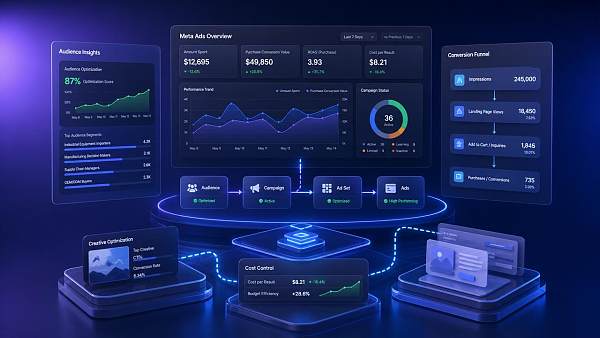
Many operators build multiple campaigns and stack multiple ad sets from the very beginning. It may look refined, but in reality it keeps interrupting the learning phase. In Meta advertising campaign tactics, an overly complex account structure is one of the most common and most hidden cost-control loopholes. Once the budget is spread too thin, a single ad set struggles to accumulate enough event volume within 3 to 5 days, and system optimization slows down.
Why overly granular structure actually drives up CPA
If a single campaign is simultaneously split by age, interests, device, placement, and region, the variables may exceed 8 within 1 week. Every additional layer of segmentation means a thinner budget and fewer samples. The result is not “greater precision,” but that the system cannot determine which audience is truly more likely to convert, ultimately causing CPM, CPC, and CPA to rise together.
3 practical principles for structural cost control
- A single campaign should preferably carry only 1 core objective, such as form submission, add to cart, or purchase, without mixing optimization events.
- During the cold-start phase, it is recommended to keep 2 to 4 creatives in each ad set, rather than uploading more than 10 assets at once and diluting exposure.
- In the first 7 days, minimize frequent edits as much as possible, and keep each adjustment within 20% to avoid re-entering the learning phase.
The table below is suitable for operators to quickly determine whether the current account is a “controllable structure” or a “high-waste structure.” In Meta advertising campaign tactics, putting the structure in order first is often more effective than rushing to increase the budget.
The key conclusion is very clear: an ad account is not more professional the more finely it is split, but the more it enables the system to quickly accumulate valid conversions, the more money it saves. For integrated website + marketing service projects, the ad structure should also stay aligned with the website conversion path, to avoid inconsistency between ad clicks and landing page logic, which causes money to be spent at the front end while users are lost at the back end.
An unsmooth website conversion path can also amplify advertising costs
Many people understand Meta advertising campaign tactics as optimization within the ad platform backend, but the real costs often arise on-site. For example, page load times exceeding 3 seconds, form fields exceeding 6 items, or a mobile first screen without a clear core selling point can all make click costs look normal while conversion costs continue rising. For operators, ads and the website must be checked together, not separately.
For a typical B2B landing page, it is recommended to keep the information structure within 3 layers: first screen for the value proposition, second screen for capability proof, and third screen for the conversion entry point. If users need to scroll through more than 5 screens to find contact information, the conversion rate will usually decline significantly. E-Marketing Bao’s full-site collaboration experience shows that optimizing website structure can often directly reduce customer acquisition costs by 10% to 20%.
Then control the audience: it is not the more precise, the more cost-saving, but the more verifiable, the more cost-saving
Audience targeting is the part of Meta advertising campaign tactics most likely to be handled “by gut feeling.” Many accounts immediately lock in multiple interest tags, and even tightly restrict age, job title, and industry. On the surface, this looks like precision targeting, but in reality it can easily shrink the sample pool, raise CPM, and deprive the system of room for automatic expansion.
In the cold-start phase, validate first, then narrow down
For new accounts or new markets, it is recommended to run the first round of testing with a “broad audience + clear conversion objective” approach, with a cycle of 5 to 7 days. As long as the pixel, CAPI, and on-site event definitions are complete, the system can often find convertible audiences faster than manual interest stacking. After obtaining the first 20 to 50 valid leads, it is more stable to move into the second-stage segmentation phase.
4 audience cost-control points at the operational level
- For new accounts, prioritize separating 3 categories: cold traffic, remarketing, and lookalike audiences of existing customers, rather than splitting out too many tag combinations at once.
- It is recommended to segment remarketing windows by 7 days, 14 days, and 30 days, rather than packaging them together, to better control frequency.
- After frequency exceeds 2.5, focus on whether CTR declines, to prevent “the same group of people from being repeatedly disturbed.”
- For low-ticket projects, interests can be relaxed appropriately, while long-decision-cycle B2B projects should place greater emphasis on the filtering power of the landing page.
In cross-border promotion or customer acquisition across multiple regions, the audience strategy should also stay aligned with localized content. As long as 1 to 2 items such as language, time zone, inquiry entry points, form fields, or customer service response time do not match, the ad system may push the budget toward audiences who are “easy to click, hard to convert,” resulting in traffic that looks good on the surface but delivers lower actual lead quality.
Do not overlook high-quality remarketing, this is the lowest-cost follow-up step
Many operators allocate more than 80% of their budget to cold start, yet do not give remarketing enough weight. In fact, remarketing usually requires only 10% to 20% of the total budget, but can often achieve a lower CPA. This is especially true for audiences who have visited product pages, stayed for more than 45 seconds, or submitted part of a form without completing it, as they are inherently closer to conversion than broad traffic.
In strategy design, the copy focus of remarketing ads can shift from “awareness education” to “risk elimination,” for example by highlighting delivery timelines, use-case scenarios, and service response mechanisms. Some companies, in their internal budgeting and performance evaluation processes, may also draw on methodologies such as Implementation obstacles and optimization paths of the Balanced Scorecard in budget assessment for aluminum processing enterprises, incorporating traffic cost, lead quality, page efficiency, and sales feedback into a unified evaluation, rather than looking only at a single click metric.
Finally, control the data: what truly enables sustained cost reduction is tracking, attribution, and optimization cadence
If structure determines whether campaigns can get off the ground, then data quality determines whether campaigns can become more cost-efficient over time. One of the most easily overlooked points in Meta advertising campaign tactics is that many accounts only look at surface-level backend data, without seriously checking whether pixel events are duplicated, whether the Conversion API is missing, or whether UTM parameters are standardized, ultimately causing the system to “learn the wrong target.”
5 key data points operators must watch closely
Rather than focusing only on CTR or CPC, more attention should be placed on “what happened after the click” as the core of cost control. Especially in B2B scenarios, actions such as inquiry forms, WhatsApp, Messenger, phone clicks, and demo bookings should ideally be defined in tiers as events with different values, so it becomes clear at which step the budget is being wasted.
As can be seen from the table, cost control is not a single-point action, but a coordinated diagnosis centered on traffic quality, page handoff, and conversion signals. A truly mature operating process usually reviews fluctuations daily, attribution weekly, and strategic performance every 14 to 30 days, rather than making major account changes simply because costs rose on a certain day.
Only complete data feedback allows the system to find cheaper conversions
If the website is equipped only with a basic pixel and the Conversion API is not configured at the same time, then in an environment where browser restrictions are becoming increasingly strict, some key events may be lost. Missing 5% to 15% of events is enough to cause the system to misjudge high-quality audiences. For integrated website + marketing service projects, it is recommended to check at least 4 items: whether pixel triggers are duplicated, whether CAPI is feeding back properly, whether event priorities are correct, and whether CRM leads can be verified through return flow.
Recommended optimization cadence
- Daily: review spend, CTR, CPC, and abnormal fluctuations, without making major changes.
- Every 3 days: review conversion trends at the ad set level and pause clearly underperforming units.
- Every 7 days: review the match among audience, creative, and page.
- Every 14 to 30 days: conduct secondary modeling based on actual deals or high-quality leads.
There is also one commonly overlooked cost-control point here: do not feed “invalid leads” to the system as successful conversions. If junk form leads account for a high proportion, Meta will continue looking for similar users. Surface-level CPA may decline, but sales effectiveness will decline in parallel. A more ideal approach is to perform secondary feedback on MQL, SQL, or customers who have already had valid communication, so that ad delivery moves increasingly closer to real business outcomes.
Common operational misunderstandings: why the harder you optimize, the higher the costs become
Many cost-control failures happen not because there are too few methods, but because actions are taken too hastily. What Meta advertising campaign tactics emphasize is “making judgments on a sufficient data foundation,” not relying on gut decisions based on experience. This is especially true when operators face short-term KPI pressure, making it easier to take the wrong action at the wrong time.
4 typical misunderstandings
- Changing budgets, audiences, and placements multiple times within 1 day, causing the learning phase to reset repeatedly.
- Looking only at front-end lead volume, without examining effectiveness and close rate after sales follow-up.
- When creative performance is poor, only changing the copy without checking whether the landing page and audience are mismatched.
- Using 1 page template for all markets without making localized adaptations by region.
If the company itself also involves budget coordination, performance management, and cross-department evaluation, then cost control will rely even more on methodological alignment. Research approaches similar to Implementation obstacles and optimization paths of the Balanced Scorecard in budget assessment for aluminum processing enterprises offer marketing teams an important insight: do not focus only on a single KPI, but use multiple linked indicators to determine whether input-output performance is healthy.
Truly effective cost reduction comes from coordination among 4 sides: the ad system, website handoff, data feedback, and business feedback. For users and operators, first keep the account structure within a learnable range, then improve efficiency through audience layering and remarketing, and finally use data calibration to optimize direction. This is usually more stable and more replicable than simply chasing “viral creatives.”
If you are advancing overseas customer acquisition, independent site promotion, or social media advertising, and hope to truly apply Meta advertising campaign tactics to cost control and lead growth, E-Marketing Bao Information Technology (Beijing) Co., Ltd. can provide integrated support from website building, tracking, and SEO to ad operations. Get a customized solution now and learn the cost-control path and growth strategy that best fit your current business stage.
Related Articles



Related Products
 EasyCamp SaaS Smart Website Marketing SystemE-Yingbao SaaS Smart Website Marketing System: AI-powered, zero-code website building. Rapidly launch multilingual independent e-commerce sites in just 10 minutes. Global server acceleration and AI-driven SEO optimization empower businesses to efficiently connect with global markets. The seamless integration of technology and user-friendly operation makes building e-commerce sites incredibly simple.
 AI+SEM Intelligent Advertising Marketing SystemAI+SEM drives intelligent ad creation, empowering full-funnel precision advertising marketing. The system automatically generates weekly/monthly reports, AI recommends keywords and target countries, monitors core metrics in real-time with intelligent alerts, and enables one-click high-conversion ad solutions to help quickly acquire customers and improve ROI.
 AI+SEO Dual Engine Optimization ServiceEasyWin AI+SEO Dual Engine Optimization System leverages AI-powered keyword mining, content generation, and comprehensive technical optimization to help foreign trade enterprises acquire high-quality organic traffic, significantly improving search rankings and conversion rates.
 AI+SNS Social Media Marketing SystemYingbao AI+SNS Social Media Marketing System - Precision social capture for the social media era. Supports one-click content synchronization across major platforms like Facebook and LinkedIn. AI intelligently rewrites posts for enhanced relevance. 24/7 AI customer service and user profiling analysis empower businesses to efficiently expand into global markets.
 AI+SEO营销解决方案易营宝AI+SEO营销解决方案,通过AI批量写作、智能生成TDK、精准关键词扩词等功能,全面优化网站SEO效果,提升流量与转化率。助力企业构建高效智能网站新生态。
 AI+SEM Advertising Marketing SolutionsAI+SEM Advertising Marketing Solution leverages AI technology to deeply empower SEM ad campaigns. It automatically generates weekly/monthly reports using AI, presenting account data across multiple dimensions for comprehensive insights into campaign performance and trends. The system precisely recommends keywords and target countries, intelligently generates high-conversion ad copy, and enables one-click activation of efficient campaign plans to help businesses rapidly acquire customers. Simultaneously, it monitors core metrics in real time, intelligently identifies abnormal fluctuations, and issues timely alerts to ensure stable, high-return advertising results.
 Domain Name ServicesEasyWin provides professional domain name services, including intelligent queries, one-stop registration, brand protection, and full lifecycle management, helping businesses build a digital brand image.
 EasyOperate B2C Cross-Border E-Commerce Platform & Independent WebsiteEasyStore B2C Cross-border E-commerce Independent Store is an intelligent website building and cross-border e-commerce integrated solution independently developed by EasyStore Information Technology (Beijing) Co., Ltd. The system is specially designed for small and medium-sized as well as large export enterprises, integrating 'website building, operation, marketing, advertising, and conversion' into one, helping enterprises quickly establish cross-border e-commerce independent stores to achieve brand globalization and global sales growth.
The platform supports multiple languages, multiple currencies, and multi-channel marketing, with built-in AI intelligent translation and SEO optimization systems, suitable for mainstream markets such as Southeast Asia, Europe and America, Latin America, and the Middle East, assisting Chinese manufacturing enterprises in efficiently deploying international e-commerce strategies. SSL证书易营宝提供专业SSL安全证书服务,包括单域名和泛域名证书,确保网站数据传输加密、身份验证和完整性保护,助力企业建立安全可信的在线业务环境。









