









- What multilingual website services are available in Sanya? Which model is more suitable for local businesses going global?Jul 08, 2026View details
- How to view the complete list of China SaaS companies in the top 100? Practical methods for screening website-building and marketing service providersJul 08, 2026View details
- How to view pricing in the global traffic ecosystem? Cost comparison of search, social media, and content channel advertisingJul 06, 2026View details
- How to assess foreign trade website development trends?Looking at 2026 changes from multilingual,AI content to conversion pathsJul 04, 2026View details
- What are the new trends in multilingual marketing data analytics tools in 2026? Focus on attribution、automation and complianceJul 04, 2026View details
- Is Brand Globalization Marketing Consulting Worth Buying? At What Stage Should Companies Bring It InJul 01, 2026View details
- Cross-Border Marketing Trend Research: Why More and More Companies Are Starting to Deploy AI Search and GEO OptimizationJun 30, 2026View details
- Cross-Border Marketing Trend Research: How Independent Sites, AI Content, and Short-Video Customer Acquisition Are ChangingJun 30, 2026View details
Meta ad placement tips to avoid learning phase waste
Meta advertising techniques may seem easy to get started with, but what truly determines whether costs are high or low is often not the bidding button, but whether the learning phase is repeatedly interrupted. In integrated website and marketing service scenarios, if the account structure is chaotic, conversion event settings are inaccurate, and the rhythm of creative testing is out of control, the system will remain in a low-efficiency exploration stage for a long time, causing the budget to be wasted ineffectively. To truly put Meta advertising techniques into practice, the key is to manage every step before, during, and after delivery in a checklist-based way.
Why Meta advertising techniques must be executed with a checklist
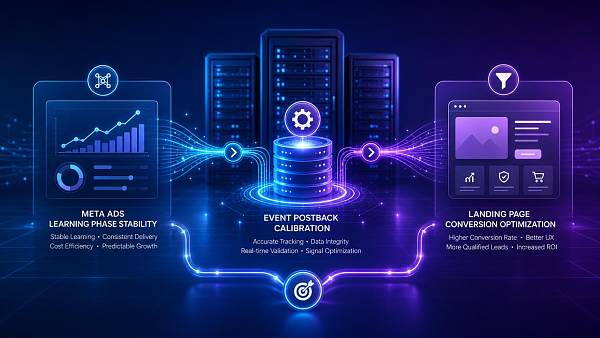
Meta advertising relies on machine learning, but machine learning is not a万能修复器. As long as the front-end page loads slowly, pixel tracking is misplaced, or audience overlap is severe, the system will continue optimizing based on incorrect data, ultimately leading to problems such as “clicks without conversions” or “conversion costs fluctuating sharply.”
Therefore, Meta advertising techniques cannot be limited to memorizing a few operational actions; more importantly, a standardized inspection process must be established. The value of checklist-based execution lies in reducing subjective judgment, avoiding learning phase resets caused by frequent changes to budgets, creatives, and audiences, and enabling advertising accounts to generate effective leads and orders more steadily.
Core checklist to avoid wasting the learning phase
- First, unify account objectives. Website traffic generation, form-based lead acquisition, direct message conversions, and remarketing sales cannot be mixed into the same advertising logic; otherwise, no matter how many Meta advertising techniques are used, they will fail due to inconsistent optimization goals.
- First, calibrate conversion events. Prioritize events that reflect real business value, such as form submissions, consultation bookings, and completed payments, and avoid looking only at landing page views, which can cause the system to learn from low-quality traffic.
- Control the number of ad sets. In the early stage, do not split the budget too thinly. When multiple ad sets compete for traffic at the same time, each set will have insufficient samples, the learning phase will be prolonged, and Meta advertising techniques will struggle to deliver stable results.
- Limit frequent changes. If budgets, audiences, placements, and events are adjusted continuously, the system will relearn. It is recommended to keep each modification within a controllable range and avoid testing one day and overturning everything the next.
- Test creatives in layers. First verify hooks, selling points, and formats, then test copy details. Do not change the video, headline, cover, and audience all at once, otherwise it will be difficult to determine the variable that truly affects conversions.
- Check the website landing page. Page loading speed, above-the-fold information, form length, and mobile adaptation directly affect conversion rates. If the website experience is poor, even the best Meta advertising techniques will be dragged down by the landing page.
- Differentiate cold start and remarketing. Cold traffic should focus on validating creatives and audiences, while remarketing should focus on validating bids and conversion actions. If both share the same budget structure, the learning results will often interfere with each other.
- Establish a data feedback mechanism. Looking only at front-end platform data can easily be misleading. CRM, website tracking, and sales follow-up results should be synchronized to evaluate lead quality and avoid being misled by superficial conversion numbers.
How to use Meta advertising techniques in different delivery scenarios
Website lead generation scenario: ensure accuracy first, then scale up
The most common problem with website lead generation ads is that the ad click cost is not high, but there are very few valid inquiries. In this type of scenario, the focus of Meta advertising techniques is not on blindly scaling traffic, but on first confirming whether pixel events, button clicks, form submissions, and thank-you page feedback are consistent.
If the business simultaneously provides website building, SEO optimization, social media marketing, and advertising services, it is recommended to split landing pages and ad sets by service type, rather than placing multiple types of needs on one page. The clearer the path, the easier it is for the learning phase to converge, and the easier it is for the system to identify high-intent users.
Brand expansion scenario: creative rhythm matters more than bidding
When the goal is to enter a new market or increase brand awareness, Meta advertising techniques should shift from “close deals immediately” to “build interest signals first.” At this time, video completion, page dwell time, and interaction behaviors are all important references, but follow-up remarketing paths still need to be set up to avoid traffic being wasted.
This type of advertising is suitable for linkage with content assets. For example, industry insights, solution pages, and case study pages can all serve as intermediate supporting content. Professional topic content such as Research on Liquidity Risk Management Strategies for Manufacturing Enterprises, when used for niche industry targeting, can also help the system identify stronger commercial interest tags.
Lead conversion scenario: shift from quantity thinking to quality thinking
A common misconception in lead ads is pursuing only cheap individual leads. In fact, a more important step in Meta advertising techniques is to block invalid inquiries at the front end. Form question settings, industry screening, requirement options, and budget ranges can all improve back-end follow-up efficiency.
If the company has already established a linkage mechanism between the website and sales, high-quality lead definitions can be fed back to the platform, allowing the system to learn the “characteristics of final transactions” rather than only optimizing for the “characteristics of form submissions.” In this way, although the learning phase is more cautious, follow-up costs are usually more stable.
The most easily overlooked risk reminders
- Ignoring audience overlap. When multiple ad sets target similar interests or the same remarketing pool, it creates internal competition. On the surface, delivery appears normal, but in reality the budget is competing against itself for traffic.
- Ignoring attribution windows. Looking only at short-cycle feedback can easily eliminate high-order-value traffic by mistake; looking only at long-cycle results can slow down the optimization rhythm. Judgment criteria need to be adjusted in combination with the business decision-making cycle.
- Ignoring creative fatigue. When frequency continues to rise, click-through rate declines, and conversion costs increase, it is often not because the system has failed, but because creative signals have decayed, and new-angle content needs to be replenished in time.
- Ignoring back-end follow-up. If no one contacts the leads generated by ads in time, the platform may mistakenly judge the traffic quality as poor. Meta advertising techniques are not only about the front end, but also about sales response and the data closed loop.
Practical execution recommendation: turn the delivery rhythm into a weekly cycle
A more reliable approach is to establish a fixed weekly optimization mechanism. On Monday, check event feedback and page status; from Tuesday to Wednesday, observe creative performance; on Thursday, handle only obvious abnormal items; on Friday, review lead quality and cost trends. This can reduce disorderly adjustments and protect the continuity of the learning phase.
For businesses that need long-term expansion into overseas or cross-regional markets, it is recommended to view website building, SEO, social media content, and advertising delivery within the same growth framework. Only when Meta advertising techniques work in coordination with website experience, content strategy, and the conversion journey can customer acquisition volatility truly be reduced.
In content asset development, more vertical solution pages can also be added for ad traffic split testing. If targeting users in specific industries, adding niche topic content such as Research on Liquidity Risk Management Strategies for Manufacturing Enterprises can help improve page relevance and the precision of subsequent remarketing.
Summary and action guide
To truly master Meta advertising techniques, the focus is not on “spending a little more to test,” but on first validating the six elements one by one: objectives, events, audiences, creatives, pages, and feedback. As long as the number of interruptions to the learning phase is reduced, the advertising system will have a better chance of steadily finding high-quality converting audiences.
The next step can start with an account audit: clean up duplicate ad sets, verify conversion events, identify the top three effective creatives, and then check website landing page speed and form logic. Once these basic actions are solidly in place, Meta advertising techniques can truly translate into more accurate, more stable, and more cost-efficient growth results.
Related Articles
 What multilingual website services are available in Sanya? Which model is more suitable for local businesses going global?
 How to view the complete list of China SaaS companies in the top 100? Practical methods for screening website-building and marketing service providers
 There are so many used heavy-duty construction machines for foreign trade. How exactly should we acquire customers?


Related Products
 EasyCamp SaaS Smart Website Marketing SystemE-Yingbao SaaS Smart Website Marketing System: AI-powered, zero-code website building. Rapidly launch multilingual independent e-commerce sites in just 10 minutes. Global server acceleration and AI-driven SEO optimization empower businesses to efficiently connect with global markets. The seamless integration of technology and user-friendly operation makes building e-commerce sites incredibly simple.
 AI+SEM Intelligent Advertising Marketing SystemAI+SEM drives intelligent ad creation, empowering full-funnel precision advertising marketing. The system automatically generates weekly/monthly reports, AI recommends keywords and target countries, monitors core metrics in real-time with intelligent alerts, and enables one-click high-conversion ad solutions to help quickly acquire customers and improve ROI.
 AI+SEO Dual Engine Optimization ServiceEasyWin AI+SEO Dual Engine Optimization System leverages AI-powered keyword mining, content generation, and comprehensive technical optimization to help foreign trade enterprises acquire high-quality organic traffic, significantly improving search rankings and conversion rates.
 AI+SNS Social Media Marketing SystemYingbao AI+SNS Social Media Marketing System - Precision social capture for the social media era. Supports one-click content synchronization across major platforms like Facebook and LinkedIn. AI intelligently rewrites posts for enhanced relevance. 24/7 AI customer service and user profiling analysis empower businesses to efficiently expand into global markets.
 AI+SEO营销解决方案易营宝AI+SEO营销解决方案,通过AI批量写作、智能生成TDK、精准关键词扩词等功能,全面优化网站SEO效果,提升流量与转化率。助力企业构建高效智能网站新生态。
 AI+SEM Advertising Marketing SolutionsAI+SEM Advertising Marketing Solution leverages AI technology to deeply empower SEM ad campaigns. It automatically generates weekly/monthly reports using AI, presenting account data across multiple dimensions for comprehensive insights into campaign performance and trends. The system precisely recommends keywords and target countries, intelligently generates high-conversion ad copy, and enables one-click activation of efficient campaign plans to help businesses rapidly acquire customers. Simultaneously, it monitors core metrics in real time, intelligently identifies abnormal fluctuations, and issues timely alerts to ensure stable, high-return advertising results.
 Domain Name ServicesEasyWin provides professional domain name services, including intelligent queries, one-stop registration, brand protection, and full lifecycle management, helping businesses build a digital brand image.
 EasyOperate B2C Cross-Border E-Commerce Platform & Independent WebsiteEasyStore B2C Cross-border E-commerce Independent Store is an intelligent website building and cross-border e-commerce integrated solution independently developed by EasyStore Information Technology (Beijing) Co., Ltd. The system is specially designed for small and medium-sized as well as large export enterprises, integrating 'website building, operation, marketing, advertising, and conversion' into one, helping enterprises quickly establish cross-border e-commerce independent stores to achieve brand globalization and global sales growth.
The platform supports multiple languages, multiple currencies, and multi-channel marketing, with built-in AI intelligent translation and SEO optimization systems, suitable for mainstream markets such as Southeast Asia, Europe and America, Latin America, and the Middle East, assisting Chinese manufacturing enterprises in efficiently deploying international e-commerce strategies. SSL证书易营宝提供专业SSL安全证书服务,包括单域名和泛域名证书,确保网站数据传输加密、身份验证和完整性保护,助力企业建立安全可信的在线业务环境。









