









- What multilingual website services are available in Sanya? Which model is more suitable for local businesses going global?Jul 08, 2026View details
- How to view the complete list of China SaaS companies in the top 100? Practical methods for screening website-building and marketing service providersJul 08, 2026View details
- How to view pricing in the global traffic ecosystem? Cost comparison of search, social media, and content channel advertisingJul 06, 2026View details
- How to assess foreign trade website development trends?Looking at 2026 changes from multilingual,AI content to conversion pathsJul 04, 2026View details
- What are the new trends in multilingual marketing data analytics tools in 2026? Focus on attribution、automation and complianceJul 04, 2026View details
- Is Brand Globalization Marketing Consulting Worth Buying? At What Stage Should Companies Bring It InJul 01, 2026View details
- Cross-Border Marketing Trend Research: Why More and More Companies Are Starting to Deploy AI Search and GEO OptimizationJun 30, 2026View details
- Cross-Border Marketing Trend Research: How Independent Sites, AI Content, and Short-Video Customer Acquisition Are ChangingJun 30, 2026View details
Meta Advertising Tips: How to Scale with a Small Budget
A limited budget does not mean it is difficult to generate results. The key to mastering Meta ad placement techniques lies in the coordinated optimization of precise audience targeting, creative testing, and budget allocation. This article will combine practical methods to help operators scale with low cost.
For teams integrating website and marketing services, Meta placement is not simply about “burning budget to buy traffic,” but about building a closed loop around website conversion handling, lead conversion, content reach, and data feedback. Especially for small and medium-budget accounts, with common monthly spending ranging from 5000 yuan to 30000 yuan, it is even more necessary to ensure every expense is spent on high-intent audiences and high-response creatives.
Yiyingbao Information Technology (Beijing) Co., Ltd. has been deeply engaged in global digital marketing services for more than ten years, with long-term service experience in coordinated scenarios involving website construction, SEO optimization, social media marketing, and ad placement. For frontline operators, truly effective Meta ad placement techniques do not center on complex terminology, but on 4 execution-level aspects: account structure, testing rhythm, budget allocation, and conversion data analysis.
Why smaller budgets make it even more important to focus on the foundational placement structure
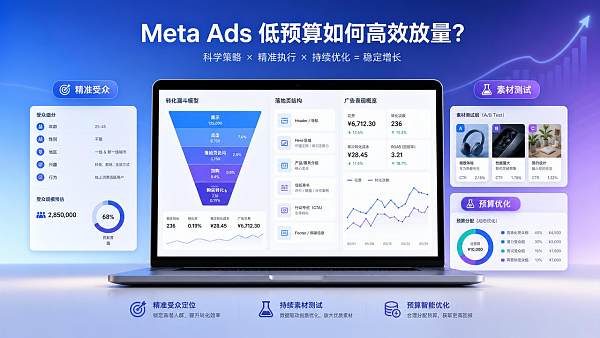
Many accounts fail to scale not because the budget is too low, but because the structure is chaotic. When the budget is only 100 yuan to 500 yuan per day, if more than 5 ad sets are launched at the same time and more than 3 conversion goals are covered, the system learning phase will be prolonged. The result is often scattered impressions, unstable clicks, and conversion costs getting out of control.
In an integrated website + marketing service scenario, Meta ad placement techniques must first solve the issue of “what happens after traffic enters the website.” If the landing page takes longer than 3 seconds to load, the form has more than 6 fields, or the mobile first screen does not clearly present the selling points, then even if click costs are controlled very low, it will still be difficult to consistently generate inquiries.
3 common problems in low-budget accounts
- Audience too broad: age, region, and interests are all expanded at the same time, resulting in many clicks but few valid inquiries.
- Too many creatives: 8 to 12 creatives are placed in a single ad set, making it difficult for the system to quickly identify high-quality creatives.
- Broken conversion chain: there is no unified information between the ad, landing page, form, and customer service response.
4 basic conditions to confirm before scaling
First, whether the pixel and conversion events are being fed back correctly; second, whether the landing page is consistent with the ad promise; third, whether the form conversion path is controlled within 2 steps; fourth, whether customer service can complete the first follow-up within 5 minutes to 30 minutes. As long as one link in the front-end traffic and back-end conversion handling chain breaks, scaling will slow down.
The table below is suitable for operators to quickly troubleshoot underlying account issues before launching ads, so as to avoid having the budget consumed ineffectively before test results are even produced.
From an execution perspective, low-budget accounts fear being “large and all-inclusive” the most. Keeping pages, tracking, forms, and ad sets within an observable range first is usually more likely than spreading too wide at the beginning to find an effective direction within 7 days to 14 days. This is also one of the most easily overlooked steps in Meta ad placement techniques.
How to scale with a small budget: coordinated optimization from audience and creatives to budget
A small budget does not mean you can only “try your luck.” A more stable approach is to divide scaling into 3 stages: testing period, screening period, and expansion period. Each stage has different goals, and the placement actions are also different. As long as the rhythm is correct, even a daily budget of around 200 yuan can gradually generate stable leads.
Step one: do not be greedy with audience size, first find the people most likely to convert
One of the keys to Meta ad placement techniques is shifting the audience range from “as many as possible” to “as accurate as possible.” For operators, in the early stage it is better to prioritize testing 2 types of audiences: one is interest + behavior targeting, and the other is remarketing to website visitors or engaged users. In the cold start stage, it is not recommended to deploy more than 4 audience segments at the same time.
If it is a B2B customer acquisition project, you can first narrow the targeting by region, industry interests, and job-related content. For example, when promoting website construction, overseas promotion, and brand globalization services, first cover core cities or core countries, then gradually expand to neighboring markets. This is more conducive to controlling testing costs in the first 7 days.
Audience testing recommendations
- In the first round, keep 2 to 3 audience groups, and do not launch too many at once.
- Keep the same creatives for each group to make it easier to determine whether the issue lies in the audience or the creative.
- Observe continuously for 3 days, reviewing click-through rate, cost per click, and landing page view rate together.
Step two: keep creative testing minimal but refined, and prioritize validating above-the-fold information
Many accounts do not have high budgets, yet place 10 videos and multiple images in the same ad set, resulting in unstable system delivery. A more reasonable approach is to place only 2 to 3 creatives in each group, with variables concentrated on the main image, the copy in the first 3 seconds, the core selling point, and the call to action.
For integrated website + marketing service businesses, the focus of creatives is not flashy techniques, but quickly explaining value: what problems can be solved, what types of companies are suitable, what the delivery includes, and how long it takes to see phased data. If users cannot understand it within 1 second to 3 seconds, subsequent conversion will most likely be weak.
Creative directions suitable for low-budget testing
- Problem-focused: no inquiries from the website, high advertising costs, inability to break into overseas markets.
- Solution-focused: coordinated website building + SEO + social media + advertising to reduce waste from isolated single-point placements.
- Result-focused: emphasize phased goals, such as optimizing structure in 7 days and observing lead trends in 30 days.
In cross-platform promotion projects, some foreign trade companies use Meta for awareness building and remarketing, while handing over traffic with stronger search intent to Google Ads for conversion handling. In this way, social media is responsible for stimulating demand, while search ads are responsible for capturing active inquiries, which is especially suitable for multilingual markets and businesses with longer overseas customer acquisition funnels.
Step three: follow the 80/20 principle in budget allocation, and keep the winners first
Low-budget accounts should not allocate budgets evenly. A more effective Meta ad placement technique is to assign about 70% to 80% of the budget to ad sets that have already produced relatively good data, and use the remaining 20% to 30% for continuously testing new audiences or new creatives. This way, you can both preserve current conversions and avoid losing room for incremental growth in the account.
The rhythm of budget scaling also needs restraint. It is generally recommended that each increase should not exceed 20%, with an observation period of 24 hours to 48 hours in between. If the budget is doubled all at once, the learning status can easily be interrupted, and the cost per conversion may instead fluctuate significantly within 2 days.
To help operators judge the action priorities at different stages, the table below can serve as a daily execution reference during account scaling.
The value of this rhythm lies in breaking “scaling” into executable actions, rather than simply pursuing impression growth. For operators, stable Meta ad placement techniques must include budget discipline, otherwise the account may appear to have traffic, but in reality it is still difficult to generate real business opportunities.
Conversion details and risk control most easily overlooked by operators
For low-budget accounts to scale, in addition to front-end placement actions, back-end conversion management is equally important. Many projects have decent click-through rates but few actual business opportunities. The problem often lies in 4 links: page conversion handling, form threshold, data misjudgment, and untimely follow-up. If Meta ad placement techniques remain only in the ad backend, results will usually be discounted.
Do not look only at surface-level data, look at truly valid leads
At the operational level, at least 6 metrics should be observed at the same time: impressions, click-through rate, cost per click, landing page view rate, form submission rate, and valid inquiry rate. If you only focus on click cost, it is easy to mistake cheap traffic for good traffic. For B2B service projects, valid inquiry rate is often more worthy of attention than cost per click.
Common misunderstandings
- Assuming a creative is successful just because the click-through rate is high, while ignoring poor back-end conversion.
- Immediately increasing the budget significantly as soon as the cost per conversion decreases.
- Looking only at platform data, without comparing it with feedback from sales or customer service.
The website landing page is the foundation for scaling, not just a supporting page
For integrated marketing service providers, advertising does not exist independently. An account that can scale sustainably usually corresponds to a clearly structured landing page: the first screen explains the service value, the middle section presents capabilities and process, and the bottom provides case types, frequently asked questions, and inquiry entry points. Page information should ideally build trust within 3 screens, and key information should not be buried too deeply.
If a company is also deploying overseas traffic at the same time, then in addition to Meta, search channels can also undertake the task of capturing high-intent demand. Taking Google Ads as an example, it is suitable for multilingual market reach, keyword refinement, performance tracking, and smart bidding scenarios for foreign trade companies, and can work together with social media placement to form a synergy of front-end awareness generation and back-end conversion capture.
Establish a weekly review mechanism, which is more important than frequent changes
It is recommended that operators conduct a review at least once every 7 days. The review should include: which audience group brought more valid inquiries, which creative performed better in the first 3 seconds, which page version had longer dwell time, and which issues repeatedly appeared in customer service feedback. By accumulating this information, the success rate of later scaling will improve significantly.
Compared with making major budget changes every day or frequently switching goals, making small-step iterations on a weekly basis is more suitable for limited budgets. Especially when the account’s daily spend is below 300 yuan, excessive operations will cause system data to keep fluctuating, making it difficult to judge whether the issue is with the creative, the audience, or the conversion handling chain.
Low-cost scaling methods suitable for integrated website and marketing teams
If your team is responsible at the same time for website building, ad placement, and lead follow-up, it is recommended to adopt the approach of “page first, ad validation, data feedback.” First build at least 1 dedicated landing page, then use a small Meta budget to test different selling points, and finally synchronize user clicks, dwell time, submissions, and inquiry results back into the content and page optimization process.
This kind of method is especially suitable for companies with limited budgets but pursuing long-term growth. It is not a one-time traffic explosion approach, but rather continuously iterates over 2 weeks to 4 weeks, making ad creatives, page structure, and conversion messaging increasingly accurate. For operators, the execution difficulty is more controllable, and it is also easier to prove the value of each optimization step to the team.
A practical execution checklist
- Prepare 1 main landing page and 1 backup version, with clearly differentiated above-the-fold selling points.
- Build 2 to 3 audience groups, with 2 creatives for each group.
- Set clear conversion events to ensure forms or inquiry buttons can be tracked.
- Record 4 core types of data every day: spend, clicks, forms, and valid leads.
- Conduct the first screening on day 7, and decide on day 14 whether to scale the volume.
Mastering Meta ad placement techniques is essentially about improving decision-making efficiency under a limited budget: which people are more worth targeting, which type of creative is more likely to trigger action, and which page structure is more likely to convert. For integrated website + marketing service teams, this capability directly affects lead cost, customer experience, and room for future repeat purchases.
If you hope to combine website building, SEO, social media, and ad placement into a more complete growth solution, Yiyingbao Information Technology (Beijing) Co., Ltd. can provide targeted recommendations based on industry, market, and budget structure. Contact us now to get a customized plan and learn about the low-cost scaling path that is more suitable for your current stage.
Related Articles
 What multilingual website services are available in Sanya? Which model is more suitable for local businesses going global?
 How to view the complete list of China SaaS companies in the top 100? Practical methods for screening website-building and marketing service providers
 There are so many used heavy-duty construction machines for foreign trade. How exactly should we acquire customers?

Related Products
 EasyCamp SaaS Smart Website Marketing SystemE-Yingbao SaaS Smart Website Marketing System: AI-powered, zero-code website building. Rapidly launch multilingual independent e-commerce sites in just 10 minutes. Global server acceleration and AI-driven SEO optimization empower businesses to efficiently connect with global markets. The seamless integration of technology and user-friendly operation makes building e-commerce sites incredibly simple.
 AI+SEM Intelligent Advertising Marketing SystemAI+SEM drives intelligent ad creation, empowering full-funnel precision advertising marketing. The system automatically generates weekly/monthly reports, AI recommends keywords and target countries, monitors core metrics in real-time with intelligent alerts, and enables one-click high-conversion ad solutions to help quickly acquire customers and improve ROI.
 AI+SEO Dual Engine Optimization ServiceEasyWin AI+SEO Dual Engine Optimization System leverages AI-powered keyword mining, content generation, and comprehensive technical optimization to help foreign trade enterprises acquire high-quality organic traffic, significantly improving search rankings and conversion rates.
 AI+SNS Social Media Marketing SystemYingbao AI+SNS Social Media Marketing System - Precision social capture for the social media era. Supports one-click content synchronization across major platforms like Facebook and LinkedIn. AI intelligently rewrites posts for enhanced relevance. 24/7 AI customer service and user profiling analysis empower businesses to efficiently expand into global markets.
 AI+SEO营销解决方案易营宝AI+SEO营销解决方案,通过AI批量写作、智能生成TDK、精准关键词扩词等功能,全面优化网站SEO效果,提升流量与转化率。助力企业构建高效智能网站新生态。
 AI+SEM Advertising Marketing SolutionsAI+SEM Advertising Marketing Solution leverages AI technology to deeply empower SEM ad campaigns. It automatically generates weekly/monthly reports using AI, presenting account data across multiple dimensions for comprehensive insights into campaign performance and trends. The system precisely recommends keywords and target countries, intelligently generates high-conversion ad copy, and enables one-click activation of efficient campaign plans to help businesses rapidly acquire customers. Simultaneously, it monitors core metrics in real time, intelligently identifies abnormal fluctuations, and issues timely alerts to ensure stable, high-return advertising results.
 Domain Name ServicesEasyWin provides professional domain name services, including intelligent queries, one-stop registration, brand protection, and full lifecycle management, helping businesses build a digital brand image.
 EasyOperate B2C Cross-Border E-Commerce Platform & Independent WebsiteEasyStore B2C Cross-border E-commerce Independent Store is an intelligent website building and cross-border e-commerce integrated solution independently developed by EasyStore Information Technology (Beijing) Co., Ltd. The system is specially designed for small and medium-sized as well as large export enterprises, integrating 'website building, operation, marketing, advertising, and conversion' into one, helping enterprises quickly establish cross-border e-commerce independent stores to achieve brand globalization and global sales growth.
The platform supports multiple languages, multiple currencies, and multi-channel marketing, with built-in AI intelligent translation and SEO optimization systems, suitable for mainstream markets such as Southeast Asia, Europe and America, Latin America, and the Middle East, assisting Chinese manufacturing enterprises in efficiently deploying international e-commerce strategies. SSL证书易营宝提供专业SSL安全证书服务,包括单域名和泛域名证书,确保网站数据传输加密、身份验证和完整性保护,助力企业建立安全可信的在线业务环境。









