









- What Does a Global Traffic Ecosystem Service Provider Do? What Are the Differences from a Single Advertising AgencyJul 16, 2026View details
- What should you focus on in the latest enterprise SaaS report? From renewal rates and delivery costs to overseas growth opportunitiesJul 12, 2026View details
- What signals are worth paying attention to in a cross-border marketing trend report? B2B companies should look at these 6 signalsJul 11, 2026View details
- How to Read a Cross-Border Marketing Trends Report? Five Key Dimensions for Evaluating Channel OpportunitiesJul 11, 2026View details
- Which channel has the highest ROI in the global traffic ecosystem? Comparative analysis of search, social media, and advertisingJul 10, 2026View details
- What multilingual website services are available in Sanya? Which model is more suitable for local businesses going global?Jul 08, 2026View details
- How to view the complete list of China SaaS companies in the top 100? Practical methods for screening website-building and marketing service providersJul 08, 2026View details
- How to view pricing in the global traffic ecosystem? Cost comparison of search, social media, and content channel advertisingJul 06, 2026View details
Where Meta ad spend gets expensive
Meta advertising is expensive, not only because clicks are costly, but even more because of audience competition, creative iteration, data optimization, and conversion funnel efficiency. For financial approvers, clearly understanding where the budget goes and what the real returns are is the key to controlling campaign risk.
Why financial approvers feel that Meta advertising “gets more expensive the more you spend”
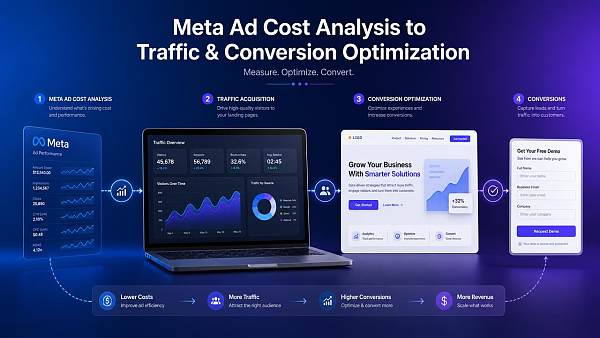
When many companies approve Meta advertising budgets, the first thing they notice is rising cost per click, cost per thousand impressions, or cost per lead. But what really drives up total investment is often not the surface-level bid, but multiple points of loss between traffic acquisition and final conversion.
In the integrated website + marketing services industry, advertising performance is not determined only by the ad account. It is also influenced by landing page speed, on-site structure, form design, tracking setup, remarketing strategy, and other interconnected factors. Looking only at the ad dashboard can easily lead to misjudging the true source of costs.
For financial approvers, the core question is not “whether to invest,” but “where the money is going, which inputs are necessary costs, which are inefficient expenses, and how long it will take to generate verifiable returns.” This determines whether the budget should be tightened conservatively or continue to scale.
- Audience competition is intense, and homogeneous advertising across the industry drives bidding prices higher, especially in overseas expansion, e-commerce, education, and service sectors.
- Creative fatigue happens quickly. After ad creatives wear out, click-through rates decline, and the system raises acquisition costs to maintain exposure.
- The conversion path is long, and weak website or form follow-through means that even if top-of-funnel traffic acquisition is normal, backend deal conversion may still be distorted.
- Data tracking is incomplete, making it impossible to accurately distinguish valid leads from invalid ones, resulting in insufficient basis for reinvestment decisions.
Where Meta advertising costs are actually high
If Meta advertising is broken down, costs usually fall into traffic costs, content costs, technical costs, and management costs. Finance departments often only see media spend, but what actually affects profit margins is the comprehensive cost of the entire funnel, not just the ad spend alone.
First, audience acquisition costs keep rising
When large numbers of companies in the same industry compete for the same interest tags, lookalike audiences, or high-value regional traffic, Meta advertising raises impression and click prices as competition intensifies. The more the budget is concentrated on hot audiences, the more likely cost per conversion is to spiral out of control.
Second, untimely creative iteration creates hidden waste
Ad creatives are not something you produce once and use for the long term. Images, short videos, copy, and call-to-action buttons all require ongoing testing. If a company lacks a stable creative production mechanism, the ad learning phase becomes longer, and low-CTR creatives will keep consuming the budget.
Third, weak website conversion capacity magnifies ad costs
For many companies, the Meta ad dashboard may appear normal, but the website loads slowly, page information lacks focus, forms are too long, and the mobile experience is poor, ultimately causing visitor drop-off. At that point, every click becomes more expensive because a large amount of traffic never enters the effective opportunity pool.
Fourth, data optimization and attribution capabilities are insufficient
Without complete tracking tags, event configuration, and phased reports, companies struggle to determine which ad sets truly generate inquiries and which only create superficial traffic. What financial approvers fear most is this state of “seeing the spending but not seeing the contribution,” because the budget cannot be properly explained.
The table below can help financial approvers quickly identify the main sources of high Meta advertising costs and the corresponding response directions.
On the surface, Meta advertising seems expensive because of the media platform; in reality, a more common situation is that companies pile all the losses that could have been reduced through website optimization, data governance, and creative testing into ad buying, ultimately creating a budget “black hole.”
Why integrated website + marketing services can reduce the real cost of Meta advertising
Hiring only an ad agency solves only media buying; building only a website solves only presentation; doing only SEO solves only organic traffic. For financial approvers who care about return on investment, what matters more is whether an integrated solution can reduce duplicated investment and coordination losses.
Since 2013, EasyABM Information Technology (Beijing) Co., Ltd. has continued to focus deeply on global digital marketing. Driven by artificial intelligence and big data, the company provides full-funnel services around intelligent website building, SEO optimization, social media marketing, and advertising placement, making it better suited for enterprises that need explainable budgets, reviewable campaigns, and sustainable growth.
From a finance perspective, the value of this type of integration lies in the fact that under one unified budget system, front-end customer acquisition, mid-funnel conversion handling, and back-end optimization are coordinated by one team, eliminating the blame-shifting of “advertising says it is a website problem, while the website says it is a traffic problem.”
- Website building and advertising are planned in sync, so landing pages are designed around conversion goals from the beginning rather than being passively patched after launch.
- SEO and Meta advertising data complement each other, enabling faster identification of high-value keywords, page topics, and user demand signals.
- Social media content and ad creatives work together, reducing duplicated costs caused by fragmented creative production.
- A unified attribution standard makes financial approval, phased reviews, and annual budget forecasting easier.
Which metrics are more reliable when approving a Meta advertising budget
When approving a Meta advertising budget, you cannot focus only on cost per click, nor can you look only at lead volume. A more reasonable approach is to establish a funnel framework from traffic to closed deals, tying the budget to stage-based business goals and avoiding decisions misled by single-point metrics.
The following table is suitable as a core evaluation framework for Meta advertising budget approval, especially for integrated website + marketing service projects.
If approvers can upgrade budget review from “how much money was spent” to “whether the investment allocation is reasonable and whether the conversion evidence is complete,” they can often identify risks earlier and find it easier to establish a unified language with the business team.
Which high Meta advertising costs are actually caused by internal business process issues
Many companies attribute high Meta advertising costs entirely to the platform, but in reality, inefficiencies in internal management processes are more likely to cause waste. Especially when cross-department collaboration is insufficient, the advertising team, website team, and sales team each operate independently, and budget waste gets amplified layer by layer.
Common problems include
- Creative approval cycles are too long, so campaigns go live only after the hot opportunity window has passed, causing costs to rise while conversion opportunities decline.
- Sales follow-up standards are inconsistent, leading to large differences in output from the same leads across different teams.
- Website revisions and advertising are not synchronized, and ad landing pages change frequently, causing historical data to lose reference value.
- Finance looks only at monthly spend, while the business side looks only at short-term inquiries, with no quarterly-level review of campaign efficiency.
This is also why integrated services are receiving more and more attention. They not only reduce external coordination costs, but also help enterprises establish a more stable delivery rhythm and budget control mechanism. Similar to the research topic Research on Hospital Infrastructure Financial Management under the Background of the New Accounting System, it essentially reminds managers that cost control is never just an accounting action, but also a matter of process design.
How to decide whether a Meta advertising budget should keep running or pause first for optimization
What financial approvers need most is not emotional judgment, but stage-based decision criteria. Rising costs do not necessarily mean campaigns must be stopped, and short-term lead generation does not necessarily mean more budget should be added. The key is to identify whether the problem lies in the front end, the middle of the page experience, or the post-sales funnel.
Situations suitable for continuing investment while optimizing
If Meta ad click-through rates are acceptable, landing page dwell time is normal, and there is already a certain proportion of valid inquiries, but the sales cycle is simply longer, then it is more appropriate to retain the basic budget and optimize while running, rather than fully pausing and interrupting the learning data.
Situations suitable for tightening the budget first
If ad clicks are low, page bounce rates are high, and valid leads are few, while internally there is no creative or page adjustment plan that can be implemented quickly, then continuing to scale will only magnify losses. In this case, the website, creatives, and tracking should be fixed first before resuming campaign testing.
FAQ: The most common questions when finance approves Meta advertising
If Meta advertising is expensive, does that mean the platform is not suitable for us?
Not necessarily. Whether Meta advertising is suitable depends on the target market, audience match, website conversion capacity, and content production capability. If the platform traffic matches the product audience but conversion is poor, the problem is often in funnel setup rather than the platform itself being ineffective.
What is the biggest risk to guard against during approval?
The biggest risk is looking only at superficial lead costs without examining validity and downstream conversion. Low-cost leads do not equal low customer acquisition cost. Invalid inquiries, duplicate submissions, and poor follow-up quality can all make the numbers look good on paper while actual returns remain unsatisfactory.
Why does the website affect Meta advertising costs?
Because Meta advertising only brings people to the website; what actually determines whether they stay and inquire is page speed, content structure, trust information, and action paths. The weaker the website, the greater the loss from every click, and average customer acquisition cost naturally gets pushed higher.
How can we avoid constantly increasing the budget without seeing returns?
It is recommended to adopt a phased budget mechanism: manage testing budgets, validation budgets, and scaling budgets separately, and require each stage to produce clear conclusions, including valid audiences, usable creatives, page performance, and lead quality, rather than providing only spend data.
Why choose us: Turn Meta advertising budgets into explainable, optimizable, and scalable growth assets
For financial approvers, a truly valuable partner is not just an ad execution provider, but a growth partner that can integrate Meta advertising with website development, SEO planning, social media content, and data tracking. Only in this way can every budget item be placed within a verifiable business funnel.
With more than ten years of global digital marketing experience, EasyABM Information Technology (Beijing) Co., Ltd. provides companies with coordinated solutions ranging from website conversion support, campaign testing, and data optimization to lead growth, helping management see budget allocation, stage objectives, and return logic more clearly.
- Consult on whether the Meta advertising budget structure is reasonable and identify high-spend, low-return links.
- Confirm whether website pages, form paths, and tracking setup are dragging down conversion efficiency.
- Evaluate whether there is room for coordination between advertising, SEO, and social media content to reduce duplicated buying.
- Discuss testing cycles, delivery rhythm, phased reporting standards, and customized solutions.
- If budget approval support is needed, we can also align business goals to build a clearer campaign evaluation framework, including the cost management perspective emphasized in topics such as Research on Hospital Infrastructure Financial Management under the Background of the New Accounting System.
If you are evaluating whether Meta advertising is still worth continuing, how the budget should be allocated, whether the website is hurting ad conversion, or if you want a campaign plan and quotation communication path better suited to financial approval, you can now move forward to discuss your specific needs in more detail.
Related Articles



Related Products
 EasyCamp SaaS Smart Website Marketing SystemE-Yingbao SaaS Smart Website Marketing System: AI-powered, zero-code website building. Rapidly launch multilingual independent e-commerce sites in just 10 minutes. Global server acceleration and AI-driven SEO optimization empower businesses to efficiently connect with global markets. The seamless integration of technology and user-friendly operation makes building e-commerce sites incredibly simple.
 AI+SEM Intelligent Advertising Marketing SystemAI+SEM drives intelligent ad creation, empowering full-funnel precision advertising marketing. The system automatically generates weekly/monthly reports, AI recommends keywords and target countries, monitors core metrics in real-time with intelligent alerts, and enables one-click high-conversion ad solutions to help quickly acquire customers and improve ROI.
 AI+SEO Dual Engine Optimization ServiceEasyWin AI+SEO Dual Engine Optimization System leverages AI-powered keyword mining, content generation, and comprehensive technical optimization to help foreign trade enterprises acquire high-quality organic traffic, significantly improving search rankings and conversion rates.
 AI+SNS Social Media Marketing SystemYingbao AI+SNS Social Media Marketing System - Precision social capture for the social media era. Supports one-click content synchronization across major platforms like Facebook and LinkedIn. AI intelligently rewrites posts for enhanced relevance. 24/7 AI customer service and user profiling analysis empower businesses to efficiently expand into global markets.
 AI+SEO营销解决方案易营宝AI+SEO营销解决方案,通过AI批量写作、智能生成TDK、精准关键词扩词等功能,全面优化网站SEO效果,提升流量与转化率。助力企业构建高效智能网站新生态。
 AI+SEM Advertising Marketing SolutionsAI+SEM Advertising Marketing Solution leverages AI technology to deeply empower SEM ad campaigns. It automatically generates weekly/monthly reports using AI, presenting account data across multiple dimensions for comprehensive insights into campaign performance and trends. The system precisely recommends keywords and target countries, intelligently generates high-conversion ad copy, and enables one-click activation of efficient campaign plans to help businesses rapidly acquire customers. Simultaneously, it monitors core metrics in real time, intelligently identifies abnormal fluctuations, and issues timely alerts to ensure stable, high-return advertising results.
 Domain Name ServicesEasyWin provides professional domain name services, including intelligent queries, one-stop registration, brand protection, and full lifecycle management, helping businesses build a digital brand image.
 EasyOperate B2C Cross-Border E-Commerce Platform & Independent WebsiteEasyStore B2C Cross-border E-commerce Independent Store is an intelligent website building and cross-border e-commerce integrated solution independently developed by EasyStore Information Technology (Beijing) Co., Ltd. The system is specially designed for small and medium-sized as well as large export enterprises, integrating 'website building, operation, marketing, advertising, and conversion' into one, helping enterprises quickly establish cross-border e-commerce independent stores to achieve brand globalization and global sales growth.
The platform supports multiple languages, multiple currencies, and multi-channel marketing, with built-in AI intelligent translation and SEO optimization systems, suitable for mainstream markets such as Southeast Asia, Europe and America, Latin America, and the Middle East, assisting Chinese manufacturing enterprises in efficiently deploying international e-commerce strategies. SSL证书易营宝提供专业SSL安全证书服务,包括单域名和泛域名证书,确保网站数据传输加密、身份验证和完整性保护,助力企业建立安全可信的在线业务环境。









