









- Cross-Border Marketing Trend Research: Why More and More Companies Are Starting to Deploy AI Search and GEO OptimizationJun 30, 2026View details
- Cross-Border Marketing Trend Research: How Independent Sites, AI Content, and Short-Video Customer Acquisition Are ChangingJun 30, 2026View details
- How Can a Brand Updates Page Be Made More SEO-Friendly? Analysis of Update Frequency, Content Structure, and Internal Linking StrategyJun 28, 2026View details
- What stages does the cross-border services ecosystem include? How do website building, promotion, payment, and compliance work togetherJun 22, 2026View details
- How will email marketing costs change in 2026Jun 22, 2026View details
- The China-US tariff arrangement has reached a preliminary consensus, and the trade association will be establishedJun 15, 2026View details
- Should overseas brand marketing start with ads or contentJun 21, 2026View details
- What determines B2C cross-border e-commerce website development costs? A breakdown of features, interfaces, and deployment methodsJun 17, 2026View details
Facebook ad strategy: test creatives or audiences first
Core Decision Logic of Facebook Ad Placement Strategy
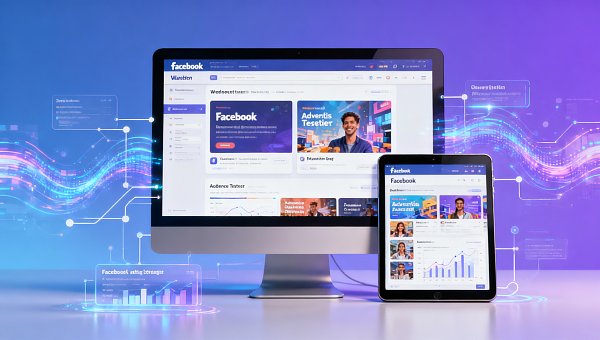
In Facebook ad placement strategy, whether to test creatives first or audiences first often determines the speed of scaling and the overall cost level. For integrated website-building and marketing service businesses, this is not a simple matter of sequence, but a systematic decision involving traffic acquisition, lead conversion, and advertising return.
Especially in scenarios such as independent website promotion, overseas customer acquisition, and brand globalization, Facebook ad placement strategy needs to simultaneously assess three factors: creative appeal, audience fit, and landing page carrying capacity. If the order is wrong, the budget will be quickly consumed by ineffective clicks.
Yiyingbao Information Technology (Beijing) Co., Ltd. has long served global digital marketing projects, and through the coordination of intelligent website building, SEO optimization, social media marketing, and ad placement, has found that a truly stable Facebook ad placement strategy is often not about single-point optimization, but about clear testing paths, timely data feedback, and a steady iteration rhythm.
Definition of Basic Concepts and Testing Sequence
Testing creatives first refers to prioritizing the verification of the click and conversion performance of creative elements such as images, videos, copy, headlines, and call-to-action buttons within a relatively stable audience range. Testing audiences first refers to prioritizing the assessment of conversion differences across different interests, behaviors, regions, and lookalike audiences under relatively fixed ad creatives.
Both methods are part of Facebook ad placement strategy, but they apply under different conditions. If the product’s selling points have not yet been quickly understood by users, prioritizing creatives is usually more effective. If the selling points are already mature and the historical content click-through rate is stable, prioritizing audiences makes it easier to shorten the testing period.
For the website + marketing integrated service industry, advertising goals often include form submissions, direct message inquiries, on-site registrations, and demo bookings. These goals usually involve a longer conversion path, so Facebook ad placement strategy cannot focus only on clicks, but must also evaluate visit quality and subsequent conversions.
Industry Context and Current Focus Points
In the current advertising environment, traffic prices fluctuate significantly, and algorithms rely more heavily on early feedback signals. Many accounts perform unstably, and the root cause is often not insufficient budget, but the lack of a clear testing framework in the Facebook ad placement strategy.
- Creative homogenization is severe, and first-screen attraction is insufficient.
- Audience targeting is too narrow, making it difficult to complete the learning phase.
- Landing page information is inconsistent, leading to obvious drop-off after clicks.
- Only surface-level data is considered, while the structure of conversion costs is ignored.
In actual execution, the website and advertising are not separate. Page loading speed, form length, trust-building content, and mobile adaptation all negatively affect the judgment results of Facebook ad placement strategy. What appears to be weak creative performance may sometimes actually be a problem with landing page support.
Business Significance of Testing Creatives First or Audiences First
If the account is in the cold-start phase, testing creatives first is usually more suitable for most scenarios. The reason is that creatives determine whether users are willing to stop, click, and enter the website. Without sufficiently strong content expression, even the most precise audience is unlikely to generate ideal conversions.
However, when the brand already has stable selling points, high historical creative click-through rates, and a clear website conversion path, the Facebook ad placement strategy can begin by testing audiences first. At this stage, the core goal is not to prove that the content works, but to find traffic entry points with lower costs and stronger intent.
From an operational perspective, the testing sequence directly affects budget efficiency. For marketing service websites, leads are highly valuable but have a long conversion cycle. An incorrect Facebook ad placement strategy will amplify ineffective inquiries and low-quality traffic, increasing the burden on subsequent sales and operations.
When companies are simultaneously focused on promotion costs and internal management efficiency, they also need to establish a clearer accounting logic. For an extended understanding centered on input-output and channel allocation, you may refer to Challenges and Strategies for Expanding the Scope of Enterprise Cost Accounting, which helps place ad testing within a more complete business analysis framework.
Classification of Testing Paths Under Typical Scenarios
At different business stages, the priorities of Facebook ad placement strategy are not the same. You can assess them according to the following scenarios.
- New product or new website launch: test creatives first, then narrow the audience.
- Scaling a mature product: test audiences first, then replicate winning combinations.
- High-ticket services: verify creatives and landing pages simultaneously.
- Remarketing campaigns: prioritize audience segmentation stages and reach frequency.
Taking services such as website building, SEO optimization, and ad account management as examples, users usually need multiple touchpoints before making a decision. Therefore, Facebook ad placement strategy should not rely on only a single conversion-focused creative, but should prepare four types of content—brand awareness, demand awakening, case proof, and conversion promotion—and test them in stages.
Practical Recommendations and Key Considerations
When executing a Facebook ad placement strategy, the most common mistake is changing creatives, copy, audiences, and bidding methods all at once. Too many variables make the results impossible to attribute. A more reliable approach is to verify only one main variable in each round, ensuring that the conclusions can be reused.
Budget Allocation Recommendations
- The testing-period budget should account for 20% to 30% of the total budget.
- Creative testing groups should maintain the same audience and the same placements.
- Audience testing groups should maintain the same creatives and the same objective.
- When scaling winning combinations, increase the budget gradually to avoid sudden spikes.
Data Evaluation Recommendations
If the front-end click-through rate remains consistently low, you should return to the creative level. If the click-through rate is acceptable but conversions are poor, check page consistency first, then review audience quality. If the number of form submissions increases but closed deals decline, it indicates that the Facebook ad placement strategy needs to incorporate lead validity metrics instead of focusing only on cost per acquisition.
In addition, website-side tracking points, event feedback, and inquiry source records must be complete. Without accurate data, any Facebook ad placement strategy may be misled by surface appearances. For cross-channel operational projects, you can also combine the ideas in Challenges and Strategies for Expanding the Scope of Enterprise Cost Accounting to uniformly evaluate the collaborative costs of advertising, content, website, and sales.
Next Steps for Practical Execution
Overall, there is no absolutely fixed answer for Facebook ad placement strategy, but there is a relatively sound sequence. In the cold-start phase, prioritize testing creatives; in the mature phase, prioritize testing audiences; and in the scaling phase, emphasize landing page support and data feedback. This makes it easier to find a growth path with lower costs and higher conversions.
For projects that aim to advance website building, SEO, and social media advertising in coordination, it is recommended to first sort out the website’s target pages, key events, creative types, and audience tiers, and then establish a weekly testing schedule. This not only improves the execution efficiency of Facebook ad placement strategy, but also makes subsequent optimization more consistent.
If you need a higher-quality global customer acquisition solution, you can diagnose four areas simultaneously—website support, data tracking, content production, and ad testing—and gradually build a closed-loop Facebook ad placement strategy suited to your own business.
Related Articles
 4 Major Reasons Behind WhatsApp Account Bans, A Quick Self-Check for Foreign Trade Professionals
 Cross-Border Marketing Trend Research: Why More and More Companies Are Starting to Deploy AI Search and GEO Optimization
 Cross-Border Marketing Trend Research: How Independent Sites, AI Content, and Short-Video Customer Acquisition Are Changing


Related Products
 EasyCamp SaaS Smart Website Marketing SystemE-Yingbao SaaS Smart Website Marketing System: AI-powered, zero-code website building. Rapidly launch multilingual independent e-commerce sites in just 10 minutes. Global server acceleration and AI-driven SEO optimization empower businesses to efficiently connect with global markets. The seamless integration of technology and user-friendly operation makes building e-commerce sites incredibly simple.
 AI+SEM Intelligent Advertising Marketing SystemAI+SEM drives intelligent ad creation, empowering full-funnel precision advertising marketing. The system automatically generates weekly/monthly reports, AI recommends keywords and target countries, monitors core metrics in real-time with intelligent alerts, and enables one-click high-conversion ad solutions to help quickly acquire customers and improve ROI.
 AI+SEO Dual Engine Optimization ServiceEasyWin AI+SEO Dual Engine Optimization System leverages AI-powered keyword mining, content generation, and comprehensive technical optimization to help foreign trade enterprises acquire high-quality organic traffic, significantly improving search rankings and conversion rates.
 AI+SNS Social Media Marketing SystemYingbao AI+SNS Social Media Marketing System - Precision social capture for the social media era. Supports one-click content synchronization across major platforms like Facebook and LinkedIn. AI intelligently rewrites posts for enhanced relevance. 24/7 AI customer service and user profiling analysis empower businesses to efficiently expand into global markets.
 AI+SEO营销解决方案易营宝AI+SEO营销解决方案,通过AI批量写作、智能生成TDK、精准关键词扩词等功能,全面优化网站SEO效果,提升流量与转化率。助力企业构建高效智能网站新生态。
 AI+SEM Advertising Marketing SolutionsAI+SEM Advertising Marketing Solution leverages AI technology to deeply empower SEM ad campaigns. It automatically generates weekly/monthly reports using AI, presenting account data across multiple dimensions for comprehensive insights into campaign performance and trends. The system precisely recommends keywords and target countries, intelligently generates high-conversion ad copy, and enables one-click activation of efficient campaign plans to help businesses rapidly acquire customers. Simultaneously, it monitors core metrics in real time, intelligently identifies abnormal fluctuations, and issues timely alerts to ensure stable, high-return advertising results.
 Domain Name ServicesEasyWin provides professional domain name services, including intelligent queries, one-stop registration, brand protection, and full lifecycle management, helping businesses build a digital brand image.
 EasyOperate B2C Cross-Border E-Commerce Platform & Independent WebsiteEasyStore B2C Cross-border E-commerce Independent Store is an intelligent website building and cross-border e-commerce integrated solution independently developed by EasyStore Information Technology (Beijing) Co., Ltd. The system is specially designed for small and medium-sized as well as large export enterprises, integrating 'website building, operation, marketing, advertising, and conversion' into one, helping enterprises quickly establish cross-border e-commerce independent stores to achieve brand globalization and global sales growth.
The platform supports multiple languages, multiple currencies, and multi-channel marketing, with built-in AI intelligent translation and SEO optimization systems, suitable for mainstream markets such as Southeast Asia, Europe and America, Latin America, and the Middle East, assisting Chinese manufacturing enterprises in efficiently deploying international e-commerce strategies. SSL证书易营宝提供专业SSL安全证书服务,包括单域名和泛域名证书,确保网站数据传输加密、身份验证和完整性保护,助力企业建立安全可信的在线业务环境。









