









- What should you focus on in the latest enterprise SaaS report? From renewal rates and delivery costs to overseas growth opportunitiesJul 12, 2026View details
- What signals are worth paying attention to in a cross-border marketing trend report? B2B companies should look at these 6 signalsJul 11, 2026View details
- How to Read a Cross-Border Marketing Trends Report? Five Key Dimensions for Evaluating Channel OpportunitiesJul 11, 2026View details
- Which channel has the highest ROI in the global traffic ecosystem? Comparative analysis of search, social media, and advertisingJul 10, 2026View details
- What multilingual website services are available in Sanya? Which model is more suitable for local businesses going global?Jul 08, 2026View details
- How to view the complete list of China SaaS companies in the top 100? Practical methods for screening website-building and marketing service providersJul 08, 2026View details
- How to view pricing in the global traffic ecosystem? Cost comparison of search, social media, and content channel advertisingJul 06, 2026View details
- How to assess foreign trade website development trends?Looking at 2026 changes from multilingual,AI content to conversion pathsJul 04, 2026View details
3 Signs Your Facebook Advertising Strategy Is Failing
When a Facebook advertising strategy starts to fail, the first thing a business usually feels is not a sharp drop in exposure, but more expensive clicks, fewer leads, and slower conversions. In an integrated website + marketing services scenario, advertising problems usually do not only occur on the media buying side, but may also appear in landing pages, data tracking, audience matching, and content messaging. Only by identifying key abnormal signals can you stop losses in time and bring the budget back onto a growth track.
Scenario 1: Traffic is still growing, but the conversion efficiency of the Facebook advertising strategy continues to decline
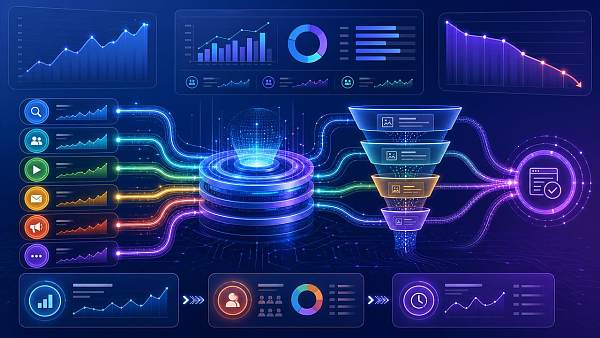
This is the most common failure scenario, and also the one most easily overlooked. The backend data appears normal, and impressions and clicks still have scale, but inquiries, registrations, lead submissions, or deals have clearly declined. At this point, you cannot just look at surface-level traffic, but must determine whether the Facebook advertising strategy has already lost its real conversion capability.
Typical signals include: a stable click-through rate, rising cost per conversion, shorter visit duration, a higher bounce rate, and a lower form submission rate. If website pages load slowly, the information structure is confusing, and the mobile experience is poor, no matter how much traffic the ads bring, it will still be difficult to generate effective results.
Core checkpoints for judging this scenario
- Click costs have not changed much, but lead costs continue to rise
- Ad creatives can still attract visits, but struggle to drive the next action
- There are breakpoints in the website visit path, and users drop off quickly after entering
- Conversion tracking is incomplete, causing optimization goals to deviate from real transactions
If the campaign link points to an outdated page, the problem will be even more obvious. Websites and ads must be optimized in coordination, rather than independently. Especially in foreign trade customer acquisition scenarios, the path from an ad click to inquiry submission is longer, and any distortion in any page step can make the Facebook advertising strategy look like it is “still running” while results keep getting worse.
Scenario 2: The budget keeps increasing, but the people reached by the Facebook advertising strategy are becoming less and less precise
The second failure signal often appears during the account scaling stage. Many accounts achieve decent results in the early stage with a small budget, then quickly increase spending, only to find that the added budget does not bring additional conversions and instead drives up overall costs. This indicates that the audience boundary of the original Facebook advertising strategy has already been reached almost to its limit.
In this scenario, the common problem is often not “not spending enough,” but “spending on the wrong people.” Overly broad audience packages, overlapping interest tags, declining lookalike audience quality, and imbalanced remarketing cycle settings can all cause ads to frequently reach low-intent audiences. The result is higher frequency, weaker engagement, and a continued decline in conversion intent.
Differences in demand across different reach scenarios
At this stage, it is even more necessary to use on-site behavioral data to define high-quality audiences in reverse. For example, visit duration, depth of browsing on key pages, form-triggering behavior, and historical inquiry quality are all closer to real demand than interest tags alone. E-Marketingeasy Information Technology (Beijing) Co., Ltd. has long served global digital marketing projects, and its core approach is to connect website building, tracking, advertising, and optimization to prevent budgets from staying only at the traffic level.
Scenario 3: Creatives are updated frequently, but the feedback from the Facebook advertising strategy is becoming slower and slower
The third signal is “content fatigue.” When data weakens, the first reaction of many accounts is to change images, copy, and videos. But if there is still no improvement after continuous replacements, it means the problem is no longer just creative material, but that the overall Facebook advertising strategy has entered a delayed feedback period.
Creative fatigue often shows up as a lower click-through rate, declining engagement rate, weaker relevance, and poorer comment quality. A deeper reason may be that the information messaging is inconsistent with the landing-page promise, or that the ad creative does not match the real needs of different conversion stages. Simply updating the format without restructuring the content logic makes it difficult to truly restore performance.
What is more suitable to check at this stage
- Whether the ad promise is consistent with the landing page selling points
- Whether the content seen by different audiences is layered appropriately
- Whether clicks have been optimized for too long while real conversions were ignored
- Whether historically high-performing creatives have been repeatedly overused
- Whether data feedback is timely and whether the algorithm has received valid samples
If the website itself has multilingual management, behavior tracking, and traceable conversion capabilities, creative adjustments will be more directional. For example, B2B foreign trade solutions combine independent website construction, multilingual SEO optimization, intelligent customer service systems, and cross-platform advertising automation optimization, making them suitable for scenarios that require continuous verification of overseas traffic quality. In this way, adjustments to the Facebook advertising strategy no longer rely on experience-based judgment, but can return to a closed data loop.
After failure signals appear, which demand differences are most worth prioritizing for judgment
Even when performance declines, the handling sequence is not the same across different business scenarios. The value of website + marketing service integration lies in first clarifying whether the problem belongs to the page, the audience, the content, or the data tracking, and then making targeted adjustments.
- If clicks are normal but visit duration is short, first check website speed and page structure
- If costs rise after budget expansion, first check audience segmentation and frequency control
- If creative updates are ineffective, first check information consistency and the conversion path
- If backend data looks good but deals worsen, first verify lead quality standards
Using foreign trade independent websites as an example, page performance, translation quality, and behavior tracking directly affect advertising results. A system with a Google PageSpeed score of 90+, translation accuracy of 92.7%, and support for buyer behavior tracking and analysis makes it easier for advertising teams to judge which Facebook advertising strategies can continue to scale and which have already reached the point where restructuring is necessary.
Avoid misjudgment: These phenomena may look normal, but are actually consuming your budget
Many accounts do not fail suddenly, but have already entered a danger zone while “not yet fully worsening.” Looking only at surface metrics can easily lead to misjudgment and delay the best adjustment timing.
Common misjudgment points
- Mistaking growing exposure for an effective strategy
- Mistaking a stable click-through rate for accurate audience targeting
- Mistaking short-term orders for account health
- Mistaking frequent creative replacements for completed optimization
- Mistaking growth in lead volume for improved deal-closing capability
A truly effective Facebook advertising strategy should meet three conditions at the same time: it can consistently acquire target traffic, smoothly direct traffic to key website pages, and show stable conversions within the tracking system. If any one of these is missing, growth may only be temporary.
Action recommendation: Recalibrate the Facebook advertising strategy from ads and website to a closed data loop
When the above three signals appear, the most effective approach is not to keep forcing the budget, but to troubleshoot in order: first check whether data tracking is accurate, then whether the landing page is properly carrying the traffic, then whether the audience is precise, and only lastly expand creative testing. Only in this way can the Facebook advertising strategy avoid falling into repeated trial and error.
If you want to shorten the diagnostic cycle, you can prioritize a coordinated solution covering website building, SEO, advertising, and data analysis. Especially in the foreign trade growth funnel, an integrated system can usually bring more stable inquiry quality and clearer evidence for media buying decisions. Whether optimizing independent website performance or rebuilding audience and content models, the key is never “spend more,” but “spend more accurately, receive the traffic well, and convert it effectively.”
When the Facebook advertising strategy begins to show these three types of signals—rising costs, audience distortion, and creative fatigue—the earlier you identify them, the easier it is to restore the growth rhythm. First place the problem back into the real business scenario for judgment, then correct it through coordination across website, content, and advertising, so that every bit of budget can truly generate value.
Related Articles



Related Products
 EasyCamp SaaS Smart Website Marketing SystemE-Yingbao SaaS Smart Website Marketing System: AI-powered, zero-code website building. Rapidly launch multilingual independent e-commerce sites in just 10 minutes. Global server acceleration and AI-driven SEO optimization empower businesses to efficiently connect with global markets. The seamless integration of technology and user-friendly operation makes building e-commerce sites incredibly simple.
 AI+SEM Intelligent Advertising Marketing SystemAI+SEM drives intelligent ad creation, empowering full-funnel precision advertising marketing. The system automatically generates weekly/monthly reports, AI recommends keywords and target countries, monitors core metrics in real-time with intelligent alerts, and enables one-click high-conversion ad solutions to help quickly acquire customers and improve ROI.
 AI+SEO Dual Engine Optimization ServiceEasyWin AI+SEO Dual Engine Optimization System leverages AI-powered keyword mining, content generation, and comprehensive technical optimization to help foreign trade enterprises acquire high-quality organic traffic, significantly improving search rankings and conversion rates.
 AI+SNS Social Media Marketing SystemYingbao AI+SNS Social Media Marketing System - Precision social capture for the social media era. Supports one-click content synchronization across major platforms like Facebook and LinkedIn. AI intelligently rewrites posts for enhanced relevance. 24/7 AI customer service and user profiling analysis empower businesses to efficiently expand into global markets.
 AI+SEO营销解决方案易营宝AI+SEO营销解决方案,通过AI批量写作、智能生成TDK、精准关键词扩词等功能,全面优化网站SEO效果,提升流量与转化率。助力企业构建高效智能网站新生态。
 AI+SEM Advertising Marketing SolutionsAI+SEM Advertising Marketing Solution leverages AI technology to deeply empower SEM ad campaigns. It automatically generates weekly/monthly reports using AI, presenting account data across multiple dimensions for comprehensive insights into campaign performance and trends. The system precisely recommends keywords and target countries, intelligently generates high-conversion ad copy, and enables one-click activation of efficient campaign plans to help businesses rapidly acquire customers. Simultaneously, it monitors core metrics in real time, intelligently identifies abnormal fluctuations, and issues timely alerts to ensure stable, high-return advertising results.
 Domain Name ServicesEasyWin provides professional domain name services, including intelligent queries, one-stop registration, brand protection, and full lifecycle management, helping businesses build a digital brand image.
 EasyOperate B2C Cross-Border E-Commerce Platform & Independent WebsiteEasyStore B2C Cross-border E-commerce Independent Store is an intelligent website building and cross-border e-commerce integrated solution independently developed by EasyStore Information Technology (Beijing) Co., Ltd. The system is specially designed for small and medium-sized as well as large export enterprises, integrating 'website building, operation, marketing, advertising, and conversion' into one, helping enterprises quickly establish cross-border e-commerce independent stores to achieve brand globalization and global sales growth.
The platform supports multiple languages, multiple currencies, and multi-channel marketing, with built-in AI intelligent translation and SEO optimization systems, suitable for mainstream markets such as Southeast Asia, Europe and America, Latin America, and the Middle East, assisting Chinese manufacturing enterprises in efficiently deploying international e-commerce strategies. SSL证书易营宝提供专业SSL安全证书服务,包括单域名和泛域名证书,确保网站数据传输加密、身份验证和完整性保护,助力企业建立安全可信的在线业务环境。









