









- What Does a Global Traffic Ecosystem Service Provider Do? What Are the Differences from a Single Advertising AgencyJul 16, 2026View details
- What should you focus on in the latest enterprise SaaS report? From renewal rates and delivery costs to overseas growth opportunitiesJul 12, 2026View details
- What signals are worth paying attention to in a cross-border marketing trend report? B2B companies should look at these 6 signalsJul 11, 2026View details
- How to Read a Cross-Border Marketing Trends Report? Five Key Dimensions for Evaluating Channel OpportunitiesJul 11, 2026View details
- Which channel has the highest ROI in the global traffic ecosystem? Comparative analysis of search, social media, and advertisingJul 10, 2026View details
- What multilingual website services are available in Sanya? Which model is more suitable for local businesses going global?Jul 08, 2026View details
- How to view the complete list of China SaaS companies in the top 100? Practical methods for screening website-building and marketing service providersJul 08, 2026View details
- How to view pricing in the global traffic ecosystem? Cost comparison of search, social media, and content channel advertisingJul 06, 2026View details
What to do about low B2B conversion rates? Investigate every aspect from traffic and page layout to forms.
Low B2B conversion rates are not a single problem; they require a thorough examination of everything from traffic quality and page experience to form design to identify the key factors truly impacting sales. For integrated website and marketing projects, conversion rate is not an isolated metric, but rather the combined result of customer acquisition cost, lead quality, and sales efficiency.
Scenario assessment: First, identify the specific timeframe in which the low B2B conversion rate occurs.
Many companies, upon seeing low inquiry volume, immediately increase their budget. However, if the traffic is inaccurate, the pages are unclear, or the forms are overly complex, the more they invest, the greater the waste.
To assess B2B conversion rates, the path should be broken down as follows: search entry, page browsing, content understanding, trust building, form submission, and follow-up.
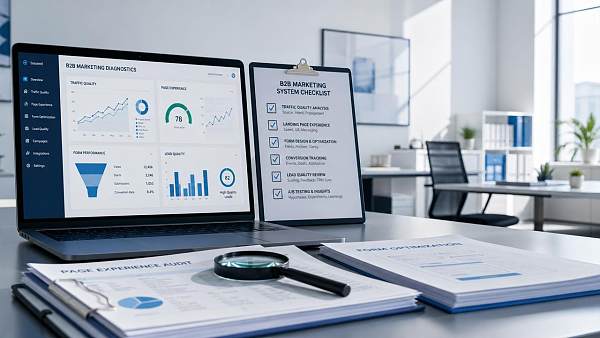
In intelligent website building, SEO optimization, social media marketing, and advertising, YiYingBao typically uses data dashboards to locate breakpoints and then matches pages with marketing actions.
Scenario 1: There are visits but no inquiries; focus on traffic quality.
If website traffic increases but B2B conversion rates don't improve, first check the traffic sources. Broad keywords, low-intent social media clicks, and invalid ad impressions will all lower conversion rates.
Key metrics for assessment include dwell time, bounce rate, page depth, country or region of origin, search term intent, and the ratio of new to returning visitors.
- High traffic for brand keywords indicates strong trust, and the inquiry entry point should be optimized.
- The problem keywords have high traffic, so solutions and case studies should be added.
- Price-related keywords have high traffic; therefore, pricing logic and configuration details should be added.
Scenario 2: The page is viewed, but no further action is taken.
When visitors spend a considerable amount of time browsing but don't click on buttons, it usually means the page's value isn't expressed directly enough. Low B2B conversion rates often stem from the perception that visitors "understand but don't believe."
The first screen of the page should clearly state the target audience, core capabilities, deliverables, and next steps. Don't make visitors search for answers across multiple pages.
For integrated website and marketing services, the page should not simply state "full-service solution." It should also demonstrate how website building, SEO, social media, and advertising work together to acquire customers.
Page Decision Checklist
- Does the first screen explain the specific business results?
- Does the case study include industry, target, and data?
- Is the button close to content that elicits high interest?
- Does the loading process on mobile devices load smoothly?
Scenario 3: Many buttons clicked, few form submissions
If the button click-through rate is good, but the form completion rate is low, it means that the intention has already been generated, and the obstacle lies in the submission stage. In this case, optimizing the form is more effective than increasing traffic.
In B2B conversion rate optimization, more form fields may lead to clearer lead quality, but may decrease the willingness to submit. A layered design based on business stages is recommended.
- For initial consultation: simply provide your name, contact information, and a brief description of your needs.
- Solution evaluation: Increase budget, region, target market.
- In-depth quote: Further collect information on the current status of the website, advertising, and content.
It's also important to clearly define the feedback after submission. For example, "provide diagnostic suggestions within one business day" reduces psychological costs more than "submit immediately".
The B2B conversion rate varies greatly depending on the scenario.
Scenario adaptation suggestions: forming a closed loop from diagnosis to optimization
Improving B2B conversion rates requires more than just changing a single button. A more reliable approach is to integrate the website, content, channels, and data into a comprehensive optimization loop.
- Use data to tag each conversion node and identify the drop-off points.
- Reorganize SEO pages and ad landing pages according to search intent.
- Enhance trust through case studies, qualifications, and processes.
- Configure different forms and scripts for different channels.
- Follow up on leads by category, budget, and region.
YiYingBao leverages artificial intelligence and big data capabilities to help businesses analyze visitor behavior, content performance, and advertising returns, making B2B conversion rate optimization more quantifiable.
Common misjudgment: Don't attribute all problems to the page.
Even after some websites have been redesigned, their B2B conversion rates remain low. This is not because the pages lack value, but because the traffic intent and the page's promises do not match.
Some companies only pursue the quantity of forms, neglecting the quality of leads. The more low-quality leads there are, the higher the subsequent communication costs, and the lower the sales efficiency.
- Do not use a single average conversion rate to judge all channels.
- Don't direct all visitors to the same landing page.
- Don't overlook the mobile form experience.
- Don't just look at the number of submissions, also look at the contribution to transaction volume.
Action-oriented approach: Identify the real bottleneck through a single system-wide investigation.
If the B2B conversion rate remains low for an extended period, it is recommended to conduct a comprehensive diagnostic test first: examine the traffic sources, page paths, form data, and lead results.
Then decide whether to adjust SEO content, refactor landing pages, optimize ad placement, or improve lead grading and follow-up processes.
Yiyingbao Information Technology provides integrated solutions for intelligent website building, SEO optimization, social media marketing, and advertising, helping businesses establish a sustainable growth mechanism from customer acquisition to conversion.
A truly effective way to improve B2B conversion rates is not through a single redesign, but through continuous investigation, verification, and iteration, making each visit closer to a valid business opportunity.
Related Articles

Related Products
 EasyCamp SaaS Smart Website Marketing SystemE-Yingbao SaaS Smart Website Marketing System: AI-powered, zero-code website building. Rapidly launch multilingual independent e-commerce sites in just 10 minutes. Global server acceleration and AI-driven SEO optimization empower businesses to efficiently connect with global markets. The seamless integration of technology and user-friendly operation makes building e-commerce sites incredibly simple.
 AI+SEM Intelligent Advertising Marketing SystemAI+SEM drives intelligent ad creation, empowering full-funnel precision advertising marketing. The system automatically generates weekly/monthly reports, AI recommends keywords and target countries, monitors core metrics in real-time with intelligent alerts, and enables one-click high-conversion ad solutions to help quickly acquire customers and improve ROI.
 AI+SEO Dual Engine Optimization ServiceEasyWin AI+SEO Dual Engine Optimization System leverages AI-powered keyword mining, content generation, and comprehensive technical optimization to help foreign trade enterprises acquire high-quality organic traffic, significantly improving search rankings and conversion rates.
 AI+SNS Social Media Marketing SystemYingbao AI+SNS Social Media Marketing System - Precision social capture for the social media era. Supports one-click content synchronization across major platforms like Facebook and LinkedIn. AI intelligently rewrites posts for enhanced relevance. 24/7 AI customer service and user profiling analysis empower businesses to efficiently expand into global markets.
 AI+SEO营销解决方案易营宝AI+SEO营销解决方案,通过AI批量写作、智能生成TDK、精准关键词扩词等功能,全面优化网站SEO效果,提升流量与转化率。助力企业构建高效智能网站新生态。
 AI+SEM Advertising Marketing SolutionsAI+SEM Advertising Marketing Solution leverages AI technology to deeply empower SEM ad campaigns. It automatically generates weekly/monthly reports using AI, presenting account data across multiple dimensions for comprehensive insights into campaign performance and trends. The system precisely recommends keywords and target countries, intelligently generates high-conversion ad copy, and enables one-click activation of efficient campaign plans to help businesses rapidly acquire customers. Simultaneously, it monitors core metrics in real time, intelligently identifies abnormal fluctuations, and issues timely alerts to ensure stable, high-return advertising results.
 Domain Name ServicesEasyWin provides professional domain name services, including intelligent queries, one-stop registration, brand protection, and full lifecycle management, helping businesses build a digital brand image.
 EasyOperate B2C Cross-Border E-Commerce Platform & Independent WebsiteEasyStore B2C Cross-border E-commerce Independent Store is an intelligent website building and cross-border e-commerce integrated solution independently developed by EasyStore Information Technology (Beijing) Co., Ltd. The system is specially designed for small and medium-sized as well as large export enterprises, integrating 'website building, operation, marketing, advertising, and conversion' into one, helping enterprises quickly establish cross-border e-commerce independent stores to achieve brand globalization and global sales growth.
The platform supports multiple languages, multiple currencies, and multi-channel marketing, with built-in AI intelligent translation and SEO optimization systems, suitable for mainstream markets such as Southeast Asia, Europe and America, Latin America, and the Middle East, assisting Chinese manufacturing enterprises in efficiently deploying international e-commerce strategies. SSL证书易营宝提供专业SSL安全证书服务,包括单域名和泛域名证书,确保网站数据传输加密、身份验证和完整性保护,助力企业建立安全可信的在线业务环境。









