









- What stages does the cross-border services ecosystem include? How do website building, promotion, payment, and compliance work togetherJun 22, 2026View details
- How will email marketing costs change in 2026Jun 22, 2026View details
- The China-US tariff arrangement has reached a preliminary consensus, and the trade association will be establishedJun 15, 2026View details
- Should overseas brand marketing start with ads or contentJun 21, 2026View details
- What determines B2C cross-border e-commerce website development costs? A breakdown of features, interfaces, and deployment methodsJun 17, 2026View details
- China-Morocco zero-tariff access, a breakthrough in the cost of Moroccan goods exports to ChinaJun 11, 2026View details
What to do if WhatsApp security code changes frequently?
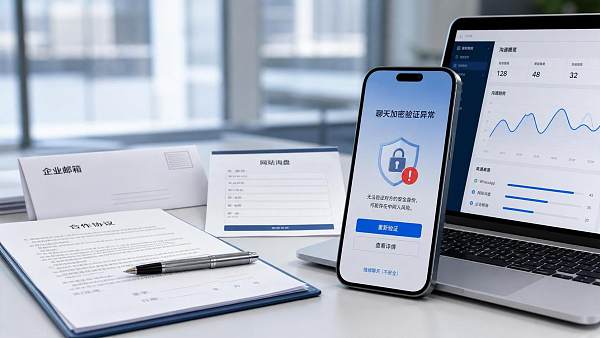
What should you do if WhatsApp security codes change frequently? This is usually related to device changes, reinstalling the app, or account settings. This article will help you quickly understand the reasons, identify risks, and master safer ways to respond, avoiding misjudgments and information leaks.
For foreign trade businesses, cross-border e-commerce sellers, and brand overseas teams, WhatsApp is not just a chat tool, but also an important touchpoint for customer communication, inquiry follow-up, and after-sales service. Once security codes change frequently, it can lightly affect communication trust, and more seriously trigger account risks, customer data leakage, and interrupted marketing chains. This is especially true in multi-member collaboration, overseas marketing promotion, and independent site customer acquisition scenarios, where a clear mechanism for checking and handling is even more necessary.
Why Do WhatsApp Security Codes Change Frequently
In essence, WhatsApp security codes are used to verify end-to-end encryption status. When a contact changes phone, reinstalls the app, switches primary devices, or when the system updates encryption keys, the security code may change. If the reminder appears 2 times or more within 7 days, it is worth a further check rather than simply ignoring it.
Common Reasons Do Not Always Mean the Account Was Stolen
Many business users, upon seeing a security code change, immediately worry that the account has been monitored. In fact, about 3 of the common reasons are normal: device replacement, app reinstallation, and automatic system updates; another 2 require special attention: login from an unfamiliar device and abnormal number migration. The key is to judge based on the frequency of changes, the timing, and whether the other party's identity can be verified.
The table below can help teams quickly distinguish between “normal changes” and “high-risk changes,” and is especially suitable for customer service, sales follow-up, and social media marketing roles to establish internal handling standards.
The key conclusion is: a security code change itself does not mean the account has been stolen, but if it changes multiple times within 24 hours and is accompanied by an avatar, signature, or abnormal reply style, it should be handled as a high-risk event. For businesses, the most worrying thing is not the reminder itself, but the lack of standardized actions within the team, which leads to incorrect object selection for quotation sheets, payment methods, or website backend information.
What Is the Relationship with Website and Marketing Operations
In a website + marketing service integrated scenario, WhatsApp is often connected with independent site forms, landing pages, Facebook lead ads, and customer service assignment processes. If security verification management is not in place, it may affect 3 key links: inquiry authenticity judgment, customer conversion rate, and brand trust maintenance. Especially for companies doing Google SEO and ad placements, front-end customer acquisition costs often continue to accumulate, and a single piece of wrong information may waste follow-up results for 7 to 30 days.
How Should a Business Team Investigate and Respond
For frequent WhatsApp security code changes, it is recommended that businesses establish a “4-step investigation method” for sales, customer service, operations, and management to execute uniformly. This can both reduce misjudgments and protect customer data, website backend accounts, and marketing data from being exposed along with them.
4-Step Investigation Process
- First confirm the timing: did it occur within 1–3 days after a device change, reinstallation, or network switch.
- Then verify identity: perform secondary verification through email, official website contact methods, or historical call records.
- Temporarily stop sending sensitive information: before identity is confirmed, do not send contracts, payment accounts, or website permissions.
- Record and classify: log risks as low, medium, or high levels to facilitate team review.
Which Information Must Be Temporarily Withheld
If security code reminders keep appearing, it is recommended to suspend sending at least 4 types of content for 12–24 hours: quotation details, payment accounts, customer lists, and website or ad account permissions. For businesses using overseas independent sites, AI website-building systems, and multilingual official websites, this is especially important, because once account permissions leak out, the subsequent losses are often much higher than a single order amount.
To help teams make consistent judgments across different business touchpoints, you can refer to the following risk response table, which is suitable for embedding into enterprise customer service SOPs or marketing operation manuals.
For B2B export businesses, the truly effective approach is not to rely on personal experience alone, but to integrate communication security into website inquiries, CRM follow-up, and ad lead conversion processes. Only when front-end lead generation and back-end verification are synchronized can the dual losses of “leads arriving but not being followed up” or “misinformation contacting the wrong person” be reduced.
How to Reduce Risk from the Marketing and Systems Perspective
If a business relies on WhatsApp for overseas customer development over the long term, the chat tool alone is not enough; it also needs website, forms, email, and marketing systems to verify each other. It is recommended to configure at least 3 stable touchpoints: the company website, company email, and a unified customer service channel. In this way, even if one instant messaging channel experiences an issue, the business chain will not be completely interrupted.
A More Stable Digital Combination
- Display the official website form, email, and WhatsApp button synchronously on the independent site contact page to avoid single-point dependency.
- Send important quotations through 2 channels synchronously, such as WhatsApp + company email.
- Website backend, ad accounts, and customer service tools should adopt permission-based management and be reviewed at least once every 90 days.
- Use a customer management process with record-keeping capability to retain key confirmation nodes for easier tracing.
Why an Integrated Solution Is More Suitable for Overseas Teams
For companies that promote multilingual website building, Google SEO, ad placements, and overseas social media simultaneously, an integrated solution can better connect traffic entry points, customer data, and communication behavior. Solutions like YiYingBao, an AI-driven enterprise SaaS smart website-building and overseas marketing platform, are suitable for teams that need to take into account website construction, lead acquisition, and risk control at the same time, improving conversion efficiency while also reducing management loopholes caused by fragmented communication channels.
If your team frequently communicates with overseas customers through WhatsApp, frequent security code changes are nothing to fear; the key is to have actionable identification standards, classification processes, and backup communication mechanisms. Integrating instant messaging security into independent sites, SEO lead generation, ad conversion, and customer management systems is the only way to truly reduce misjudgment and leakage risks. If you want to optimize overseas independent site building, marketing lead generation channels, and customer communication security simultaneously, welcome to contact YiYingBao for a customized solution that is more suitable for enterprise overseas expansion scenarios.
Related Articles
Related Products
 EasyCamp SaaS Smart Website Marketing SystemE-Yingbao SaaS Smart Website Marketing System: AI-powered, zero-code website building. Rapidly launch multilingual independent e-commerce sites in just 10 minutes. Global server acceleration and AI-driven SEO optimization empower businesses to efficiently connect with global markets. The seamless integration of technology and user-friendly operation makes building e-commerce sites incredibly simple.
 AI+SEM Intelligent Advertising Marketing SystemAI+SEM drives intelligent ad creation, empowering full-funnel precision advertising marketing. The system automatically generates weekly/monthly reports, AI recommends keywords and target countries, monitors core metrics in real-time with intelligent alerts, and enables one-click high-conversion ad solutions to help quickly acquire customers and improve ROI.
 AI+SEO Dual Engine Optimization ServiceEasyWin AI+SEO Dual Engine Optimization System leverages AI-powered keyword mining, content generation, and comprehensive technical optimization to help foreign trade enterprises acquire high-quality organic traffic, significantly improving search rankings and conversion rates.
 AI+SNS Social Media Marketing SystemYingbao AI+SNS Social Media Marketing System - Precision social capture for the social media era. Supports one-click content synchronization across major platforms like Facebook and LinkedIn. AI intelligently rewrites posts for enhanced relevance. 24/7 AI customer service and user profiling analysis empower businesses to efficiently expand into global markets.
 AI+SEO营销解决方案易营宝AI+SEO营销解决方案,通过AI批量写作、智能生成TDK、精准关键词扩词等功能,全面优化网站SEO效果,提升流量与转化率。助力企业构建高效智能网站新生态。
 AI+SEM Advertising Marketing SolutionsAI+SEM Advertising Marketing Solution leverages AI technology to deeply empower SEM ad campaigns. It automatically generates weekly/monthly reports using AI, presenting account data across multiple dimensions for comprehensive insights into campaign performance and trends. The system precisely recommends keywords and target countries, intelligently generates high-conversion ad copy, and enables one-click activation of efficient campaign plans to help businesses rapidly acquire customers. Simultaneously, it monitors core metrics in real time, intelligently identifies abnormal fluctuations, and issues timely alerts to ensure stable, high-return advertising results.
 Domain Name ServicesEasyWin provides professional domain name services, including intelligent queries, one-stop registration, brand protection, and full lifecycle management, helping businesses build a digital brand image.
 EasyOperate B2C Cross-Border E-Commerce Platform & Independent WebsiteEasyStore B2C Cross-border E-commerce Independent Store is an intelligent website building and cross-border e-commerce integrated solution independently developed by EasyStore Information Technology (Beijing) Co., Ltd. The system is specially designed for small and medium-sized as well as large export enterprises, integrating 'website building, operation, marketing, advertising, and conversion' into one, helping enterprises quickly establish cross-border e-commerce independent stores to achieve brand globalization and global sales growth.
The platform supports multiple languages, multiple currencies, and multi-channel marketing, with built-in AI intelligent translation and SEO optimization systems, suitable for mainstream markets such as Southeast Asia, Europe and America, Latin America, and the Middle East, assisting Chinese manufacturing enterprises in efficiently deploying international e-commerce strategies. SSL证书易营宝提供专业SSL安全证书服务,包括单域名和泛域名证书,确保网站数据传输加密、身份验证和完整性保护,助力企业建立安全可信的在线业务环境。









