









- Cross-Border Marketing Trend Research: Why More and More Companies Are Starting to Deploy AI Search and GEO OptimizationJun 30, 2026View details
- Cross-Border Marketing Trend Research: How Independent Sites, AI Content, and Short-Video Customer Acquisition Are ChangingJun 30, 2026View details
- How Can a Brand Updates Page Be Made More SEO-Friendly? Analysis of Update Frequency, Content Structure, and Internal Linking StrategyJun 28, 2026View details
- What stages does the cross-border services ecosystem include? How do website building, promotion, payment, and compliance work togetherJun 22, 2026View details
- How will email marketing costs change in 2026Jun 22, 2026View details
- The China-US tariff arrangement has reached a preliminary consensus, and the trade association will be establishedJun 15, 2026View details
LinkedIn Operation Methods for B2B Companies: How Industrial Product Accounts Align Content and Customer Acquisition
For Industrial Product Accounts on LinkedIn, Don’t Rush to Chase “More Posts”
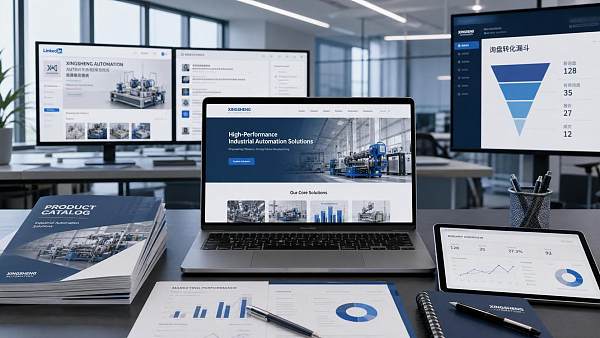
For B2B companies, the real challenge in LinkedIn operation is usually not the volume of content, but whether the content can support customer acquisition. For industrial product accounts, customers have long evaluation cycles, in-depth technical communication, and multiple decision-making layers. If an account only stays at the level of company updates, it is difficult to generate a steady flow of leads.
A more common situation is that the website, SEO, advertising, and social media are each being promoted separately. In the end, everyone is doing communication, but no one is connecting the customer touchpoints. To create value from industrial product content, LinkedIn must work together with independent website landing pages, case study pages, inquiry entry points, and sales follow-up. This is also the dividing line that determines whether a LinkedIn operation method for B2B companies can truly be implemented.
In the actual work of website + marketing service integration, LinkedIn is better suited to the tasks of “building professional awareness, encouraging further visits, and driving lead accumulation.” The value of a platform like 易营宝, which covers intelligent website building, SEO optimization, overseas social media, and advertising at the same time, lies in connecting content exposure with the on-site conversion journey, rather than isolating account operation as a single action.
In Different Industrial Product Scenarios, LinkedIn Operation Methods for B2B Companies Are Not the Same
Industrial product accounts may all appear to be talking about products, but their application scenarios vary greatly. Highly standardized products are more suitable for building trust through comparison, model selection, and delivery efficiency. Highly customized products, on the other hand, need to persuade customers through process capabilities, project experience, and problem-solving capabilities.
If the target regions are different, the key evaluation points will also change. North America and Europe usually pay more attention to certifications, stability, and long-term supply capabilities. Markets such as Southeast Asia, the Middle East, and Latin America often focus more on delivery time, communication efficiency, and cost performance. A LinkedIn operation method for B2B companies cannot simply be copied around one template. It must adjust content based on the market, product complexity, and transaction path.
Standard Product Accounts Need to “Filter Traffic” More
A common misjudgment for this type of industrial product account is treating LinkedIn as a specification bulletin board. Specifications are certainly important, but simply listing parameters makes it difficult for potential leads to judge the differences. A more effective approach is to develop content around delivery cycles, application stability, alternative compatibility, and common model selection misunderstandings, so that the content first completes basic filtering.
At this point, website content needs to work in sync. Posts are responsible for raising the issue, landing pages are responsible for receiving search and visits, case study pages are responsible for adding evidence, and inquiry forms are responsible for capturing leads. Without website support, LinkedIn operation methods for B2B companies can easily remain at the exposure level.
Customized Projects Depend More on “Process Credibility”
Customized equipment, non-standard parts, and complex integrated solutions are usually not something that can trigger communication with just one product introduction. The content focus should be placed on requirement clarification, sampling processes, quality control, delivery milestones, and past project experience, allowing external visitors to see the collaboration logic rather than only finished product photos.
In this type of scenario, LinkedIn account content is best connected with a multilingual official website. The reason is straightforward: complex projects often involve cross-regional communication. If the website can provide multilingual case studies, structured technical pages, and clear contact entry points, the trust generated by content is more likely to turn into valid inquiries.
In High-Frequency Operation Scenarios, How Should Content and Customer Acquisition Be Divided
Many industrial product accounts fail to produce results for a long time not because they lack content, but because the content has no division of roles. A LinkedIn operation method for B2B companies should first clarify the role of each type of content before deciding the posting rhythm.
From this perspective, a LinkedIn operation method for B2B companies is more like a content distribution and lead management mechanism. Posts do not need to sell products in every piece, but each type of content must know which step of conversion it serves.
Truly Useful Content Often Comes from the Sales Front Line and Website Data
The biggest risk for industrial product content is talking only to itself. In actual operations, the highest-priority topics are usually not decided subjectively by the brand department, but come from inquiry records, chat questions, search terms, and landing page dwell-time data. Which questions are asked repeatedly and which pages tend to lose visitors after visits often determine what LinkedIn should talk about in the next stage.
If a company has already built an independent website and deployed Google SEO, then LinkedIn operation methods for B2B companies can reuse on-site content, but not by simply copying and pasting it. Website articles are suitable for explaining a complete logic, while LinkedIn is better suited to breaking it down into judgment points, case snippets, and application reminders, and then directing high-intent traffic to more complete pages.
- Frequently asked inquiry questions can be broken down into short posts and serial topics.
- High-traffic pages can be refined into angles that are more suitable for social media communication.
- Case study pages with high conversion rates should focus on receiving LinkedIn visits.
- Directions where low-quality leads are concentrated require stronger content filtering adjustments.
What Is Most Easily Overlooked Before Implementation Is Not Posting Frequency, but Fit Conditions
Many industrial product accounts look very active, but their lead quality is not high. The problem often lies in failing to confirm fit conditions in advance. For example, the content emphasizes performance but does not explain applicable working conditions; it emphasizes case studies but does not clarify project boundaries; it emphasizes global service but does not provide local response methods. As a result, traffic arrives, but evaluation stops.
If a LinkedIn operation method for B2B companies is to take both content and customer acquisition into account, at least several conditions should be checked in advance: whether the website has stable receiving pages, whether the inquiry entry point is clear, whether the content covers the certifications and application information that the target market cares about, and whether the sales side can promptly follow up on leads from social media.
This is also why integrated operation is becoming increasingly important. A service system like 易营宝, which integrates intelligent website building, SEO, advertising, and overseas social media, is more suitable for industrial product companies pursuing long-term growth. This is not because there are more tools, but because content, traffic, pages, and lead attribution can finally be viewed within the same journey.
Several Common Misjudgments Often Slow Down the Growth of Industrial Product Accounts
One common misjudgment is using peer content as the only reference. It is very easy for industrial product industries to imitate each other, resulting in similar pages, similar posts, and similar selling points, which ultimately makes it difficult to build recognizability. A more effective LinkedIn operation method for B2B companies is to return to their own delivery advantages and application experience, rather than copying what others are saying.
Another misjudgment is focusing only on short-term engagement and ignoring long-term conversion. Some content receives many likes but does not bring website visits or inquiries. Some content spreads only moderately, but the visits it brings go deeper and stay longer. What industrial product accounts should look at is not surface-level popularity, but whether the content later enters the official website, case studies, forms, and email communication.
There is also a situation where the same expression is used to cover all markets. In reality, different regions have different concerns about delivery, certification, language, and application cases. The more complete the multilingual website and localized content configuration are, the more likely visits from LinkedIn are to complete the next step of evaluation.
If You Are Preparing for Long-Term Inquiry Growth, You Can Start with These Steps
If you want to truly apply LinkedIn operation methods for B2B companies to an industrial product business, there is no need to pursue complexity at the starting stage. First clarify account positioning, content role division, and website support, then gradually scale up the rhythm. This is often more effective than blindly updating at a high frequency.
- First clarify whether the product is a standard product or a customized project.
- Then confirm which evaluation conditions the target market cares about most.
- Complete the official website case studies, landing pages, and form entry points in sync.
- Build a quarterly content topic library based on inquiry questions.
- Continuously track post visits, page dwell time, and lead quality.
Ultimately, operating an industrial product account on LinkedIn is not about making the platform look busy, but about allowing professional content to enter real business processes. As long as content, the website, and sales actions can stay aligned, LinkedIn operation methods for B2B companies will no longer be only a branding activity, but will gradually become a stable entry point for overseas customer acquisition.
Related Articles
 LinkedIn Operation Methods for B2B Companies: How Industrial Product Accounts Align Content and Customer Acquisition
 How to Build a Global Social Media Content Operations Matrix? Practical Guide to Platform Roles, Content Pillar Planning, and Publishing Cadence
 What Types of Social Media Operations Tools Are There? Comparison of Scheduling, Collaboration, Monitoring, and Direct Message Management Features

Related Products
 EasyCamp SaaS Smart Website Marketing SystemE-Yingbao SaaS Smart Website Marketing System: AI-powered, zero-code website building. Rapidly launch multilingual independent e-commerce sites in just 10 minutes. Global server acceleration and AI-driven SEO optimization empower businesses to efficiently connect with global markets. The seamless integration of technology and user-friendly operation makes building e-commerce sites incredibly simple.
 AI+SEM Intelligent Advertising Marketing SystemAI+SEM drives intelligent ad creation, empowering full-funnel precision advertising marketing. The system automatically generates weekly/monthly reports, AI recommends keywords and target countries, monitors core metrics in real-time with intelligent alerts, and enables one-click high-conversion ad solutions to help quickly acquire customers and improve ROI.
 AI+SEO Dual Engine Optimization ServiceEasyWin AI+SEO Dual Engine Optimization System leverages AI-powered keyword mining, content generation, and comprehensive technical optimization to help foreign trade enterprises acquire high-quality organic traffic, significantly improving search rankings and conversion rates.
 AI+SNS Social Media Marketing SystemYingbao AI+SNS Social Media Marketing System - Precision social capture for the social media era. Supports one-click content synchronization across major platforms like Facebook and LinkedIn. AI intelligently rewrites posts for enhanced relevance. 24/7 AI customer service and user profiling analysis empower businesses to efficiently expand into global markets.
 AI+SEO营销解决方案易营宝AI+SEO营销解决方案,通过AI批量写作、智能生成TDK、精准关键词扩词等功能,全面优化网站SEO效果,提升流量与转化率。助力企业构建高效智能网站新生态。
 AI+SEM Advertising Marketing SolutionsAI+SEM Advertising Marketing Solution leverages AI technology to deeply empower SEM ad campaigns. It automatically generates weekly/monthly reports using AI, presenting account data across multiple dimensions for comprehensive insights into campaign performance and trends. The system precisely recommends keywords and target countries, intelligently generates high-conversion ad copy, and enables one-click activation of efficient campaign plans to help businesses rapidly acquire customers. Simultaneously, it monitors core metrics in real time, intelligently identifies abnormal fluctuations, and issues timely alerts to ensure stable, high-return advertising results.
 Domain Name ServicesEasyWin provides professional domain name services, including intelligent queries, one-stop registration, brand protection, and full lifecycle management, helping businesses build a digital brand image.
 EasyOperate B2C Cross-Border E-Commerce Platform & Independent WebsiteEasyStore B2C Cross-border E-commerce Independent Store is an intelligent website building and cross-border e-commerce integrated solution independently developed by EasyStore Information Technology (Beijing) Co., Ltd. The system is specially designed for small and medium-sized as well as large export enterprises, integrating 'website building, operation, marketing, advertising, and conversion' into one, helping enterprises quickly establish cross-border e-commerce independent stores to achieve brand globalization and global sales growth.
The platform supports multiple languages, multiple currencies, and multi-channel marketing, with built-in AI intelligent translation and SEO optimization systems, suitable for mainstream markets such as Southeast Asia, Europe and America, Latin America, and the Middle East, assisting Chinese manufacturing enterprises in efficiently deploying international e-commerce strategies. SSL证书易营宝提供专业SSL安全证书服务,包括单域名和泛域名证书,确保网站数据传输加密、身份验证和完整性保护,助力企业建立安全可信的在线业务环境。









