









- The China-US tariff arrangement has reached a preliminary consensus, and the trade association will be establishedJun 15, 2026View details
- What determines B2C cross-border e-commerce website development costs? A breakdown of features, interfaces, and deployment methodsJun 17, 2026View details
- China-Morocco zero-tariff access, a breakthrough in the cost of Moroccan goods exports to ChinaJun 11, 2026View details
- What signal should be released for the suspension of exports to JapanJun 10, 2026View details
- China's May LNG imports rebounded, with increased volumes from Russia and Canada filling the Middle East supply gapJun 10, 2026View details
- Will GEO change its SEO strategy?Jun 04, 2026View details
How can a foreign trade website translation balance lead generation conversion? Writing recommendations for product pages, case pages, and FAQs
When translating an export website, first look at the conversion path, not just whether the language reads smoothly

What really affects translation for an export website is not only page readability, but also whether visitors want to keep learning, whether they are willing to submit an inquiry, and whether they can make a quick decision. Many websites in English do not seem to have obvious errors, but product pages lack trust signals, case pages only show the process but not the results, and FAQ pages do not address payment, delivery, certification, or after-sales support. This kind of content structure is hard to support overseas lead generation.
In actual application, different pages are responsible for different tasks. Product pages are responsible for establishing the first impression and core selling points, case pages are responsible for proving conversion, and FAQ is more like pre-handling objections. If export website translation only pursues a unified surface expression while ignoring the differences in page responsibilities, it is easy for the whole website content to end up as “everything is correct, yet nothing converts”.
Especially in the scenario of integrated websites and marketing services, translated content is no longer an independent link. It simultaneously affects search engine indexing, ad landing page performance, social media traffic retention, and subsequent form submission rates. When Yiyingbao provides long-term multilingual official websites, B2B marketing websites, and cross-border independent sites, it usually first judges whether the content service is exposure, screening, or conversion, and then decides how deep the export website translation should be.
Why product pages, case pages, and FAQ pages cannot use the same writing logic
Although all are export website translation, the stage of the page is different, so the questions visitors care about are different. When they first enter a product page, they care more about whether it matches their needs; when they view a case page, they care more about whether it is truly verifiable; when they read an FAQ, they are often already in a comparison and hesitation stage, focusing on risks and details.
A more common misunderstanding is to translate the whole site into a brochure-like tone. That may seem professional, but it actually weakens inquiry efficiency. Because overseas visitors do not read line by line, they rely more on titles, short paragraphs, data points, and evidence links to quickly judge whether it is worth contacting.
For product pages, the focus of export website translation is “can people judge quickly”
A product page is not just about translating Chinese materials into a foreign language. Effective export website translation first reorganizes the information order. The homepage usually first answers “what it is, what scenario it is suitable for, and why it is worth continuing to read”, and then expands parameters, craftsmanship, certifications, delivery capabilities, and contact methods.
The judgment focus for manufacturing websites and cross-border e-commerce sites is also different. The former pays more attention to specifications, customization, certifications, and delivery times; the latter pays more attention to page loading speed, mobile experience, and whether the purchase path is smooth. If a multilingual site loads slowly or language switching lags, even the best copy will lose traffic. Solutions like Yiyingbao export marketing-type (super) websites will consider multilingual management, global node acceleration, and SEO foundation structure together, to avoid conversion loss caused by the user experience after translated content goes live.
In terms of product page writing, it is recommended to present “parameter explanation” and “application results” side by side. For example, do not only write material, size, and model; also add applicable environments, common delivery ranges, whether customization is supported, and whether there are local certification requirements. What visitors see is a solution, not just product terminology.
Product page content organization that is more suitable for inquiries
- The title should first reflect the product category and core differences, and should not only write the internal model number.
- The hero section selling points should be controlled within short sentences, highlighting delivery, certification, customization, or performance advantages.
- Add application scenarios next to the parameter section to avoid parameters being piled up in isolation.
- Place trust content near the inquiry button, such as service regions, sample cycles, or response times.
A case page is not corporate news, the key is to clearly explain proof of conversion
Many websites have done export website translation, but turned the case page into brand updates. Such pages may be easy to read, but their conversion value is low. Because truly persuasive cases are not about “we worked on a project”, but about “under what background did we solve what problem, and what was the result”.
For B2B wholesale, brand going global, and service export businesses, case pages are especially important. Visitors rarely submit requirements just because of a product description; they often first confirm whether this solution has been validated in similar markets. Case page translation should preserve industry background, cooperation scope, execution cycle, and result indicators, and if necessary explain region, language version, and promotion channel information, as these details more easily build credibility.
If the site itself also undertakes SEO and advertising reception tasks, the case page title should not be too empty either. Compared with “success cases”, it is more suitable to write “inquiry growth after a site launch in a certain region” or “improved indexing performance after multilingual redesign”. This is not only easier to understand in search, but also closer to the decision-making process.
FAQ pages are often underestimated, but they are the closest to the conversion gate
FAQ is often treated as supplementary content, but in fact it is most suitable for handling high-intent traffic. When visitors enter this page, they usually are no longer browsing casually, but confirming risks. Export website translation here cannot only pursue politeness and completeness; it must directly face real questions.
Common high-frequency questions include minimum order quantity, delivery cycle, payment methods, after-sales scope, certificate support, whether private labeling is available, and whether multilingual materials can be provided. The focus also changes by region. European and American sites pay more attention to standards and responsibility boundaries, while Middle East and Southeast Asian markets are often more sensitive to delivery times, communication efficiency, and mobile access experience.
Before landing, what needs to be confirmed is that FAQ cannot be translated by directly copying Chinese customer service Q&A. Many Chinese expressions assume the other party already understands the industry background, but overseas pages need to state the conditions completely. Which services are included, which require extra confirmation, and which data will change with order terms should all be written clearly. The more specific the answers are, the fewer invalid inquiries there will be later.
Under different business scenarios, the adaptation conditions for export website translation are not the same
If a website is responsible for building the site, SEO, ads, and social media traffic acquisition at the same time, the translation strategy cannot only look at a single page. It needs to be set according to business type, regional language, update frequency, and operational capacity. Yiyingbao, which has been deeply engaged in global digital marketing services for more than ten years, usually first looks at the site goals in multi-region projects, and then decides which pages need fine-grained localization and which pages should use a high-efficiency translation workflow.
- Manufacturing websites: prioritize accurate terminology, clear parameters, and consistency between certificates and craftsmanship expressions.
- Cross-border e-commerce sites: place more emphasis on page speed, mobile synchronization, and the efficiency of bulk multilingual maintenance.
- Brand going-global sites: emphasize a unified brand tone, storytelling, and content search visibility.
- Service export sites: focus more on solution explanations, response processes, and completeness of case details.
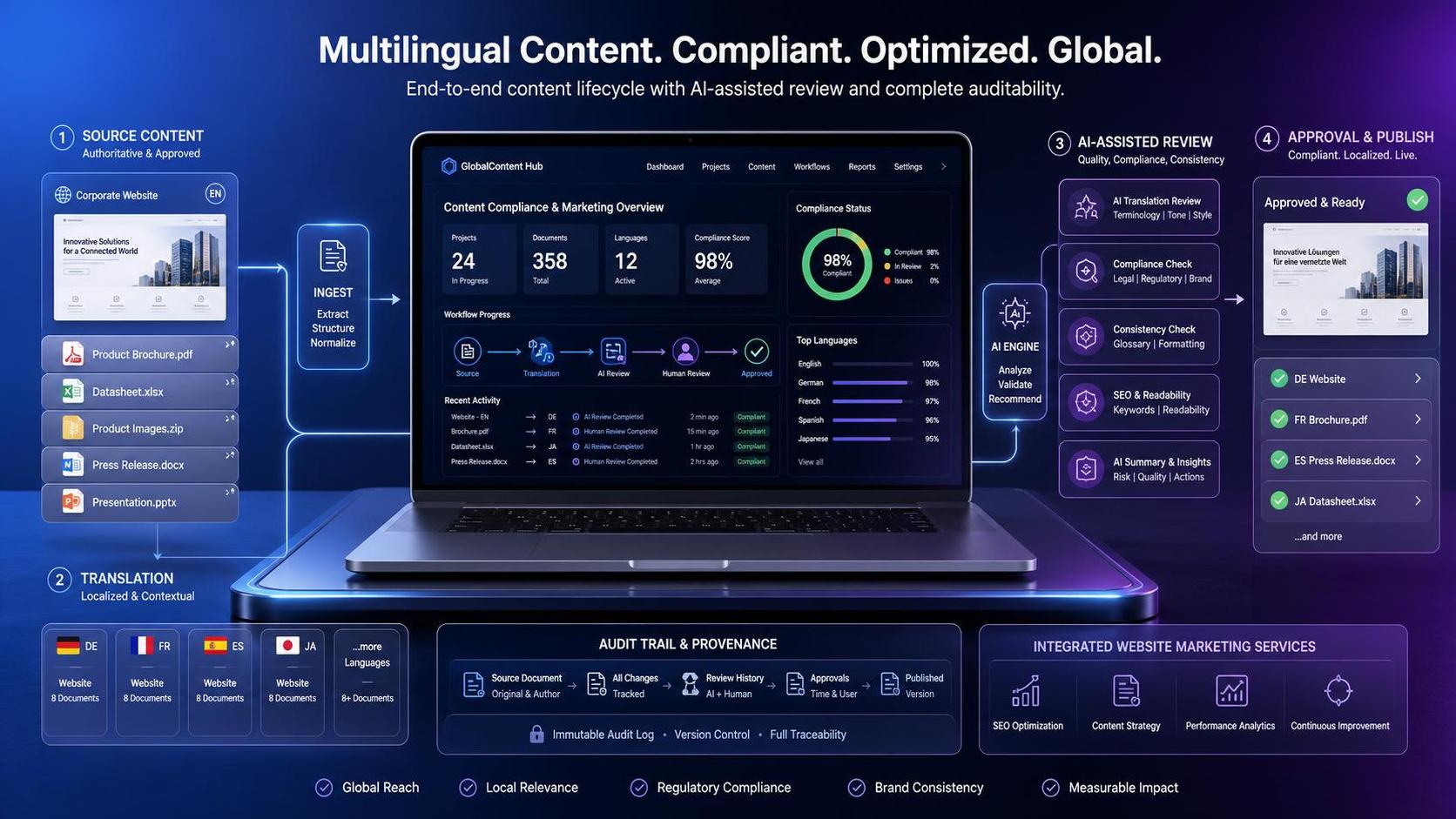
If the site has many language versions and content updates are frequent, manually maintaining each page will quickly become a cost pressure. At that point, it is more suitable to choose a system that supports more than 100 languages, automatic translation combined with human proofreading, and synchronized PC and mobile content. This can ensure launch efficiency and also facilitate later page writing adjustments based on data iteration.
What is easily overlooked at landing time is not translation quality itself, but collaboration issues
The problem with many projects is not single-sentence translation errors, but cross-site collaboration gaps. For example, the title is optimized for keywords, but the body has no corresponding explanation; the case page mentions delivery capability, but the FAQ does not cover logistics and after-sales; the ad landing page promises fast response, but the form follow-up route cannot track the source. Even if such a site looks complete, it is still hard to scale inquiries stably.
Therefore, export website translation should be judged within a complete marketing loop. Page loading speed, search indexing structure, language switching experience, data tracking, and source attribution all determine whether content can deliver value. Some platforms with AI site building, SEO optimization, marketing analysis, and global acceleration capabilities can handle content production, launch efficiency, and conversion analysis in the same system, which is more stable than uploading translated files separately.
If you are planning a multilingual official website or optimizing an existing overseas site, you can first sort out the conversion tasks undertaken by product pages, case pages, and FAQ pages, and then check whether language versions, access speed, SEO structure, and data tracking are consistent. After aligning these basic conditions, export website translation can more easily move from “can be understood” to “can generate inquiries”.
Related Articles
Related Products
 EasyCamp SaaS Smart Website Marketing SystemE-Yingbao SaaS Smart Website Marketing System: AI-powered, zero-code website building. Rapidly launch multilingual independent e-commerce sites in just 10 minutes. Global server acceleration and AI-driven SEO optimization empower businesses to efficiently connect with global markets. The seamless integration of technology and user-friendly operation makes building e-commerce sites incredibly simple.
 AI+SEM Intelligent Advertising Marketing SystemAI+SEM drives intelligent ad creation, empowering full-funnel precision advertising marketing. The system automatically generates weekly/monthly reports, AI recommends keywords and target countries, monitors core metrics in real-time with intelligent alerts, and enables one-click high-conversion ad solutions to help quickly acquire customers and improve ROI.
 AI+SEO Dual Engine Optimization ServiceEasyWin AI+SEO Dual Engine Optimization System leverages AI-powered keyword mining, content generation, and comprehensive technical optimization to help foreign trade enterprises acquire high-quality organic traffic, significantly improving search rankings and conversion rates.
 AI+SNS Social Media Marketing SystemYingbao AI+SNS Social Media Marketing System - Precision social capture for the social media era. Supports one-click content synchronization across major platforms like Facebook and LinkedIn. AI intelligently rewrites posts for enhanced relevance. 24/7 AI customer service and user profiling analysis empower businesses to efficiently expand into global markets.
 AI+SEO营销解决方案易营宝AI+SEO营销解决方案,通过AI批量写作、智能生成TDK、精准关键词扩词等功能,全面优化网站SEO效果,提升流量与转化率。助力企业构建高效智能网站新生态。
 AI+SEM Advertising Marketing SolutionsAI+SEM Advertising Marketing Solution leverages AI technology to deeply empower SEM ad campaigns. It automatically generates weekly/monthly reports using AI, presenting account data across multiple dimensions for comprehensive insights into campaign performance and trends. The system precisely recommends keywords and target countries, intelligently generates high-conversion ad copy, and enables one-click activation of efficient campaign plans to help businesses rapidly acquire customers. Simultaneously, it monitors core metrics in real time, intelligently identifies abnormal fluctuations, and issues timely alerts to ensure stable, high-return advertising results.
 Domain Name ServicesEasyWin provides professional domain name services, including intelligent queries, one-stop registration, brand protection, and full lifecycle management, helping businesses build a digital brand image.
 EasyOperate B2C Cross-Border E-Commerce Platform & Independent WebsiteEasyStore B2C Cross-border E-commerce Independent Store is an intelligent website building and cross-border e-commerce integrated solution independently developed by EasyStore Information Technology (Beijing) Co., Ltd. The system is specially designed for small and medium-sized as well as large export enterprises, integrating 'website building, operation, marketing, advertising, and conversion' into one, helping enterprises quickly establish cross-border e-commerce independent stores to achieve brand globalization and global sales growth.
The platform supports multiple languages, multiple currencies, and multi-channel marketing, with built-in AI intelligent translation and SEO optimization systems, suitable for mainstream markets such as Southeast Asia, Europe and America, Latin America, and the Middle East, assisting Chinese manufacturing enterprises in efficiently deploying international e-commerce strategies. SSL证书易营宝提供专业SSL安全证书服务,包括单域名和泛域名证书,确保网站数据传输加密、身份验证和完整性保护,助力企业建立安全可信的在线业务环境。









