









- Which channel has the highest ROI in the global traffic ecosystem? Comparative analysis of search, social media, and advertisingJul 10, 2026View details
- What multilingual website services are available in Sanya? Which model is more suitable for local businesses going global?Jul 08, 2026View details
- How to view the complete list of China SaaS companies in the top 100? Practical methods for screening website-building and marketing service providersJul 08, 2026View details
- How to view pricing in the global traffic ecosystem? Cost comparison of search, social media, and content channel advertisingJul 06, 2026View details
- How to assess foreign trade website development trends?Looking at 2026 changes from multilingual,AI content to conversion pathsJul 04, 2026View details
- What are the new trends in multilingual marketing data analytics tools in 2026? Focus on attribution、automation and complianceJul 04, 2026View details
How to structure Arabic website SEO? Key points for hierarchy, URL, and hreflang settings
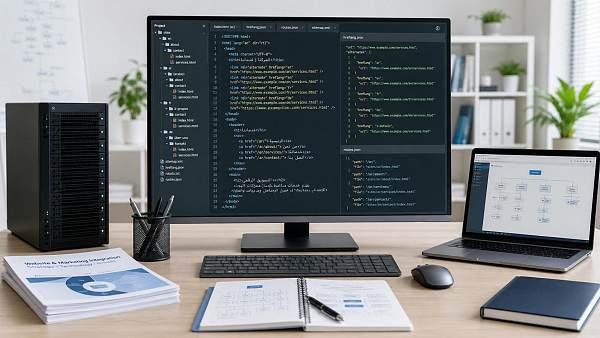
How should the SEO structure of an Arabic website be set up? This is not just a matter of translating pages. What really affects indexing efficiency and multi-region rankings is often whether the directory hierarchy is clear, whether the URL is stable, and whether hreflang accurately passes region and language relationships.
For independent sites targeting the Middle East market, once these basic structures are set up incorrectly, subsequent content optimization, backlink building, and ad traffic acquisition will all be weakened. Especially in website development and marketing integration scenarios, the SEO structure of an Arabic website is more like the underlying framework, determining whether traffic can continue to accumulate.
Why Site Points in Arabic Depend More on Structural Design
The Arabic market is usually not a single-country market. An Arabic page may simultaneously target Saudi Arabia, the UAE, Egypt, Qatar, and other regions, while search intent, keyword competition, and page relevance judgments are not completely consistent.
This means a website cannot simply be an “Arabic version”; it must also handle the matching relationship between language and region. Search engines need to know which page serves which country, and users also need to quickly access the correct content within the site.
From a technical perspective, the SEO structure of an Arabic website bears both the responsibility of crawl guidance and internal authority distribution. If the directory is messy, paths are duplicated, or language versions compete with each other, it becomes difficult for pages to form stable rankings no matter how many there are.
This is also why multilingual website platforms increasingly emphasize structure first. Platforms like Yiyingbao, which integrate intelligent website building, SEO optimization, and overseas marketing, place front-end presentation, search indexing, and subsequent promotion within the same architecture rather than handling them separately.
How to Set Up Directory Hierarchy So Indexing Won’t Be Delayed
The first step in the SEO structure of an Arabic website is to define the relationship between the language directory and the content directory. Usually, the more stable approach is to fix the language layer first, then enter the category layer, rather than scattering language parameters across different page rules.
Common Directory Approaches
- Set up an Arabic directory under the main domain, for example /ar/
- If region distinction is needed, subdivide country layers under the Arabic directory
- Keep product, solutions, cases, and blog sections at a unified level
- Avoid the same content appearing repeatedly in multiple directory sets
In most projects, the directory should not be too deep. The deeper the hierarchy, the longer the crawl path, and the slower internal link equity is passed. For marketing-oriented websites, about three layers is usually more favorable for both scalability and crawlability.
For example, visitors enter the Arabic site from the homepage, then move to the product category, and then to the product details page. This structure is already sufficient to support most B2B lead generation sites or cross-border brand sites. There is no need to force all industries, regions, and product models into the path.
Issues That Need Special Avoidance
- The same page has both dynamic and static paths as two entry points
- No 301 redirect after a section migration
- Arabic and English pages share the same content template but do not distinguish standard links
- Filter pages and search pages are accidentally opened for indexing
These issues may seem like development details, but in practice they directly affect the stability of the SEO structure of an Arabic website. Once search engines interpret the site as a duplicate-content cluster, ranking release speed will slow down significantly.
URL Standards Are Not Just About Appearance, They Also Affect Indexing Efficiency
URL design is often underestimated. For Arabic site points, whether the URL uses Arabic characters, keeps English transliteration, or includes parameters will all affect system compatibility, shareability, and search engine parsing.
It is usually more recommended to use a unified English or transliterated semantic path, while carrying Arabic expression in the page content. The reason is simple: the path is more stable, logs are easier to review, system adaptation costs are lower, and it is also more convenient for ad placement and external citations.
Key Points for URL Setup Judgment
If the site also supports Google ads, social media landing pages, or AI search entry points, the importance of URL standards will be even higher. Because these channels bring a large amount of traffic from different sources, once the path is not unified, both attribution tracking and page accumulation will be compromised.
What hreflang Really Solves Is Version Matching
Many websites have Arabic pages, but the hreflang tags are not set correctly. As a result, English pages, generic Arabic pages, and region-specific Arabic pages compete with each other, and search engines cannot accurately determine which version should be shown to which target users.
The core of hreflang is not to tell search engines “I have multiple languages,” but to tell them “these pages correspond to one another and each serves a different language or region.” This is especially critical for the SEO structure of an Arabic website.
Three Levels to Check When Setting It Up
- Whether the language code is correct, for example Arabic uses ar
- Whether region codes are needed, for example ar-sa, ar-ae
- Whether the versions point to each other bidirectionally and include self-references
If the content is aimed at the entire Arabic market, you can first use a generic Arabic version; if the product, pricing, logistics, certificates, or service scope differ significantly by country, then you should consider splitting regional versions and clearly marking them in hreflang.
A common misconception is that page content is almost identical, yet multiple country pages are forcibly split out. This creates a large number of weakly differentiated pages. The SEO structure of an Arabic website should serve real business differences, not create pages for the sake of form.
Looking at Structure in the Business Scenario Makes Judgment More Accurate
From an application perspective, different types of websites have different requirements for the SEO structure of an Arabic website. Foreign trade lead generation sites place more emphasis on product clustering and industry content linkage, while cross-border malls place more emphasis on category logic, filtering rules, and page deduplication.
If it is a multilingual official website, the focus is usually on clear mapping between brand pages, solution pages, case pages, and contact entry points; if it also adds ad placement and social media operations, then landing page paths must be considered simultaneously to see whether they are incorporated into the main site architecture.
This is also why website and marketing service integration is being taken more and more seriously. If the website building team only handles page launch and does not participate in SEO structure design, later promotion often requires repeated rework to fix early architectural mistakes.
From Yiyingbao’s practical logic, placing cloud intelligent website building, multilingual site management, AI+SEO optimization, and advertising marketing systems under the same framework can help identify directory conflicts, language mapping issues, and regional page configuration deviations earlier, reducing later adjustment costs.
To Evaluate Whether a Structure Is Usable, Check These Items First
In actual evaluation, there is no need to first look at the number of pages; instead, first check whether the basic structure forms a closed loop. As long as this step is unstable, the more content there is, the more complex the problems usually become.
- Whether the language directories are unified and can be expanded long term to more country sites
- Whether the URL is concise, unique, and trackable, and whether it supports standard link management
- Whether hreflang corresponds one-to-one with the real pages, and whether there are missing or mismatched entries
- Whether the breadcrumb, internal links, and sitemap are consistent with the directory logic
- Whether product pages, blog pages, and landing pages use the same indexing rules
- Whether the path remains stable when ads, social media, and AI search traffic are later connected
If these dimensions are clear, the SEO structure of an Arabic website usually already has relatively good executability. Next, content strategy, keyword layout, and external promotion can be judged, and the efficiency will be much higher.
A more practical approach is to first sort out the target market, language versions, and page types, and then review the existing directories, URLs, and hreflang configurations item by item. The earlier structural issues are discovered, the lower the cost of subsequent international SEO and multi-channel growth will be.
Related Articles
 GCC Digital Trade Partner Certification, Precondition for Independent Site Dual Verification and Listing
 SEAEC unified API gateway enabled, ASEAN six-country independent site payments and tax interface entered into hard constraints
 How to plan multilingual B2C cross-border e-commerce store development? Key points for products, payment, and localized user experience


Related Products
 EasyCamp SaaS Smart Website Marketing SystemE-Yingbao SaaS Smart Website Marketing System: AI-powered, zero-code website building. Rapidly launch multilingual independent e-commerce sites in just 10 minutes. Global server acceleration and AI-driven SEO optimization empower businesses to efficiently connect with global markets. The seamless integration of technology and user-friendly operation makes building e-commerce sites incredibly simple.
 AI+SEM Intelligent Advertising Marketing SystemAI+SEM drives intelligent ad creation, empowering full-funnel precision advertising marketing. The system automatically generates weekly/monthly reports, AI recommends keywords and target countries, monitors core metrics in real-time with intelligent alerts, and enables one-click high-conversion ad solutions to help quickly acquire customers and improve ROI.
 AI+SEO Dual Engine Optimization ServiceEasyWin AI+SEO Dual Engine Optimization System leverages AI-powered keyword mining, content generation, and comprehensive technical optimization to help foreign trade enterprises acquire high-quality organic traffic, significantly improving search rankings and conversion rates.
 AI+SNS Social Media Marketing SystemYingbao AI+SNS Social Media Marketing System - Precision social capture for the social media era. Supports one-click content synchronization across major platforms like Facebook and LinkedIn. AI intelligently rewrites posts for enhanced relevance. 24/7 AI customer service and user profiling analysis empower businesses to efficiently expand into global markets.
 AI+SEO营销解决方案易营宝AI+SEO营销解决方案,通过AI批量写作、智能生成TDK、精准关键词扩词等功能,全面优化网站SEO效果,提升流量与转化率。助力企业构建高效智能网站新生态。
 AI+SEM Advertising Marketing SolutionsAI+SEM Advertising Marketing Solution leverages AI technology to deeply empower SEM ad campaigns. It automatically generates weekly/monthly reports using AI, presenting account data across multiple dimensions for comprehensive insights into campaign performance and trends. The system precisely recommends keywords and target countries, intelligently generates high-conversion ad copy, and enables one-click activation of efficient campaign plans to help businesses rapidly acquire customers. Simultaneously, it monitors core metrics in real time, intelligently identifies abnormal fluctuations, and issues timely alerts to ensure stable, high-return advertising results.
 Domain Name ServicesEasyWin provides professional domain name services, including intelligent queries, one-stop registration, brand protection, and full lifecycle management, helping businesses build a digital brand image.
 EasyOperate B2C Cross-Border E-Commerce Platform & Independent WebsiteEasyStore B2C Cross-border E-commerce Independent Store is an intelligent website building and cross-border e-commerce integrated solution independently developed by EasyStore Information Technology (Beijing) Co., Ltd. The system is specially designed for small and medium-sized as well as large export enterprises, integrating 'website building, operation, marketing, advertising, and conversion' into one, helping enterprises quickly establish cross-border e-commerce independent stores to achieve brand globalization and global sales growth.
The platform supports multiple languages, multiple currencies, and multi-channel marketing, with built-in AI intelligent translation and SEO optimization systems, suitable for mainstream markets such as Southeast Asia, Europe and America, Latin America, and the Middle East, assisting Chinese manufacturing enterprises in efficiently deploying international e-commerce strategies. SSL证书易营宝提供专业SSL安全证书服务,包括单域名和泛域名证书,确保网站数据传输加密、身份验证和完整性保护,助力企业建立安全可信的在线业务环境。









