









- What Does a Global Traffic Ecosystem Service Provider Do? What Are the Differences from a Single Advertising AgencyJul 16, 2026View details
- What should you focus on in the latest enterprise SaaS report? From renewal rates and delivery costs to overseas growth opportunitiesJul 12, 2026View details
- What signals are worth paying attention to in a cross-border marketing trend report? B2B companies should look at these 6 signalsJul 11, 2026View details
- How to Read a Cross-Border Marketing Trends Report? Five Key Dimensions for Evaluating Channel OpportunitiesJul 11, 2026View details
- Which channel has the highest ROI in the global traffic ecosystem? Comparative analysis of search, social media, and advertisingJul 10, 2026View details
- What multilingual website services are available in Sanya? Which model is more suitable for local businesses going global?Jul 08, 2026View details
How to Integrate an AI Translation Tool with a Multilingual Website
Before Integrating an AI Translation Tool into a Multilingual Website, First Check Whether the Business Workflow Is Complete
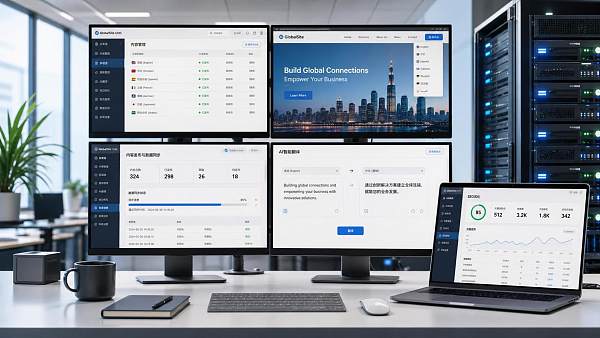
Integrating an AI translation tool into a multilingual website may appear to be a language-processing issue, but in practice it is more like a coordinated transformation of the website architecture and marketing workflow. What truly affects the results after launch is not simply how fast translation is completed, but whether pages can be published in bulk, content in different languages can be continuously updated, search engines can index it consistently, and subsequent advertising campaigns and organic traffic can continue to use the same content assets.
In an integrated website and marketing services scenario, an AI translation tool is rarely deployed in isolation. It must be considered together with the website-building system, page templates, SEO rules, form leads, and advertising landing-page management. Based on its long-term experience serving multilingual corporate websites, cross-border marketplaces, and overseas marketing projects, 易营宝 has found that translation capabilities can be procured, but the real differentiator is whether the integration method matches the pace of the business.
Integration Priorities Differ Across Different Website Types
Even when the same AI translation tool is used, the evaluation criteria for multilingual corporate websites, B2B inquiry websites, and B2C stores are not the same. The reason is straightforward: page structure, update frequency, conversion paths, and search objectives all differ. If every website is handled with a “one-click translation of the entire site” approach, it may seem to save effort at first, but it will usually come at the cost of indexing quality, content consistency, and maintenance efficiency later.
A more common approach is to first distinguish which content is suitable for bulk machine processing and which content must undergo human review, then decide whether to integrate the AI translation tool at the page, field, or content-workflow level. This sequence is important because it can directly reduce rework.
Corporate and Brand Websites Are More Concerned About Distorted Content Than Slow Translation
When integrating an AI translation tool into a brand website, the primary concern is usually not the number of pages, but content stability. Once the meaning of company introductions, service solutions, or case-study pages deviates from the original, overseas visitors do not merely see incomplete information; they perceive an unfocused brand message. This is especially important when targeting North American, European, Japanese, and South Korean markets, where tone, professional wording, and page structure all require greater precision.
For these scenarios, it is more appropriate to integrate the AI translation tool into the content management system rather than attach it directly to the front-end pages for real-time translation. The reason is practical: although real-time translation is fast, SEO fields such as titles, descriptions, navigation, breadcrumbs, and image alt text are easily overlooked. After integration with the CMS, the main content, summaries, and metadata can enter the publishing workflow together, maintaining consistency across multilingual pages.
If the website is also responsible for SEO growth, it is necessary to further determine whether the URL structure, hreflang tags, and language directories can be generated synchronously. Many multilingual websites do not suffer from poor translation quality; instead, search engines fail to identify the independent pages for each language, resulting in delayed indexing and stagnant long-term traffic.
For Product and Inquiry Pages, Terminology and Conversion Information Must Be Accurate
On B2B product pages, the challenges of an AI translation tool shift in another direction. The greatest concern is not whether the sentences sound elegant, but whether parameters, application descriptions, and industry terminology are translated incorrectly. An incorrect material name, certification standard, or unit of measurement does not merely affect the reading experience; it reduces inquiry quality and increases the cost of subsequent communication.
In practice, a more reliable approach is to first establish a terminology database, then use the AI translation tool to process titles, selling points, and application-scenario content in bulk. Content such as product models, units, certifications, and delivery terms should be governed by field-level rules to prevent the model from rewriting them freely. This preserves translation efficiency while controlling deviations in core information.
- First distinguish translatable text from fields that must not be rewritten.
- Create multilingual glossaries for high-frequency product terms.
- Review form buttons, promises, and delivery-period information separately.
- Retain a second round of human refinement for key markets.
Cross-Border Stores Are Updated Faster, So AI Translation Must Connect to Data Flows, Not Just Pages
The biggest difference between an e-commerce scenario and a corporate website is the high frequency of content changes. Product names, variant attributes, inventory status, and promotional copy often change in sync. If the AI translation tool connects only to page text and not to the product database, the result is often untimely updates on multilingual front-end pages and information gaps between category and detail pages.
These projects are better suited to integrating the AI translation tool with product fields, category fields, and promotional campaign modules, combined with scheduled tasks or event-triggered mechanisms for automatic updates. This is particularly important in Southeast Asian, Latin American, and Middle Eastern markets, where more than one multilingual version may be required. Maintaining pages manually one by one is almost impossible to sustain. A truly usable solution must create a closed loop connecting translation, publishing, search indexing, and advertising-material updates.
The value of systems like 易营宝, which integrate intelligent website building, cross-border stores, and overseas marketing, becomes more apparent here. After multilingual content goes live, it must continue to support Google SEO, advertising landing pages, and social media traffic acquisition. If the translation workflow is separated from the marketing workflow, subsequent campaign efficiency will usually be slowed down.
Landing Pages Require Speed, but Not at the Expense of Search and Advertising Coordination
Advertising landing pages are another scenario that is easily misjudged. To go live quickly, many projects directly ask an AI translation tool to generate an entire page and publish multiple language versions within a few hours. Although this appears highly efficient in the short term, advertising data will quickly become distorted if the value propositions, CTA buttons, and conversion paths are inconsistent across language versions.
A more reasonable approach is to use the AI translation tool to generate the first draft, then review the headlines, benefits, form guidance, and compliant wording separately. An advertising page is not merely a translated page; it also carries the task of conversion testing. The copy may consist of only a few lines, but it is actually more sensitive than that of an informational page.
The Real Source of Problems Is Not the Tool Itself, but These Misjudgments
When integrating AI translation tools, many teams assume that “the more languages, the better, and the faster the launch, the better.” However, once a multilingual website enters long-term operation, problems often arise because the initial assessment was too simplistic. Treating similar pages as if they served the same purpose is the most common mistake.
- Looking only at translation API pricing without assessing whether SEO fields can be output synchronously.
- Looking only at the initial launch cycle without considering whether subsequent updates can trigger automatic retranslations.
- Looking only at the quality of the main content without checking forms, buttons, URLs, and meta tags.
- Treating the Russian-speaking regions, Middle East, and Japanese and South Korean markets as having the same localization requirements.
- Treating the AI translation tool as the final result rather than as part of the content workflow.
These issues may not be obvious at the beginning, but once the website enters the stages of indexing, advertising, and lead conversion, the cost of correction will be significantly higher than that of the initial deployment. This is especially true for live multilingual directories, internal links, and historical pages. If their structure is changed later, the SEO cost will be even greater.
Before Integration, Confirm These Conditions First
To ensure that an AI translation tool genuinely serves a multilingual website, it is advisable to sort out several key conditions according to the implementation sequence. This makes it easier to determine whether a lightweight integration is sufficient or whether the tool should be incorporated directly into the entire content system.
- Confirm the number of language versions and whether regional versions need to be distinguished.
- Identify which pages are responsible for SEO growth and which are responsible for advertising conversions.
- List the fields that need to be locked, such as specifications, prices, certifications, and policy explanations.
- Check whether the website-building system supports language directories, hreflang, and bulk publishing.
- Define the scope of human review instead of reviewing every page in the same way.
- Assess the frequency of subsequent maintenance to avoid a smooth initial launch followed by long-term loss of control.
If the website also handles overseas social media traffic acquisition, Google advertising, and AI search visibility, the integration criteria for the AI translation tool should go one step further by directly considering whether content can be reused across channels. The value lies not in translating a few fewer pages, but in enabling every future content update to drive both on-site indexing and off-site customer acquisition.
Ultimately, there is no universal answer to how an AI translation tool should be integrated into a multilingual website. It is generally more effective to first clarify the business tasks the website undertakes, then determine the integration level, degree of automation, and boundaries of human review, rather than simply comparing tool parameters. By evaluating the scenario, SEO, and operational maintenance together, a multilingual website is more likely to achieve stable growth after integration.
Related Articles
Related Products
 EasyCamp SaaS Smart Website Marketing SystemE-Yingbao SaaS Smart Website Marketing System: AI-powered, zero-code website building. Rapidly launch multilingual independent e-commerce sites in just 10 minutes. Global server acceleration and AI-driven SEO optimization empower businesses to efficiently connect with global markets. The seamless integration of technology and user-friendly operation makes building e-commerce sites incredibly simple.
 AI+SEM Intelligent Advertising Marketing SystemAI+SEM drives intelligent ad creation, empowering full-funnel precision advertising marketing. The system automatically generates weekly/monthly reports, AI recommends keywords and target countries, monitors core metrics in real-time with intelligent alerts, and enables one-click high-conversion ad solutions to help quickly acquire customers and improve ROI.
 AI+SEO Dual Engine Optimization ServiceEasyWin AI+SEO Dual Engine Optimization System leverages AI-powered keyword mining, content generation, and comprehensive technical optimization to help foreign trade enterprises acquire high-quality organic traffic, significantly improving search rankings and conversion rates.
 AI+SNS Social Media Marketing SystemYingbao AI+SNS Social Media Marketing System - Precision social capture for the social media era. Supports one-click content synchronization across major platforms like Facebook and LinkedIn. AI intelligently rewrites posts for enhanced relevance. 24/7 AI customer service and user profiling analysis empower businesses to efficiently expand into global markets.
 AI+SEO营销解决方案易营宝AI+SEO营销解决方案,通过AI批量写作、智能生成TDK、精准关键词扩词等功能,全面优化网站SEO效果,提升流量与转化率。助力企业构建高效智能网站新生态。
 AI+SEM Advertising Marketing SolutionsAI+SEM Advertising Marketing Solution leverages AI technology to deeply empower SEM ad campaigns. It automatically generates weekly/monthly reports using AI, presenting account data across multiple dimensions for comprehensive insights into campaign performance and trends. The system precisely recommends keywords and target countries, intelligently generates high-conversion ad copy, and enables one-click activation of efficient campaign plans to help businesses rapidly acquire customers. Simultaneously, it monitors core metrics in real time, intelligently identifies abnormal fluctuations, and issues timely alerts to ensure stable, high-return advertising results.
 Domain Name ServicesEasyWin provides professional domain name services, including intelligent queries, one-stop registration, brand protection, and full lifecycle management, helping businesses build a digital brand image.
 EasyOperate B2C Cross-Border E-Commerce Platform & Independent WebsiteEasyStore B2C Cross-border E-commerce Independent Store is an intelligent website building and cross-border e-commerce integrated solution independently developed by EasyStore Information Technology (Beijing) Co., Ltd. The system is specially designed for small and medium-sized as well as large export enterprises, integrating 'website building, operation, marketing, advertising, and conversion' into one, helping enterprises quickly establish cross-border e-commerce independent stores to achieve brand globalization and global sales growth.
The platform supports multiple languages, multiple currencies, and multi-channel marketing, with built-in AI intelligent translation and SEO optimization systems, suitable for mainstream markets such as Southeast Asia, Europe and America, Latin America, and the Middle East, assisting Chinese manufacturing enterprises in efficiently deploying international e-commerce strategies. SSL证书易营宝提供专业SSL安全证书服务,包括单域名和泛域名证书,确保网站数据传输加密、身份验证和完整性保护,助力企业建立安全可信的在线业务环境。









