









- Cross-Border Marketing Trend Research: Why More and More Companies Are Starting to Deploy AI Search and GEO OptimizationJun 30, 2026View details
- Cross-Border Marketing Trend Research: How Independent Sites, AI Content, and Short-Video Customer Acquisition Are ChangingJun 30, 2026View details
- How Can a Brand Updates Page Be Made More SEO-Friendly? Analysis of Update Frequency, Content Structure, and Internal Linking StrategyJun 28, 2026View details
- What stages does the cross-border services ecosystem include? How do website building, promotion, payment, and compliance work togetherJun 22, 2026View details
- How will email marketing costs change in 2026Jun 22, 2026View details
- The China-US tariff arrangement has reached a preliminary consensus, and the trade association will be establishedJun 15, 2026View details
What should you do if the SEO ranking of your German-language foreign trade website is not improving? Check each item from keywords to hreflang
If Your German Website Rankings Are Stagnant, Don’t Rush to Only Change Keywords
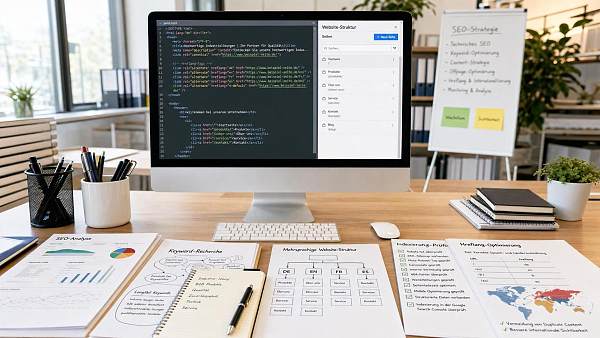
When SEO rankings for a German foreign trade website fail to improve, the common reason is often not that there is too little content, but that the site structure, language versions, crawl signals, and keyword assessment are misaligned together. On the surface, it looks like a ranking issue, but in practice it is often because the website-building logic and marketing logic are not aligned.
Especially in multilingual global expansion scenarios, a German website must not only meet search engine recognition requirements, but also match local search habits. If a website simply translates English pages into German and continues using the original directory and title rules, the SEO rankings of a German foreign trade website are usually difficult to improve steadily.
In actual maintenance, a more effective approach is to check items one by one. Look at the keywords first, then the pages, then the index status, and finally check whether hreflang is truly telling search engines that this is a page system intended for the German-speaking market.
In Different Business Scenarios, the Key Diagnostic Focus Is Not the Same
Even for the same SEO ranking issue on a German foreign trade website, the root causes for a B2B inquiry website and a cross-border e-commerce store are often different. The former relies more on industry terms, solution pages, and trust-building content, while the latter is more likely to get stuck in category structure, duplicate pages, and the indexing of filter links.
If the website has gone live within the last six months, first review indexation and basic page signals. If the website has been operating for a long time but rankings are stagnant, the focus should be on keyword hierarchy, old page quality, and conflicts between language versions. Problems at different stages are not suitable for the same handling method.
This is also why integrated website-building and marketing services are becoming increasingly important. For platforms like 易营宝, which have long worked on multilingual website development and overseas optimization, the value is not only in building websites, but also in handling technical architecture, content deployment, and subsequent SEO operations within the same growth chain.
Several High-Frequency Situations Can Be Distinguished First in This Way
Even If the Keywords Are Not Wrong, Rankings May Still Fail to Rise
Many German foreign trade websites have unsatisfactory SEO rankings not because they have not done keyword work, but because they understand keywords as direct translations. In German search, the same type of product may involve industry abbreviations, compound words, application terms, and regional spelling differences. Directly copying an English keyword list often fails to cover real search demand.
A more common misjudgment is focusing only on major core keywords. In the German-speaking market, inquiry-oriented pages are often more suitable for combinations such as “product term + application term”, “product term + industry term”, and “product term + purchasing condition term”. These keywords are less competitive, while conversion intent is often clearer.
If the homepage, category pages, and product pages are all competing for the same group of German keywords, search engines will find it difficult to determine the main page, resulting in internal competition. When SEO rankings for a German foreign trade website hover on the second page or lower for a long time, this is often the reason.
When Checking Keywords, First Look at These Diagnostic Points
- Whether the title keywords correspond to the page purpose, rather than being generic site-wide terms.
- Whether the German terms conform to local expression, rather than stiff combinations after machine translation.
- Whether keyword hierarchy has been clearly divided between category pages and detail pages.
- Whether there are conversion-supporting long-tail content pages to capture search traffic.
A Normal Page Structure Does Not Mean Search Engines Can Easily Understand It
Some websites look complete on the front end, with no obvious issues in navigation, images, or forms, but SEO rankings for the German foreign trade website still fail to improve. The problems often lie in duplicate title tags, chaotic H tags, overly short body content, or product pages that only contain parameters without application explanations.
For B2B websites, German pages cannot only have translated product names. Search engines pay more attention to whether a page develops around a clear topic and whether it answers questions about application, specifications, delivery, compatibility range, and more. If the content lacks business context, it is difficult for the page to establish topical relevance.
If dozens of German pages were quickly duplicated using templates, it is also necessary to check whether there is a large amount of highly similar content. Too many similar pages will weaken the overall quality assessment and further slow down the improvement of SEO rankings for the German foreign trade website.
Indexation and Crawling Issues Are Often Mistaken for Content Issues
If a page has a lot of content but rankings show no response, do not rush to rewrite it. First confirm whether the German page has truly been crawled, indexed, and treated as a valid page. If there is very little crawling in the logs, or Search Console shows “Discovered, currently not indexed”, then the problem is not with the copy itself.
This situation is very common on multilingual independent websites. For example, German directory levels that are too deep, weak internal entry points, internal links pointing only to English pages, and sitemaps not being updated in time can all leave German pages in a state where they exist but are not active.
If the website uses an integrated website-building system, this is where the technical advantage appears. Data-driven platforms like 易营宝, which cover intelligent website building, SEO operations, and overseas marketing at the same time, can usually locate more quickly whether the issue comes from template output, link structure, or crawl distribution, reducing repeated trial and error.
If English Pages Have Traffic but German Pages Do Not Grow, Focus on Checking hreflang
In troubleshooting SEO rankings for German foreign trade websites, hreflang is one of the most easily overlooked items and also one of the most prone to serious errors. Many websites think that having a language switcher is enough, but search engines need to know clearly which page is intended for which language or regional version.
If hreflang is missing, reciprocal references are incomplete, or the German page is canonicalized back to the English page, search engines may treat the German page as duplicate content. The result is not simply a ranking penalty; rather, the German page may not receive the visibility opportunities it should have at all.
In practical application, a German website must also distinguish whether it targets general German or leans more toward the markets of Germany, Austria, or Switzerland. When business coverage areas differ, language annotations and content wording should also be handled differently. Similar markets cannot be directly treated as having completely identical needs.
When Checking hreflang, Confirm at Least Four Things
- Whether the German page and pages in other languages reference each other reciprocally.
- Whether the URL is an accessible formal page, rather than a redirect page.
- Whether the canonical points to itself to avoid being overridden by the English page.
- Whether the language and region codes match the actual market layout.
Several Misjudgments That Most Easily Occur During Implementation
The first misjudgment is attributing all ranking problems to insufficient content volume. In reality, no matter how many pages there are, if indexation is chaotic or language signals are incorrect, SEO rankings for a German foreign trade website still will not rise.
The second misjudgment is believing that a German website only needs accurate translation. Search optimization focuses on matching search intent, not literal correspondence. When users search for procurement, specifications, certifications, or alternative solutions, the page must provide complete semantic support.
The third misjudgment is looking only at a single page instead of the whole site. If the homepage, category pages, product pages, case pages, and knowledge pages do not have a clear division of roles, even an excellent single page will struggle to form stable rankings.
How to Set the Troubleshooting Order to Better Support Later Maintenance
To improve SEO rankings for a German foreign trade website as quickly as possible, it is recommended to prioritize according to the impact chain rather than by departmental division of labor. First confirm indexation and hreflang, then handle keyword-to-page mapping, and finally supplement content and internal links. This makes it easier to see phased results.
If the website also carries tasks such as advertising landing pages, social media traffic acquisition, or AI search visibility, page development should not focus only on organic rankings. The website-building system, content organization, and SEO strategy are best coordinated within the same framework to avoid fixing one channel while creating conflicts in another.
A more reliable approach is to first establish a German website troubleshooting checklist: keyword mapping, title structure, index status, internal link entry points, language tags, canonical links, and conversion page support. After clarifying these core items, determine whether to continue with local corrections or reconstruct the underlying site structure. Handled this way, improvements in SEO rankings for a German foreign trade website will be more sustainable.
Related Articles
 What should you do if the SEO ranking of your German-language foreign trade website is not improving? Check each item from keywords to hreflang
 How Should SEO for European Export Markets Be Localized? An Analysis of Country-Specific Sites, Multilingual Strategies, and Backlink Strategies
 How to optimize website speed with technical SEO? Step-by-step troubleshooting from code and images to caching strategies

Related Products
 EasyCamp SaaS Smart Website Marketing SystemE-Yingbao SaaS Smart Website Marketing System: AI-powered, zero-code website building. Rapidly launch multilingual independent e-commerce sites in just 10 minutes. Global server acceleration and AI-driven SEO optimization empower businesses to efficiently connect with global markets. The seamless integration of technology and user-friendly operation makes building e-commerce sites incredibly simple.
 AI+SEM Intelligent Advertising Marketing SystemAI+SEM drives intelligent ad creation, empowering full-funnel precision advertising marketing. The system automatically generates weekly/monthly reports, AI recommends keywords and target countries, monitors core metrics in real-time with intelligent alerts, and enables one-click high-conversion ad solutions to help quickly acquire customers and improve ROI.
 AI+SEO Dual Engine Optimization ServiceEasyWin AI+SEO Dual Engine Optimization System leverages AI-powered keyword mining, content generation, and comprehensive technical optimization to help foreign trade enterprises acquire high-quality organic traffic, significantly improving search rankings and conversion rates.
 AI+SNS Social Media Marketing SystemYingbao AI+SNS Social Media Marketing System - Precision social capture for the social media era. Supports one-click content synchronization across major platforms like Facebook and LinkedIn. AI intelligently rewrites posts for enhanced relevance. 24/7 AI customer service and user profiling analysis empower businesses to efficiently expand into global markets.
 AI+SEO营销解决方案易营宝AI+SEO营销解决方案,通过AI批量写作、智能生成TDK、精准关键词扩词等功能,全面优化网站SEO效果,提升流量与转化率。助力企业构建高效智能网站新生态。
 AI+SEM Advertising Marketing SolutionsAI+SEM Advertising Marketing Solution leverages AI technology to deeply empower SEM ad campaigns. It automatically generates weekly/monthly reports using AI, presenting account data across multiple dimensions for comprehensive insights into campaign performance and trends. The system precisely recommends keywords and target countries, intelligently generates high-conversion ad copy, and enables one-click activation of efficient campaign plans to help businesses rapidly acquire customers. Simultaneously, it monitors core metrics in real time, intelligently identifies abnormal fluctuations, and issues timely alerts to ensure stable, high-return advertising results.
 Domain Name ServicesEasyWin provides professional domain name services, including intelligent queries, one-stop registration, brand protection, and full lifecycle management, helping businesses build a digital brand image.
 EasyOperate B2C Cross-Border E-Commerce Platform & Independent WebsiteEasyStore B2C Cross-border E-commerce Independent Store is an intelligent website building and cross-border e-commerce integrated solution independently developed by EasyStore Information Technology (Beijing) Co., Ltd. The system is specially designed for small and medium-sized as well as large export enterprises, integrating 'website building, operation, marketing, advertising, and conversion' into one, helping enterprises quickly establish cross-border e-commerce independent stores to achieve brand globalization and global sales growth.
The platform supports multiple languages, multiple currencies, and multi-channel marketing, with built-in AI intelligent translation and SEO optimization systems, suitable for mainstream markets such as Southeast Asia, Europe and America, Latin America, and the Middle East, assisting Chinese manufacturing enterprises in efficiently deploying international e-commerce strategies. SSL证书易营宝提供专业SSL安全证书服务,包括单域名和泛域名证书,确保网站数据传输加密、身份验证和完整性保护,助力企业建立安全可信的在线业务环境。









