









- Is Brand Globalization Marketing Consulting Worth Buying? At What Stage Should Companies Bring It InJul 01, 2026View details
- Cross-Border Marketing Trend Research: Why More and More Companies Are Starting to Deploy AI Search and GEO OptimizationJun 30, 2026View details
- Cross-Border Marketing Trend Research: How Independent Sites, AI Content, and Short-Video Customer Acquisition Are ChangingJun 30, 2026View details
- How Can a Brand Updates Page Be Made More SEO-Friendly? Analysis of Update Frequency, Content Structure, and Internal Linking StrategyJun 28, 2026View details
- What stages does the cross-border services ecosystem include? How do website building, promotion, payment, and compliance work togetherJun 22, 2026View details
- How will email marketing costs change in 2026Jun 22, 2026View details
Is it too early to start Generative Engine Optimization now
Many companies are asking: is it too early to start Generative Engine Optimization now? The conclusion is not complicated: for companies that rely on their official websites for customer acquisition, overseas exposure, and long-term content asset accumulation, starting now is not too early. Instead, it is a critical window for building a first-mover advantage. Especially as website development, SEO, and overseas marketing become increasingly integrated, the earlier you build AI search visibility, the greater your chance of securing future traffic entry points.
The reason this question has been raised frequently recently is that more and more users no longer look for answers only in traditional search engines. Instead, they are beginning to obtain information through AI search, generative Q&A, and intelligent summaries. What companies care about most is not whether the concept is new, but whether there will be practical returns after investment, and whether it is just another round of marketing hype.
If Generative Engine Optimization is understood as optimizing how AI search results, answer citations, content summaries, and brand information are presented, then it is not a new species separated from SEO. Rather, it is an extension of website content development, structured information, brand credibility, and multilingual visibility in the new search environment. For many companies expanding overseas, starting now has very practical significance.
Is It Too Early to Start Generative Engine Optimization Now? First Look at What Users Really Want to Ask
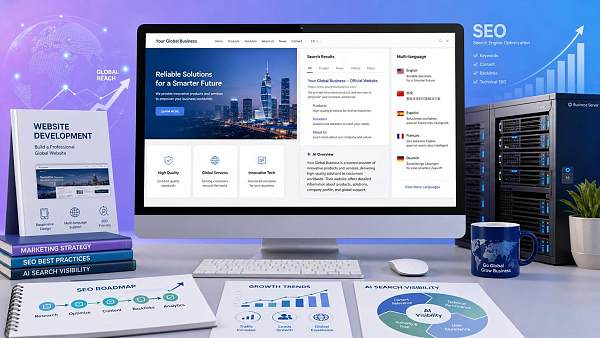
Users who search for “is it too early to start Generative Engine Optimization now” usually do not primarily want to hear a conceptual explanation. They are evaluating whether this is worth investing in right now. They care more about three questions: whether it can become a stable source of traffic, whether it will replace part of traditional SEO, and whether the company currently has the execution foundation to do it.
These readers are often business owners, marketing managers, foreign trade managers, or teams responsible for taking brands global. They are not concerned with technical terminology, but with business outcomes, including whether it can increase official website exposure, whether it helps improve inquiry conversion, whether it can reduce customer acquisition costs, and whether it is worth allocating budget and team resources at the current stage.
Therefore, what this article really needs to answer is not the abstract judgment of “whether it is too early”, but “which companies should start now, how far they should go, how to control trial-and-error costs, and how to connect it with existing website and SEO work”. Once these questions are clarified, readers can naturally make their own judgment.
Why Now Is Not Too Early, but a Relatively Suitable Entry Period
The real difficulty with many new channels is not the tool itself, but waiting until everyone has confirmed that it works before entering. By then, traffic, content space, and industry authority are often already occupied by early movers. The same is true for Generative Engine Optimization. The earlier you plan and execute, the easier it is to build advantages in AI answer citations, brand recommendations, and positioning within industry knowledge.
AI search is still in a stage of rapid evolution, which means that content standards, brand citation habits, and result presentation logic have not yet been fully solidified. For companies that already have official websites, product materials, case study content, and industry expertise, organizing and optimizing content assets now is often more efficient and more controllable in cost than catching up later.
This is especially true for foreign trade companies, manufacturing factories, cross-border brands, and B2B service providers. Their customers have long decision-making cycles and strong needs for information verification, so brand visibility in AI search results directly affects trust building. If your competitors are already being mentioned frequently in AI Q&A, while your official website information is incomplete, your content is scattered, and your structure is confusing, catching up later will put you in a much more passive position.
Which Companies Are Most Suitable to Start Generative Engine Optimization Now
The first category is companies that rely on their official websites for customer acquisition. Examples include foreign trade independent websites, B2B marketing websites, multilingual official websites, and sites built for brands expanding overseas. These companies already need to continuously acquire search traffic and organic inquiries. When Generative Engine Optimization works together with SEO, it can amplify the long-term value of official website content instead of ending after a one-time advertising campaign.
The second category is companies with relatively complex products and services that require explanation. In fields such as manufacturing equipment, industrial components, solution-based services, enterprise software, and cross-border supply chains, customers often ask detailed questions during search. Whoever can answer these questions with high-quality content is more likely to appear in AI-generated answers, thereby gaining clicks and trust.
The third category is companies planning to develop global markets. Because generative search has higher requirements for semantic understanding of content, multilingual expression, and brand consistency, the earlier a company builds a standardized website architecture, language versions, product information pages, and industry content library, the better it can support the later expansion of search visibility in markets such as North America, Europe, and Southeast Asia.
How Companies Should Evaluate Their Biggest Concerns
The first concern is: will there be no effect if we start now? This concern is understandable, but it is important to distinguish between “immediate short-term explosion” and “long-term advantage building”. Generative Engine Optimization does not mean bringing in massive traffic immediately. Instead, it helps companies increase the probability of being understood, cited, and recommended in the AI search environment. It is more like building long-term assets.
The second concern is: will it overlap with SEO? In fact, the two are highly related but not exactly the same. Traditional SEO focuses more on search rankings, page indexing, and click traffic; Generative Engine Optimization focuses more on whether content is easy for AI to understand, whether it has credible sources, and whether it can enter Q&A summaries and recommendation contexts. The foundational capabilities are connected, but the target scenarios are different.
The third concern is: is it only suitable for large companies? No. If small and medium-sized enterprises already have an independent website, product pages, and a basic content system, they may be even more suitable to start early because their adjustment path is shorter and execution is more flexible. The real threshold is not company size, but whether the company has clear content assets and an execution mechanism for continuous optimization.
If You Start Now, the Focus Is Not Chasing Concepts, but Building These Foundations First
First, whether the website foundation is suitable for promotion. Many companies say they want to do GEO or AI search optimization, but their official websites are slow to load, poorly structured, filled with stacked content, and incomplete in page information. Such websites are difficult for search engines and AI systems to understand effectively. A website that can be indexed, crawled, read, and converted is still the prerequisite for all optimization work.
Second, whether the content truly revolves around customer questions. AI search values “answering capability” more than simple keyword stacking. Companies need to systematically organize frequently asked customer questions, purchasing decision factors, product comparison points, delivery processes, industry scenarios, case study results, and other information, and deposit this high-value information into the website instead of only writing empty promotional copy.
Third, whether brand information is consistent and credible. This includes company introductions, product naming, service scope, industry cases, contact information, multilingual page expression, third-party platform profiles, and more, all of which should be as unified as possible. When AI integrates information, it evaluates source consistency. The clearer the information, the easier it is to form a stable foundation for brand recognition and answer citations.
Why Generative Engine Optimization Should Be Considered Together with Website Development, SEO, and Overseas Marketing
Many companies mistakenly believe that Generative Engine Optimization is only the work of the content team. In fact, it is related to website development quality, search optimization, advertising landing pages, multilingual strategy, and social media content distribution. This is because what AI search ultimately cites is content, while the visibility, accessibility, and credibility of content essentially depend on the entire digital marketing infrastructure.
If a website is built only for display and is not suitable for indexing or conversion, even the best content will struggle to produce results. If SEO only focuses on keyword rankings without supplementing product knowledge, industry answers, and multilingual content, performance in AI search scenarios will also be limited. If the pages receiving traffic from advertising and social media are incomplete in information, conversion efficiency will likewise be discounted.
This is also why more and more companies are beginning to coordinate website development, SEO optimization, advertising, social media operations, and GEO. Isolated actions are increasingly unable to support long-term growth. Only by treating the official website as a core content asset and managing search visibility together with AI visibility can the customer acquisition path become more stable and more reusable.
How Companies Should Act Now to Invest Reasonably and Follow the Right Pace
A more practical approach is not to invest heavily from the beginning, but to conduct a basic assessment first. Start by checking whether the website has the conditions for promotion, and then review whether product pages, solution pages, case study pages, FAQ pages, and blog content cover real customer questions. For companies expanding overseas, it is also necessary to check whether multilingual versions are merely translated rather than localized in expression.
Next, companies can establish a “small steps, fast iteration” content optimization mechanism. Prioritize content around topics with high commercial value, such as product applications, industry scenarios, purchasing guides, frequently asked questions, delivery capabilities, certifications and qualifications, and customer cases. The advantage of doing this is that even if returns from AI search are still in the accumulation stage, this content will also improve SEO and official website conversion rates at the same time.
Finally, companies need to be data-conscious. They should not treat Generative Engine Optimization as a vague concept, but should observe brand keyword exposure, organic traffic quality, page dwell time, inquiry growth, content indexing, and key page performance. As long as the method is correct, its value usually does not appear in isolation. Instead, it gradually shows up in official website customer acquisition efficiency, content reuse rate, and brand credibility.
Conclusion: For Most Overseas Expansion and Customer Acquisition-Oriented Companies, Starting Now Is Not Too Early
Returning to the original question: is it too early to start Generative Engine Optimization now? For companies that use their official websites as the core destination for overseas traffic, hope to achieve long-term organic growth, and value brand search visibility, the answer is basically no. It is not too early. Rather, it is currently a stage worth entering, with a relatively strong opportunity to build advantages.
More importantly, companies do not need to see it as a new task detached from reality. In essence, it is an upgraded requirement for website development, SEO optimization, content systems, and overseas marketing capabilities. Whoever makes official website content clearer, more credible, and more suitable for AI understanding first will have a better chance of taking the initiative in the next round of search traffic changes.
For companies that want to continuously acquire global customers, what they really need to worry about is often not “starting too early”, but realizing only after competitors have completed their layout and AI search entry points have begun to steadily divert traffic that their own official website and content system are still not ready. By then, catching up will usually cost much more.
Related Articles
 Which websites are suitable to prioritize generative engine optimization?Consider content scale and brand exposure needs
 How to choose a GEO optimization website builder platform?Start with indexing and content control capabilities
 Can AI+SEO optimization services completely replace manual SEO?See the boundaries clearly from strategy to execution



Related Products
 EasyCamp SaaS Smart Website Marketing SystemE-Yingbao SaaS Smart Website Marketing System: AI-powered, zero-code website building. Rapidly launch multilingual independent e-commerce sites in just 10 minutes. Global server acceleration and AI-driven SEO optimization empower businesses to efficiently connect with global markets. The seamless integration of technology and user-friendly operation makes building e-commerce sites incredibly simple.
 AI+SEM Intelligent Advertising Marketing SystemAI+SEM drives intelligent ad creation, empowering full-funnel precision advertising marketing. The system automatically generates weekly/monthly reports, AI recommends keywords and target countries, monitors core metrics in real-time with intelligent alerts, and enables one-click high-conversion ad solutions to help quickly acquire customers and improve ROI.
 AI+SEO Dual Engine Optimization ServiceEasyWin AI+SEO Dual Engine Optimization System leverages AI-powered keyword mining, content generation, and comprehensive technical optimization to help foreign trade enterprises acquire high-quality organic traffic, significantly improving search rankings and conversion rates.
 AI+SNS Social Media Marketing SystemYingbao AI+SNS Social Media Marketing System - Precision social capture for the social media era. Supports one-click content synchronization across major platforms like Facebook and LinkedIn. AI intelligently rewrites posts for enhanced relevance. 24/7 AI customer service and user profiling analysis empower businesses to efficiently expand into global markets.
 AI+SEO营销解决方案易营宝AI+SEO营销解决方案,通过AI批量写作、智能生成TDK、精准关键词扩词等功能,全面优化网站SEO效果,提升流量与转化率。助力企业构建高效智能网站新生态。
 AI+SEM Advertising Marketing SolutionsAI+SEM Advertising Marketing Solution leverages AI technology to deeply empower SEM ad campaigns. It automatically generates weekly/monthly reports using AI, presenting account data across multiple dimensions for comprehensive insights into campaign performance and trends. The system precisely recommends keywords and target countries, intelligently generates high-conversion ad copy, and enables one-click activation of efficient campaign plans to help businesses rapidly acquire customers. Simultaneously, it monitors core metrics in real time, intelligently identifies abnormal fluctuations, and issues timely alerts to ensure stable, high-return advertising results.
 Domain Name ServicesEasyWin provides professional domain name services, including intelligent queries, one-stop registration, brand protection, and full lifecycle management, helping businesses build a digital brand image.
 EasyOperate B2C Cross-Border E-Commerce Platform & Independent WebsiteEasyStore B2C Cross-border E-commerce Independent Store is an intelligent website building and cross-border e-commerce integrated solution independently developed by EasyStore Information Technology (Beijing) Co., Ltd. The system is specially designed for small and medium-sized as well as large export enterprises, integrating 'website building, operation, marketing, advertising, and conversion' into one, helping enterprises quickly establish cross-border e-commerce independent stores to achieve brand globalization and global sales growth.
The platform supports multiple languages, multiple currencies, and multi-channel marketing, with built-in AI intelligent translation and SEO optimization systems, suitable for mainstream markets such as Southeast Asia, Europe and America, Latin America, and the Middle East, assisting Chinese manufacturing enterprises in efficiently deploying international e-commerce strategies. SSL证书易营宝提供专业SSL安全证书服务,包括单域名和泛域名证书,确保网站数据传输加密、身份验证和完整性保护,助力企业建立安全可信的在线业务环境。









