









- What stages does the cross-border services ecosystem include? How do website building, promotion, payment, and compliance work togetherJun 22, 2026View details
- How will email marketing costs change in 2026Jun 22, 2026View details
- The China-US tariff arrangement has reached a preliminary consensus, and the trade association will be establishedJun 15, 2026View details
- Should overseas brand marketing start with ads or contentJun 21, 2026View details
- What determines B2C cross-border e-commerce website development costs? A breakdown of features, interfaces, and deployment methodsJun 17, 2026View details
- China-Morocco zero-tariff access, a breakthrough in the cost of Moroccan goods exports to ChinaJun 11, 2026View details
What is the difference between AI search optimization and traditional SEO? How should the content organization structure evolve
AI search optimization is reshaping how enterprises acquire traffic and customers. Compared with traditional SEO, which focuses only on rankings, AI search places greater emphasis on content structure, semantic understanding, and answer presentation. For business decision-makers, the key is not simply whether to do it, but how content systems, website architecture, and marketing assets should be upgraded in sync so they can continue to gain leads and growth in the new round of search entry changes.
First, the conclusion: AI search optimization is not a replacement for SEO, but an upgrade in how content is organized
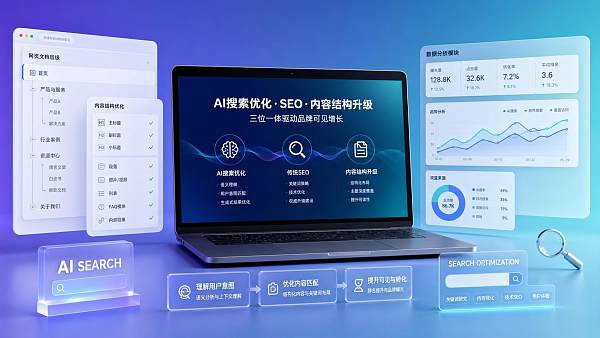
When many companies look at AI search optimization, they easily fall into two misconceptions: either treating it as a simple extension of traditional SEO, or regarding it as a completely new channel. In practice, neither judgment is accurate enough.
The core goal of traditional SEO is to help web pages achieve higher rankings on search results pages, thereby driving clicks and visits. AI search optimization goes a step further: its goal is to enable brand content to be understood, cited, and integrated by search engines and AI question-answer systems, and to appear directly in answers.
This means that the focus of business competition is no longer only “who ranks higher,” but also “whose content is more likely to be recognized by machines as a reliable answer,” “whose content is more suitable for summarization and invocation,” and “whose content can be shown first when users ask questions.”
For enterprise managers, the business implication behind this change is very clear: the traffic entry is shifting from “link clicks” to “answer distribution,” and content assets must also shift from “writing for search engines to see” to “being able to rank and be cited by AI.”
What business decision-makers should care about most is not the conceptual difference, but how customer acquisition methods will change
If we stay only at the technical concept level, AI search optimization can easily be seen as a new buzzword. But from an operations perspective, what really matters is that customer search paths are changing, and this will directly affect brand exposure, inquiry acquisition, and marketing investment efficiency.
In the past, customers entered the results page through keyword searches, browsed multiple web pages, and then screened suppliers. Now, more and more users will directly ask AI complete questions, such as “Which solution is more suitable for foreign trade companies to build a website?” or “For a certain industry’s overseas promotion, should we prioritize SEO or advertising?”
In this scenario, AI systems will first integrate information and then provide a concise answer. If a company’s content structure is clear, its arguments are sufficient, and its credibility is high, it will be more likely to be included as an answer source; otherwise, even if the website has content, it may still lose exposure opportunities because of poor structure.
This is why enterprises cannot just focus on keyword rankings, but must begin paying attention to whether content has the capability to be “understood, cited, verified, and converted.” AI search optimization is essentially a competition for content interpretation rights in the new-generation search interface.
AI search optimization and traditional SEO: where exactly are the differences?
First, the goals are different. Traditional SEO emphasizes page rankings, click-through rates, and organic traffic growth; AI search optimization places more emphasis on answer inclusion, semantic matching, brand mentions, and the probability that content will be invoked by the system.
Second, the writing approach is different. Traditional SEO is often based on keyword placement and expands around a single topic page. AI search optimization requires content to have stronger question orientation, be able to respond directly to user queries, and form a clear logical hierarchy.
Third, the structural requirements are different. Traditional SEO can accept some page organization that is “written for rankings,” but AI search relies more on standardized structure, clear heading hierarchy, concise paragraphs, Q&A-style expression, and consistent information definitions.
Fourth, the authority signals are different. Traditional SEO values backlinks, indexing, page quality, and technical indicators. In addition to these fundamentals, AI search optimization also depends more on brand professionalism, content reliability, factual consistency, and whether on-site and off-site information corroborate each other.
Fifth, the conversion path is different. Traditional SEO usually achieves conversion through “search—click—visit—consultation,” while in AI search scenarios it may be shortened to “search—read the answer—form a preference—enter brand verification,” which significantly accelerates the user decision process.
Why content organization must change, and why this is one of the most easily overlooked steps for many companies
Many companies are already continuously updating articles and have also invested in website development and Google SEO, but the results are unstable. The root cause is often not that they “didn’t write enough,” but that the logic of content organization is still stuck in the old search era.
Traditional content is often accumulated by columns, products, news, and case studies. This is suitable for website display, but not necessarily for AI understanding. That is because AI systems prefer to build clear knowledge units around questions, rather than dispersed, repetitive, and hierarchically disordered information fragments.
For example, a high-quality piece of content should not only introduce a service, but should clearly answer “who it is for, what it solves, how it differs from alternatives, how ROI is evaluated, what common risks exist, and how implementation is carried out.”
When this information is broken down clearly enough, search engines and AI systems are more likely to identify the page topic, extract core viewpoints, recognize professional value, and thus improve AI search optimization performance while also strengthening traditional SEO performance.
How should enterprises adjust content structure to serve both SEO and AI search at the same time?
The first step is to move from “keyword-centric” to “problem-centric.” Keywords are still important, but content planning cannot revolve around terms alone; it must expand around users’ real decision-making questions, especially the core questions they repeatedly search before purchasing.
The second step is to make content into a “retrievable answer” structure. Heading hierarchy should be clear, paragraphs should be short, conclusions should come first, key concepts should be unified, and multiple topics should be avoided within a single passage so as not to affect system understanding and citation.
The third step is to build topic clusters rather than fighting with single articles. Enterprises should center on core themes such as website building, SEO, advertising, social media, and AI search optimization, and construct content connections among homepage pages, scenario pages, Q&A pages, and case pages.
The fourth step is to strengthen evidence-based content. Company introductions, customer cases, data results, methodology steps, regional experience, and multilingual capabilities are all important materials for improving credibility, and can help AI judge whether a brand is worth recommending.
The fifth step is to unify internal information channels. Core information such as service capabilities, industry positioning, solution frameworks, and regional market coverage needs to remain consistent across the homepage, service pages, article pages, and case pages to reduce semantic conflicts.
For enterprise managers, whether content is effective can be judged from these four dimensions
First, whether it truly answers customer questions. If, after reading, customers still do not understand the applicable scenario, budget logic, implementation cycle, or expected results, then this content, even if indexed, will still be hard to bring high-quality conversions.
Second, whether it is easy for machines to understand. This includes whether the heading directly addresses the question, whether the paragraphs are concise, whether the terminology is unified, and whether the page structure is standardized. AI search optimization is not a pile of technical buzzwords, but about making systems read your professional expression more accurately.
Third, whether it can support brand trust. Decision-makers will not place an order because of one article, but they will use content to judge whether a service provider is professional, whether it is stable over the long term, and whether it truly understands industry growth logic.
Fourth, whether it forms content asset synergy. The value of a single viral article is limited; the truly sustainable approach is to let the official website, topic pages, case studies, FAQ, and service introductions support one another as a knowledge network, continuously improving brand visibility.
From a growth perspective, which enterprises is AI search optimization more suitable for first?
The first category is B2B companies that rely on search to acquire inquiries, especially foreign trade enterprises, manufacturing factories, and brand companies going global. Such companies have long decision cycles, high search frequency, and the earlier they layout, the easier it is to form a content moat.
The second category is companies that already have an independent website and a basic SEO system, but whose growth has begun to slow. At this stage, simply expanding the number of articles often leads to declining marginal returns, while shifting toward content structure upgrades is more likely to bring new incremental gains.
The third category is companies with complex services and obvious solution-based sales. Since AI search is better at handling problem-based queries, industries that require explanation and professional judgment are even more suitable for influencing early decision-making through high-quality content.
For such companies, choosing a service provider that integrates technology, website building, content, and overseas marketing capabilities is more practical. For example, at the level of knowledge research and content organization, some professional materials such as Research on Common Questions and Countermeasures in the Basic Construction Project Completion Financial Settlement Audit essentially also reflect the content value of “outputting structured answers around problems.”
Why is an integrated platform like YiYingBao more suited to current content upgrade needs?
AI search optimization is not a single action; behind it are website technical foundations, content architecture, multilingual expression, search indexing, advertising coordination, and data feedback. Many companies’ problems are not that they cannot write articles, but that each link is disconnected, making it difficult to form a unified growth system.
As an AI-driven enterprise SaaS intelligent website-building and overseas marketing digital service platform, YiYingBao covers AI intelligent website building, multilingual website development, Google SEO optimization, advertising placement, overseas social media operations, and GEO generative engine optimization. Its advantage lies in the ability to connect content and channels.
The value of this integrated capability is that enterprises do not need to coordinate website builders, SEO teams, ad agencies, and content suppliers separately. Instead, they can center on one growth objective and plan website structure, content strategy, and customer acquisition paths in a unified way.
For enterprises hoping to improve AI search visibility, this kind of coordination is especially important. Because truly effective AI search optimization is not just writing a few more articles, but enabling the website to have the ability, from the ground up, to be “promotable, indexable, convertible, and understandable by AI.”
Conclusion: In the future of content competition, what matters is not who writes more, but who is more likely to become the answer
Returning to the original question, the biggest difference between AI search optimization and traditional SEO is not whether keywords are still used, but that the content goal has already upgraded from “competing for rankings” to “competing for answer entry points.” This will directly change how enterprise content is organized.
For business decision-makers, what is most worth doing now is not blindly chasing trends, nor forcibly overturning the existing SEO system, but reconstructing content logic, page structure, and knowledge expression while retaining the SEO foundation.
Whoever can turn content into a clear, reliable, and citable answer system earlier will be more likely to continue gaining brand exposure, organic traffic, and high-quality business opportunities in the AI search era. That is the true strategic value of AI search optimization.
Related Articles

Related Products
 EasyCamp SaaS Smart Website Marketing SystemE-Yingbao SaaS Smart Website Marketing System: AI-powered, zero-code website building. Rapidly launch multilingual independent e-commerce sites in just 10 minutes. Global server acceleration and AI-driven SEO optimization empower businesses to efficiently connect with global markets. The seamless integration of technology and user-friendly operation makes building e-commerce sites incredibly simple.
 AI+SEM Intelligent Advertising Marketing SystemAI+SEM drives intelligent ad creation, empowering full-funnel precision advertising marketing. The system automatically generates weekly/monthly reports, AI recommends keywords and target countries, monitors core metrics in real-time with intelligent alerts, and enables one-click high-conversion ad solutions to help quickly acquire customers and improve ROI.
 AI+SEO Dual Engine Optimization ServiceEasyWin AI+SEO Dual Engine Optimization System leverages AI-powered keyword mining, content generation, and comprehensive technical optimization to help foreign trade enterprises acquire high-quality organic traffic, significantly improving search rankings and conversion rates.
 AI+SNS Social Media Marketing SystemYingbao AI+SNS Social Media Marketing System - Precision social capture for the social media era. Supports one-click content synchronization across major platforms like Facebook and LinkedIn. AI intelligently rewrites posts for enhanced relevance. 24/7 AI customer service and user profiling analysis empower businesses to efficiently expand into global markets.
 AI+SEO营销解决方案易营宝AI+SEO营销解决方案,通过AI批量写作、智能生成TDK、精准关键词扩词等功能,全面优化网站SEO效果,提升流量与转化率。助力企业构建高效智能网站新生态。
 AI+SEM Advertising Marketing SolutionsAI+SEM Advertising Marketing Solution leverages AI technology to deeply empower SEM ad campaigns. It automatically generates weekly/monthly reports using AI, presenting account data across multiple dimensions for comprehensive insights into campaign performance and trends. The system precisely recommends keywords and target countries, intelligently generates high-conversion ad copy, and enables one-click activation of efficient campaign plans to help businesses rapidly acquire customers. Simultaneously, it monitors core metrics in real time, intelligently identifies abnormal fluctuations, and issues timely alerts to ensure stable, high-return advertising results.
 Domain Name ServicesEasyWin provides professional domain name services, including intelligent queries, one-stop registration, brand protection, and full lifecycle management, helping businesses build a digital brand image.
 EasyOperate B2C Cross-Border E-Commerce Platform & Independent WebsiteEasyStore B2C Cross-border E-commerce Independent Store is an intelligent website building and cross-border e-commerce integrated solution independently developed by EasyStore Information Technology (Beijing) Co., Ltd. The system is specially designed for small and medium-sized as well as large export enterprises, integrating 'website building, operation, marketing, advertising, and conversion' into one, helping enterprises quickly establish cross-border e-commerce independent stores to achieve brand globalization and global sales growth.
The platform supports multiple languages, multiple currencies, and multi-channel marketing, with built-in AI intelligent translation and SEO optimization systems, suitable for mainstream markets such as Southeast Asia, Europe and America, Latin America, and the Middle East, assisting Chinese manufacturing enterprises in efficiently deploying international e-commerce strategies. SSL证书易营宝提供专业SSL安全证书服务,包括单域名和泛域名证书,确保网站数据传输加密、身份验证和完整性保护,助力企业建立安全可信的在线业务环境。









