









- What Does a Global Traffic Ecosystem Service Provider Do? What Are the Differences from a Single Advertising AgencyJul 16, 2026View details
- What should you focus on in the latest enterprise SaaS report? From renewal rates and delivery costs to overseas growth opportunitiesJul 12, 2026View details
- What signals are worth paying attention to in a cross-border marketing trend report? B2B companies should look at these 6 signalsJul 11, 2026View details
- How to Read a Cross-Border Marketing Trends Report? Five Key Dimensions for Evaluating Channel OpportunitiesJul 11, 2026View details
- Which channel has the highest ROI in the global traffic ecosystem? Comparative analysis of search, social media, and advertisingJul 10, 2026View details
- What multilingual website services are available in Sanya? Which model is more suitable for local businesses going global?Jul 08, 2026View details
How to Improve Your AI Search Indexing Rate: Check These 5 Items First
How to Improve AI Search Indexing Rates: Check These 5 Items First
How can you improve your AI search indexing rate? Many people start by changing titles, stuffing keywords, and rewriting copy, only to find that indexing is still slow after all that effort. Those who actually manage websites know that whether AI search can smoothly read, understand, and cite your website often depends not on “how well it is written,” but first on whether it can consistently crawl, interpret, and determine that the page is worth indexing.
If you are responsible for a corporate website, an international trade site, an independent website, or especially a multilingual site, do not rush to make major content changes. Go through the following five items first. Many website issues actually stem from technical structure, page quality, crawl entry points, data markup, and update mechanisms. Once these fundamentals are organized, AI search indexing efficiency is usually improved more directly than by simply revising copy.
1. First Check Whether the Page Can Be Crawled—not Just Whether You Can Open It
This is the most common misjudgment. Being able to access a page in the backend or open it in a browser does not mean that search systems can crawl it smoothly. Websites that use frontend rendering, complex redirects, or content assembled through JavaScript often appear normal to users while the crawler cannot retrieve the main content.
Focus on the following points at this stage:
- Does the page consistently return a 200 status code, rather than repeatedly switching through 302 redirects, temporary redirects, or occasional 5xx errors?
- Does robots.txt mistakenly block directories, parameter pages, or static resources?
- Is canonical pointing to the correct page? This is especially important for multilingual and multi-region pages, where a common problem is that all pages point back to the homepage or the default-language page.
- Is the main content directly present in the HTML, rather than relying entirely on script rendering?
- Do mobile and desktop versions return the same core content? One should not be complete while the other contains only the framework.
In practice, B2B manufacturing websites and cross-border e-commerce stores often run into this issue. To pursue visual effects, they add many dynamic modules, filtering components, and lazy-loaded content, but the key information on product pages ends up deeply buried. When crawl resources are limited, AI search will not patiently wait for all your content to finish rendering.
A practical rule of thumb is to view the page in a “no-script environment.” If the product name, core specifications, service description, and contact information summary are unclear, the page should first undergo technical optimization.
Do not underestimate this item. When people ask how to improve AI search indexing rates, the real obstacle is often not weak content but an obstructed crawling process.
2. Then Check Whether the Page Is Worth Indexing: Does It Have a Clear Topic and Sufficient Business Information Density?
AI search does not only recognize titles and keywords in the traditional sense. It pays more attention to whether a page can answer questions, whether its information is complete, and whether its context is credible. If your page contains only a few slogans accompanied by several images, it is normal for indexing to be slow.
At the operational level, focus on these criteria:
- Is the page focused on one clear topic? One page should address one issue. Do not put company information, a complete product catalog, solutions, news, and FAQs all on one page.
- Are there extractable information blocks? Examples include product specifications, application scenarios, service processes, delivery scope, frequently asked questions, and supported regional languages.
- Is there a real business context? International trade websites, in particular, should clearly state the target buyers, delivery methods, minimum order quantity, supported markets, or industry applications. Without these details, the page may appear very empty.
- Are similar pages highly repetitive? Large numbers of templated city pages, country pages, and product pages are a common cause of declining indexing quality.
There is a common misconception here: assuming that “short” means concise. For a marketing-oriented corporate website, concise does not mean lacking information. When AI systems create summaries and citations, they usually need sufficiently clear entity information, contextual terms, and supporting criteria to be present on the page. For example, the sentence “We provide high-quality services” has almost no citation value. By contrast, “We support multilingual corporate website development for the North American, European, and Southeast Asian markets, with adaptations for B2B inquiry generation and Google SEO advertising landing pages” enables the system to identify the page’s purpose more quickly.
3. Keep Crawl Entry Points Open: Internal Links, Sitemaps, and Hub Pages Must Be Able to Surface Important Pages
For many websites, the issue is not that the content has not been created, but that important pages are too deeply buried. AI search, like traditional search, relies on entry points. If a page can only be reached through backend menus, internal search, or direct access from an advertising landing page, indexing will remain passive in the long term.
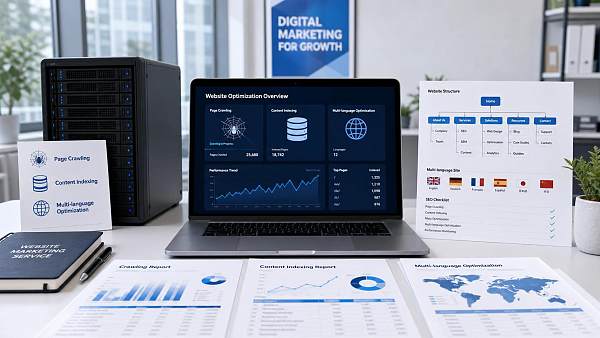
During an actual review, I recommend working backward from the “user path” to the “crawl path.” Can the pages you want indexed be reached from the homepage or a category page within 3 clicks? Are they naturally linked from related articles, solution pages, or product category pages? Is there a clear HTML sitemap, and is the XML sitemap updated continuously? These measures are more effective over the long term than submitting individual URLs.
Pay special attention to multilingual websites. Many companies create English, Japanese, and other language versions separately, but do not establish clear links between them, and hreflang may not be fully configured 【The specific implementation should be verified against the website code】. As a result, crawlers have difficulty determining the relationship between corresponding pages, often leading to indexing the wrong language, duplicate indexing, and unstable primary versions.
4. Do Not Omit Structured Information: At Minimum, Let the System Know What the Page Is About
Many operators regard “data markup” as an advanced SEO practice and leave it for later. I take the opposite view: if you are operating a corporate website, product website, or service website, the earlier your structured information is standardized, the easier it is for AI search to establish a framework for understanding the page.
There is no need to add everything indiscriminately in pursuit of completeness. Mark what should be marked, and do not force markup where it does not apply. Commonly suitable types include organization information, webpage information, breadcrumbs, products, articles, and FAQs. The prerequisite is that the corresponding content actually exists on the page. Do not create FAQ markup when there is no FAQ, and do not mark prices when no prices are provided. For B2B inquiry-oriented pages in particular, forcibly adding standard prices may instead create inaccurate information.
This item is most vulnerable to two situations: one is doing nothing at all, leaving the system to infer everything from the main text; the other is implementing markup that does not match the page, such as conflicts involving the title, publication date, product name, brand ownership, or language version. The latter can be even more troublesome than doing nothing because it directly affects credibility assessments.
If you provide integrated website development and marketing operations, it is best to make these fields maintainable rather than requiring content editors to assemble them manually each time. In actual projects, websites that operate reliably over the long term are often not those that received the most aggressive one-time optimization, but those whose foundational fields have remained standardized.
5. Finally, Check the Update Mechanism: It Is Not About Publishing Frequently, but Showing Search Systems That Your Website Is Active
Many websites have had no new content for six months. Their product pages, case study pages, and news pages show no new signals, and then they ask why AI search does not favor indexing them. The issue is very practical: when a website has no recognizable updates for a long time, search systems typically reduce crawling frequency, and indexing naturally becomes slower.
However, updating does not mean “publishing one article every day.” The truly effective updates include the following:
- Add specifications, delivery information, application scenarios, and Q&A content to key product pages.
- Add regional versions, industry versions, or scenario extensions to solution pages instead of repeatedly changing titles.
- Expand article pages around real customer questions, such as shipping, certifications, differences between language markets, and advertising landing page adaptation.
- Handle inactive pages promptly to avoid having large numbers of 404 pages and outdated content listed in the sitemap.
If you operate a website targeting overseas markets, also pay attention to regional differences. Users in North America are more concerned with completeness of information and conversion entry points; some European markets place greater emphasis on compliant wording 【Specific regulatory requirements must be verified by country】; Southeast Asian and Latin American markets often involve multilingual content and mobile access experience. Update strategies should not focus only on the convenience of operating through a Chinese backend, but should address the page requirements of the target markets.
A practical recommendation is to set priorities for content updates rather than applying equal effort everywhere. Maintain the homepage, core product pages, key solution pages, and key country-language pages first, and deal with peripheral content later. AI search pays more attention to the core nodes of your website; not every page needs to be updated at the same frequency.
A Practical Troubleshooting Order for Operators
If you are ready to take action now, follow this order: first select the 10 most important pages and check their status codes, crawlability, and whether the main content is rendered directly; then check whether these 10 pages have clear topics and sufficient information; next add internal entry points and sitemaps; then organize the structured fields; finally arrange ongoing updates.
Do not make major changes across the entire website from the start. Focus on the core pages first, where changes are usually easier to observe. For teams working on international trade lead generation, cross-border independent websites, and multilingual corporate websites, the answer to how to improve AI search indexing rates is often not one particular technique, but making these five fundamental tasks solid. Only when pages can be crawled, read, understood, found, and continuously updated is there real room for indexing and visibility to improve.
If you are already working on integrated website development, SEO, advertising, and content coordination, it is best to incorporate this inspection process directly into the website development workflow instead of addressing it after launch. It can of course be handled later, but the cost is usually higher and troubleshooting takes longer.
Related Articles

Related Products
 EasyCamp SaaS Smart Website Marketing SystemE-Yingbao SaaS Smart Website Marketing System: AI-powered, zero-code website building. Rapidly launch multilingual independent e-commerce sites in just 10 minutes. Global server acceleration and AI-driven SEO optimization empower businesses to efficiently connect with global markets. The seamless integration of technology and user-friendly operation makes building e-commerce sites incredibly simple.
 AI+SEM Intelligent Advertising Marketing SystemAI+SEM drives intelligent ad creation, empowering full-funnel precision advertising marketing. The system automatically generates weekly/monthly reports, AI recommends keywords and target countries, monitors core metrics in real-time with intelligent alerts, and enables one-click high-conversion ad solutions to help quickly acquire customers and improve ROI.
 AI+SEO Dual Engine Optimization ServiceEasyWin AI+SEO Dual Engine Optimization System leverages AI-powered keyword mining, content generation, and comprehensive technical optimization to help foreign trade enterprises acquire high-quality organic traffic, significantly improving search rankings and conversion rates.
 AI+SNS Social Media Marketing SystemYingbao AI+SNS Social Media Marketing System - Precision social capture for the social media era. Supports one-click content synchronization across major platforms like Facebook and LinkedIn. AI intelligently rewrites posts for enhanced relevance. 24/7 AI customer service and user profiling analysis empower businesses to efficiently expand into global markets.
 AI+SEO营销解决方案易营宝AI+SEO营销解决方案,通过AI批量写作、智能生成TDK、精准关键词扩词等功能,全面优化网站SEO效果,提升流量与转化率。助力企业构建高效智能网站新生态。
 AI+SEM Advertising Marketing SolutionsAI+SEM Advertising Marketing Solution leverages AI technology to deeply empower SEM ad campaigns. It automatically generates weekly/monthly reports using AI, presenting account data across multiple dimensions for comprehensive insights into campaign performance and trends. The system precisely recommends keywords and target countries, intelligently generates high-conversion ad copy, and enables one-click activation of efficient campaign plans to help businesses rapidly acquire customers. Simultaneously, it monitors core metrics in real time, intelligently identifies abnormal fluctuations, and issues timely alerts to ensure stable, high-return advertising results.
 Domain Name ServicesEasyWin provides professional domain name services, including intelligent queries, one-stop registration, brand protection, and full lifecycle management, helping businesses build a digital brand image.
 EasyOperate B2C Cross-Border E-Commerce Platform & Independent WebsiteEasyStore B2C Cross-border E-commerce Independent Store is an intelligent website building and cross-border e-commerce integrated solution independently developed by EasyStore Information Technology (Beijing) Co., Ltd. The system is specially designed for small and medium-sized as well as large export enterprises, integrating 'website building, operation, marketing, advertising, and conversion' into one, helping enterprises quickly establish cross-border e-commerce independent stores to achieve brand globalization and global sales growth.
The platform supports multiple languages, multiple currencies, and multi-channel marketing, with built-in AI intelligent translation and SEO optimization systems, suitable for mainstream markets such as Southeast Asia, Europe and America, Latin America, and the Middle East, assisting Chinese manufacturing enterprises in efficiently deploying international e-commerce strategies. SSL证书易营宝提供专业SSL安全证书服务,包括单域名和泛域名证书,确保网站数据传输加密、身份验证和完整性保护,助力企业建立安全可信的在线业务环境。









