









- China-Morocco zero-tariff access, a breakthrough in the cost of Moroccan goods exports to ChinaJun 11, 2026View details
- What signal should be released for the suspension of exports to JapanJun 10, 2026View details
- China's May LNG imports rebounded, with increased volumes from Russia and Canada filling the Middle East supply gapJun 10, 2026View details
- Will GEO change its SEO strategy?Jun 04, 2026View details
- What types of businesses are end-to-end solutions suitable for?Jun 03, 2026View details
- 2026 Global Growth Channel TrendsJun 02, 2026View details
Before opening a Google Ads account, first clarify what it is
Before Opening a Google Ads Account, Why Not Rush to Set Up the Account First?
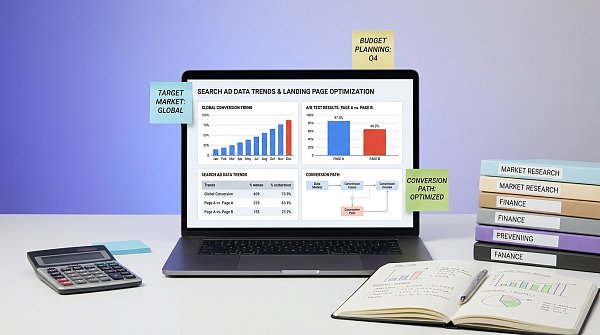
When many people mention Google Ads, their first reaction is to set up the account first, top up the account first, and start running ads first. But what really affects the results is often not how quickly the account is created, but whether the early-stage judgment is clear enough.
If the target market is not defined clearly, the budget can easily be wasted on invalid clicks; if the conversion path is incomplete, ads may still fail to turn traffic into inquiries or orders even if there is traffic; if the landing page quality is average, the later optimization cost will only keep increasing.
In a website and marketing integrated scenario, Google Ads is never a standalone action. It is directly related to website development, page content, data tracking, SEO foundation, and regional language adaptation. If the front-end is well organized, the back-end advertising will be more stable.
More often than not, the real issue is not that companies cannot run ads, but that they did not complete several key confirmations before opening the account, which leads to continuous rework after launch. Below, we will walk through several common questions and explain what should be made clear before opening a Google Ads account.
The First Thing to Clarify: What Problem Do You Actually Want Google Ads to Solve?
This question seems simple, but it is actually the easiest to overlook. Because “want traffic” does not equal a target, and “want exposure” does not equal results. Before opening the account, you need to first distinguish whether the goal is to get inquiries, sell products, test the market, or increase brand visibility in a certain region.
Different goals determine a completely different Google Ads structure. For B2B inquiry generation, you usually focus more on search ads, form conversions, and lead quality; for independent site sales, you pay more attention to shopping ads, remarketing, and conversion returns.
If targets are mixed together from the start, the account may simultaneously run brand terms, competitor terms, display ads, and remarketing, and the data will become very messy, making it difficult to judge whether the budget is effective.
In practice, you can ask yourself three questions first:
- What do you most want right now: inquiries, deals, or market feedback?
- Does the conversion happen online, or does it require sales follow-up?
- Do you want short-term ad results, or are you willing to go through a testing period?
Only by defining the target clearly can the keywords, bidding, pages, and data metrics in Google Ads have a unified direction.
How Should the Target Market Be Defined So You Won't Disperse the Budget from the Very Beginning?
When many accounts first go live, the country and language coverage is set very broadly, with the idea that broader coverage means more opportunities. In reality, it is often the opposite. The more countries there are, the more different the search habits, click costs, competition intensity, and page language requirements become.
Before opening a Google Ads account, it is recommended to narrow the market scope first and prioritize regions with high product fit, stable logistics lead times, and mature payment or delivery processes. This makes it easier to accumulate the first batch of usable data.
Especially for overseas promotion, the website language versions should not stop at the translation level. What users search for, what selling points they care about, whether they pay attention to certification, delivery time, and privacy statements all affect the stay and conversion after an ad click.
At this point, website capability and advertising efficiency are bound together. For example, a foreign trade multilingual website solution with AI translation, localized content optimization, multilingual SEO, and data tracking capabilities is more suitable for first laying a solid multi-region page foundation before Google Ads launch, avoiding the situation where ads run first and pages are filled in later.
If the market is not fully determined yet, you can start with a small-scale test instead of covering multiple major regions all at once. Finding regions with better click-through rates, inquiry rates, and landing page match first, and then expanding step by step, will be more stable than a “full open” approach.
How Should the Budget Be Allocated So It Is Reasonable and Not a Blind Bet?
A budget is not just about filling in how much money to spend in a month; it should be split into testing budget, stable budget, and optimization budget. If you do not break this down before Google Ads launch, it will be difficult later to determine whether the issue is strategy-related or sample size-related.
The more practical approach is to divide it first according to “channel objective” and “keyword intent.” High-intent search terms can be given priority in the budget because such traffic is more likely to generate inquiries; display ads or audience expansion ads are more suitable for the testing stage.
To judge more accurately, you can first create a simplified table before opening the account:
Simply put, the key to a Google Ads budget is not how much it is, but whether it is verifiable. Being able to see which term, which region, and which page is worth scaling up is the core of budget allocation.
Why Must You Check the Conversion Path and Landing Pages Before Opening the Account?
Many ad results are not ideal not because the ads themselves are problematic, but because users do not know what to do next after clicking in. Unclear page information, slow loading, too long forms, and unclear contact methods will directly reduce Google Ads performance.
The ad front end is responsible for attracting clicks, while the landing page is responsible for receiving intent. If the two do not match, even the best keywords can easily be wasted. Especially for foreign trade websites, if the page language is not localized enough, or if updates across different language versions are not synchronized, conversion losses will be more obvious.
Before opening the account, it is recommended to focus on checking these items:
- Whether the page loading speed is stable and whether the mobile experience is smooth.
- Whether the selling points promised by the ads can be responded to immediately on the page.
- Whether the form, WhatsApp, email, or phone entry is clear.
- Whether tracking tools such as GA4 and GTM have already been properly connected.
For integrated service providers like Yiyingbao, who have long focused on global digital marketing, the reason they emphasize the connection between website development and advertising is because ad performance often depends on page reception, not just account operations. If the website can complete multilingual SEO, localized meta tags, conversion tracking, and compliance settings in sync, later Google Ads will be much easier to manage.
Does Account Opening Completion Mean It Is Ready for Official Advertising?
Not yet. Account opening is only the beginning. Before official launch, you still need to confirm data, materials, policies, and pacing. Especially for new accounts, the system needs a learning period, and the team also needs an observation window. You cannot mistake “activation” for “mature operation.”
A relatively stable launch preparation usually includes the following items:
- Confirm that conversion events can be recorded accurately, rather than only page views.
- Check whether the ad copy matches the page content to avoid a high bounce rate.
- Prepare negative keywords to reduce irrelevant search triggers.
- Set a two-week observation period and avoid frequent major changes to the account structure.
If you are promoting multiple countries simultaneously, you should also look at the website's foundational capabilities. For example, whether the page supports switching among more than 300 languages, whether content updates are automatically synchronized to each language version, and whether privacy policy templates and regional compliance support are available. These all affect the continuity of Google Ads.
In actual applications, listing these items clearly before opening the account saves more time and money than patching holes after launch.
If You Want to Avoid Detours, Which Mistakes Are Most Worth Confirming Before Opening the Account?
Common mistakes in Google Ads are actually very concentrated. It is not that the technology is too complex, but that the judgment order is wrong. The following issues are often more worth confirming in advance than “how to set up the account.”
Is Chasing Low Cost-per-Click the Right Thing to Do?
Not necessarily. Cheap clicks do not equal a conversion-friendly budget. Some terms may be low-cost, but the intent is weak and the traffic they bring is not easy to convert. Google Ads should pay more attention to the cost per valid inquiry, not just the surface-level unit price.
Can You Test First Without a Mature Website?
You can test, but the risk will be much higher. Ads can help you validate demand, but they cannot replace page reception. If the website speed, trust information, language versions, and conversion tools are not ready, the test results are also likely to be inaccurate.
If There Is Someone Handling Operations, Is It Okay to Ignore the Early-Stage Strategy?
No, it is not. Whether self-operated or outsourced, the core information still needs to be clarified in advance, including market priority, acceptable cost, sales follow-up timing, and page objectives. If the strategy is unclear, outsourced operations will also find it difficult to truly scale the results.
If you hope to push website development, ad placement, data tracking, and multilingual content forward together, you can look at solutions like foreign trade multilingual website solutions, which have stronger integrated capabilities. They are more suitable for setting up the early foundation all at once, rather than filling gaps while advertising.
If You Understand These Things Before Opening the Account, Google Ads Will Go Much More Smoothly Later
Back to the core issue, what really needs to be clarified before opening a Google Ads account is not only the process and materials, but also the target, market, budget, conversion path, and page reception capability. These determine whether the later data is usable and whether optimization has a direction.
If you are still in the preparation stage, it is better to first organize the target countries, initial keywords, budget ceiling, landing page versions, and conversion tracking checklist, and then decide on the account structure and advertising pace. This may be a slower step, but it usually helps you avoid many detours.
For website projects focused on overseas customer acquisition, Google Ads is never an isolated action. Looking at the website, content, localization, data, and advertising together is the path closer to stable growth.
Related Articles
 Brazil abolishes import tariffs on mobile power supplies, cross-border e-commerce welcomes a window of opportunity
 Pressure Relief in the Supply Chain within the Vietnam Shipbuilding Sector
 How should the Google Ads budget be allocated? The spending ratio for brand keywords, search keywords, and remarketing


Related Products
 EasyCamp SaaS Smart Website Marketing SystemE-Yingbao SaaS Smart Website Marketing System: AI-powered, zero-code website building. Rapidly launch multilingual independent e-commerce sites in just 10 minutes. Global server acceleration and AI-driven SEO optimization empower businesses to efficiently connect with global markets. The seamless integration of technology and user-friendly operation makes building e-commerce sites incredibly simple.
 AI+SEM Intelligent Advertising Marketing SystemAI+SEM drives intelligent ad creation, empowering full-funnel precision advertising marketing. The system automatically generates weekly/monthly reports, AI recommends keywords and target countries, monitors core metrics in real-time with intelligent alerts, and enables one-click high-conversion ad solutions to help quickly acquire customers and improve ROI.
 AI+SEO Dual Engine Optimization ServiceEasyWin AI+SEO Dual Engine Optimization System leverages AI-powered keyword mining, content generation, and comprehensive technical optimization to help foreign trade enterprises acquire high-quality organic traffic, significantly improving search rankings and conversion rates.
 AI+SNS Social Media Marketing SystemYingbao AI+SNS Social Media Marketing System - Precision social capture for the social media era. Supports one-click content synchronization across major platforms like Facebook and LinkedIn. AI intelligently rewrites posts for enhanced relevance. 24/7 AI customer service and user profiling analysis empower businesses to efficiently expand into global markets.
 AI+SEO营销解决方案易营宝AI+SEO营销解决方案,通过AI批量写作、智能生成TDK、精准关键词扩词等功能,全面优化网站SEO效果,提升流量与转化率。助力企业构建高效智能网站新生态。
 AI+SEM Advertising Marketing SolutionsAI+SEM Advertising Marketing Solution leverages AI technology to deeply empower SEM ad campaigns. It automatically generates weekly/monthly reports using AI, presenting account data across multiple dimensions for comprehensive insights into campaign performance and trends. The system precisely recommends keywords and target countries, intelligently generates high-conversion ad copy, and enables one-click activation of efficient campaign plans to help businesses rapidly acquire customers. Simultaneously, it monitors core metrics in real time, intelligently identifies abnormal fluctuations, and issues timely alerts to ensure stable, high-return advertising results.
 Domain Name ServicesEasyWin provides professional domain name services, including intelligent queries, one-stop registration, brand protection, and full lifecycle management, helping businesses build a digital brand image.
 EasyOperate B2C Cross-Border E-Commerce Platform & Independent WebsiteEasyStore B2C Cross-border E-commerce Independent Store is an intelligent website building and cross-border e-commerce integrated solution independently developed by EasyStore Information Technology (Beijing) Co., Ltd. The system is specially designed for small and medium-sized as well as large export enterprises, integrating 'website building, operation, marketing, advertising, and conversion' into one, helping enterprises quickly establish cross-border e-commerce independent stores to achieve brand globalization and global sales growth.
The platform supports multiple languages, multiple currencies, and multi-channel marketing, with built-in AI intelligent translation and SEO optimization systems, suitable for mainstream markets such as Southeast Asia, Europe and America, Latin America, and the Middle East, assisting Chinese manufacturing enterprises in efficiently deploying international e-commerce strategies. SSL证书易营宝提供专业SSL安全证书服务,包括单域名和泛域名证书,确保网站数据传输加密、身份验证和完整性保护,助力企业建立安全可信的在线业务环境。









