









- What Does a Global Traffic Ecosystem Service Provider Do? What Are the Differences from a Single Advertising AgencyJul 16, 2026View details
- What should you focus on in the latest enterprise SaaS report? From renewal rates and delivery costs to overseas growth opportunitiesJul 12, 2026View details
- What signals are worth paying attention to in a cross-border marketing trend report? B2B companies should look at these 6 signalsJul 11, 2026View details
- How to Read a Cross-Border Marketing Trends Report? Five Key Dimensions for Evaluating Channel OpportunitiesJul 11, 2026View details
- Which channel has the highest ROI in the global traffic ecosystem? Comparative analysis of search, social media, and advertisingJul 10, 2026View details
- What multilingual website services are available in Sanya? Which model is more suitable for local businesses going global?Jul 08, 2026View details
- How to view the complete list of China SaaS companies in the top 100? Practical methods for screening website-building and marketing service providersJul 08, 2026View details
- How to view pricing in the global traffic ecosystem? Cost comparison of search, social media, and content channel advertisingJul 06, 2026View details
What Is a Reasonable Price for Yingyingbao B2B Website Development?
What Is a Reasonable Price for Yiyingbao B2B Website Development?
What is a reasonable price for Yiyingbao B2B website development? For those responsible for financial approval, the real challenge is not simply obtaining a quote, but determining whether the money is being spent on a “web page” or on a website that can continuously generate leads. Websites that are all called foreign trade B2B websites may be quoted at several thousand, tens of thousands, or even more than one hundred thousand yuan. The difference is often not whether the homepage looks good, but the underlying technology, marketing adaptability, multilingual capabilities, content production efficiency, and ongoing operating costs.
If you are responsible for budget approval, it is advisable not to focus only on the total price. First, clarify the order in which purchasing decisions should be made. The following checklist is not a general discussion of the “importance of website development.” Instead, from the perspective of actual purchasing and cost control, it helps you determine which price range is more reasonable, which expenses are worth paying, and which may easily become unnecessary costs.
First, Clarify What You Are Buying: a Template Website, a Custom Website, or a Marketing Website
The most common mistake during approval is comparing different types of websites as if they were the same. A basic presentation website and a marketing website designed to convert overseas inquiries are fundamentally different types of purchases.
- If the website is only used for company introductions, product displays, and contact information, the price is generally lower, but its subsequent lead-generation capabilities are limited.
- If it needs to support Google indexing, page speed optimization, inquiry form tracking, multilingual deployment, and SEO structure development, this is no longer simply “creating web pages.”
- If it also needs to support advertising, overseas social media traffic acquisition, and landing page conversion testing, the budget should be calculated as a “growth tool,” rather than as a “design fee.”
Therefore, when asking “What is a reasonable price for Yiyingbao B2B website development?”, do not rush to look at the figure. First, confirm the boundaries of the solution. Without clear boundaries, any low price may simply mean that the costs have been transferred to the later stage.
When Approving the Budget, Review at Least These Items Separately
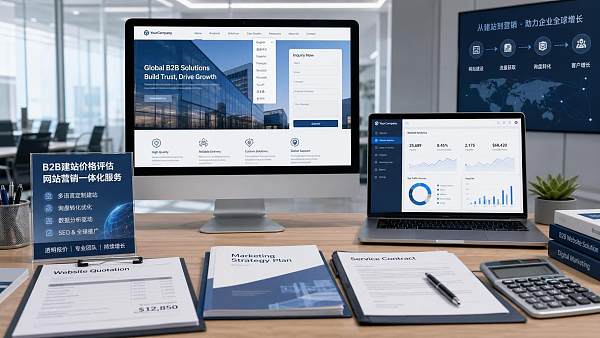
Many quotations simply bundle everything into one total price. Although this seems convenient, it actually makes evaluation more difficult. A more prudent approach is to ask the supplier to break the costs down into several parts. The clearer the breakdown, the easier it is to identify what is reasonable and where duplicate charges may exist.
Once the costs are separated, you may find that some low-priced solutions exclude SEO, multilingual support, content uploading, form tracking, and technical maintenance. They may be inexpensive at the beginning, but adding these functions later can actually cost more.
When Evaluating Whether the Price Is Reasonable, Consider the Business Context
Even for B2B websites, the cost structure differs between a manufacturing company website targeting industrial buyers in Europe and North America and a cross-border brand website targeting multiple regions. If financial approval is separated from business objectives, it is easy to cut costs in the wrong areas.
Here is a very practical criterion: if the company's primary goal is to obtain overseas inquiries, the inquiry form path, product categorization logic, technical parameter presentation, and the persuasive power of case study pages are more important than the visual style of the homepage. You may accept a design that is not overly elaborate, but you cannot accept product pages that cannot be properly indexed by search engines or mobile pages that load so slowly that they affect form submissions.
If the target markets cover multiple regions such as North America, Europe, Japan and South Korea, and the Middle East, multilingual support and localized structures cannot be limited to superficial translation. The more language versions there are, the higher the complexity of later maintenance. A common problem with low-priced solutions is that the website can go live initially, but the entire site becomes disorganized whenever content is later modified.
Several Easily Overlooked Factors That Have a Significant Impact on Total Costs
First, consider whether the backend is genuinely suitable for the business team. Many websites look complete upon delivery, but adding products, editing multilingual pages, publishing news, or replacing banners requires contacting the service provider. For such websites, the purchase price may not be high, but the cost of use continues to increase.
Second, consider whether the underlying SEO architecture is supported from the outset. Adding technical optimization later is usually more expensive than building the website as a marketing website from the beginning. For example, whether page URLs are standardized, whether the site hierarchy is clear, whether titles and descriptions can be set independently, and whether a sitemap can be generated automatically may not appear to be “visible features,” but they directly affect the foundation of organic traffic.
Third, consider the content production method. Many companies are now interested in AI website development, AI copywriting, and AI translation. These can indeed save time, but during approval you should clarify whether the AI-generated content can be edited, whether it is convenient for manual proofreading, and whether industry terminology can be corrected. Otherwise, content may be produced quickly but take a long time to revise, meaning efficiency has not genuinely improved.
How to Determine Whether a Quote Is Excessively High or Dangerously Low
I would recommend that financial approvers ask the following types of questions instead of repeatedly asking, “Can you make it any cheaper?” Experienced suppliers generally have structural reasons behind their prices.
- Which functions are ready to use upon launch, and which require additional purchases later?
- If more languages, channels, or products are added after one year, how will the fees be calculated?
- Can the website later support SEO, Google advertising, and social media campaigns without requiring a complete rebuild?
- Who owns the website data, including the backend account, content assets, form data, and lead data?
- What renewal items are there? Are domain names, servers, system licenses, maintenance, plugins, and content services charged separately?
If these questions cannot be answered clearly, caution is necessary even if the quote does not appear high. The costs most likely to exceed the budget later are not those of the initial order, but renewal and expansion costs.
For Foreign Trade and Overseas Expansion Companies, a Reasonable Budget Often Depends on Whether It Saves Money Later
These projects are different from ordinary corporate websites. A website genuinely intended to acquire overseas customers should minimize repeated investment later wherever possible. For example, the website system should ideally support multilingual capabilities, SEO, advertising landing pages, content updates, and data tracking, rather than requiring a new system every time a new channel is added.
From this perspective, for an integrated “website + marketing services” solution such as Yiyingbao, the key consideration is not merely the website development price, but whether the subsequent marketing process has been taken into account. For foreign trade companies, manufacturing factories, and cross-border e-commerce sellers in particular, the common problem is not that the website cannot be built, but that it cannot be indexed after completion, the advertising landing page is built separately, and social media traffic acquisition is disconnected from the official website. Ultimately, each stage requires repeated payment.
If a solution can integrate AI-powered website development, multilingual deployment, SEO fundamentals, advertising landing pages, and content management within the same system, it is generally more conducive to controlling the total cost of ownership. This means “generally”; the specific situation still depends on the contract scope and actual delivery list, and should not be based solely on a salesperson's verbal description.
Before Approval, It Is Recommended to Review This Checklist
- Is the website objective clear: brand presentation, inquiry generation, advertising conversion, or multiple objectives in parallel?
- Is the quotation clearly broken down: how are the system, design, languages, content, SEO, and maintenance calculated separately?
- Does it support access speed optimization for target markets, especially key regions such as North America, Europe, and Southeast Asia?
- Is it convenient for the internal team to maintain without repeatedly relying on the supplier to perform operations?
- Has the integration of subsequent SEO, Google advertising, social media traffic acquisition, and improved AI search visibility been considered?
- Are renewal, additional-item, and expansion rules written into the contract rather than left only in communication records?
- Are data permissions and ownership of the source code or content assets clearly defined [specific delivery model to be verified]?
If all of these points can be explained clearly, the price is usually easier to evaluate. Conversely, any solution that only emphasizes “we are cheaper” or “other suppliers are too expensive” while leaving the delivery scope unclear is likely to cause problems later.
One Practical Point for Financial Approvers
There is no standard answer, independent of context, to what constitutes a reasonable price for Yiyingbao B2B website development. A more reliable way to evaluate it is to ask whether the budget can provide clear delivery boundaries, sustainable operating capabilities, and a foundation that will not require frequent rework within the next year. If the answer is yes, it is usually more cost-effective than simply reducing the price of the initial order.
During approval, ask more detailed questions and look more carefully into hidden costs. This makes it less likely that website procurement will become a case of “going live cheaply and rebuilding expensively.” For companies seeking overseas growth, the key issue is never the figure on the quotation itself, but whether the solution can support the customer acquisition activities that follow.
Related Articles


Related Products
 EasyCamp SaaS Smart Website Marketing SystemE-Yingbao SaaS Smart Website Marketing System: AI-powered, zero-code website building. Rapidly launch multilingual independent e-commerce sites in just 10 minutes. Global server acceleration and AI-driven SEO optimization empower businesses to efficiently connect with global markets. The seamless integration of technology and user-friendly operation makes building e-commerce sites incredibly simple.
 AI+SEM Intelligent Advertising Marketing SystemAI+SEM drives intelligent ad creation, empowering full-funnel precision advertising marketing. The system automatically generates weekly/monthly reports, AI recommends keywords and target countries, monitors core metrics in real-time with intelligent alerts, and enables one-click high-conversion ad solutions to help quickly acquire customers and improve ROI.
 AI+SEO Dual Engine Optimization ServiceEasyWin AI+SEO Dual Engine Optimization System leverages AI-powered keyword mining, content generation, and comprehensive technical optimization to help foreign trade enterprises acquire high-quality organic traffic, significantly improving search rankings and conversion rates.
 AI+SNS Social Media Marketing SystemYingbao AI+SNS Social Media Marketing System - Precision social capture for the social media era. Supports one-click content synchronization across major platforms like Facebook and LinkedIn. AI intelligently rewrites posts for enhanced relevance. 24/7 AI customer service and user profiling analysis empower businesses to efficiently expand into global markets.
 AI+SEO营销解决方案易营宝AI+SEO营销解决方案,通过AI批量写作、智能生成TDK、精准关键词扩词等功能,全面优化网站SEO效果,提升流量与转化率。助力企业构建高效智能网站新生态。
 AI+SEM Advertising Marketing SolutionsAI+SEM Advertising Marketing Solution leverages AI technology to deeply empower SEM ad campaigns. It automatically generates weekly/monthly reports using AI, presenting account data across multiple dimensions for comprehensive insights into campaign performance and trends. The system precisely recommends keywords and target countries, intelligently generates high-conversion ad copy, and enables one-click activation of efficient campaign plans to help businesses rapidly acquire customers. Simultaneously, it monitors core metrics in real time, intelligently identifies abnormal fluctuations, and issues timely alerts to ensure stable, high-return advertising results.
 Domain Name ServicesEasyWin provides professional domain name services, including intelligent queries, one-stop registration, brand protection, and full lifecycle management, helping businesses build a digital brand image.
 EasyOperate B2C Cross-Border E-Commerce Platform & Independent WebsiteEasyStore B2C Cross-border E-commerce Independent Store is an intelligent website building and cross-border e-commerce integrated solution independently developed by EasyStore Information Technology (Beijing) Co., Ltd. The system is specially designed for small and medium-sized as well as large export enterprises, integrating 'website building, operation, marketing, advertising, and conversion' into one, helping enterprises quickly establish cross-border e-commerce independent stores to achieve brand globalization and global sales growth.
The platform supports multiple languages, multiple currencies, and multi-channel marketing, with built-in AI intelligent translation and SEO optimization systems, suitable for mainstream markets such as Southeast Asia, Europe and America, Latin America, and the Middle East, assisting Chinese manufacturing enterprises in efficiently deploying international e-commerce strategies. SSL证书易营宝提供专业SSL安全证书服务,包括单域名和泛域名证书,确保网站数据传输加密、身份验证和完整性保护,助力企业建立安全可信的在线业务环境。









