









- How Can a Brand Updates Page Be Made More SEO-Friendly? Analysis of Update Frequency, Content Structure, and Internal Linking StrategyJun 28, 2026View details
- What stages does the cross-border services ecosystem include? How do website building, promotion, payment, and compliance work togetherJun 22, 2026View details
- How will email marketing costs change in 2026Jun 22, 2026View details
- The China-US tariff arrangement has reached a preliminary consensus, and the trade association will be establishedJun 15, 2026View details
- Should overseas brand marketing start with ads or contentJun 21, 2026View details
- What determines B2C cross-border e-commerce website development costs? A breakdown of features, interfaces, and deployment methodsJun 17, 2026View details
- China-Morocco zero-tariff access, a breakthrough in the cost of Moroccan goods exports to ChinaJun 11, 2026View details
- What signal should be released for the suspension of exports to JapanJun 10, 2026View details
What hidden costs are included in website design quotes
When reviewing website design quotations, many procurement personnel tend to focus only on the total price while overlooking hidden costs such as later maintenance, functional expansion, and content uploads. Identifying these costs in advance is the only way to avoid budget overruns and make more prudent purchasing decisions.
In integrated website + marketing service projects, website design quotations usually cover more than just visual page design fees. They also involve the website building system, content management, search optimization, interface development, launch support, and ongoing operations. For procurement personnel, what truly matters is not “how many items are listed in the quotation,” but rather “which items are not listed but will definitely occur.”
Especially when a company expects its website to handle brand presentation, lead generation and conversion, SEO structure, and ad landing page support at the same time, low-priced solutions in the early stage often recover costs within 1–3 months through add-ons, changes, maintenance, or data integration. Only by understanding the structure behind a website design quotation can procurement negotiations be upgraded from “comparing prices” to “comparing total cost of ownership.”
Why website design quotations are prone to hidden costs
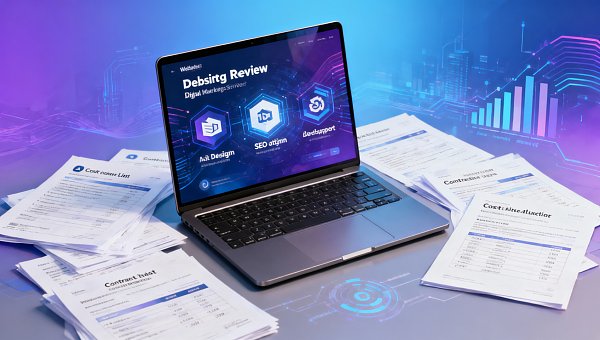
Website projects have clear phased characteristics and are usually divided into 5 stages: requirement analysis, UI design, front-end and back-end development, testing and launch, and operation and maintenance. Some service providers only cover the first 2–3 stages in the initial quotation. Although the total price appears lower, new costs continue to be triggered during later execution.
Three common pricing logics behind low-cost quotations
The first is “sign the basic version first,” which only includes 5–10 standard pages and does not include SEO architecture, form strategy, or data tracking. The second is “charge by function as needed,” splitting modules such as membership, inquiries, payment, and multiple languages into separate add-on items. The third is “charged separately after launch,” excluding servers, maintenance, content uploads, and security protection from the contract.
The judgment mistakes procurement personnel are most likely to overlook
- Only comparing the total price, without comparing delivery scope and acceptance criteria.
- Only looking at the homepage mockup, without verifying the number of sections, device compatibility, and backend permissions.
- Only confirming a development cycle of 7–15 days, without confirming the number of revision rounds and launch support times.
- Only asking whether it “includes SEO,” without confirming whether it includes keyword placement, TDK settings, URL rules, and a sitemap.
For companies building group corporate websites, foreign trade independent sites, or lead-generation marketing websites, website design quotations must shift from a “project procurement” perspective to a “business results” perspective. Integrated service providers like Yiyingbao Information Technology (Beijing) Co., Ltd., with more than 10 years of deep industry experience and coverage across intelligent website building, SEO optimization, social media marketing, and advertising, often place greater emphasis on full-chain planning, because a website is not an isolated page but the infrastructure for traffic capture and lead conversion.
The table below can help procurement quickly identify the cost modules most commonly downplayed in website design quotations, making it suitable for direct item-by-item review of supplier proposals during the price comparison stage.
As can be seen from the table, hidden costs are not necessarily “malicious charges”; in many cases, the quotation scope is simply defined too narrowly. If procurement does not clearly specify the number of pages, function list, maintenance cycle, and marketing support during the tendering or price comparison stage, later add-on items are almost unavoidable.
The 6 most common types of hidden costs in website design quotations
A complete website project usually has at least 6 types of hidden costs. They may not all appear in the first round of quotations, but their impact on the procurement budget is usually between 10%–40% of the total price. The higher the project complexity, the greater the fluctuation range.
1. Content entry and material organization costs
Many suppliers assume by default that the client will provide and upload copy, images, and product materials themselves. If a company has 30–200 product pages and the material formats are inconsistent, content organization and uploads will become a significant labor cost. According to common market practice, bulk entry beyond the basic page count is usually charged separately by page, by language, or by work hour.
2. Multilingual and localization expansion costs
A quotation stating “supports Chinese-English bilingual” does not mean it includes translation, layout adaptation, and multilingual SEO. In actual execution, adding 1 new language often means synchronizing sections, adjusting the URL structure, revising text layout, and configuring independent Meta information, usually extending the timeline by 3–7 days.
3. Functional interfaces and third-party system integration costs
Corporate websites are increasingly integrated with CRM, ERP, customer service systems, email marketing tools, or ad conversion tracking platforms. The number of interfaces can range from 1 to 5, and the openness of different systems varies greatly. If the supplier does not clarify in advance “whether integration testing is included,” later development costs and scheduling may both increase.
4. SEO foundation setup costs
Many website design quotations will say “SEO-friendly,” but real SEO foundation work includes at least 7 items such as TDK settings, internal linking logic, page loading optimization, image Alt, 301 rules, sitemap, and robots configuration. If these items are not included in the contract, doing them after the website goes live usually requires a separate project.
5. Security, backup, and operation & maintenance costs
A website going live does not mean the project is finished. Common operation and maintenance work includes weekly backups, vulnerability fixes, plugin updates, anomaly monitoring, certificate renewals, and server inspections. If you only purchase one-time delivery without a 3-month, 6-month, or 12-month maintenance plan, any subsequent issue may be charged separately each time.
6. Revision rounds and training support costs
One of the easiest ways for a website project to exceed budget is the assumption that “revisions are included by default.” In fact, most plans only include 2 to 3 rounds of page revisions, and anything beyond that will be charged by page or by work hour. Backend training is also often limited to 1 remote session. If multiple departments, job handovers, or written manual output are involved, these also usually require separate quotations.
If the procurement department also handles policy research, knowledge resource procurement, or professional topic support at the same time, similar patterns will also appear: the apparent price does not equal the final cost of use. For example, when selecting management materials, professional content such as Research on the Path for Building Internal Control in Public Hospitals from the Perspective of Financial and Accounting Supervision derives its real value from scenario fit, depth of use, and subsequent implementation, rather than from the purchase unit price alone.
How procurement personnel should review website design quotations
Compared with simply pushing down prices, a more effective approach is to establish a quotation review checklist. For the three types of projects—corporate websites, marketing websites, and foreign trade independent sites—it is recommended to examine at least 4 dimensions and 12 detailed items to ensure that each item has clear boundaries.
Four core review dimensions
- Delivery scope: whether the number of pages, number of functions, language versions, and device adaptation scope are clearly defined.
- Implementation timeline: whether the timing for each stage—requirement confirmation, design, development, testing, and launch—is marked.
- Add-on rules: whether charges beyond the scope are calculated by page, by module, or by work hour.
- Maintenance responsibilities: whether fault response time, backup frequency, and after-sales period are written into the contract.
In actual procurement, it is recommended to use the “website design quotation review form” as an attachment for supplier Q&A. This not only facilitates horizontal price comparison, but also reduces execution disputes caused by verbal commitments. The table below is suitable as an internal evaluation reference template.
The key conclusion of this table is: procurement review cannot stop at “whether website design is included,” but must instead evaluate whether it can support subsequent customer acquisition and operations. If the company’s website plan will work together with SEO, social media advertising, or ad conversion, then tracking, forms, landing page templates, and content expansion mechanisms should be written into the website design quotation from the start.
5 questions you must ask when communicating with suppliers
Question 1: How many revision rounds are included in this quotation, and how will extra revisions be charged?
It is recommended to require this to be written into the contract attachment, clearly stating whether the standard is “2 rounds of design revisions and 1 round of development adjustments” or another standard, so as to avoid disputes in the later stage of the project.
Question 2: Does it include content uploads and material organization?
If not included, the additional workload the supplier can undertake should be confirmed, for example within 50 pages, within 100 images, or billed by hour.
Question 3: To what extent are the SEO foundation items implemented?
Do not just accept the statement “supports optimization.” You should confirm item by item whether site structure, Meta configuration, URL rules, sitemap, and page speed optimization are within scope.
Question 4: How long is the maintenance period after launch, and how many hours is the response time?
For companies with higher business continuity requirements, it is recommended to clearly specify at least response within 4 working hours, a solution within 24 hours, as well as quarterly backups or monthly inspection arrangements.
Question 5: Can the website connect with subsequent marketing systems?
If the company plans to do SEO, advertising, or overseas social media traffic generation within the next 6–12 months, then the website design quotation should not only look at website building costs, but also whether it can smoothly connect with subsequent traffic operations.
From one-time website building to long-term growth, how procurement should make more reliable choices
The core of a mature procurement strategy is not obtaining the lowest website design quotation, but achieving more certain delivery outcomes within the budget range. If a company hopes that within 3 months after launch, the website can take on the dual tasks of brand presentation and lead conversion, then priority should be given to integrated service solutions that can provide website building, SEO, content strategy, and campaign coordination.
From the perspective of long-term operations, there are 3 capabilities truly worth paying attention to: first, whether the supplier can unify technical development with marketing objectives in planning; second, whether it has localized communication and ongoing service capabilities; third, whether it can provide differentiated page structures, keyword placement, and conversion path design based on industry characteristics.
For procurement personnel, a transparent website design quotation should at least clearly list page scope, functional boundaries, revision mechanisms, maintenance cycle, and marketing adaptation capabilities. This not only facilitates internal project approval, but also avoids slowing business rhythm after the project goes live due to frequent add-on items.
If you are evaluating a corporate website revamp, marketing website construction, or overseas independent website project, it is recommended to incorporate hidden cost review into the price comparison process as early as possible. Choosing a service team with both technical and marketing coordination capabilities can make the budget more controllable, delivery clearer, and subsequent growth smoother. Contact us now to obtain a more transparent website design quotation and customized solutions.
Related Articles
 Why a Google-optimized independent website is essential for trailer exports
 How Can a Brand Updates Page Be Made More SEO-Friendly? Analysis of Update Frequency, Content Structure, and Internal Linking Strategy
 Why is it that your foreign trade peers receive inquiries every day, while you can only wait for exhibitions?


Related Products
 EasyCamp SaaS Smart Website Marketing SystemE-Yingbao SaaS Smart Website Marketing System: AI-powered, zero-code website building. Rapidly launch multilingual independent e-commerce sites in just 10 minutes. Global server acceleration and AI-driven SEO optimization empower businesses to efficiently connect with global markets. The seamless integration of technology and user-friendly operation makes building e-commerce sites incredibly simple.
 AI+SEM Intelligent Advertising Marketing SystemAI+SEM drives intelligent ad creation, empowering full-funnel precision advertising marketing. The system automatically generates weekly/monthly reports, AI recommends keywords and target countries, monitors core metrics in real-time with intelligent alerts, and enables one-click high-conversion ad solutions to help quickly acquire customers and improve ROI.
 AI+SEO Dual Engine Optimization ServiceEasyWin AI+SEO Dual Engine Optimization System leverages AI-powered keyword mining, content generation, and comprehensive technical optimization to help foreign trade enterprises acquire high-quality organic traffic, significantly improving search rankings and conversion rates.
 AI+SNS Social Media Marketing SystemYingbao AI+SNS Social Media Marketing System - Precision social capture for the social media era. Supports one-click content synchronization across major platforms like Facebook and LinkedIn. AI intelligently rewrites posts for enhanced relevance. 24/7 AI customer service and user profiling analysis empower businesses to efficiently expand into global markets.
 AI+SEO营销解决方案易营宝AI+SEO营销解决方案,通过AI批量写作、智能生成TDK、精准关键词扩词等功能,全面优化网站SEO效果,提升流量与转化率。助力企业构建高效智能网站新生态。
 AI+SEM Advertising Marketing SolutionsAI+SEM Advertising Marketing Solution leverages AI technology to deeply empower SEM ad campaigns. It automatically generates weekly/monthly reports using AI, presenting account data across multiple dimensions for comprehensive insights into campaign performance and trends. The system precisely recommends keywords and target countries, intelligently generates high-conversion ad copy, and enables one-click activation of efficient campaign plans to help businesses rapidly acquire customers. Simultaneously, it monitors core metrics in real time, intelligently identifies abnormal fluctuations, and issues timely alerts to ensure stable, high-return advertising results.
 Domain Name ServicesEasyWin provides professional domain name services, including intelligent queries, one-stop registration, brand protection, and full lifecycle management, helping businesses build a digital brand image.
 EasyOperate B2C Cross-Border E-Commerce Platform & Independent WebsiteEasyStore B2C Cross-border E-commerce Independent Store is an intelligent website building and cross-border e-commerce integrated solution independently developed by EasyStore Information Technology (Beijing) Co., Ltd. The system is specially designed for small and medium-sized as well as large export enterprises, integrating 'website building, operation, marketing, advertising, and conversion' into one, helping enterprises quickly establish cross-border e-commerce independent stores to achieve brand globalization and global sales growth.
The platform supports multiple languages, multiple currencies, and multi-channel marketing, with built-in AI intelligent translation and SEO optimization systems, suitable for mainstream markets such as Southeast Asia, Europe and America, Latin America, and the Middle East, assisting Chinese manufacturing enterprises in efficiently deploying international e-commerce strategies. SSL证书易营宝提供专业SSL安全证书服务,包括单域名和泛域名证书,确保网站数据传输加密、身份验证和完整性保护,助力企业建立安全可信的在线业务环境。









