









- Can Zhejiang foreign trade independent websites still be developed today? Look at changes in traffic and lead generationJul 28, 2026View details
- What New Signals Are Emerging in Enterprise Services SaaS Marketing ReportsJul 27, 2026View details
- What Does a Global Traffic Ecosystem Service Provider Do? What Are the Differences from a Single Advertising AgencyJul 16, 2026View details
- What should you focus on in the latest enterprise SaaS report? From renewal rates and delivery costs to overseas growth opportunitiesJul 12, 2026View details
- What signals are worth paying attention to in a cross-border marketing trend report? B2B companies should look at these 6 signalsJul 11, 2026View details
- How to Read a Cross-Border Marketing Trends Report? Five Key Dimensions for Evaluating Channel OpportunitiesJul 11, 2026View details
- Which channel has the highest ROI in the global traffic ecosystem? Comparative analysis of search, social media, and advertisingJul 10, 2026View details
- What multilingual website services are available in Sanya? Which model is more suitable for local businesses going global?Jul 08, 2026View details
How much does website development generally cost?
How much does website development generally cost? In fact, prices vary significantly, from template-based showcase sites to customized marketing websites. This article will help you quickly understand the budget structure by considering functional requirements, design level, promotional capabilities, and ongoing maintenance, so you can avoid wasting money.
For foreign trade enterprises, manufacturing factories, cross-border sellers, and brands expanding overseas, a website is not simply a matter of “creating a page.” The factors that truly affect the budget often include language versions, inquiry conversion, SEO foundation, advertising landing page capabilities, content management efficiency, and ongoing operational support.
Therefore, when discussing how much website development generally costs, you cannot look only at the initial payment. You also need to consider three core outcomes: whether the site can be indexed by search engines, whether it can handle advertising traffic, and whether it can continuously generate inquiries and orders. This is also the fundamental difference between an integrated website and marketing service solution and ordinary website development services.
How Much Does Website Development Generally Cost? Start with Common Price Ranges
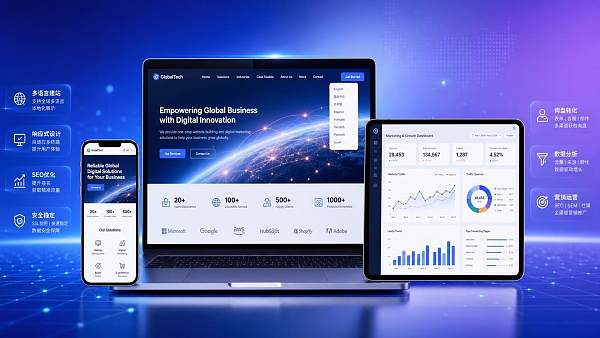
When requesting quotations, businesses often find that projects all described as “official website development” may be priced anywhere from several thousand yuan to over one hundred thousand yuan. The difference is usually not caused by the number of pages alone, but by differences in functional depth, design complexity, development methods, and marketing capabilities.
Common Website Types and Budget Differences
If only basic presentation is needed, template-based website development is usually adopted. The typical project cycle is approximately 7—15 days, making it suitable for startups that need to launch quickly. If multilingual support, inquiry forms, product categorization, SEO structure, and content expansion capabilities are required, the budget generally falls within the range of 10,000—50,000 yuan. If brand visual customization, overseas promotion architecture, and system integration are involved, the cost will continue to increase.
The table below can help you gain a more intuitive understanding of how much website development generally costs for different types of projects and which business scenarios each type is suitable for.
From a procurement perspective, low-cost solutions are more suitable for the stage of “getting a website first.” For enterprises with advertising plans, SEO objectives, and overseas business strategies, what they truly need is a website that can be promoted, indexed, and converted. The value of this type of website is usually higher than the price of the pages alone.
Why Can Quotations Differ by More Than Ten Times for Website Development?
1. Different Design Levels
Template-based websites usually replace content within existing layouts, with costs concentrated on basic configuration. Customized websites require homepage strategy, product page structures, conversion paths, visual guidelines, and interaction details. Design and front-end development often account for 30%—50% of the total budget.
2. Different Functional Modules
A basic website only requires sections, forms, and backend management. A marketing website adds capabilities such as SEO tag management, landing page creation, data tracking, lead tracking, multilingual switching, and content categorization. Each additional layer of functionality increases development and testing costs.
3. Different Ongoing Operational Capabilities
Many enterprises calculate only the website development cost while overlooking post-launch maintenance, content updates, speed optimization, security backups, and promotional support. In fact, the first three months after launch are often the period for validating results. Insufficient maintenance capabilities can directly affect indexing, visits, and inquiry performance.
5 Key Factors Affecting Website Development Costs
To accurately determine how much website development generally costs, it is recommended not to ask only “How much does it cost to build a website?” Instead, first break down the budget structure. This is especially important for B2B enterprises because their websites often serve three functions: brand presentation, lead generation and conversion, and channel coordination.
Functional Requirements: Determining the Cost Floor
Common functions include product management, news publishing, inquiry forms, online customer service, download centers, case studies, and multilingual versions. If membership systems, payment modules, CRM integration, or API interfaces are added, the budget will typically increase by 20%—80%.
Content Scale: Determining the Implementation Workload
A 5—10-page showcase website and a website containing 50 product pages, 20 content pages, and 3 language versions involve completely different workloads. The number of pages, copy organization, image processing, and multilingual proofreading all directly contribute to project costs.
Promotional Capabilities: Determining Whether the Website Is Merely Decorative
Many enterprises spend their budgets on page design while overlooking SEO structure, URL standards, TDK configuration, internal linking logic, page loading speed, and mobile experience. If Google SEO, Google Ads, or social media traffic acquisition will be carried out in the future, these foundational capabilities should preferably be deployed during the website development stage.
Technical Architecture: Determining Scalability and Maintenance Costs
SaaS intelligent website development generally allows faster launch and involves lower annual maintenance pressure, making it suitable for enterprises that prioritize efficiency. Fully customized development offers greater flexibility, but may extend the launch cycle by 2—6 weeks, while subsequent updates also depend more heavily on the technical team. Selection should be based on the enterprise’s internal operational capabilities.
Service Team: Determining Delivery Quality
For the same quotation of 20,000 yuan, some service providers include only page production, while others cover planning, website development, basic optimization, launch deployment, and training. Different delivery scopes can lead to significant differences in the final results. Before procurement, at least the following 6 items should be clarified: number of pages, number of languages, functional list, number of revisions, delivery schedule, and after-sales response.
How Can Different Types of Enterprises Choose the Right Solution and Avoid Wasting Money?
There is no universal standard for how much website development generally costs, but there is a clear selection logic. Enterprises can quickly match a more suitable solution according to their business stage, customer acquisition methods, and target markets, rather than blindly choosing the lowest price or the most fully configured option.
Match Solutions to Enterprise Types
If you are a startup, a solution costing less than 10,000 yuan can first be used to complete a basic official website and brand presentation. If you are a foreign trade factory, it is recommended to prioritize multilingual structure, product page layout, and inquiry conversion. If you are a cross-border brand, priority should be given to e-commerce capabilities, advertising landing pages, and data tracking.
The table below is suitable for budget assessment before project initiation and can help management quickly evaluate the investment priorities for websites at different business stages.
As can be seen, a higher budget is not necessarily better; it should match the business objectives. For most enterprises seeking overseas customers, planning website development and marketing capabilities as an integrated whole is usually more cost-effective than repeatedly rebuilding the website later.
4 Common Pitfalls in Procurement
- Comparing only homepage mockups without considering backend and expansion capabilities.
- Looking only at the one-time quotation without asking about annual maintenance, server, and upgrade fees.
- Building only a Chinese website and adding multilingual versions later, resulting in duplicated structural development.
- Building the website first and considering promotion later, resulting in pages that are unsuitable for SEO and advertising conversion.
If an enterprise has overseas promotion plans within the next 12 months, it is recommended to clarify the keyword direction, target countries, content sections, and inquiry handling path before website development begins. This is the only way to accurately determine how much website development should cost, rather than passively adding to the budget later.
What Ongoing Costs Are Involved After the Website Goes Live?
Many procurement teams are concerned about how much website development generally costs but overlook the fact that the website truly begins generating results after launch. Generally speaking, annual ongoing costs mainly consist of four parts: domain name and server, technical maintenance, content updates, and promotional operations.
Basic Maintenance Costs
Domain names and hosting are usually billed annually, with common costs ranging from several hundred yuan to several thousand yuan. If the website targets visitors in North America, Europe, or multiple regions, CDN, overseas nodes, and access speed optimization should also be considered. These costs vary according to traffic volume.
Operational and Growth Costs
If continuous lead generation is required, the recommended content update frequency is at least 2—4 times per month. If SEO optimization, advertising, or social media traffic acquisition is also carried out, the website should not be merely a static showcase page; it should become a marketing hub. In this case, the better website development coordinates with subsequent operations, the more stable the return on investment will be.
Types of Enterprises Suitable for Integrated Services
For enterprises seeking overseas growth, the advantage of an integrated solution is that it helps avoid unnecessary detours. Platforms such as Yiyingbao, an AI-driven enterprise-level SaaS intelligent website development and overseas marketing platform, cover not only multilingual website development, B2B marketing websites, and B2C cross-border e-commerce stores, but also connect with Google SEO, Google Ads, Facebook marketing, overseas social media, and GEO optimization. They are suitable for teams that want to plan website development, promotion, and conversion as an integrated process.
This is particularly applicable to enterprises targeting regions such as North America, Europe, Southeast Asia, Japan and South Korea, the Middle East, and Latin America. If a website has content expansion, search friendliness, advertising support, and multilingual operational capabilities from the outset, it is generally more efficient than purchasing services from multiple suppliers separately, while also reducing internal coordination costs.
How Can You Determine Whether Your Budget Is Reasonable?
Conduct a Quick Self-Check with 3 Questions
- After launch, will this website only provide information, or will it also be responsible for customer acquisition?
- Over the next 6—12 months, will multilingual support, SEO, or advertising be added?
- Does the current quotation clearly specify the number of pages, functional list, delivery schedule, and after-sales scope?
If the answer to at least 2 of the 3 questions is “yes,” what you generally need is not the lowest-cost website development, but a website solution designed around growth objectives. In this case, how much website development generally costs should be evaluated based on long-term usage value rather than only the initial development cost.
When an enterprise values overseas market expansion, lead generation, and brand accumulation, choosing a team with intelligent website development, marketing optimization, and localized service capabilities can often better control total costs and shorten the trial-and-error cycle. To learn more about budget solutions, functional configurations, and delivery schedules suitable for your business stage, contact us now to obtain a customized solution and learn about more solutions.
Related Articles
 Promoting chemical products on Google is essential—otherwise, you are effectively handing your customers over to competitors
 Can Zhejiang foreign trade independent websites still be developed today? Look at changes in traffic and lead generation
 What New Signals Are Emerging in Enterprise Services SaaS Marketing Reports


Related Products
 EasyCamp SaaS Smart Website Marketing SystemE-Yingbao SaaS Smart Website Marketing System: AI-powered, zero-code website building. Rapidly launch multilingual independent e-commerce sites in just 10 minutes. Global server acceleration and AI-driven SEO optimization empower businesses to efficiently connect with global markets. The seamless integration of technology and user-friendly operation makes building e-commerce sites incredibly simple.
 AI+SEM Intelligent Advertising Marketing SystemAI+SEM drives intelligent ad creation, empowering full-funnel precision advertising marketing. The system automatically generates weekly/monthly reports, AI recommends keywords and target countries, monitors core metrics in real-time with intelligent alerts, and enables one-click high-conversion ad solutions to help quickly acquire customers and improve ROI.
 AI+SEO Dual Engine Optimization ServiceEasyWin AI+SEO Dual Engine Optimization System leverages AI-powered keyword mining, content generation, and comprehensive technical optimization to help foreign trade enterprises acquire high-quality organic traffic, significantly improving search rankings and conversion rates.
 AI+SNS Social Media Marketing SystemYingbao AI+SNS Social Media Marketing System - Precision social capture for the social media era. Supports one-click content synchronization across major platforms like Facebook and LinkedIn. AI intelligently rewrites posts for enhanced relevance. 24/7 AI customer service and user profiling analysis empower businesses to efficiently expand into global markets.
 AI+SEO营销解决方案易营宝AI+SEO营销解决方案,通过AI批量写作、智能生成TDK、精准关键词扩词等功能,全面优化网站SEO效果,提升流量与转化率。助力企业构建高效智能网站新生态。
 AI+SEM Advertising Marketing SolutionsAI+SEM Advertising Marketing Solution leverages AI technology to deeply empower SEM ad campaigns. It automatically generates weekly/monthly reports using AI, presenting account data across multiple dimensions for comprehensive insights into campaign performance and trends. The system precisely recommends keywords and target countries, intelligently generates high-conversion ad copy, and enables one-click activation of efficient campaign plans to help businesses rapidly acquire customers. Simultaneously, it monitors core metrics in real time, intelligently identifies abnormal fluctuations, and issues timely alerts to ensure stable, high-return advertising results.
 Domain Name ServicesEasyWin provides professional domain name services, including intelligent queries, one-stop registration, brand protection, and full lifecycle management, helping businesses build a digital brand image.
 EasyOperate B2C Cross-Border E-Commerce Platform & Independent WebsiteEasyStore B2C Cross-border E-commerce Independent Store is an intelligent website building and cross-border e-commerce integrated solution independently developed by EasyStore Information Technology (Beijing) Co., Ltd. The system is specially designed for small and medium-sized as well as large export enterprises, integrating 'website building, operation, marketing, advertising, and conversion' into one, helping enterprises quickly establish cross-border e-commerce independent stores to achieve brand globalization and global sales growth.
The platform supports multiple languages, multiple currencies, and multi-channel marketing, with built-in AI intelligent translation and SEO optimization systems, suitable for mainstream markets such as Southeast Asia, Europe and America, Latin America, and the Middle East, assisting Chinese manufacturing enterprises in efficiently deploying international e-commerce strategies. SSL证书易营宝提供专业SSL安全证书服务,包括单域名和泛域名证书,确保网站数据传输加密、身份验证和完整性保护,助力企业建立安全可信的在线业务环境。









