









- What should you focus on in the latest enterprise SaaS report? From renewal rates and delivery costs to overseas growth opportunitiesJul 12, 2026View details
- What signals are worth paying attention to in a cross-border marketing trend report? B2B companies should look at these 6 signalsJul 11, 2026View details
- How to Read a Cross-Border Marketing Trends Report? Five Key Dimensions for Evaluating Channel OpportunitiesJul 11, 2026View details
- Which channel has the highest ROI in the global traffic ecosystem? Comparative analysis of search, social media, and advertisingJul 10, 2026View details
- What multilingual website services are available in Sanya? Which model is more suitable for local businesses going global?Jul 08, 2026View details
- How to view the complete list of China SaaS companies in the top 100? Practical methods for screening website-building and marketing service providersJul 08, 2026View details
- How to view pricing in the global traffic ecosystem? Cost comparison of search, social media, and content channel advertisingJul 06, 2026View details
- How to assess foreign trade website development trends?Looking at 2026 changes from multilingual,AI content to conversion pathsJul 04, 2026View details
Is a multilingual foreign trade website suitable for small teams
Are multilingual foreign trade websites suitable for small teams? The answer is not absolutely suitable, nor is it necessarily unsuitable.
The real criterion for judgment is whether a small team can use less manpower to connect website building, translation, content updates, and overseas customer acquisition.
If you are still at the stage of "first creating a few language pages to try," a multilingual website will often become a maintenance burden.
But if the platform, process, and content strategy are chosen correctly, small teams can also enter overseas markets with a controllable budget and gradually scale up results.
Conclusion first: small teams can do it, but the "heavy construction, light operation" approach is not suitable
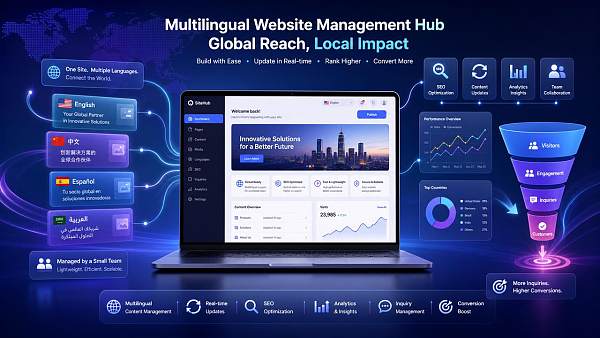
When business decision-makers search for "Are multilingual foreign trade websites suitable for small teams", the core is not wanting to understand the concept, but wanting to judge whether it is worth investing in.
What they really care about is whether, under the condition of a small team and limited budget, creating a multilingual website will slow down the business and whether it can bring in orders.
Therefore, the essence of this question is not "whether to do it", but "under what conditions to do it so that resources are not wasted".
For small teams, the biggest fear is not a slow start, but that after launch there is no one to maintain it in the long term, resulting in many pages, many languages, but very few inquiries.
So whether a multilingual website is suitable depends on three key things: whether the target market is clear, whether the content is sustainable, and whether marketing can advance in coordination.
What small teams care about most is actually the input-output ratio
From a management perspective, a multilingual website is not a purely technical project, but an overseas growth investment.
If a company hopes to simultaneously improve search traffic, brand presentation, and overseas inquiries, a multilingual website usually has clear value.
Because users in different countries are more willing to search, read, and submit requests in their native language, this directly affects time on page, trust, and conversion rate.
Especially in B2B foreign trade scenarios, the customer decision-making chain is long, and the website often plays the key role of "initial supplier screening".
When a company uses only an English website to cover all markets, it often misses non-English search traffic and also reduces the efficiency of localized communication.
But if the company currently has no clear market direction and even its core product positioning is not yet stable, a multilingual website may not be the priority investment item.
At this time, a more reasonable approach is often to first focus on building one primary-language website, get the conversion path running smoothly, and then expand to a second and third language.
What kinds of small teams are more suitable for building multilingual foreign trade websites
Not all small teams are suitable for immediately launching a multilingual project, but the following types of companies are usually more likely to achieve results.
The first type is companies that already have stable export products and clearly know their target countries or regions; these teams have a clearer direction.
The second type is companies that already have an English website and basic inquiries, but whose growth has stagnated and who hope to expand organic traffic sources.
The third type is growing companies whose sales rely on trade shows, platforms, or referrals, and that want to gradually establish independent customer acquisition channels.
Although these types of teams are not large, their business goals are clear, and they can allocate content and promotional resources around a few key markets.
By contrast, if a company has many product lines, scattered markets, and lacks a unified person in charge of content internally, it is not advisable to roll out too many languages in the early stage.
For small teams, being focused and precise is more important than being broad and scattered. It is more practical to first go deep in key markets than to spread out all at once.
For small teams building multilingual websites, the biggest risk is not website creation, but losing control of subsequent maintenance
Many companies underestimate the continuous investment required for multilingual websites, thinking that once the website is built and translated and goes live, overseas customers will come naturally.
In fact, what really creates the gap is subsequent operations, including page updates, keyword planning, technical optimization, and inquiry follow-up.
Once the number of languages increases, common problems appear: product information gets out of sync, translation quality varies, and page structures become seriously repetitive.
If there is also a lack of a unified backend and content management mechanism, small teams will quickly fall into the inefficient cycle of "fixing one place, missing three others".
This is also why many companies feel that multilingual foreign trade websites are not suitable for small teams. In essence, the direction is not wrong, but the method is wrong.
Choosing a platform that supports batch management, intelligent translation assistance, reusable page templates, and unified SEO rules will greatly reduce maintenance costs.
How should business decision-makers judge: do it now, or do it later
A practical way to judge is to first see whether the company already has a "minimum viable overseas content system".
If the company can at least steadily provide product information, industry applications, case descriptions, contact information, and a basic brand introduction, then it can get started.
If this content is still lacking for a long time, or external materials rely entirely on temporary compilation by sales staff, rashly building a multilingual website will often produce half the result with twice the effort.
The second point of judgment is whether there is someone internally who can be responsible for content updates and performance reviews. It does not have to be a full-time role, but someone must take the lead.
The third point of judgment is whether there is a clear priority, for example, starting with English plus one key minor language, rather than beginning with five or six languages at once.
Decision-makers need to understand that a multilingual website is not about "the more languages, the better", but about "the closer to the target market, the more effective".
When resources are limited, focusing on high-potential countries can bring more real inquiries than pursuing superficial international scale.
What kind of implementation path is more suitable for small teams
For most small and medium-sized foreign trade companies, a more稳妥 path is to advance in stages rather than making a one-time heavy investment to launch a complete matrix.
In the first stage, you can first build a core main site and complete the basic content framework around flagship products, application scenarios, and trust-building endorsements.
In the second stage, based on search data and inquiry sources, add one target-language version with the highest commercial value.
In the third stage, combined with SEO and advertising data, gradually expand high-conversion pages instead of evenly translating all sections.
The advantage of this approach is that it allows budget control, reduces trial-and-error costs, and at the same time preserves the ability for later expansion.
From a management perspective, this is more suitable for small teams than building a large and all-inclusive website at one time, and it also makes it easier to see actual output clearly.
In some internal management discussions, responsible persons may even refer to materials such as Research on Comprehensive Budget Management in Administrative Institutions to learn from ideas on budget allocation and phased control.
The real value of a multilingual website is not just "translating pages"
If it is only about mechanically translating Chinese content into multiple languages, then the significance of a multilingual foreign trade website for small teams will be very limited.
What is truly valuable is using a multilingual website to build a content expression system that better fits how overseas users understand and search.
For example, for the same product, search habits, technical terminology, and certification concerns may be completely different in different countries.
This means page content cannot be only translated; it must also be localized, including titles, selling points, cases, and calls to action.
For business decision-makers, this localization capability is directly related to search visibility and inquiry quality, rather than the superficial number of pages.
So when evaluating whether a solution is suitable for a small team, you cannot look only at website-building costs, but also at whether it supports long-term content growth.
How to reduce execution pressure for small teams
If small teams want to turn multilingual websites into effective assets, the key is not increasing headcount, but reducing repetitive work.
First, the website system should support unified management of product libraries, news, cases, and SEO settings, avoiding scattered maintenance across multiple languages.
Second, content production should have templates, such as a unified structure for product pages, unified logic for industry pages, and unified conversion actions for inquiry pages.
Third, the translation workflow is best handled with a "machine-assisted + human proofreading" approach, achieving a balance between efficiency and professionalism.
Finally, marketing actions should be coordinated. Do not let the website exist independently, but instead form a closed loop with SEO, social media, and advertising.
The result of doing this is that even if the team is not large, every content update can still be turned into a long-term accumulable traffic asset.
If a company values phased returns and resource allocation when planning investment, then management thinking like Research on Comprehensive Budget Management in Administrative Institutions can also provide some inspiration.
Conclusion: whether multilingual foreign trade websites are suitable for small teams depends on whether they follow a "lightweight, operable, growth-capable" path
Returning to the original question, are multilingual foreign trade websites suitable for small teams? The answer is yes, but with prerequisites.
This prerequisite is not whether the team size is sufficient, but whether there are clear market goals, a sustainable content mechanism, and coordinated marketing capabilities.
If a company builds a multilingual website only to appear more international, small teams can easily fall into inefficient maintenance and ineffective investment.
But if the company takes key markets as the core, adopts a phased implementation approach, and advances together with SEO and content operations, a multilingual website can absolutely become a growth lever.
For business decision-makers, the most correct way of thinking is not to ask "Can we do it with a small team", but to ask "How should we do it to get better returns".
When the path is clear, the tools are appropriate, and the pace is reasonable, small teams can not only do it, but can often validate overseas market opportunities faster than large teams.
Related Articles



Related Products
 EasyCamp SaaS Smart Website Marketing SystemE-Yingbao SaaS Smart Website Marketing System: AI-powered, zero-code website building. Rapidly launch multilingual independent e-commerce sites in just 10 minutes. Global server acceleration and AI-driven SEO optimization empower businesses to efficiently connect with global markets. The seamless integration of technology and user-friendly operation makes building e-commerce sites incredibly simple.
 AI+SEM Intelligent Advertising Marketing SystemAI+SEM drives intelligent ad creation, empowering full-funnel precision advertising marketing. The system automatically generates weekly/monthly reports, AI recommends keywords and target countries, monitors core metrics in real-time with intelligent alerts, and enables one-click high-conversion ad solutions to help quickly acquire customers and improve ROI.
 AI+SEO Dual Engine Optimization ServiceEasyWin AI+SEO Dual Engine Optimization System leverages AI-powered keyword mining, content generation, and comprehensive technical optimization to help foreign trade enterprises acquire high-quality organic traffic, significantly improving search rankings and conversion rates.
 AI+SNS Social Media Marketing SystemYingbao AI+SNS Social Media Marketing System - Precision social capture for the social media era. Supports one-click content synchronization across major platforms like Facebook and LinkedIn. AI intelligently rewrites posts for enhanced relevance. 24/7 AI customer service and user profiling analysis empower businesses to efficiently expand into global markets.
 AI+SEO营销解决方案易营宝AI+SEO营销解决方案,通过AI批量写作、智能生成TDK、精准关键词扩词等功能,全面优化网站SEO效果,提升流量与转化率。助力企业构建高效智能网站新生态。
 AI+SEM Advertising Marketing SolutionsAI+SEM Advertising Marketing Solution leverages AI technology to deeply empower SEM ad campaigns. It automatically generates weekly/monthly reports using AI, presenting account data across multiple dimensions for comprehensive insights into campaign performance and trends. The system precisely recommends keywords and target countries, intelligently generates high-conversion ad copy, and enables one-click activation of efficient campaign plans to help businesses rapidly acquire customers. Simultaneously, it monitors core metrics in real time, intelligently identifies abnormal fluctuations, and issues timely alerts to ensure stable, high-return advertising results.
 Domain Name ServicesEasyWin provides professional domain name services, including intelligent queries, one-stop registration, brand protection, and full lifecycle management, helping businesses build a digital brand image.
 EasyOperate B2C Cross-Border E-Commerce Platform & Independent WebsiteEasyStore B2C Cross-border E-commerce Independent Store is an intelligent website building and cross-border e-commerce integrated solution independently developed by EasyStore Information Technology (Beijing) Co., Ltd. The system is specially designed for small and medium-sized as well as large export enterprises, integrating 'website building, operation, marketing, advertising, and conversion' into one, helping enterprises quickly establish cross-border e-commerce independent stores to achieve brand globalization and global sales growth.
The platform supports multiple languages, multiple currencies, and multi-channel marketing, with built-in AI intelligent translation and SEO optimization systems, suitable for mainstream markets such as Southeast Asia, Europe and America, Latin America, and the Middle East, assisting Chinese manufacturing enterprises in efficiently deploying international e-commerce strategies. SSL证书易营宝提供专业SSL安全证书服务,包括单域名和泛域名证书,确保网站数据传输加密、身份验证和完整性保护,助力企业建立安全可信的在线业务环境。









