









- How Can a Brand Updates Page Be Made More SEO-Friendly? Analysis of Update Frequency, Content Structure, and Internal Linking StrategyJun 28, 2026View details
- What stages does the cross-border services ecosystem include? How do website building, promotion, payment, and compliance work togetherJun 22, 2026View details
- How will email marketing costs change in 2026Jun 22, 2026View details
- The China-US tariff arrangement has reached a preliminary consensus, and the trade association will be establishedJun 15, 2026View details
- Should overseas brand marketing start with ads or contentJun 21, 2026View details
- What determines B2C cross-border e-commerce website development costs? A breakdown of features, interfaces, and deployment methodsJun 17, 2026View details
- China-Morocco zero-tariff access, a breakthrough in the cost of Moroccan goods exports to ChinaJun 11, 2026View details
- What signal should be released for the suspension of exports to JapanJun 10, 2026View details
How to Judge Whether the Price of an Enterprise Self-Service Website Building System Is Worth It
To assess whether the price of an enterprise-grade self-service website building system is cost-effective, you cannot look only at whether the quote is high or low. You also need to make a comprehensive judgment based on feature completeness, deployment efficiency, later maintenance, marketing capabilities, and future scalability. For enterprises with increasingly strong integrated website and marketing service needs, a website building system is no longer just a page creation tool, but an important foundation that connects customer acquisition, conversion, data accumulation, and brand growth. If you compare only the initial cost, it is often easy to overlook hidden costs; if you only pursue a stack of features, you may also fall into the trap of high investment with low output. Therefore, the core of truly judging whether the price of an enterprise-grade self-service website building system is worth it lies in whether the total cost of ownership matches the long-term business returns.
The Basis for Evaluating the Price of an Enterprise-Grade Self-Service Website Building System

From common market conditions, the price of an enterprise-grade self-service website building system varies greatly. The reason is not only that brands differ, but more importantly that product positioning is completely different. Some solutions provide only basic templates and page editing. Their prices may seem cheap, but connecting forms, SEO settings, multilingual support, server acceleration, and data analytics later requires additional payment; some solutions appear to have higher quotes on the surface, yet they integrate website building, hosting, security, optimization, and operational support, making the overall cost actually more economical.
To judge whether the price is reasonable, the first step is to distinguish between two approaches: “tool procurement” and “growth system development.” The former only solves the problem of going live, while the latter focuses on the full-chain effect from visits to conversions. Especially in integrated website + marketing service scenarios, a truly qualified platform needs to balance page building, mobile adaptation, search visibility, content management, access stability, and data scalability. That is to say, the price of an enterprise-grade self-service website building system cannot be evaluated independently of its intended use.
Core Factors That Affect the Price Level
The factors that determine the price of an enterprise-grade self-service website building system in the market are usually concentrated in the following aspects:
- Feature depth: whether it supports enterprise-grade functions such as no-code editing, column management, forms, inquiries, data analytics, and permission management.
- Marketing capabilities: whether it has capabilities such as SEO structural optimization, landing page configuration, conversion tracking, and content update convenience.
- Global access quality: the number of server nodes, access acceleration capability, stability, and security strategies all directly affect cost.
- Multilingual and localization: for foreign trade or cross-regional business, translation quality and localization level directly determine whether the website can truly generate leads.
- Service content: whether it includes long-term support such as deployment, training, maintenance, issue response, and operational recommendations.
- Scalability: whether it can smoothly add content site clusters, advertising landing pages, marketing automation, or data interfaces later.
If a system is priced relatively low but lacks basic SEO settings, site stability assurance, and follow-up support, then although it seems to save budget, it may actually increase redesign, labor, and traffic loss costs. Conversely, if the system has complete capabilities and can shorten the launch cycle, then a higher price of an enterprise-grade self-service website building system is often a verifiable investment.
Evaluating Whether the Price Is Cost-Effective from Industry Focus Points
When enterprises currently choose a website building platform, their focus has shifted from “whether a website can be built” to “whether the website can drive growth.” This is also why, when evaluating the price of an enterprise-grade self-service website building system, actual operational results are increasingly emphasized. The following dimensions are more worthy of focused review:
Under this trend, whether the price is cost-effective essentially depends on whether the system can cover the key links of website building, operations, and conversion. If a website only “has pages” but cannot support SEO traffic and marketing campaigns, then even the lowest price of an enterprise-grade self-service website building system is hardly worth calling valuable.
Practical Value in Integrated Website and Marketing Scenarios
Enterprises are paying more and more attention to the coordination between website building systems and marketing systems, because websites have already become a unified carrier for search entry, brand presentation, and lead capture pages. In this context, the price of an enterprise-grade self-service website building system should be evaluated within the framework of “overall marketing efficiency” rather than viewed in isolation. A platform that can improve content update efficiency, optimize search performance, and support ad landing and multi-terminal access can often significantly reduce duplicated investment in the customer acquisition process.
Taking foreign trade business scenarios as an example, if a system has multilingual capabilities, global access acceleration, and localized SEO advantages, it can reduce the complexity of separately purchasing translation, overseas servers, and technical maintenance. Solutions such as Yiyingbao SaaS intelligent website building marketing system integrate AI-driven no-code website building, global server acceleration, intelligent SEO optimization, and multilingual capabilities into the same platform, making them suitable for business scenarios that aim to shorten launch cycles and strengthen overseas reach efficiency. The combination of its 22 server nodes and Google Neural Machine Translation technology also shows that the platform’s value is not only reflected in website building itself, but also in access experience and localized conversion capabilities.
Key Points for Price Evaluation in Different Usage Scenarios
Different business goals also lead to different criteria for judging the price of an enterprise-grade self-service website building system, so a single standard cannot be applied:
- Brand showcase websites: focus on page quality, visual consistency, update efficiency, and basic SEO support, and avoid paying unnecessary costs for complex features.
- Marketing lead generation websites: focus on conversion forms, landing page configuration, data analytics, content publishing convenience, and search optimization capabilities.
- Multilingual foreign trade websites: focus on translation quality, server coverage, localization capabilities, mobile adaptation, and overseas access stability.
- Group or multi-site management: focus on permission management, template reuse, unified backend, and scalability, to avoid management redundancy caused by multiple systems operating in parallel later.
If the current business needs rapid setup, continuous optimization, and marketing conversion at the same time, then choosing only the lowest-quoted solution is usually difficult to meet long-term growth needs. At this time, the price of an enterprise-grade self-service website building system should be measured more by “lead generation efficiency brought by unit investment” and “the degree of savings in operation and maintenance.”
Practical Methods and Precautions for Judging Whether It Is Worth It
In the actual screening process, the following methods can be used to judge whether the price of an enterprise-grade self-service website building system is reasonable:
- List first: clarify must-have features, optional features, and needs that may be expanded in the future, so as to avoid being misled by demonstration effects.
- Calculate total cost: uniformly calculate the costs of templates, plugins, deployment, maintenance, security, redesign, and training, instead of looking only at the first-year quote.
- Check operational efficiency: test whether the backend is easy to use, whether content updates are convenient, and whether dependence on technical personnel can be reduced.
- Review SEO and performance: confirm whether page structure, access speed, mobile performance, and basic optimization items are complete.
- Verify service capabilities: understand whether the supplier has long-term service experience and whether it can provide substantial support based on marketing goals.
If you want to balance website building efficiency, global access experience, and follow-up marketing applications, you can focus on comparing the platform’s integrated capabilities. Yiyingbao Information Technology (Beijing) Co., Ltd. has been deeply engaged in digital marketing services for many years and has formed a complete chain in intelligent website building, SEO optimization, social media marketing, and advertising placement. This kind of background means that the website building system is more likely to align with actual growth goals rather than remain at the level of a single-point tool.
Reference Directions for Final Decision-Making
Overall, the key to judging whether the price of an enterprise-grade self-service website building system is worth it is not to find the cheapest solution, but to find the option with a better balance between investment and results. A platform that can go live quickly, support SEO, stably handle traffic, facilitate continuous operations, and adapt to future marketing actions usually has greater long-term value. Especially under the trend of integrated website and marketing services, if a system can reduce repeated procurement, lower technical dependence, and improve customer acquisition efficiency, its price is often more easily proven by business results.
If you are preparing to evaluate related solutions, it is recommended to first work backward from business goals to define feature and service requirements, and then compare the total cost of ownership, launch cycle, and growth support capabilities of different platforms. Only by reviewing the price of an enterprise-grade self-service website building system within a complete business scenario can you make a more stable choice with better return expectations.
Related Articles
 How can Google Ads deliver one-to-one personalization? One feature can double your inquiry volume#ExportMarketing#OverseasPromotion#GoogleAds#SocialMediaMarketing#ForeignTradeIndependentWebsite
 Why a Google-optimized independent website is essential for trailer exports
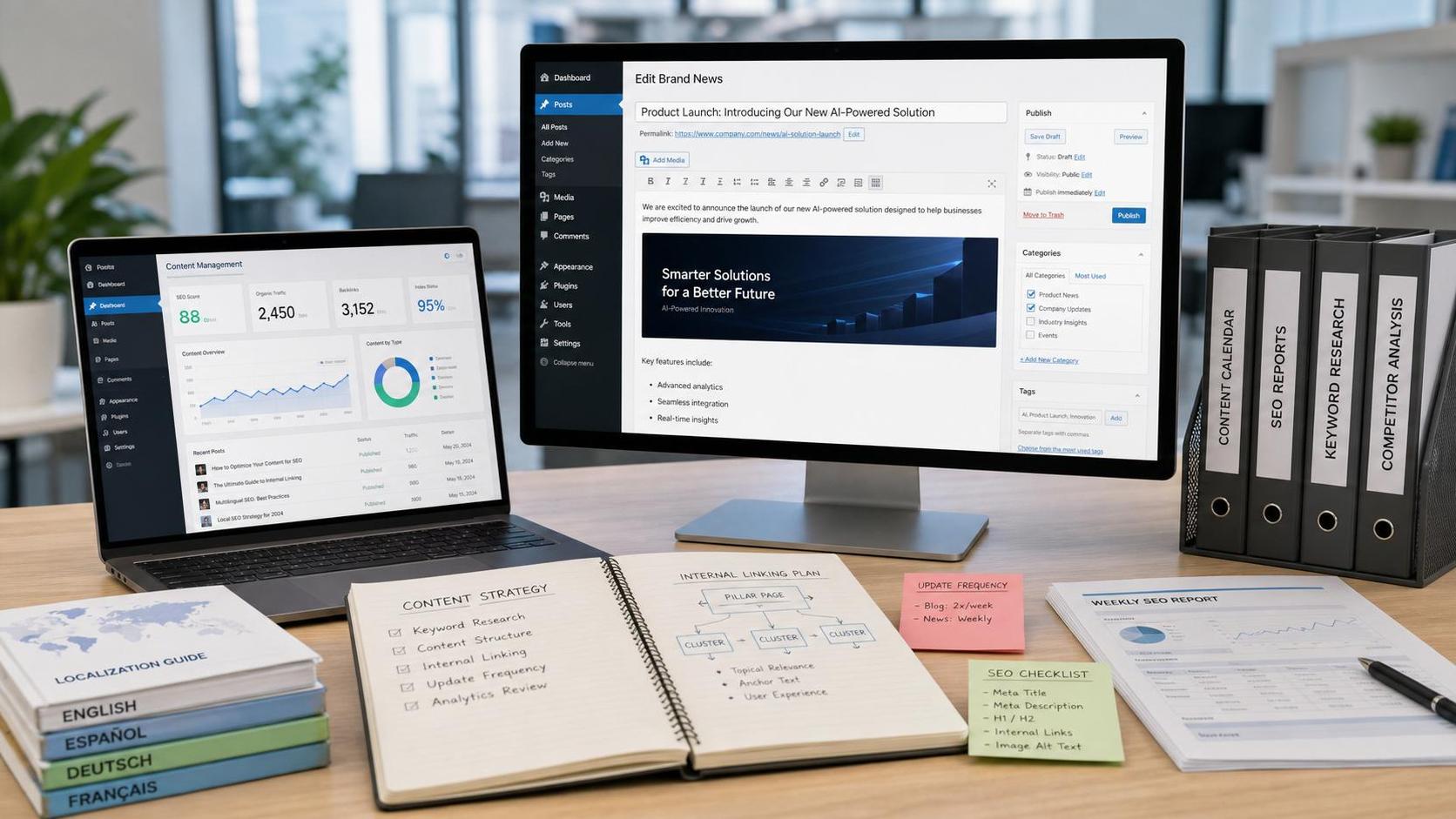
 How Can a Brand Updates Page Be Made More SEO-Friendly? Analysis of Update Frequency, Content Structure, and Internal Linking Strategy


Related Products
 EasyCamp SaaS Smart Website Marketing SystemE-Yingbao SaaS Smart Website Marketing System: AI-powered, zero-code website building. Rapidly launch multilingual independent e-commerce sites in just 10 minutes. Global server acceleration and AI-driven SEO optimization empower businesses to efficiently connect with global markets. The seamless integration of technology and user-friendly operation makes building e-commerce sites incredibly simple.
 AI+SEM Intelligent Advertising Marketing SystemAI+SEM drives intelligent ad creation, empowering full-funnel precision advertising marketing. The system automatically generates weekly/monthly reports, AI recommends keywords and target countries, monitors core metrics in real-time with intelligent alerts, and enables one-click high-conversion ad solutions to help quickly acquire customers and improve ROI.
 AI+SEO Dual Engine Optimization ServiceEasyWin AI+SEO Dual Engine Optimization System leverages AI-powered keyword mining, content generation, and comprehensive technical optimization to help foreign trade enterprises acquire high-quality organic traffic, significantly improving search rankings and conversion rates.
 AI+SNS Social Media Marketing SystemYingbao AI+SNS Social Media Marketing System - Precision social capture for the social media era. Supports one-click content synchronization across major platforms like Facebook and LinkedIn. AI intelligently rewrites posts for enhanced relevance. 24/7 AI customer service and user profiling analysis empower businesses to efficiently expand into global markets.
 AI+SEO营销解决方案易营宝AI+SEO营销解决方案,通过AI批量写作、智能生成TDK、精准关键词扩词等功能,全面优化网站SEO效果,提升流量与转化率。助力企业构建高效智能网站新生态。
 AI+SEM Advertising Marketing SolutionsAI+SEM Advertising Marketing Solution leverages AI technology to deeply empower SEM ad campaigns. It automatically generates weekly/monthly reports using AI, presenting account data across multiple dimensions for comprehensive insights into campaign performance and trends. The system precisely recommends keywords and target countries, intelligently generates high-conversion ad copy, and enables one-click activation of efficient campaign plans to help businesses rapidly acquire customers. Simultaneously, it monitors core metrics in real time, intelligently identifies abnormal fluctuations, and issues timely alerts to ensure stable, high-return advertising results.
 Domain Name ServicesEasyWin provides professional domain name services, including intelligent queries, one-stop registration, brand protection, and full lifecycle management, helping businesses build a digital brand image.
 EasyOperate B2C Cross-Border E-Commerce Platform & Independent WebsiteEasyStore B2C Cross-border E-commerce Independent Store is an intelligent website building and cross-border e-commerce integrated solution independently developed by EasyStore Information Technology (Beijing) Co., Ltd. The system is specially designed for small and medium-sized as well as large export enterprises, integrating 'website building, operation, marketing, advertising, and conversion' into one, helping enterprises quickly establish cross-border e-commerce independent stores to achieve brand globalization and global sales growth.
The platform supports multiple languages, multiple currencies, and multi-channel marketing, with built-in AI intelligent translation and SEO optimization systems, suitable for mainstream markets such as Southeast Asia, Europe and America, Latin America, and the Middle East, assisting Chinese manufacturing enterprises in efficiently deploying international e-commerce strategies. SSL证书易营宝提供专业SSL安全证书服务,包括单域名和泛域名证书,确保网站数据传输加密、身份验证和完整性保护,助力企业建立安全可信的在线业务环境。









