









- What multilingual website services are available in Sanya? Which model is more suitable for local businesses going global?Jul 08, 2026View details
- How to view the complete list of China SaaS companies in the top 100? Practical methods for screening website-building and marketing service providersJul 08, 2026View details
- How to view pricing in the global traffic ecosystem? Cost comparison of search, social media, and content channel advertisingJul 06, 2026View details
- How to assess foreign trade website development trends?Looking at 2026 changes from multilingual,AI content to conversion pathsJul 04, 2026View details
- What are the new trends in multilingual marketing data analytics tools in 2026? Focus on attribution、automation and complianceJul 04, 2026View details
- Is Brand Globalization Marketing Consulting Worth Buying? At What Stage Should Companies Bring It InJul 01, 2026View details
- Cross-Border Marketing Trend Research: Why More and More Companies Are Starting to Deploy AI Search and GEO OptimizationJun 30, 2026View details
- Cross-Border Marketing Trend Research: How Independent Sites, AI Content, and Short-Video Customer Acquisition Are ChangingJun 30, 2026View details
3 Common Reasons Why Ad Spend Budgets Go Out of Control
Ad campaign budgets that repeatedly go over budget are often not caused by spending too much, but by managing too loosely. For finance approvers, what truly needs to be judged is not just “whether this money is worth it,” but why the budget has lost its boundaries, where the process lacks constraints, and whether the campaign results can be verified. This article will start from search intent, management pain points, and practical control methods to break down the 3 common reasons why ad campaign budgets get out of control, helping companies find a more stable balance between growth efficiency and capital security.
Start with the essence: when finance approvers search for “ad campaign budget out of control,” what are they really trying to solve
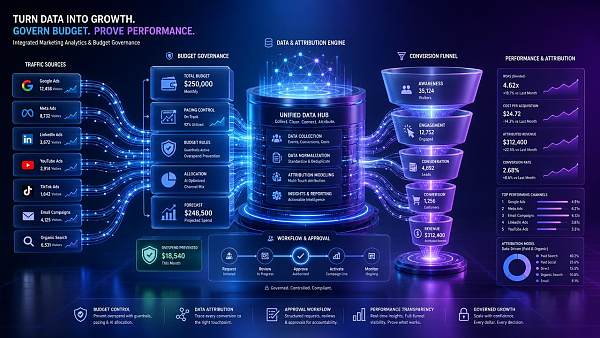
From the perspective of search intent, the core need behind this type of keyword is not to learn campaign terminology, but to quickly identify the root cause of budget overspending and establish executable review standards to prevent advertising expenses from continuously deviating from the original goals.
For finance approvers, the three issues they usually care about most are: first, why is the budget always being increased; second, why do campaign data seem good but are difficult to match with actual business cash returns; third, what kind of campaign request is worth approving, and what kind should be treated cautiously.
Therefore, the focus of the article cannot remain at broad statements such as “advertising is important,” but should concentrate on budget boundaries, attribution logic, approval mechanisms, and post-campaign review—content that can better help management make judgments.
In one sentence, an out-of-control ad campaign budget is usually not the problem of a single department, but the result of the combined effect of vague goals, distorted data, and loose processes. Only by seeing these three points clearly can finance shift from passive sign-off to proactive control.
Reason 1: Campaign goals talk only about growth, not boundaries, so the budget naturally keeps increasing
When many companies run advertising campaigns, the most common mistake is to propose only “get more customers, increase sales, seize market share,” while failing to simultaneously set clear budget boundaries, phased goals, and stop-loss conditions. The more general the goal, the easier it is to justify expanding the budget.
For marketing teams, “performance is still improving” and “let’s add a little more budget and test it” may sound reasonable, but from the finance perspective, if key indicators such as cost per lead, order conversion rate, and payback period are not agreed in advance, then additional budget requests lack an auditable basis.
This is also why some companies clearly have a budget sheet at the beginning of the month, yet temporary requests keep appearing mid-month. The problem is not necessarily that the execution team is spending recklessly, but that the initial budget plan never established a practical control framework.
When reviewing advertising plans, finance approvers are advised to focus on four questions: what is the direct objective of this campaign; what measurement standard corresponds to that objective; what is the budget ceiling; and under what circumstances must the campaign be paused or reviewed.
Only by breaking down “we want growth” into “how much money will be spent, what result will be achieved, and how often it will be verified” can the budget shift from being a flexible pocket to becoming an operational tool that can be tracked and held accountable.
Especially in integrated service scenarios that combine website development, SEO optimization, social media marketing, and advertising, companies are more likely to mix multiple growth activities into one calculation, ultimately leading to unclear budget attribution. On the surface it looks like ad overspending, but in essence the overall marketing goals may simply not have been clearly broken down.
If a company is in the stage of upgrading its digital management, it can also learn from methodologies in other management fields. For example, when promoting institutional optimization, many organizations refer to research materials such as Strategic Analysis of Digital Transformation in Human Resource Management for Public Institutions in the Intelligent Era. The core insight is equally applicable to marketing budget management: first define the process, then define authority, and finally define evaluation.
Reason 2: Looking only at platform data and not at real business results leads to “effective campaigns” being overestimated
The second common reason why ad campaign budgets get out of control is that companies rely too heavily on platform backend data, yet fail to connect impressions, clicks, and leads with actual deals, collections, and repeat purchases. Once the data chain is broken, budget judgment is easily distorted.
Many campaign reports show higher click-through rates, increased form submissions, and lower consultation costs, which all look very positive. But what finance approvers really need to see is not “front-end excitement,” but whether this traffic ultimately creates confirmed business value.
If the leads generated by advertising are low quality, sales follow-up efficiency is poor, or a large number of conversions come from low-intent audiences, then no matter how impressive the front-end data look, they still cannot prove that the budget was spent reasonably. Continuing to add budget will only further amplify ineffective costs.
Therefore, when reviewing advertising campaigns, finance should not merely accept platform screenshots, but should require a unified measurement framework from the advertising side to the business side, including key outcome indicators such as number of qualified leads, opportunity conversion rate, contract value, and collection cycle.
This is especially true for B2B companies, where the conversion path is often long and ad performance does not show up on the same day as the click. Without integration among CRM, website analytics, ad platforms, and sales data, budget decisions will be misled by partial indicators, creating a situation where “it looks effective, but in reality it is not profitable.”
From a management perspective, finance approvers do not need to personally study every campaign detail, but they must at least distinguish among three types of data: platform process data, marketing intermediate data, and business outcome data. Only the third type of data is the most valuable basis for budget approval.
For companies with full-funnel service capabilities, technical tools are extremely important here. Through data collaboration across intelligent website building, SEO, social media, and advertising, companies can identify traffic source quality earlier and prevent budgets from flowing for a long time into low-return channels.
For digital marketing service providers like E-Marketing Treasure, driven by artificial intelligence and big data, the value lies not only in “helping companies place ads,” but more importantly in connecting traffic acquisition, landing page engagement, lead analysis, and performance attribution so that budget decisions are closer to actual business results.
Reason 3: The approval mechanism focuses too much on pre-approval, while lacking in-process alerts and post-campaign review
The third reason is often the most easily overlooked. Many companies do not lack budget approval, but the approval only happens before the campaign starts. Once the project goes live, there is no dynamic monitoring during execution, and no strict review after completion, so the budget naturally becomes easy to lose control of.
From the perspective of financial management practice, a one-time approval cannot replace full-process management. Advertising campaigns are characterized by real-time change: traffic prices, audience feedback, and channel performance may all fluctuate in the short term. Without phased validation, even a reasonable initial budget may still deviate.
A common issue is that the marketing department applies for budget according to plan at the beginning of the month, then keeps requesting increases mid-month due to campaign events, rising bids, or creative adjustments, while finance, lacking a mid-process monitoring mechanism, can only make passive choices between “the money has already been spent” and “the business says it still needs to continue.”
A more prudent approach is to divide advertising approval into three stages: pre-set limits, in-process alerts, and post-campaign review. Before launch, clearly define the ceiling and objectives; during execution, monitor deviations in spend and conversions; after completion, evaluate channel contribution and budget efficiency.
For example, when the cost per lead of a certain channel remains above the preset threshold, or the qualified conversion rate continues to stay below expectations, a re-approval review should be triggered automatically instead of allowing continued spending by default. Only in this way can finance approvers shift from “result confirmers” to “risk gatekeepers.”
Post-campaign review should not stop at “how much was spent this month, and how many leads were generated.” More importantly, it should analyze at which stage the budget deviation occurred: was it an error in channel selection, poor landing page performance, or a bottleneck in the sales conversion chain. Different causes require completely different solutions.
In the process of management upgrading, companies can also transfer ideas from other digital governance approaches. For example, the process traceability, node control, and data feedback emphasized in Strategic Analysis of Digital Transformation in Human Resource Management for Public Institutions in the Intelligent Era are essentially also applicable to the refined management of advertising expenses.
How finance approvers can judge more efficiently whether an advertising campaign should be approved
To improve the quality of advertising approval, finance does not need to become a marketing expert, but it does need to master a concise judgment framework. Compared with studying platform details, what matters more is whether the logic between budget and results forms a closed loop.
First, check whether the objective is measurable. A campaign request without clear objectives is essentially difficult to evaluate for success or failure, and it is also the most likely to keep changing its standards during execution. Second, check whether the budget is released in stages rather than fully opened at one time.
Third, check whether the data can be tied back to business results. If reports show only clicks and inquiries, but not deals and collections, then the value of the budget still remains at the level of speculation. Fourth, check whether pause lines and review mechanisms have been set.
For finance approvers, truly high-quality advertising plans usually have three characteristics: clear objectives, traceable data, and executable correction mechanisms. When these three conditions are met, the risk of budget overspending will drop significantly.
Conversely, if a proposal only emphasizes market opportunities, competitor actions, and channel popularity, but cannot explain expected returns, verification paths, and risk control measures, then even if the campaign direction is not wrong, approval should still be cautious or supplementary materials should be requested.
Conclusion: Controlling the advertising budget is not about cutting investment, but about increasing certainty
Returning to the original question, the 3 common reasons why ad campaign budgets get out of control are goals without boundaries, disconnected data, and processes without a closed loop. These three types of issues make budget approval a mere formality and also make campaign results difficult to evaluate truthfully.
For finance approvers, controlling the advertising budget does not mean blindly compressing marketing expenses, but helping the company place every investment in a position that is more verifiable, more reviewable, and closer to actual business results.
When a company can define objectives and upper limits before launch, monitor deviations during execution, and verify actual returns after the campaign, the advertising budget will no longer be just a cost center, but will become a manageable asset that drives growth. This is the healthier way to advertise.
Related Articles
 What multilingual website services are available in Sanya? Which model is more suitable for local businesses going global?
 How to view the complete list of China SaaS companies in the top 100? Practical methods for screening website-building and marketing service providers
 There are so many used heavy-duty construction machines for foreign trade. How exactly should we acquire customers?



Related Products
 EasyCamp SaaS Smart Website Marketing SystemE-Yingbao SaaS Smart Website Marketing System: AI-powered, zero-code website building. Rapidly launch multilingual independent e-commerce sites in just 10 minutes. Global server acceleration and AI-driven SEO optimization empower businesses to efficiently connect with global markets. The seamless integration of technology and user-friendly operation makes building e-commerce sites incredibly simple.
 AI+SEM Intelligent Advertising Marketing SystemAI+SEM drives intelligent ad creation, empowering full-funnel precision advertising marketing. The system automatically generates weekly/monthly reports, AI recommends keywords and target countries, monitors core metrics in real-time with intelligent alerts, and enables one-click high-conversion ad solutions to help quickly acquire customers and improve ROI.
 AI+SEO Dual Engine Optimization ServiceEasyWin AI+SEO Dual Engine Optimization System leverages AI-powered keyword mining, content generation, and comprehensive technical optimization to help foreign trade enterprises acquire high-quality organic traffic, significantly improving search rankings and conversion rates.
 AI+SNS Social Media Marketing SystemYingbao AI+SNS Social Media Marketing System - Precision social capture for the social media era. Supports one-click content synchronization across major platforms like Facebook and LinkedIn. AI intelligently rewrites posts for enhanced relevance. 24/7 AI customer service and user profiling analysis empower businesses to efficiently expand into global markets.
 AI+SEO营销解决方案易营宝AI+SEO营销解决方案,通过AI批量写作、智能生成TDK、精准关键词扩词等功能,全面优化网站SEO效果,提升流量与转化率。助力企业构建高效智能网站新生态。
 AI+SEM Advertising Marketing SolutionsAI+SEM Advertising Marketing Solution leverages AI technology to deeply empower SEM ad campaigns. It automatically generates weekly/monthly reports using AI, presenting account data across multiple dimensions for comprehensive insights into campaign performance and trends. The system precisely recommends keywords and target countries, intelligently generates high-conversion ad copy, and enables one-click activation of efficient campaign plans to help businesses rapidly acquire customers. Simultaneously, it monitors core metrics in real time, intelligently identifies abnormal fluctuations, and issues timely alerts to ensure stable, high-return advertising results.
 Domain Name ServicesEasyWin provides professional domain name services, including intelligent queries, one-stop registration, brand protection, and full lifecycle management, helping businesses build a digital brand image.
 EasyOperate B2C Cross-Border E-Commerce Platform & Independent WebsiteEasyStore B2C Cross-border E-commerce Independent Store is an intelligent website building and cross-border e-commerce integrated solution independently developed by EasyStore Information Technology (Beijing) Co., Ltd. The system is specially designed for small and medium-sized as well as large export enterprises, integrating 'website building, operation, marketing, advertising, and conversion' into one, helping enterprises quickly establish cross-border e-commerce independent stores to achieve brand globalization and global sales growth.
The platform supports multiple languages, multiple currencies, and multi-channel marketing, with built-in AI intelligent translation and SEO optimization systems, suitable for mainstream markets such as Southeast Asia, Europe and America, Latin America, and the Middle East, assisting Chinese manufacturing enterprises in efficiently deploying international e-commerce strategies. SSL证书易营宝提供专业SSL安全证书服务,包括单域名和泛域名证书,确保网站数据传输加密、身份验证和完整性保护,助力企业建立安全可信的在线业务环境。









