









- What multilingual website services are available in Sanya? Which model is more suitable for local businesses going global?Jul 08, 2026View details
- How to view the complete list of China SaaS companies in the top 100? Practical methods for screening website-building and marketing service providersJul 08, 2026View details
- How to view pricing in the global traffic ecosystem? Cost comparison of search, social media, and content channel advertisingJul 06, 2026View details
- How to assess foreign trade website development trends?Looking at 2026 changes from multilingual,AI content to conversion pathsJul 04, 2026View details
- What are the new trends in multilingual marketing data analytics tools in 2026? Focus on attribution、automation and complianceJul 04, 2026View details
- Is Brand Globalization Marketing Consulting Worth Buying? At What Stage Should Companies Bring It InJul 01, 2026View details
- Cross-Border Marketing Trend Research: Why More and More Companies Are Starting to Deploy AI Search and GEO OptimizationJun 30, 2026View details
- Cross-Border Marketing Trend Research: How Independent Sites, AI Content, and Short-Video Customer Acquisition Are ChangingJun 30, 2026View details
Why Data-Driven Marketing Places Greater Emphasis on Attribution
Big data-driven marketing is shifting from “looking at results” to “looking at pathways”
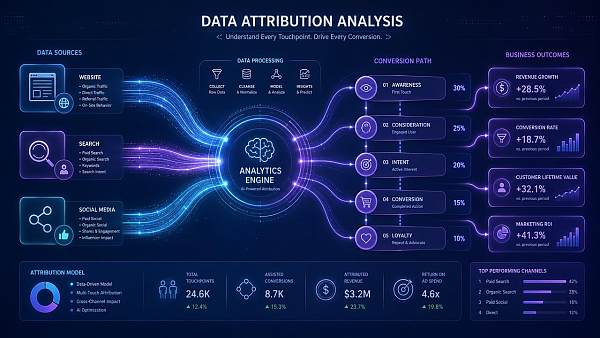
Against the backdrop of soaring traffic costs and fragmented channels, big data-driven marketing no longer focuses only on exposure and conversions, but places greater emphasis on attribution accuracy. Only by clearly understanding the true value of every touchpoint can business decision-makers optimize budget allocation and improve growth efficiency.
In the past, many companies evaluated marketing only by the number of leads, cost per click, and transaction results. This approach could still work when there were fewer channels, but today, with websites, search, social media, and advertising running in parallel, single-point data can no longer support high-quality decision-making.
Especially in integrated website + marketing service scenarios, big data-driven operations are no longer just about “collecting data.” Instead, they emphasize connecting the entire chain from website building, content, and search optimization to conversion tracking, so that every visit, stay, inquiry, and transaction can be traced through data.
Yiyingbao Information Technology (Beijing) Co., Ltd. has been deeply engaged in global digital marketing services for ten years. Leveraging artificial intelligence and big data capabilities, the company integrates intelligent website building, SEO optimization, social media marketing, and advertising placement in a coordinated way, helping enterprises move from “traffic acquisition” to “growth attribution,” which is a key watershed in the current marketing upgrade.
The more channels there are, the more important attribution becomes, and this has already become a clear trend signal
Today’s users rarely convert after just one contact. Behind a single transaction, the user may first come from organic search, then be influenced by a short video, afterward click an ad for a return visit, and finally submit a request through a website form. Without an attribution mechanism, companies can easily misjudge which channels are truly effective.
This is also why big data-driven marketing is placing increasing importance on cross-channel identification, behavioral path reconstruction, and conversion contribution evaluation. Who created the initial awareness, who drove deeper comparison, and who facilitated the final transaction—these three roles do not carry the same value, but all of them should be recognized.
From industry practice, rough analysis based only on the “last click” is being replaced by more refined multi-touch attribution. Website data, keyword performance, landing page quality, and depth of content interaction are jointly forming a new marketing evaluation system.
Several core forces driving the upgrade of big data-driven attribution
The renewed emphasis on attribution is not simply a conceptual shift, but a result of pressure from the market environment. The following factors are continuously pushing big data-driven marketing into a more refined stage.
- The traffic dividend is weakening: customer acquisition costs continue to rise, and wasted budget is becoming harder to tolerate.
- Channels continue to fragment: search, social media, information feeds, private-domain traffic, and official websites operate simultaneously.
- The decision-making chain is getting longer: users repeatedly compare options, and conversions are no longer determined by a single entry point.
- The role of the website is upgrading: the official website is no longer just a display page, but a center for data accumulation and lead conversion.
- The adoption of artificial intelligence is expanding: improved data processing efficiency makes complex attribution more practical to implement.
The impact on website development, campaign optimization, and content operations is deepening
First, the logic of website development has changed. In the past, many websites emphasized display and paid little attention to tracking, but now big data-driven operations require websites to have event tracking capabilities, form classification capabilities, and page behavior analysis capabilities from the very beginning. Without a data foundation, subsequent attribution can only remain superficial.
Second, advertising is no longer evaluated only by clicks and inquiry volume. Truly efficient advertising must combine on-site visit depth, bounce performance, repeat visits, and final transactions for comprehensive evaluation. Otherwise, channels with superficially high conversions may only represent the final step of “picking the fruit.”
Third, SEO and content marketing can also gain clearer value through an attribution system. Much of the traffic generated by organic search does not bring immediate transactions, but rather early-stage education and demand stimulation. Without big data-driven attribution, this part of the value can easily be overlooked, causing companies to mistakenly cut long-term investment.
This way of thinking also applies to other complex decision-making fields. For example, in cost accounting research, only by carefully breaking down the contribution of each link can the true source of efficiency be found. A similar approach is also reflected in Research on the Application Optimization of Activity-Based Costing in Cost Accounting of Coal Mining Enterprises, and at its core, both improve the quality of resource allocation through more accurate attribution and judgment.
What enterprises need to focus on is not just the volume of data, but the interpretability of data
Many companies already have large amounts of data, yet still fail to optimize marketing effectively. The problem often lies not in insufficient data, but in the inability of data to explain the business. The focus of big data-driven operations is not to make reports more complex, but to enable data to answer specific questions.
Five current priorities that deserve more attention
- Whether a unified conversion standard has been established to avoid each channel speaking its own language.
- Whether the data chain between the website, advertising, search, and social media has been connected.
- Whether the differences among first-touch points, assisting touchpoints, and closing touchpoints have been identified.
- Whether performance can be broken down by industry, region, page, and keyword.
- Whether attribution results are being fed back into budget and content strategy adjustments.
For integrated website + marketing service solutions, these five points directly determine subsequent growth efficiency. Without a unified data perspective, website development, promotion, content, and sales support are difficult to coordinate, and big data-driven operations will also be reduced to a slogan.
In the next stage, the key judgment will not be who spends more, but who understands attribution more clearly
Future competition will increasingly center on “measurable growth.” When budgets are limited, companies need to put money into the links that truly contribute, rather than only looking at superficial excitement. The clearer the attribution, the lower the cost of trial and error, and the more stable the growth path.
It is recommended to advance the big data-driven upgrade from the following directions:
- First build a trackable website to ensure that pages, buttons, and forms can all be recorded.
- Then unify the conversion definitions and clarify the criteria for inquiries, lead submissions, and transactions.
- After that, establish a multi-touch attribution model to avoid looking only at the final step.
- Regularly review the contribution of keywords, content, and channels, and dynamically adjust the budget.
- With the help of artificial intelligence tools, improve the speed of data analysis and the efficiency of strategy iteration.
Truly sustainable growth comes from every visible contribution
The reason big data-driven marketing places greater emphasis on attribution is not because the technology is becoming more complex, but because the market is becoming more realistic. Every budget requires a higher return, every channel requires a clearer value assessment, and every conversion requires a more complete explanation.
For enterprises advancing global customer acquisition and digital transformation, websites, SEO, social media, and advertising should not be separated from one another, but should operate collaboratively within a unified data framework. Only by clearly understanding the value of each touchpoint can big data-driven operations truly be transformed into a growth engine.
If you want to further improve official website conversion efficiency, optimize channel budget allocation, and build a more reliable attribution system, the next step should be to first examine the existing website’s data collection capabilities and the integrity of the marketing chain, and then continue iterating around real business goals. Only by seeing the path clearly can you amplify the results.
Related Articles
 What multilingual website services are available in Sanya? Which model is more suitable for local businesses going global?
 How to view the complete list of China SaaS companies in the top 100? Practical methods for screening website-building and marketing service providers
 There are so many used heavy-duty construction machines for foreign trade. How exactly should we acquire customers?



Related Products
 EasyCamp SaaS Smart Website Marketing SystemE-Yingbao SaaS Smart Website Marketing System: AI-powered, zero-code website building. Rapidly launch multilingual independent e-commerce sites in just 10 minutes. Global server acceleration and AI-driven SEO optimization empower businesses to efficiently connect with global markets. The seamless integration of technology and user-friendly operation makes building e-commerce sites incredibly simple.
 AI+SEM Intelligent Advertising Marketing SystemAI+SEM drives intelligent ad creation, empowering full-funnel precision advertising marketing. The system automatically generates weekly/monthly reports, AI recommends keywords and target countries, monitors core metrics in real-time with intelligent alerts, and enables one-click high-conversion ad solutions to help quickly acquire customers and improve ROI.
 AI+SEO Dual Engine Optimization ServiceEasyWin AI+SEO Dual Engine Optimization System leverages AI-powered keyword mining, content generation, and comprehensive technical optimization to help foreign trade enterprises acquire high-quality organic traffic, significantly improving search rankings and conversion rates.
 AI+SNS Social Media Marketing SystemYingbao AI+SNS Social Media Marketing System - Precision social capture for the social media era. Supports one-click content synchronization across major platforms like Facebook and LinkedIn. AI intelligently rewrites posts for enhanced relevance. 24/7 AI customer service and user profiling analysis empower businesses to efficiently expand into global markets.
 AI+SEO营销解决方案易营宝AI+SEO营销解决方案,通过AI批量写作、智能生成TDK、精准关键词扩词等功能,全面优化网站SEO效果,提升流量与转化率。助力企业构建高效智能网站新生态。
 AI+SEM Advertising Marketing SolutionsAI+SEM Advertising Marketing Solution leverages AI technology to deeply empower SEM ad campaigns. It automatically generates weekly/monthly reports using AI, presenting account data across multiple dimensions for comprehensive insights into campaign performance and trends. The system precisely recommends keywords and target countries, intelligently generates high-conversion ad copy, and enables one-click activation of efficient campaign plans to help businesses rapidly acquire customers. Simultaneously, it monitors core metrics in real time, intelligently identifies abnormal fluctuations, and issues timely alerts to ensure stable, high-return advertising results.
 Domain Name ServicesEasyWin provides professional domain name services, including intelligent queries, one-stop registration, brand protection, and full lifecycle management, helping businesses build a digital brand image.
 EasyOperate B2C Cross-Border E-Commerce Platform & Independent WebsiteEasyStore B2C Cross-border E-commerce Independent Store is an intelligent website building and cross-border e-commerce integrated solution independently developed by EasyStore Information Technology (Beijing) Co., Ltd. The system is specially designed for small and medium-sized as well as large export enterprises, integrating 'website building, operation, marketing, advertising, and conversion' into one, helping enterprises quickly establish cross-border e-commerce independent stores to achieve brand globalization and global sales growth.
The platform supports multiple languages, multiple currencies, and multi-channel marketing, with built-in AI intelligent translation and SEO optimization systems, suitable for mainstream markets such as Southeast Asia, Europe and America, Latin America, and the Middle East, assisting Chinese manufacturing enterprises in efficiently deploying international e-commerce strategies. SSL证书易营宝提供专业SSL安全证书服务,包括单域名和泛域名证书,确保网站数据传输加密、身份验证和完整性保护,助力企业建立安全可信的在线业务环境。









