









- The China-US tariff arrangement has reached a preliminary consensus, and the trade association will be establishedJun 15, 2026View details
- What determines B2C cross-border e-commerce website development costs? A breakdown of features, interfaces, and deployment methodsJun 17, 2026View details
- China-Morocco zero-tariff access, a breakthrough in the cost of Moroccan goods exports to ChinaJun 11, 2026View details
- What signal should be released for the suspension of exports to JapanJun 10, 2026View details
- China's May LNG imports rebounded, with increased volumes from Russia and Canada filling the Middle East supply gapJun 10, 2026View details
- Will GEO change its SEO strategy?Jun 04, 2026View details
- What types of businesses are end-to-end solutions suitable for?Jun 03, 2026View details
- 2026 Global Growth Channel TrendsJun 02, 2026View details
How to avoid duplication and keyword stuffing in TDK settings? A summary of common issues on product websites
Why Does TDK Optimization Often Lead to Repetition and Keyword Stuffing?
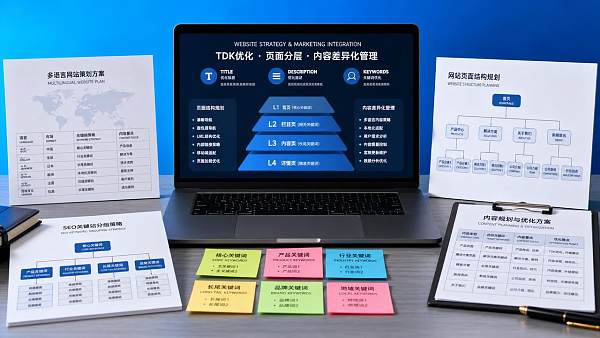
TDK optimization may seem to be only about changing the title, description, and keywords, but the real challenge lies in unclear page positioning. Many product sites are indexed slowly not because they lack content, but because multiple pages express the same thing, making it hard for search engines to determine which one deserves to be shown first.
A more common problem is that in the early stage of website building, in pursuit of coverage, core keywords are repeatedly stuffed into titles, descriptions, and even section names, resulting in highly similar pages. This not only makes it difficult to improve rankings, but also weakens click-through rates because users see summaries that lack differentiation.
In practical applications, TDK optimization must first answer one question: what search need does this page actually solve? Is it a product model page, category page, application scenario page, or case page? As long as the page purposes are different, the title logic cannot use the same template.
For platforms like Yiyingbao, which cover intelligent website building, SEO optimization, advertising, and multilingual site operations, when serving different overseas markets, they usually first split page intent and then match country, language, and conversion goals. The value of doing this is not only to avoid repetition, but also to align pages with traffic sources.
The Title Looks Very Full, So Why Are Rankings and Clicks Still Average?
Because “full” does not equal “correct”. The easiest trap in TDK optimization is turning one title into a keyword list. It may look comprehensive on the surface, but in reality the theme is diluted, and both search engines and users struggle to grasp the focus.
An effective title usually keeps only one primary target term, plus one piece of limiting information. The limiting information can be product type, application, region, material, price range, or service attribute. This helps avoid keyword stuffing and makes the page direction clearer.
For example, product pages are more suitable for “core product term + differentiator”, category pages for “category term + selection range”, and solution pages for “scenario term + outcome direction”. If all pages are written in the same style, even with different words, it can still easily create structural repetition.
The description is the same. It should not repeat the title, but instead supplement selling points, delivery method, applicable scenarios, and next steps. Concise yet specific content is more valuable than repeatedly inserting the term TDK optimization.
Take a Look at This Common Problem Comparison Table First
If you are not sure where the problem lies, first use the method below to check. It can usually help you quickly identify the source of repetition.
For Product Sites Doing TDK Optimization, Which Pages Should Be Addressed First?
Not all pages need to be overhauled at the same time. A more stable approach is to first handle pages with high indexing value and high conversion relevance. Priority is usually given to the homepage, core category pages, main product pages, and key landing pages.
If the site is aimed at overseas promotion, it is also necessary to see whether language versions and market versions are mixed together. Many multilingual sites do not have poor content quality; rather, Chinese logic has been mechanically translated into English, Russian, or Spanish pages, causing TDK optimization to lose effectiveness and making the page expression inconsistent with local search habits.
In multilingual website development and AI+SEO/GEO optimization scenarios, Yiyingbao usually divides pages into lead-generation pages, conversion pages, and content pages, and then sets title rules for each. The benefit of doing this is that when expanding products later, it is less likely to fall back into repetitive naming.
- The homepage focuses on brand terms and core business, and does not bear the full keyword task.
- Category pages carry category terms and transactional intent terms, and should not be written as general introduction pages.
- Product pages should highlight differentiating parameters, uses, and application scenarios.
- Article pages and case pages are more suitable for long-tail problem terms and layout.
If the content system includes professional resource pages, you can also draw on document naming logic. For example, some research pages use clear themes and question boundaries, and this approach is also suitable for SEO page naming. Titles like Common Questions and Countermeasure Research on Financial Settlement Audit in Basic Construction Project Completion, with a focused theme and clear object, are a typical expression of readability.
How Do You Judge Whether Current TDK Optimization Is Too Much or Not Enough?
Judgment cannot rely on feeling alone; it is best to combine page data and text structure. Excessive optimization usually has three signals: titles repeatedly duplicate main terms, descriptions read unnaturally, and different pages compete for the same search intent.
Insufficient optimization is also very common. For example, titles are too short and only include the product name; descriptions have no application scenarios; category pages do not explain the coverage scope. These issues may not be directly judged as keyword stuffing, but page recognition remains low.
Simply put, good TDK optimization is not about being shorter or longer; it is about having just the right amount of information layers. Search engines can understand the theme, and users can quickly judge whether it is worth clicking. That is effective.
You Can Do a Quick Self-Check Like This
- Sample 20 pages and see whether the first half of the titles is overly similar.
- Check whether the same business term group appears repeatedly in the descriptions.
- Compare page types to confirm whether keywords are layered by structure.
- Review indexed and non-indexed pages to identify duplicate template sources.
Besides Titles and Descriptions, What Other Details Can Drag Down Results?
Many sites think that TDK optimization alone is enough. In fact, the page body, breadcrumb labels, internal anchor text, and section structure all affect results. Even if the title is written perfectly, if the main content is still copied content, search engines will still lower their judgment of page value.
Another easily overlooked point is the lack of coordination between technology and content. For example, the website system may allow batch title generation, but if it does not reserve differentiated fields for different product categories, later supplementation will be very passive. For product sites, truly efficient TDK optimization often depends on the underlying website-building capability.
This is also why integrated platforms are more suitable for long-term operations. When website building, SEO, advertising, and content strategy are placed within the same logic, page naming, landing page deployment, and organic search entry points are easier to unify, and the site will not change titles today and be overridden by templates tomorrow.
Sometimes referring to naming methods from other industry resource pages can also be inspiring. For example, the structure of Common Questions and Countermeasure Research on Financial Settlement Audit in Basic Construction Project Completion is essentially “theme + question + solution direction”, which is very suitable for content-page reference, but does not need to be copied to all product pages.
If You Need to Revise It Now, How Should You Arrange It More Safely Without Causing Rework?
It is recommended to first create a page naming rules sheet before starting the revision. First define page types, then define the main terms, modifiers, and differentiating fields for each type of page. In this way, when expanding new products, new languages, and new markets later, TDK optimization can still remain consistent.
In actual execution, there is no need to cover the entire site at once. You can first handle core category pages, observe changes in indexing, exposure, and clicks, and then gradually expand to long-tail pages. A cycle of two to four weeks is generally easier for observing whether adjustments are effective.
If the site also undertakes overseas lead-generation tasks, the next step is to synchronously check whether multilingual expression, localized keywords, and landing page conversion information are consistent. Because good TDK optimization is not ultimately just for indexing, but also for ensuring that the right page matches the right visitor.
Returning to the core point: to avoid repetition and keyword stuffing, the key is not to delete a few keywords, but to realign page purpose, search intent, and website structure. First organize high-value pages clearly, then establish reusable rules, and future optimization will become much easier.
Related Articles



Related Products
 EasyCamp SaaS Smart Website Marketing SystemE-Yingbao SaaS Smart Website Marketing System: AI-powered, zero-code website building. Rapidly launch multilingual independent e-commerce sites in just 10 minutes. Global server acceleration and AI-driven SEO optimization empower businesses to efficiently connect with global markets. The seamless integration of technology and user-friendly operation makes building e-commerce sites incredibly simple.
 AI+SEM Intelligent Advertising Marketing SystemAI+SEM drives intelligent ad creation, empowering full-funnel precision advertising marketing. The system automatically generates weekly/monthly reports, AI recommends keywords and target countries, monitors core metrics in real-time with intelligent alerts, and enables one-click high-conversion ad solutions to help quickly acquire customers and improve ROI.
 AI+SEO Dual Engine Optimization ServiceEasyWin AI+SEO Dual Engine Optimization System leverages AI-powered keyword mining, content generation, and comprehensive technical optimization to help foreign trade enterprises acquire high-quality organic traffic, significantly improving search rankings and conversion rates.
 AI+SNS Social Media Marketing SystemYingbao AI+SNS Social Media Marketing System - Precision social capture for the social media era. Supports one-click content synchronization across major platforms like Facebook and LinkedIn. AI intelligently rewrites posts for enhanced relevance. 24/7 AI customer service and user profiling analysis empower businesses to efficiently expand into global markets.
 AI+SEO营销解决方案易营宝AI+SEO营销解决方案,通过AI批量写作、智能生成TDK、精准关键词扩词等功能,全面优化网站SEO效果,提升流量与转化率。助力企业构建高效智能网站新生态。
 AI+SEM Advertising Marketing SolutionsAI+SEM Advertising Marketing Solution leverages AI technology to deeply empower SEM ad campaigns. It automatically generates weekly/monthly reports using AI, presenting account data across multiple dimensions for comprehensive insights into campaign performance and trends. The system precisely recommends keywords and target countries, intelligently generates high-conversion ad copy, and enables one-click activation of efficient campaign plans to help businesses rapidly acquire customers. Simultaneously, it monitors core metrics in real time, intelligently identifies abnormal fluctuations, and issues timely alerts to ensure stable, high-return advertising results.
 Domain Name ServicesEasyWin provides professional domain name services, including intelligent queries, one-stop registration, brand protection, and full lifecycle management, helping businesses build a digital brand image.
 EasyOperate B2C Cross-Border E-Commerce Platform & Independent WebsiteEasyStore B2C Cross-border E-commerce Independent Store is an intelligent website building and cross-border e-commerce integrated solution independently developed by EasyStore Information Technology (Beijing) Co., Ltd. The system is specially designed for small and medium-sized as well as large export enterprises, integrating 'website building, operation, marketing, advertising, and conversion' into one, helping enterprises quickly establish cross-border e-commerce independent stores to achieve brand globalization and global sales growth.
The platform supports multiple languages, multiple currencies, and multi-channel marketing, with built-in AI intelligent translation and SEO optimization systems, suitable for mainstream markets such as Southeast Asia, Europe and America, Latin America, and the Middle East, assisting Chinese manufacturing enterprises in efficiently deploying international e-commerce strategies. SSL证书易营宝提供专业SSL安全证书服务,包括单域名和泛域名证书,确保网站数据传输加密、身份验证和完整性保护,助力企业建立安全可信的在线业务环境。









