









- The China-US tariff arrangement has reached a preliminary consensus, and the trade association will be establishedJun 15, 2026View details
- What determines B2C cross-border e-commerce website development costs? A breakdown of features, interfaces, and deployment methodsJun 17, 2026View details
- China-Morocco zero-tariff access, a breakthrough in the cost of Moroccan goods exports to ChinaJun 11, 2026View details
- What signal should be released for the suspension of exports to JapanJun 10, 2026View details
- China's May LNG imports rebounded, with increased volumes from Russia and Canada filling the Middle East supply gapJun 10, 2026View details
- Will GEO change its SEO strategy?Jun 04, 2026View details
- What types of businesses are end-to-end solutions suitable for?Jun 03, 2026View details
- 2026 Global Growth Channel TrendsJun 02, 2026View details
Why isn't website indexing optimization working? What are the reasons pages are not being indexed?
Site indexing optimization isn’t working; don’t rush to blame the content first
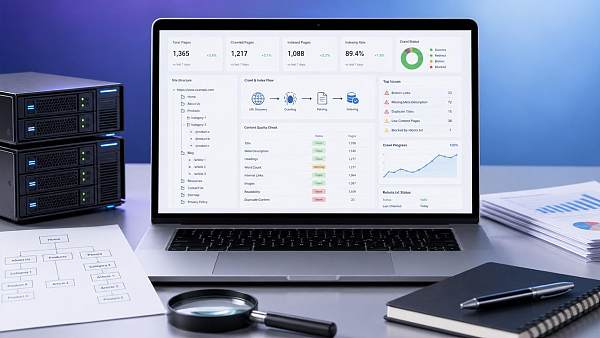
Site indexing optimization is slow to show results, and it is often not caused by a single issue, but by the combined effects of technology, content, and crawling mechanisms. If you want to figure out why a page is not being indexed, you need to find the root cause first before you can truly improve site visibility and SEO performance.
Many businesses initially focus on publishing articles, changing titles, and piling up keywords, but the results are often not ideal. The reason is simple: search engines first look at whether they can crawl the page, and only then whether it is worth indexing.
If the crawling path is not smooth, no amount of page content will help. Conversely, if a page can be crawled but the content is repetitive, low quality, or poorly structured, site indexing optimization will still struggle to deliver results. This is also a core reason why many sites get stuck for the long term.
Recent changes show that search engines have become more granular in how they assess page value. They no longer just look at whether content exists; they also look at whether the page solves a problem, whether it is clear and trustworthy, and whether it is suitable for display to target users.
What are the common reasons pages are not indexed?
To improve site indexing optimization, you first need to break the problem down. Usually, you can review it from four directions: technology, content, site structure, and external signals.
1. Crawl blockage: search engines can’t get in
This is the most basic and also the easiest type of problem to overlook. For example, incorrect robots settings, abnormal page status codes, unstable servers, or overly long redirect chains can all cause search engine crawling to fail.
Another very common situation is when the main content of a page depends on script loading. To users, it looks normal, but for search engines, what is actually crawled is a blank framework, which directly slows down site indexing optimization.
2. Low page quality: insufficient indexing value
Many pages can be opened, but the content is too thin. Common signs include too few words, disjointed paragraphs, repeated information, inconsistent titles and body text, or simply a rewritten version of an existing page.
Search engines now pay more attention to whether something has independent value. If multiple pages only change the region name, product term, or order of presentation, while the substance stays the same, site indexing optimization will naturally be difficult to push forward.
3. Too many duplicate pages: authority is dispersed
Pagination, filtering, tags, and parameter URLs are all high-frequency sources of duplicate pages. Without standardized handling, search engines will see a large number of similar URLs and won’t know which one to index.
In this case, site indexing optimization is not about doing less, but about having too many ineffective pages. Crawl budget is wasted, and the pages that really matter do not receive enough attention.
4. Confused internal linking: important pages lack support
Search engines judge page importance by internal links within the site. If core pages are buried too deeply, or if there are no continuous internal links from related articles, product pages, or category pages, indexing speed is usually slower.
A more obvious sign is that some pages exist only in the backend or in the sitemap, and are almost impossible to reach from the front end. Even if such pages are discovered, they are not easy to gain stable indexing.
5. New sites lack trust, so indexing takes longer
New sites need time for site indexing optimization. Domain history, content update rhythm, page quality, and external mentions all affect a search engine’s initial assessment of the site.
If a large number of pages are generated shortly after launch but there is a lack of structural planning and content hierarchy, the site is often judged as unstable in quality, and indexing naturally does not happen easily.
When site indexing optimization is not effective, what should you focus on?
Truly effective troubleshooting is not about changing things based on instinct, but about handling issues in order of priority. First check whether the site can be crawled, then whether it is worth indexing, and finally how to speed up indexing.
- First check server stability, page status codes, robots, and the sitemap.
- Then verify whether core pages can be accessed normally and whether any abnormal redirects exist.
- Next review duplicate pages, low-quality pages, and invalid parameter pages.
- Finally optimize the category structure, breadcrumb navigation, related articles, and product recommendation internal links.
In real business, many websites are not completely lacking content, but rather their content assets have not been properly organized. Whether site indexing optimization is done well or not depends largely on whether the page system is clear and whether the themes are concentrated.
For example, if a site simultaneously serves as a corporate website, product showcase, industry articles hub, and landing page for ads, but lacks clear category boundaries, search engines will find it difficult to quickly understand the role and value of each type of page.
If you want pages to be indexed more easily, optimize in this way
Site indexing optimization is not a one-time fix, but continuous development. The following methods usually make real changes easier to see.
Optimize page entry points and hierarchy
Keep core pages as shallow as possible. Do not hide important content too deeply. Category pages, topic pages, and related article pages should form a stable link network.
Improve content uniqueness and practicality
Do not write only concepts. Add scenarios, questions, steps, and decision criteria. The more specific the content is, the higher the probability that the page will be recognized as “useful”, and the easier site indexing optimization will be to advance.
Handle duplicate and invalid pages
Organize filter pages, search pages, empty tag pages, and parameter pages. Merge what should be merged, block what should be blocked, standardize what should be standardized, and reduce invalid crawling by search engines.
Keep the update rhythm stable
Rather than publishing a large number of low-quality pages at once, it is better to keep updating key content continuously. Stable output of high-quality content is more conducive to building positive signals for site indexing optimization.
If a company needs more systematic digital support, platforms like YiYingBao, an AI-driven website building and overseas marketing platform, will consider website structure, content production, SEO optimization, ad placement, and multilingual layout together, reducing issues where a site can go live but still fails to be indexed well.
Different website types have different indexing pain points
This is also something many people easily overlook when doing site indexing optimization. Different site types usually have different root causes, so the treatment approach should also vary accordingly.
Some industries also borrow clear data-table-style expression when writing content. For example, Common Issues and Countermeasures in Project Completion Financial Settlement Audit for Basic Construction Projects is not an SEO topic, but its problem breakdown and countermeasure logic nicely illustrates the organizational value of “find the root cause first, then give the solution”.
To see results from site indexing optimization, the key is continuous correction
If a page is not indexed, it does not necessarily mean the site has no value. More often, the site gets stuck in some part of crawling, structure, content, or signal transmission.
Therefore, site indexing optimization should not focus only on the number of pages indexed. It should also look at which pages should have been indexed but were not, why they were not indexed, and whether there was improvement after adjustments. This analytical approach is closer to real results.
If you are currently facing slow indexing, pages not being indexed for a long time, or content being published without response, it is recommended to start with a four-step process: technical inspection, page hierarchy, content restructuring, and internal link cleanup. Fix the foundation first, then pursue growth; this is often more effective than blindly adding pages.
Once a site has the conditions to be crawled, understood, and judged as valuable, site indexing optimization will gradually start to work, and the subsequent ranking, traffic, and conversions will also have real room to grow.
Related Articles



Related Products
 EasyCamp SaaS Smart Website Marketing SystemE-Yingbao SaaS Smart Website Marketing System: AI-powered, zero-code website building. Rapidly launch multilingual independent e-commerce sites in just 10 minutes. Global server acceleration and AI-driven SEO optimization empower businesses to efficiently connect with global markets. The seamless integration of technology and user-friendly operation makes building e-commerce sites incredibly simple.
 AI+SEM Intelligent Advertising Marketing SystemAI+SEM drives intelligent ad creation, empowering full-funnel precision advertising marketing. The system automatically generates weekly/monthly reports, AI recommends keywords and target countries, monitors core metrics in real-time with intelligent alerts, and enables one-click high-conversion ad solutions to help quickly acquire customers and improve ROI.
 AI+SEO Dual Engine Optimization ServiceEasyWin AI+SEO Dual Engine Optimization System leverages AI-powered keyword mining, content generation, and comprehensive technical optimization to help foreign trade enterprises acquire high-quality organic traffic, significantly improving search rankings and conversion rates.
 AI+SNS Social Media Marketing SystemYingbao AI+SNS Social Media Marketing System - Precision social capture for the social media era. Supports one-click content synchronization across major platforms like Facebook and LinkedIn. AI intelligently rewrites posts for enhanced relevance. 24/7 AI customer service and user profiling analysis empower businesses to efficiently expand into global markets.
 AI+SEO营销解决方案易营宝AI+SEO营销解决方案,通过AI批量写作、智能生成TDK、精准关键词扩词等功能,全面优化网站SEO效果,提升流量与转化率。助力企业构建高效智能网站新生态。
 AI+SEM Advertising Marketing SolutionsAI+SEM Advertising Marketing Solution leverages AI technology to deeply empower SEM ad campaigns. It automatically generates weekly/monthly reports using AI, presenting account data across multiple dimensions for comprehensive insights into campaign performance and trends. The system precisely recommends keywords and target countries, intelligently generates high-conversion ad copy, and enables one-click activation of efficient campaign plans to help businesses rapidly acquire customers. Simultaneously, it monitors core metrics in real time, intelligently identifies abnormal fluctuations, and issues timely alerts to ensure stable, high-return advertising results.
 Domain Name ServicesEasyWin provides professional domain name services, including intelligent queries, one-stop registration, brand protection, and full lifecycle management, helping businesses build a digital brand image.
 EasyOperate B2C Cross-Border E-Commerce Platform & Independent WebsiteEasyStore B2C Cross-border E-commerce Independent Store is an intelligent website building and cross-border e-commerce integrated solution independently developed by EasyStore Information Technology (Beijing) Co., Ltd. The system is specially designed for small and medium-sized as well as large export enterprises, integrating 'website building, operation, marketing, advertising, and conversion' into one, helping enterprises quickly establish cross-border e-commerce independent stores to achieve brand globalization and global sales growth.
The platform supports multiple languages, multiple currencies, and multi-channel marketing, with built-in AI intelligent translation and SEO optimization systems, suitable for mainstream markets such as Southeast Asia, Europe and America, Latin America, and the Middle East, assisting Chinese manufacturing enterprises in efficiently deploying international e-commerce strategies. SSL证书易营宝提供专业SSL安全证书服务,包括单域名和泛域名证书,确保网站数据传输加密、身份验证和完整性保护,助力企业建立安全可信的在线业务环境。









