









- What Does a Global Traffic Ecosystem Service Provider Do? What Are the Differences from a Single Advertising AgencyJul 16, 2026View details
- What should you focus on in the latest enterprise SaaS report? From renewal rates and delivery costs to overseas growth opportunitiesJul 12, 2026View details
- What signals are worth paying attention to in a cross-border marketing trend report? B2B companies should look at these 6 signalsJul 11, 2026View details
- How to Read a Cross-Border Marketing Trends Report? Five Key Dimensions for Evaluating Channel OpportunitiesJul 11, 2026View details
- Which channel has the highest ROI in the global traffic ecosystem? Comparative analysis of search, social media, and advertisingJul 10, 2026View details
- What multilingual website services are available in Sanya? Which model is more suitable for local businesses going global?Jul 08, 2026View details
- How to view the complete list of China SaaS companies in the top 100? Practical methods for screening website-building and marketing service providersJul 08, 2026View details
- How to view pricing in the global traffic ecosystem? Cost comparison of search, social media, and content channel advertisingJul 06, 2026View details
Is the free version of Let's Encrypt SSL certificates sufficient?
Is the free version of Let's Encrypt SSL certificate sufficient? For most corporate websites, the answer is not absolute. Whether to choose a free certificate depends on the overall balance between security requirements, brand image, maintenance costs, and SEO performance.
For overseas trade independent websites, corporate websites, B2B inquiry websites, and cross-border e-commerce stores, SSL is no longer an “optional item” but a basic configuration. Especially in Google SEO, advertising landing pages, form lead generation, and multilingual website operations, HTTPS affects not only security warnings but also crawling, conversions, and user trust.
Many companies prioritize free solutions during the initial website-building stage. However, once they enter the promotion stage, whether the certificate type matches their business goals often directly affects maintenance efficiency over the following 1 to 3 years. For integrated website and marketing service projects, certificate selection should not be based solely on price; scenario suitability is even more important.
What problems can a free SSL certificate solve, and what can it not solve?
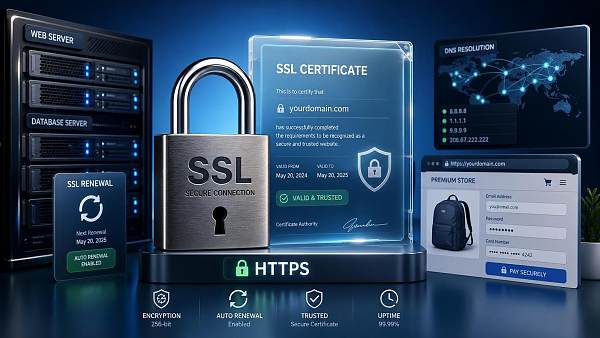
The core value of Let's Encrypt is clear: it provides DV certificates trusted by mainstream browsers, supports basic HTTPS encryption, can usually be issued within 5 to 30 minutes, and generally has a validity period of 90 days, making it suitable for automated renewal scenarios.
For presentation websites, test sites, short-term campaign pages, and early-stage SEO projects, a free certificate is often sufficient. It can resolve basic issues such as “browser security warnings,” “unencrypted data transmission,” and “lower search-engine trust in HTTP pages,” making it a cost-effective choice for building a website from 0 to 1.
3 types of website scenarios suitable for Let's Encrypt
- Corporate websites in the early stages of development, with between 10 and 100 pages, where the initial priority is to go live and get indexed.
- B2B overseas trade inquiry websites, whose core objectives are SEO launch, advertising testing, and form submissions, without complex payment processes.
- Multilingual sub-sites or regional sites that require certificates to be configured in batches and the cost per site to be reduced.
Its limitations are also clear
A free DV certificate can only prove that “control of this domain has been verified”; it cannot display the company’s verified identity information. For companies with long purchasing decision cycles and high order values that need to strengthen brand credibility, this may affect the trust judgments of some overseas visitors, especially at key stages such as inquiries, registration, and payment.
In addition, the 90-day validity period means that the certificate must rely on an automatic renewal mechanism. If there are issues with the server environment, DNS resolution, control-panel permissions, or scheduled tasks, a failed renewal may cause the certificate to expire within 1 to 7 days, directly affecting advertising, SEO crawling, and the customer access experience.
From the perspective of marketing implementation, different certificate solutions have different priorities. The following table is more suitable for practical selection among corporate websites, overseas trade websites, and cross-border e-commerce stores.
The key conclusion is that the free version solves the question of “whether the website can be accessed securely,” while the paid version focuses more on “whether it can operate more reliably, with less maintenance effort, and be better suited to brand and transaction scenarios.” If the website is only being launched as a basic site, the free version is generally sufficient; if it supports marketing and conversions, the selection criteria should be higher.
Will the free version be at a disadvantage in terms of SEO, advertising, and conversion rates?
From the perspective of search-engine indexing alone, Google does not directly award ranking benefits based on whether a certificate is free or paid. What truly affects SEO is whether HTTPS is functioning properly, whether the certificate remains valid, whether mixed content exists, whether 301 redirects are configured correctly, and whether the crawling path is stable.
In other words, if the question is whether the free version of Let's Encrypt SSL certificate is sufficient and only basic SEO is being discussed, the answer is often “yes.” However, if certificate renewal fails and causes security warnings, crawling anomalies, or advertising review failures within 48 hours, the loss will not be the certificate fee but organic traffic and advertising budget.
4 key SEO impact points
- Whether a 301 redirect from HTTP to HTTPS has been completed to avoid duplicate indexing.
- Whether all on-site images, JS, and CSS are delivered over HTTPS to reduce mixed-content warnings.
- Whether the certificate renews reliably to prevent access problems when the 90-day renewal point arrives.
- Whether multilingual websites, CDNs, and subdomains are deployed consistently to reduce breaks in the crawling path.
Practical impact on marketing conversions
In B2B overseas trade scenarios, users typically go through 3 steps from their first visit to submitting an inquiry: entering the page, reviewing the company’s capabilities and content, and completing the form. If the browser displays a “Not secure” warning, the form submission rate may fall noticeably even when there is no issue with the product content. Mobile visitors are particularly sensitive to this.
In B2C cross-border e-commerce stores, the impact is more direct. Login, registration, shopping-cart, and pre-payment pages are all highly sensitive areas. Even if payment is completed through a third-party platform, a more stable certificate management method should be prioritized whenever the on-site account system, order inquiries, or member-data transmission involves user information.
Advertising is especially vulnerable to “short-term outages”
For Google Ads, Facebook advertising, and overseas social media landing pages, the common problem is not that “the certificate level is insufficient,” but that “the page suddenly becomes unavailable.” If a landing page’s certificate expires during an advertising campaign, the result may range from abnormal review to wasted daily budget. For projects with a daily budget of $200 to $2,000, this risk is not insignificant.
How should companies choose? Assess based on website type, team capabilities, and growth stage
The biggest mistake in certificate selection is taking a “one-size-fits-all” approach. For companies at different stages, the most appropriate approach is not to pursue the most expensive option but to establish a 4-dimensional evaluation model: business type, data sensitivity, maintenance capabilities, and brand requirements. Once these 4 factors are clear, the question of whether the free version of Let's Encrypt SSL certificate is sufficient can be answered quickly.
Situations in which the free version is recommended
- The corporate website has just launched, and the current priority is to complete indexing and basic inquiry testing within 3 months.
- The company has a technical team or a SaaS platform that can renew certificates automatically and control the risk associated with the 90-day renewal cycle.
- There are many websites, such as more than 10 regional sub-sites, and deployment costs need to be reduced.
Situations in which a paid certificate should be considered
- The website is responsible for key brand presentation, and customers come from markets such as North America and Europe where businesses are more sensitive to compliance.
- There are many frequently used interactive pages, such as forms, member areas, orders, and back-office logins, leaving little room for error.
- There is no dedicated person responsible for maintaining the server, DNS, and certificate renewal, and the company cannot accept an interruption in advertising caused by a single expiration.
If the decision is further quantified, the following table can be used for quick screening. It is more suitable as a reference for companies working on overseas independent website development, SEO optimization, or supporting advertising campaigns.
This table shows that certificate selection is actually an intersection of “technical configuration” and “marketing objectives.” For marketing-oriented websites, stability is often more important than whether the certificate itself is free.
A more suitable implementation approach for businesses: not an either-or choice, but a tiered configuration
Many companies assume that they must choose between two types of certificates. In fact, a more practical approach is tiered deployment. For example, the main website, inquiry pages, online store, and back-office system can use different strategies. This controls costs while also balancing security and marketing performance.
A common 3-layer deployment approach
- Corporate websites and information pages: the free version can be used as a priority to ensure indexing and secure access.
- Key landing pages and core inquiry pages: monitoring and automatic renewal should be strengthened, and a paid certificate should be adopted when necessary.
- Online stores, login centers, and member systems: prioritize a stable management solution to reduce the probability of business interruptions.
Why are integrated services more suitable for corporate websites?
In integrated website and marketing service projects, SSL is not an isolated module. It works together with the website architecture, CDN, SEO rules, form system, advertising landing pages, and multi-site management. Looking only at the certificate price often overlooks subsequent configuration, inspection, alerts, and recovery processes.
Platforms such as Yiyingbao, which provide SaaS website-building and marketing services for overseas trade companies, manufacturing factories, cross-border sellers, and brands expanding overseas, place greater emphasis on making websites promotable, indexable, and conversion-ready. Certificate configuration should generally be incorporated into the unified process of website delivery, basic SEO optimization, and pre-launch promotion checks to reduce repetitive manual operations.
Multilingual corporate websites, B2B overseas trade marketing websites, B2C cross-border e-commerce stores, and overseas advertising landing pages often involve multiple domains, subdomains, and regional sites. Managing certificates, redirect rules, and monitoring alerts through a unified back office can reduce daily maintenance steps from 6 to 2 or 3, significantly lowering the probability of errors.
If your website is still in the basic launch or early SEO stage, the free version of Let's Encrypt is generally sufficient. However, if the website has entered the stage of overseas promotion, continuous advertising, brand building, or online-store transactions, the certificate should be evaluated as part of a more complete security and conversion system.
For businesses, what truly matters is not simply the choice between “free or paid,” but whether the certificate solution matches the pace of business growth, reduces maintenance risks, and ensures stable inquiry and order processes. Choosing a suitable website-building and marketing service provider is often more important than selecting a certificate independently.
If you are planning an overseas trade independent website, multilingual corporate website, cross-border e-commerce store, or Google SEO project and would like to further determine whether the free version of Let's Encrypt SSL certificate is sufficient, please contact Yiyingbao to obtain a website-building and integrated marketing solution better suited to your business stage and learn more about our solutions.
Related Articles

Related Products
 EasyCamp SaaS Smart Website Marketing SystemE-Yingbao SaaS Smart Website Marketing System: AI-powered, zero-code website building. Rapidly launch multilingual independent e-commerce sites in just 10 minutes. Global server acceleration and AI-driven SEO optimization empower businesses to efficiently connect with global markets. The seamless integration of technology and user-friendly operation makes building e-commerce sites incredibly simple.
 AI+SEM Intelligent Advertising Marketing SystemAI+SEM drives intelligent ad creation, empowering full-funnel precision advertising marketing. The system automatically generates weekly/monthly reports, AI recommends keywords and target countries, monitors core metrics in real-time with intelligent alerts, and enables one-click high-conversion ad solutions to help quickly acquire customers and improve ROI.
 AI+SEO Dual Engine Optimization ServiceEasyWin AI+SEO Dual Engine Optimization System leverages AI-powered keyword mining, content generation, and comprehensive technical optimization to help foreign trade enterprises acquire high-quality organic traffic, significantly improving search rankings and conversion rates.
 AI+SNS Social Media Marketing SystemYingbao AI+SNS Social Media Marketing System - Precision social capture for the social media era. Supports one-click content synchronization across major platforms like Facebook and LinkedIn. AI intelligently rewrites posts for enhanced relevance. 24/7 AI customer service and user profiling analysis empower businesses to efficiently expand into global markets.
 AI+SEO营销解决方案易营宝AI+SEO营销解决方案,通过AI批量写作、智能生成TDK、精准关键词扩词等功能,全面优化网站SEO效果,提升流量与转化率。助力企业构建高效智能网站新生态。
 AI+SEM Advertising Marketing SolutionsAI+SEM Advertising Marketing Solution leverages AI technology to deeply empower SEM ad campaigns. It automatically generates weekly/monthly reports using AI, presenting account data across multiple dimensions for comprehensive insights into campaign performance and trends. The system precisely recommends keywords and target countries, intelligently generates high-conversion ad copy, and enables one-click activation of efficient campaign plans to help businesses rapidly acquire customers. Simultaneously, it monitors core metrics in real time, intelligently identifies abnormal fluctuations, and issues timely alerts to ensure stable, high-return advertising results.
 Domain Name ServicesEasyWin provides professional domain name services, including intelligent queries, one-stop registration, brand protection, and full lifecycle management, helping businesses build a digital brand image.
 EasyOperate B2C Cross-Border E-Commerce Platform & Independent WebsiteEasyStore B2C Cross-border E-commerce Independent Store is an intelligent website building and cross-border e-commerce integrated solution independently developed by EasyStore Information Technology (Beijing) Co., Ltd. The system is specially designed for small and medium-sized as well as large export enterprises, integrating 'website building, operation, marketing, advertising, and conversion' into one, helping enterprises quickly establish cross-border e-commerce independent stores to achieve brand globalization and global sales growth.
The platform supports multiple languages, multiple currencies, and multi-channel marketing, with built-in AI intelligent translation and SEO optimization systems, suitable for mainstream markets such as Southeast Asia, Europe and America, Latin America, and the Middle East, assisting Chinese manufacturing enterprises in efficiently deploying international e-commerce strategies. SSL证书易营宝提供专业SSL安全证书服务,包括单域名和泛域名证书,确保网站数据传输加密、身份验证和完整性保护,助力企业建立安全可信的在线业务环境。









