









- What stages does the cross-border services ecosystem include? How do website building, promotion, payment, and compliance work togetherJun 22, 2026View details
- How will email marketing costs change in 2026Jun 22, 2026View details
- The China-US tariff arrangement has reached a preliminary consensus, and the trade association will be establishedJun 15, 2026View details
- Should overseas brand marketing start with ads or contentJun 21, 2026View details
- What determines B2C cross-border e-commerce website development costs? A breakdown of features, interfaces, and deployment methodsJun 17, 2026View details
- China-Morocco zero-tariff access, a breakthrough in the cost of Moroccan goods exports to ChinaJun 11, 2026View details
Is AI content marketing suitable for B2B companies? How can content production efficiency and lead quality be balanced
Is AI content marketing suitable for B2B companies? The answer is usually not a simple “yes” or “no.” What really deserves judgment is whether, after content generation becomes faster, it can still maintain professional expression, industry insight, and lead screening capabilities. For businesses that rely on website customer acquisition, SEO accumulation, and long-term lead nurturing, more content is not necessarily better; the more it approaches real purchasing questions, the more effective it is.
Why B2B Is Reassessing AI Content Marketing
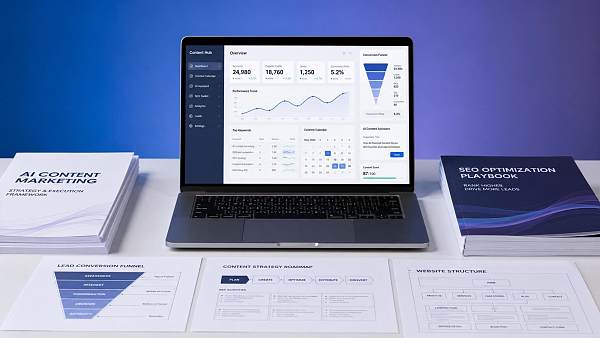
In the past, the biggest pressure in B2B content production came from long cycles, difficult topic selection, and slow cross-department collaboration. Now, AI content marketing significantly boosts the efficiency of writing, rewriting, outlining, and multilingual adaptation, making it easier for companies to continuously update website content, industry pages, case articles, and landing pages.
However, B2B and consumer content differ in one key respect: the final purpose of content is to serve inquiry quality, not merely to pursue readership. Especially in foreign trade, manufacturing, cross-border brands, and complex solution sales, whether an article can attract truly relevant prospects matters more than publishing ten pieces of generic traffic content.
In other words, the core value of AI content marketing in B2B scenarios is not to replace business judgment, but to free the content team from repetitive labor and allow more energy to be spent on keyword selection, user-question analysis, conversion-path design, and high-quality lead identification.
Efficiency Gains Do Not Equal True Conversion
After many companies launch AI writing, the first thing they notice is growth in output. Article libraries expand faster, site update frequency becomes more stable, and long-tail keyword coverage is easier to achieve. These changes do help SEO, especially for businesses that need to continuously build overseas independent-site content systems.
The problem is that once B2B content is left to “automatic generation,” three biases can easily appear: industry wording may look correct but lack decision-making depth; keyword coverage may be broad, but page intent becomes scattered; reading metrics may look good, yet fail to bring in effective inquiries.
Therefore, when assessing whether AI content marketing has value, you cannot look only at publishing volume. You also need to see whether it improves the following outcomes: whether site indexing is more stable, whether time on core pages is longer, whether inquiry forms match the target market better, and whether sales follow-up costs decline.
What Kind of AI Content Marketing Approach Fits B2B Better
In actual business, AI content marketing is better suited to “systematic scaling” rather than “indistinguishable ghostwriting.” If a company already has clear product positioning, target regions, and inquiry standards, AI can help quickly build a content matrix; if these foundations are still unclear, AI will only amplify the original fuzziness.
An ideal approach is to divide content into different tiers: some content is responsible for capturing search traffic, some for building professional trust, some for explaining solution differences, and some for supporting conversion actions. In this way, AI content marketing is no longer just a writing tool, but a content engine integrated with the website and marketing system.
More Valuable Content Types to Invest In
- Problem-oriented content: focused on common procurement questions, delivery risks, cost structures, and certification standards.
- Comparative solution content: explains the applicable boundaries of different website-building methods, promotion channels, and ad placement strategies.
- Scenario-based content: targeted at foreign trade lead generation, independent-site conversion, multilingual SEO, and landing page optimization tasks.
- Evidence-based content: customer cases, data results, process explanations, and breakdowns of common misconceptions.
This type of content makes it easier for visitors to move from “knowing you” to “willing to communicate,” and it is also more suitable for having AI generate the framework first, with the business team then filling in the professional details.
Where Lead Quality Usually Breaks Down
Many companies do not lack content; they lack alignment between content and business criteria. For example, keywords are too broad, bringing in a large number of non-target visitors; article structures are too generic, making it impossible to filter out people who truly care about solution details; and site-side handoff is weak, so once traffic arrives, there is no clear next step.
For a website + marketing service integrated business, content must be designed together with site architecture, SEO strategy, conversion pages, and ad traffic handoff. Otherwise, AI content marketing becomes only front-end buzz, while the back end never forms an inquiry loop.
From Website Building to Customer Acquisition, AI Content Marketing Requires Coordination
Truly effective AI content marketing is often not the result of a single tool, but a product of coordination among content, technology, and channels. In a service model represented by Yiyingbao, the emphasis on intelligent website building, SEO optimization, ad placement, social media operations, and AI search visibility is, in essence, about turning content from a “publishing action” into a “growth asset.”
This is especially important for businesses targeting overseas markets. Search habits, expression styles, and procurement priorities vary significantly across regions. Only by considering multilingual site structure, localized content, search intent analysis, and lead handoff mechanisms together can AI content marketing move beyond superficial efficiency gains.
For example, a piece of content about industry risks and operating strategies has limited value if it is only a conceptual list. But when combined with the site theme, solution pages, and extended reading, it can form a stronger content pathway. Material-based content such as Research on the Risk Management Strategies for Manufacturing Enterprises’ Liquidity Risk is suitable as one link in professional trust building, naturally supplementing the informational depth required in decision-making scenarios.
How to Balance Efficiency and Lead Quality
The key to balance is not limiting AI usage, but setting clear boundaries for AI. Which content can be produced in bulk, and which content must be guided by humans, should ideally be defined before the content process even begins.
Judgment Criteria That Can Be Prioritized
- Does it revolve around real customer questions, rather than around what the company wants to say?
- Does it serve a clearly defined page objective, such as indexing, staying, inquiry, download, or consultation?
- Can it reflect industry differences and avoid empty generic statements that any competitor could use?
- Is there follow-up handoff, such as case pages, product pages, form pages, or related recommendations?
- Is there a content review mechanism to identify high-traffic, low-conversion pages and continuously optimize them?
Usually, AI handles first drafts, clustering, rewriting, and multi-version output, while humans handle topic selection, verification, industry cases, risk judgment, and conversion design, which better balances speed and quality.
What Should Be Reviewed Next
If you are evaluating AI content marketing, start with three questions: Does the current website content support inquiry growth? Is the current traffic accurate enough? Can the current content production mechanism continue to iterate? Only by clarifying these three questions can you know whether what needs to be supplemented is tooling, site capability, or the overall marketing collaboration mechanism.
For B2B, the most valuable aspect of AI content marketing has never been “writing faster,” but “making the right content produce results more consistently.” First sort out the content objectives, then evaluate whether website building, SEO, advertising, and social media are coordinated, and finally use data to verify changes in lead quality. This judgment is more stable than simply chasing output volume.
When content truly enters the website conversion pathway, AI can shift from an efficiency tool to a sustainable growth driver.
Related Articles


Related Products
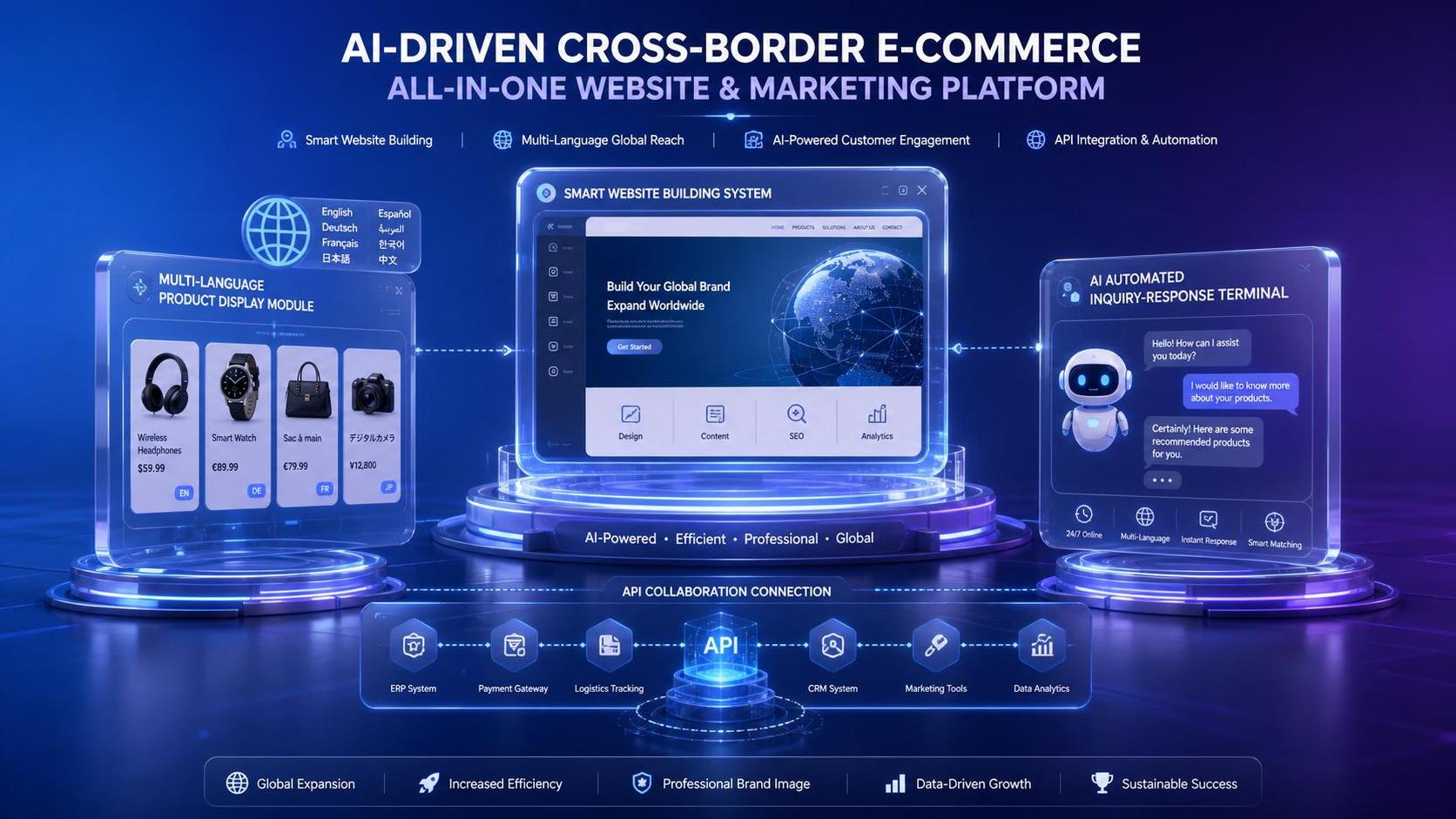
 EasyCamp SaaS Smart Website Marketing SystemE-Yingbao SaaS Smart Website Marketing System: AI-powered, zero-code website building. Rapidly launch multilingual independent e-commerce sites in just 10 minutes. Global server acceleration and AI-driven SEO optimization empower businesses to efficiently connect with global markets. The seamless integration of technology and user-friendly operation makes building e-commerce sites incredibly simple.
 AI+SEM Intelligent Advertising Marketing SystemAI+SEM drives intelligent ad creation, empowering full-funnel precision advertising marketing. The system automatically generates weekly/monthly reports, AI recommends keywords and target countries, monitors core metrics in real-time with intelligent alerts, and enables one-click high-conversion ad solutions to help quickly acquire customers and improve ROI.
 AI+SEO Dual Engine Optimization ServiceEasyWin AI+SEO Dual Engine Optimization System leverages AI-powered keyword mining, content generation, and comprehensive technical optimization to help foreign trade enterprises acquire high-quality organic traffic, significantly improving search rankings and conversion rates.
 AI+SNS Social Media Marketing SystemYingbao AI+SNS Social Media Marketing System - Precision social capture for the social media era. Supports one-click content synchronization across major platforms like Facebook and LinkedIn. AI intelligently rewrites posts for enhanced relevance. 24/7 AI customer service and user profiling analysis empower businesses to efficiently expand into global markets.
 AI+SEO营销解决方案易营宝AI+SEO营销解决方案,通过AI批量写作、智能生成TDK、精准关键词扩词等功能,全面优化网站SEO效果,提升流量与转化率。助力企业构建高效智能网站新生态。
 AI+SEM Advertising Marketing SolutionsAI+SEM Advertising Marketing Solution leverages AI technology to deeply empower SEM ad campaigns. It automatically generates weekly/monthly reports using AI, presenting account data across multiple dimensions for comprehensive insights into campaign performance and trends. The system precisely recommends keywords and target countries, intelligently generates high-conversion ad copy, and enables one-click activation of efficient campaign plans to help businesses rapidly acquire customers. Simultaneously, it monitors core metrics in real time, intelligently identifies abnormal fluctuations, and issues timely alerts to ensure stable, high-return advertising results.
 Domain Name ServicesEasyWin provides professional domain name services, including intelligent queries, one-stop registration, brand protection, and full lifecycle management, helping businesses build a digital brand image.
 EasyOperate B2C Cross-Border E-Commerce Platform & Independent WebsiteEasyStore B2C Cross-border E-commerce Independent Store is an intelligent website building and cross-border e-commerce integrated solution independently developed by EasyStore Information Technology (Beijing) Co., Ltd. The system is specially designed for small and medium-sized as well as large export enterprises, integrating 'website building, operation, marketing, advertising, and conversion' into one, helping enterprises quickly establish cross-border e-commerce independent stores to achieve brand globalization and global sales growth.
The platform supports multiple languages, multiple currencies, and multi-channel marketing, with built-in AI intelligent translation and SEO optimization systems, suitable for mainstream markets such as Southeast Asia, Europe and America, Latin America, and the Middle East, assisting Chinese manufacturing enterprises in efficiently deploying international e-commerce strategies. SSL证书易营宝提供专业SSL安全证书服务,包括单域名和泛域名证书,确保网站数据传输加密、身份验证和完整性保护,助力企业建立安全可信的在线业务环境。









