









- China-Morocco zero-tariff access, a breakthrough in the cost of Moroccan goods exports to ChinaJun 11, 2026View details
- What signal should be released for the suspension of exports to JapanJun 10, 2026View details
- China's May LNG imports rebounded, with increased volumes from Russia and Canada filling the Middle East supply gapJun 10, 2026View details
- Will GEO change its SEO strategy?Jun 04, 2026View details
- What types of businesses are end-to-end solutions suitable for?Jun 03, 2026View details
- 2026 Global Growth Channel TrendsJun 02, 2026View details
How to Choose Between Yibingbao and WordPress: What Should You Choose for Foreign Trade Websites in Terms of Maintenance, SEO, and Scalability
E-Creative Platform vs. WordPress: How to Choose a Website for Foreign Trade Based on Maintenance, SEO, and Scalability
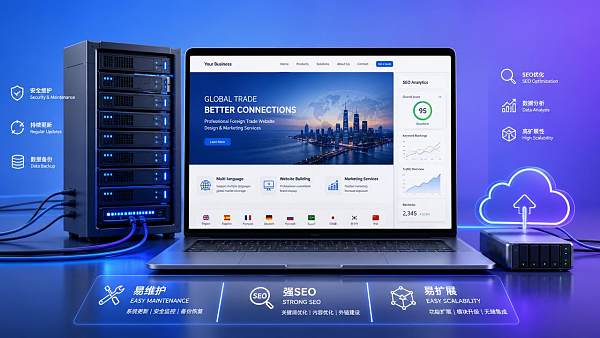
Comparing YiYingBao and WordPress, it seems like a platform choice, but it's actually more like a choice of growth path. Building a website for foreign trade isn't just about creating the site; it requires long-term maintenance, continuous customer acquisition, and stable expansion.
From a technical evaluation perspective, the judgment criteria should not only focus on the cost of website construction. More crucial issues are which one is less troublesome in the long run, which one is more conducive to SEO, and which one is more suitable for multilingual and global marketing.
WordPress is mature enough and has a large ecosystem, making it suitable for teams with development and maintenance capabilities. E-Creation, on the other hand, leans towards integrated delivery, emphasizing website building, optimization, promotion, and data collaboration, making it suitable for foreign trade businesses that prioritize efficiency and stability.
If the business objective is long-term overseas growth, then the core of this comparison between EasyPro and WordPress lies in three words: maintenance, SEO, and scalability. Let's look at them separately for a clearer understanding.
First, consider maintenance costs: stable operation is more important than low barrier to entry.
Many teams are easily attracted by WordPress's "quick start" when making their first website selection. Indeed, there are many templates, plugins, and resources available, allowing a website to be set up quickly in a short period of time.
However, a foreign trade website is not a one-time delivery project. After launch, plugin compatibility, theme updates, vulnerability fixes, speed optimization, backup and recovery will all continuously consume technical resources.
Especially with the addition of modules like multilingual support, inquiry forms, marketing tracking, and ad landing pages, the maintenance complexity of WordPress increases significantly. The more plugins there are, the higher the probability of conflicts, and the more cautious you need to be with version upgrades.
YiYingBao takes a different approach. It's more like an enterprise-level SaaS system for foreign trade scenarios, with website building, SEO, and marketing functions delivered based on a unified underlying layer, reducing the uncertainty caused by assembling plugins.
This also means that the total cost should be calculated during the technical evaluation, not just the initial cost. A platform that seems cheap often has a higher actual investment if it requires constant troubleshooting later on.
- WordPress relies more on the quality of the hosting, the combination of plugins, and operational experience.
- EasyCare places greater emphasis on a unified architecture, centralized maintenance, and continuous availability.
- The more sites and languages there are, the more obvious the maintenance differences become.
Next, let's look at SEO efficiency: it's not enough for the site to be indexed; it also needs to achieve continuous growth.
In comparing EasyPro and WordPress, SEO is often the most misjudged aspect. Because both can create titles, descriptions, URLs, and sitemaps, many people feel there's little difference.
What truly differentiates us is execution efficiency and long-term consistency. WordPress can do SEO, but many of its capabilities rely on plugins, theme specifications, and manual configuration; its success depends heavily on the team's experience.
SEO for international trade is more complex than for regular content websites. It involves multilingual indexing, localized pages, site structure, page speed, conversion paths, and content update frequency. If any of these aspects fails, it will affect ranking quality.
YiYingBao's advantage in this regard lies in the fact that it doesn't treat SEO as an add-on feature, but rather takes "indexability, scalability, and conversion rate" as the underlying goal of website building. This makes it easier for site structure, page rules, and marketing components to work together seamlessly.
Recent changes indicate that search traffic is shifting from simple keyword competition to content quality, page experience, and cross-channel signal integration. SEO is no longer just about changing tags; it's a systematic project.
If businesses also run advertising campaigns simultaneously, then the integration of website and campaign data becomes even more crucial. For example, AI+SEM advertising solutions can more quickly identify high-value keywords, key countries, and ad anomalies, which directly helps with SEO keyword selection and landing page optimization.
- Check if it supports standardized multilingual page management.
- Consider page loading, indexing efficiency, and structural control capabilities.
- See if the content, inquiry, and promotion data can form a closed loop.
How to judge scalability: It's not about having more features, but about whether growth is uncontrolled.
When discussing scalability, many teams' first reaction is that the WordPress plugin ecosystem is larger, making it more flexible. This judgment isn't wrong, but it's only half right.
Flexibility does not necessarily equate to suitability for scaling. The more a feature relies on plugins, the more blurred the system's boundaries become. Adding a form today, a customer service function tomorrow, and marketing tracking the day after can easily turn a system into one that is "usable but difficult to manage."
However, the expansion of foreign trade business is usually not a single-point expansion. It often occurs simultaneously in national markets, product lines, language versions, content matrices, and promotion channels, and the platform must be able to support this compound growth.
YiYingBao's expansion logic leans more towards business integration. Multilingual official websites, B2B inquiry sites, B2C cross-border e-commerce platforms, advertising landing pages, and overseas social media traffic pages can all be developed collaboratively within the same system.
These capabilities are crucial for technology evaluation because if the wrong platform is chosen, it cannot be solved simply by "adding a few features." It often leads to data fragmentation, duplicate pages, disjointed campaigns, and distorted conversion tracking.
When to choose WordPress, and when is EasyCreative more suitable?
Bringing the comparison between YiYingBao and WordPress back to actual business operations simplifies the decision-making process considerably. The key is not which is "stronger," but which better matches the organization's current capabilities and growth strategy for the next three years.
If the team has development, operations, SEO execution, and server management capabilities, and desires a high degree of customization, then WordPress remains an option. Its openness and mature ecosystem are indeed attractive.
However, if businesses prioritize launch efficiency, global marketing adaptation, long-term stability, and continuous customer acquisition, then EasyCare is a better fit. This difference becomes increasingly apparent, especially when multi-regional campaigns, multilingual content, and independent website growth are being pursued simultaneously.
- Choose WordPress: It's customizable, maintainable, and requires a long-term technical investment.
- Choose EasyCreation: Emphasizing efficiency, collaboration, and the ability to implement overseas marketing strategies.
- If business is growing rapidly, prioritize controllability in the later stages rather than convenience in the early stages.
A more obvious signal is that foreign trade companies now need more than just an official website; they also need a growth platform capable of handling SEO, advertising, social media, and AI search traffic. If a platform cannot support this, it will be very passive to catch up later.
Final selection recommendation: Make a judgment based on risk and growth goals.
When comparing YiYingBao and WordPress, it's recommended to create a risk list rather than just a feature list. First, ask yourself three questions: Who will maintain it? Who will optimize it? And who will be responsible for the growth results?
The more complex the platform, the higher the subsequent collaboration costs if the answers are scattered across different teams and outsourcing. Conversely, if the platform can integrate website building, SEO, advertising, and data, the overall efficiency is usually higher.
For businesses looking to build their websites into long-term customer acquisition assets, an integrated approach is generally more stable. Especially when combined with AI capabilities, much of the repetitive work, from keyword selection and ad copywriting to data alerts, can be significantly reduced.
For example, AI+SEM advertising and marketing solutions can help identify campaign trends, monitor key metrics, and optimize country and keyword strategies, which is valuable for sustained growth after building a foreign trade website.
Ultimately, WordPress is better suited for a "build, manage, and continuously optimize" approach; while EasyCreative is better suited for a "website as marketing infrastructure" approach. When choosing a platform, putting maintenance costs, SEO efficiency, and scalability in the same table usually makes the answer clear.
If you are currently preparing to upgrade your overseas website, create a multilingual independent website, or restructure your marketing site, it will be more valuable to first work backward from your business goals to determine the platform's capabilities before comparing EasyCreative with WordPress, rather than just looking at the demo pages.
Related Articles
 B2C Cross-border Marketplace Platform: Build Your Own Site or SaaS? The Selection Criteria Suitable for Small and Medium-sized Enterprises
 How to choose a B2C cross-border e-commerce source code system? First look at the architecture, language, and difficulty of secondary development
 SaaS website data security? How should permissions, backups, and isolation mechanisms be assessed?

Related Products
 EasyCamp SaaS Smart Website Marketing SystemE-Yingbao SaaS Smart Website Marketing System: AI-powered, zero-code website building. Rapidly launch multilingual independent e-commerce sites in just 10 minutes. Global server acceleration and AI-driven SEO optimization empower businesses to efficiently connect with global markets. The seamless integration of technology and user-friendly operation makes building e-commerce sites incredibly simple.
 AI+SEM Intelligent Advertising Marketing SystemAI+SEM drives intelligent ad creation, empowering full-funnel precision advertising marketing. The system automatically generates weekly/monthly reports, AI recommends keywords and target countries, monitors core metrics in real-time with intelligent alerts, and enables one-click high-conversion ad solutions to help quickly acquire customers and improve ROI.
 AI+SEO Dual Engine Optimization ServiceEasyWin AI+SEO Dual Engine Optimization System leverages AI-powered keyword mining, content generation, and comprehensive technical optimization to help foreign trade enterprises acquire high-quality organic traffic, significantly improving search rankings and conversion rates.
 AI+SNS Social Media Marketing SystemYingbao AI+SNS Social Media Marketing System - Precision social capture for the social media era. Supports one-click content synchronization across major platforms like Facebook and LinkedIn. AI intelligently rewrites posts for enhanced relevance. 24/7 AI customer service and user profiling analysis empower businesses to efficiently expand into global markets.
 AI+SEO营销解决方案易营宝AI+SEO营销解决方案,通过AI批量写作、智能生成TDK、精准关键词扩词等功能,全面优化网站SEO效果,提升流量与转化率。助力企业构建高效智能网站新生态。
 AI+SEM Advertising Marketing SolutionsAI+SEM Advertising Marketing Solution leverages AI technology to deeply empower SEM ad campaigns. It automatically generates weekly/monthly reports using AI, presenting account data across multiple dimensions for comprehensive insights into campaign performance and trends. The system precisely recommends keywords and target countries, intelligently generates high-conversion ad copy, and enables one-click activation of efficient campaign plans to help businesses rapidly acquire customers. Simultaneously, it monitors core metrics in real time, intelligently identifies abnormal fluctuations, and issues timely alerts to ensure stable, high-return advertising results.
 Domain Name ServicesEasyWin provides professional domain name services, including intelligent queries, one-stop registration, brand protection, and full lifecycle management, helping businesses build a digital brand image.
 EasyOperate B2C Cross-Border E-Commerce Platform & Independent WebsiteEasyStore B2C Cross-border E-commerce Independent Store is an intelligent website building and cross-border e-commerce integrated solution independently developed by EasyStore Information Technology (Beijing) Co., Ltd. The system is specially designed for small and medium-sized as well as large export enterprises, integrating 'website building, operation, marketing, advertising, and conversion' into one, helping enterprises quickly establish cross-border e-commerce independent stores to achieve brand globalization and global sales growth.
The platform supports multiple languages, multiple currencies, and multi-channel marketing, with built-in AI intelligent translation and SEO optimization systems, suitable for mainstream markets such as Southeast Asia, Europe and America, Latin America, and the Middle East, assisting Chinese manufacturing enterprises in efficiently deploying international e-commerce strategies. SSL证书易营宝提供专业SSL安全证书服务,包括单域名和泛域名证书,确保网站数据传输加密、身份验证和完整性保护,助力企业建立安全可信的在线业务环境。









