









- Can Zhejiang foreign trade independent websites still be developed today? Look at changes in traffic and lead generationJul 28, 2026View details
- What New Signals Are Emerging in Enterprise Services SaaS Marketing ReportsJul 27, 2026View details
- What Does a Global Traffic Ecosystem Service Provider Do? What Are the Differences from a Single Advertising AgencyJul 16, 2026View details
- What should you focus on in the latest enterprise SaaS report? From renewal rates and delivery costs to overseas growth opportunitiesJul 12, 2026View details
- What signals are worth paying attention to in a cross-border marketing trend report? B2B companies should look at these 6 signalsJul 11, 2026View details
- How to Read a Cross-Border Marketing Trends Report? Five Key Dimensions for Evaluating Channel OpportunitiesJul 11, 2026View details
How to Choose a Foreign Trade Website-Building Platform Without Falling into Common Traps
How to choose a foreign trade website-building platform without falling into pitfalls is a major concern for many companies before expanding overseas. Choosing the right platform is not just about getting a website built; it also determines whether the website can be indexed by Google, effectively handle traffic from advertising campaigns, and continuously generate inquiries. For most companies, the key comparison should not be whether the templates look attractive, but whether the platform suits their business model, market strategy, and customer acquisition goals.
Users searching for “how to choose a foreign trade website-building platform without falling into pitfalls” usually have a clear intent: they want a practical set of evaluation criteria to avoid website-building solutions that are difficult to promote, maintain, or convert later on. Such readers are typically most concerned with whether the platform supports SEO, facilitates multilingual operations, suits B2B or B2C scenarios, keeps long-term costs under control, and whether the service provider has ongoing marketing capabilities.
Therefore, this article will not focus solely on platform categories and feature lists. Instead, it will address several practical questions: what type of platform is more suitable for foreign trade companies, which hidden risks are most likely to be overlooked, how companies should make decisions based on their business development stage, and why integrated “website building + marketing” capabilities are becoming increasingly important.
First, the conclusion: choosing a foreign trade website-building platform is not about selecting the one with the most features, but the one best suited to a complete customer acquisition process
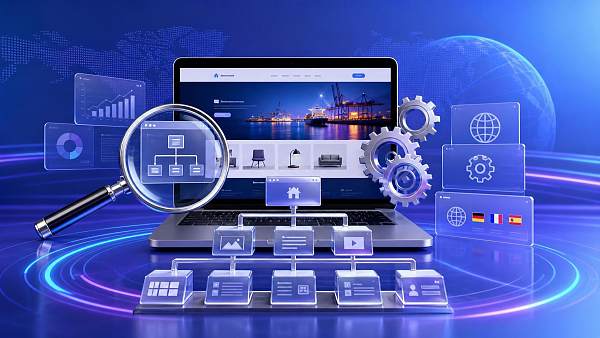
When building an overseas independent website for the first time, many companies tend to focus on visual design, the number of templates, and website-building speed. However, what truly affects results is often the website’s promotional capabilities after launch. If a foreign trade website cannot be understood by search engines, handle advertising traffic, or support multilingual content strategies, even an attractive design will have difficulty generating business value.
Therefore, the core criterion for choosing a foreign trade website-building platform without falling into pitfalls should be whether it can support long-term customer acquisition. Specifically, companies should consider not only whether the website can be launched quickly, but also whether the platform supports basic SEO optimization, mobile user experience, conversion components, multi-region deployment, data tracking, and subsequent marketing collaboration.
If a company does not have a mature technical team, it should be especially careful not to purchase only a “website-building tool.” A foreign trade website is not a one-time deliverable, but a long-term business asset. If the platform, system, content, traffic, and conversion processes are disconnected from one another, operating costs will rise significantly, ultimately slowing down the company’s overseas expansion.
The pitfalls companies most often encounter usually appear not during website development, but after launch
Many platforms that appear to save money only reveal their problems after going live. For example, the backend may not allow flexible TDK settings, the URL structure may be disorganized, pages may load slowly, multilingual versions may not be independently optimized, inquiry form data may be difficult to manage, or website revisions may repeatedly depend on technical personnel. These problems may not be obvious during the initial development stage, but they directly affect Google indexing, advertising Quality Score, and customer conversion.
The second common problem is that “the platform can build websites, but does not understand foreign trade marketing.” A foreign trade company’s website is not merely a corporate site for displaying information. It also serves the comprehensive functions of building the brand, increasing search visibility, providing advertising landing pages, and handling inquiries. If a service provider only knows how to create pages but lacks knowledge of SEO, advertising, and overseas user experience, the completed website can easily become nothing more than a display piece.
The third risk is insufficient scalability. Many companies initially plan to build only an English website, but later discover that they need to expand into Spanish-, French-, Arabic-, and Russian-speaking markets. Others may initially want only a corporate website, but later need to add an online store, landing pages, and social media traffic acquisition. If the platform cannot support business expansion, the company may face secondary development or even a complete rebuild, resulting in repeated consumption of time and budget.
To determine whether a platform is suitable, first examine these five key capabilities
First, evaluate its SEO friendliness. This is the one area where a foreign trade website-building platform should not compromise. At a minimum, the platform should support customized titles, descriptions, keywords, URLs, image ALT text, sitemaps, 301 redirects, structured optimization, and page loading performance. Without these basic capabilities, implementing Google SEO later will be extremely difficult.
Second, evaluate its multilingual and multi-region capabilities. A website genuinely targeting overseas markets cannot rely on simple translation alone. The platform should support independent management of pages in different languages and, ideally, content, forms, currencies, and landing pages tailored to different countries and regions. This is more suitable for global marketing scenarios.
Third, evaluate its conversion capabilities. A foreign trade website is not a competition based on page views, but is driven by inquiry results. Whether the platform supports convenient inquiry forms, WhatsApp, online chat, product category navigation, case studies, downloadable materials, and CTA buttons directly affects whether visitors are willing to leave their contact information.
Fourth, evaluate its data and marketing collaboration capabilities. A platform that genuinely supports business growth should make it convenient to integrate Google Analytics, Google Ads, Meta pixels, and search control tools. Companies need to know which pages are attracting traffic, which keywords are generating visits, and which advertising landing pages are converting, rather than merely checking whether the website has been “completed.”
Fifth, evaluate the service provider’s long-term support capabilities. A foreign trade website is not finished once it has been delivered. Subsequent work may include revisions, content updates, optimization recommendations, campaign page creation, SEO operations, and advertising coordination. If there is no mature service team behind the platform and the company also lacks professional staff, the website can easily remain stuck at the stage of “launching is the endpoint.”
B2B companies and cross-border e-commerce businesses do not use the same logic when choosing a platform
For B2B foreign trade companies, the website’s core objectives are usually to establish professional trust, showcase product capabilities, and generate inquiries. Such companies should pay greater attention to content architecture, product page presentation, case studies and credentials, SEO scalability, and the ability to adapt multilingual websites to different markets.
For manufacturers, equipment companies, and raw material companies, the website is more like a long-term overseas customer acquisition base. The platform does not necessarily need to prioritize complex transaction functions, but it must facilitate search engine indexing, product category expansion, and lead conversion management. Otherwise, subsequent content growth and inquiry accumulation will become very difficult.
For B2C brands expanding overseas or cross-border online stores, the focus tends to shift toward product management, payment capabilities, logistics integration, campaign pages, user experience, and advertising landing efficiency. In this case, companies need to evaluate not only the website-building system itself, but also whether it can coordinate with advertising, social media traffic acquisition, and remarketing activities.
In other words, the prerequisite for choosing a foreign trade website-building platform without falling into pitfalls is not to first look at which one is cheaper, but to first clarify the company’s business model. Different models have different objectives, so the platform priorities will naturally differ. Applying the logic of a B2B corporate website to a B2C online store, or using the approach of a simple display website for global marketing, is often where the pitfalls begin.
Why are more and more companies better suited to integrated “website building + marketing” platforms?
The competition faced by foreign trade companies today is no longer about whether they have a website, but whether the website can continuously generate customers. Website building is only the starting point. What truly determines growth efficiency is subsequent SEO planning, advertising, social media traffic acquisition, content updates, and improved visibility in AI search. If these capabilities are distributed among multiple suppliers, communication and execution costs can be very high.
The value of an integrated platform lies in designing the website around promotion and conversion from the very beginning. For example, the page structure can better align with SEO crawling logic, landing pages can be more suitable for handling advertising traffic, multilingual content can be managed more efficiently, and subsequent iterative optimization can be more easily driven by data. Such a website is not merely “able to go live”; it has a greater opportunity to become an overseas growth asset for the company.
Take Yiyingbao, an AI-driven enterprise SaaS intelligent website-building and overseas marketing platform, as an example. Its advantage lies not only in helping companies build multilingual corporate websites, B2B foreign trade marketing websites, or B2C cross-border online stores, but also in integrating Google SEO, Google advertising, Facebook marketing, overseas social media operations, and AI optimization capabilities into the same growth process.
For companies that lack an overseas digital marketing team, this model makes it easier to reduce the cost of trial and error. Companies do not need to connect multiple processes involving technology, content, advertising, and data analysis on their own. Instead, they can use unified platform capabilities to build overseas independent websites that are promotable, indexable, and conversion-oriented more quickly.
Foreign trade companies can use this checklist directly when selecting a platform
When screening platforms in practice, companies are advised to first ask themselves five questions: Is my primary objective brand presentation, SEO-based customer acquisition, or advertising conversion? Do my main markets require a multilingual strategy? Do I need an online store or payment functions? Is there a dedicated person internally to operate the website continuously? Do I need a tool, or a complete service?
Next, confirm several key details with the service provider: Does it support basic SEO settings? Does it support flexible revisions at a later stage? Does it have multi-region deployment capabilities? Is it convenient to integrate analytics and advertising tools? Does it have actual case studies in the foreign trade industry? Will it provide ongoing operational and optimization support? The more specific the questions, the easier it is to determine whether the platform is mature.
If the other party can only repeatedly emphasize templates, prices, and website-building speed, but cannot clearly answer questions about SEO, conversion, and long-term operations, it is probably not suitable as the core platform for foreign trade business. What companies need to purchase is not a page generator, but digital growth infrastructure for serving global markets.
Conclusion: the key to avoiding pitfalls is to work backward from “whether it can generate customers” when choosing a platform
Returning to the original question—how can companies choose a foreign trade website-building platform without falling into pitfalls? The answer is clear: do not focus only on website development itself. Instead, work backward from future promotion, conversion, and global operations capabilities when selecting a platform. A truly suitable platform should meet current launch requirements while also supporting subsequent SEO growth, advertising, multilingual expansion, and brand development.
For foreign trade companies, a website is not a cost item, but an important asset for operating in overseas markets. Focusing only on low prices and superficial features during selection often leads to higher costs in subsequent optimization, customer acquisition, and rebuilding. In contrast, choosing a platform that combines technical and marketing capabilities provides a better opportunity to turn the website into a growth gateway that continuously generates business opportunities.
If a company is currently in the stage of planning its overseas expansion, the most reliable approach is not to rush to decide “which template to use,” but first to clarify its business objectives, target markets, and customer acquisition methods, and then match them with a suitable website-building and marketing solution. Only when the direction is right can the platform truly serve growth.
Related Articles


Related Products
 EasyCamp SaaS Smart Website Marketing SystemE-Yingbao SaaS Smart Website Marketing System: AI-powered, zero-code website building. Rapidly launch multilingual independent e-commerce sites in just 10 minutes. Global server acceleration and AI-driven SEO optimization empower businesses to efficiently connect with global markets. The seamless integration of technology and user-friendly operation makes building e-commerce sites incredibly simple.
 AI+SEM Intelligent Advertising Marketing SystemAI+SEM drives intelligent ad creation, empowering full-funnel precision advertising marketing. The system automatically generates weekly/monthly reports, AI recommends keywords and target countries, monitors core metrics in real-time with intelligent alerts, and enables one-click high-conversion ad solutions to help quickly acquire customers and improve ROI.
 AI+SEO Dual Engine Optimization ServiceEasyWin AI+SEO Dual Engine Optimization System leverages AI-powered keyword mining, content generation, and comprehensive technical optimization to help foreign trade enterprises acquire high-quality organic traffic, significantly improving search rankings and conversion rates.
 AI+SNS Social Media Marketing SystemYingbao AI+SNS Social Media Marketing System - Precision social capture for the social media era. Supports one-click content synchronization across major platforms like Facebook and LinkedIn. AI intelligently rewrites posts for enhanced relevance. 24/7 AI customer service and user profiling analysis empower businesses to efficiently expand into global markets.
 AI+SEO营销解决方案易营宝AI+SEO营销解决方案,通过AI批量写作、智能生成TDK、精准关键词扩词等功能,全面优化网站SEO效果,提升流量与转化率。助力企业构建高效智能网站新生态。
 AI+SEM Advertising Marketing SolutionsAI+SEM Advertising Marketing Solution leverages AI technology to deeply empower SEM ad campaigns. It automatically generates weekly/monthly reports using AI, presenting account data across multiple dimensions for comprehensive insights into campaign performance and trends. The system precisely recommends keywords and target countries, intelligently generates high-conversion ad copy, and enables one-click activation of efficient campaign plans to help businesses rapidly acquire customers. Simultaneously, it monitors core metrics in real time, intelligently identifies abnormal fluctuations, and issues timely alerts to ensure stable, high-return advertising results.
 Domain Name ServicesEasyWin provides professional domain name services, including intelligent queries, one-stop registration, brand protection, and full lifecycle management, helping businesses build a digital brand image.
 EasyOperate B2C Cross-Border E-Commerce Platform & Independent WebsiteEasyStore B2C Cross-border E-commerce Independent Store is an intelligent website building and cross-border e-commerce integrated solution independently developed by EasyStore Information Technology (Beijing) Co., Ltd. The system is specially designed for small and medium-sized as well as large export enterprises, integrating 'website building, operation, marketing, advertising, and conversion' into one, helping enterprises quickly establish cross-border e-commerce independent stores to achieve brand globalization and global sales growth.
The platform supports multiple languages, multiple currencies, and multi-channel marketing, with built-in AI intelligent translation and SEO optimization systems, suitable for mainstream markets such as Southeast Asia, Europe and America, Latin America, and the Middle East, assisting Chinese manufacturing enterprises in efficiently deploying international e-commerce strategies. SSL证书易营宝提供专业SSL安全证书服务,包括单域名和泛域名证书,确保网站数据传输加密、身份验证和完整性保护,助力企业建立安全可信的在线业务环境。









