









- What Does a Global Traffic Ecosystem Service Provider Do? What Are the Differences from a Single Advertising AgencyJul 16, 2026View details
- What should you focus on in the latest enterprise SaaS report? From renewal rates and delivery costs to overseas growth opportunitiesJul 12, 2026View details
- What signals are worth paying attention to in a cross-border marketing trend report? B2B companies should look at these 6 signalsJul 11, 2026View details
- How to Read a Cross-Border Marketing Trends Report? Five Key Dimensions for Evaluating Channel OpportunitiesJul 11, 2026View details
- Which channel has the highest ROI in the global traffic ecosystem? Comparative analysis of search, social media, and advertisingJul 10, 2026View details
- What multilingual website services are available in Sanya? Which model is more suitable for local businesses going global?Jul 08, 2026View details
How to Choose a Digital Marketing Service Provider? Start by Reviewing the Scope of Delivery
When selecting a digital marketing service provider, a common mistake is to compare case studies first, negotiate the price down, and only later discover that the project scopes are not actually the same. On the surface, they may all provide website development, SEO, advertising, and social media operations, but during actual execution, there can be significant differences in what is delivered, how far it is delivered, who is responsible, and how acceptance is carried out. For projects aimed at integrating websites and marketing, reviewing the delivery boundaries first can control the budget more effectively than focusing on the lowest price, while also reducing the time cost caused by repeated communication later on.
Delivery Boundaries Determine Whether Cooperation Can Be Managed
Many companies understand digital marketing services as “helping me generate traffic.” This direction is not wrong, but it is far from sufficient for procurement decisions.
What a digital marketing service provider delivers is not limited to execution activities. It also includes systems, strategies, content, data, optimization schedules, and methods of collaboration. When the boundaries are unclear, misunderstandings may arise at every subsequent step.

Simply put, delivery boundaries are a cooperation roadmap. They specify what the project includes and excludes, what the objectives are at each stage, whether third-party platforms are involved, how data definitions are unified, and who ultimately confirms the results.
If a digital marketing service provider emphasizes only “results” while avoiding delivery lists, workflows, and acceptance criteria, such cooperation is usually difficult to advance steadily.
Why Integrated Website and Marketing Services Require Even Greater Attention to Boundaries
At present, many projects are no longer limited to individual advertising campaigns. Instead, they begin with the development of an independent website and then connect with organic search, advertising-based lead generation, social media traffic acquisition, and lead conversion.
The advantage of this model is a complete business chain, but the issues are also more complex. Website structure affects indexing, content strategy affects inquiry quality, advertising accounts affect traffic-scaling efficiency, and data tracking determines whether subsequent reviews are reliable.
In other words, websites and marketing cannot be viewed separately. Website development is not simply about launching pages, and marketing is not merely about purchasing traffic independently. An effective digital marketing service provider needs to consider the website foundation, channel operations, and data analysis within the same framework.
This is even more evident in overseas business. Multilingual websites, overseas advertising platforms, long-term SEO accumulation, and improved visibility in AI search are all forms of cross-module collaboration. When the boundaries are unclear, the common result is that the website goes online but is difficult to promote, or that investment is made in channels but the traffic cannot be effectively received.
When Evaluating a Digital Marketing Service Provider, First Check These Four Categories
Is the Project Scope Specific Enough?
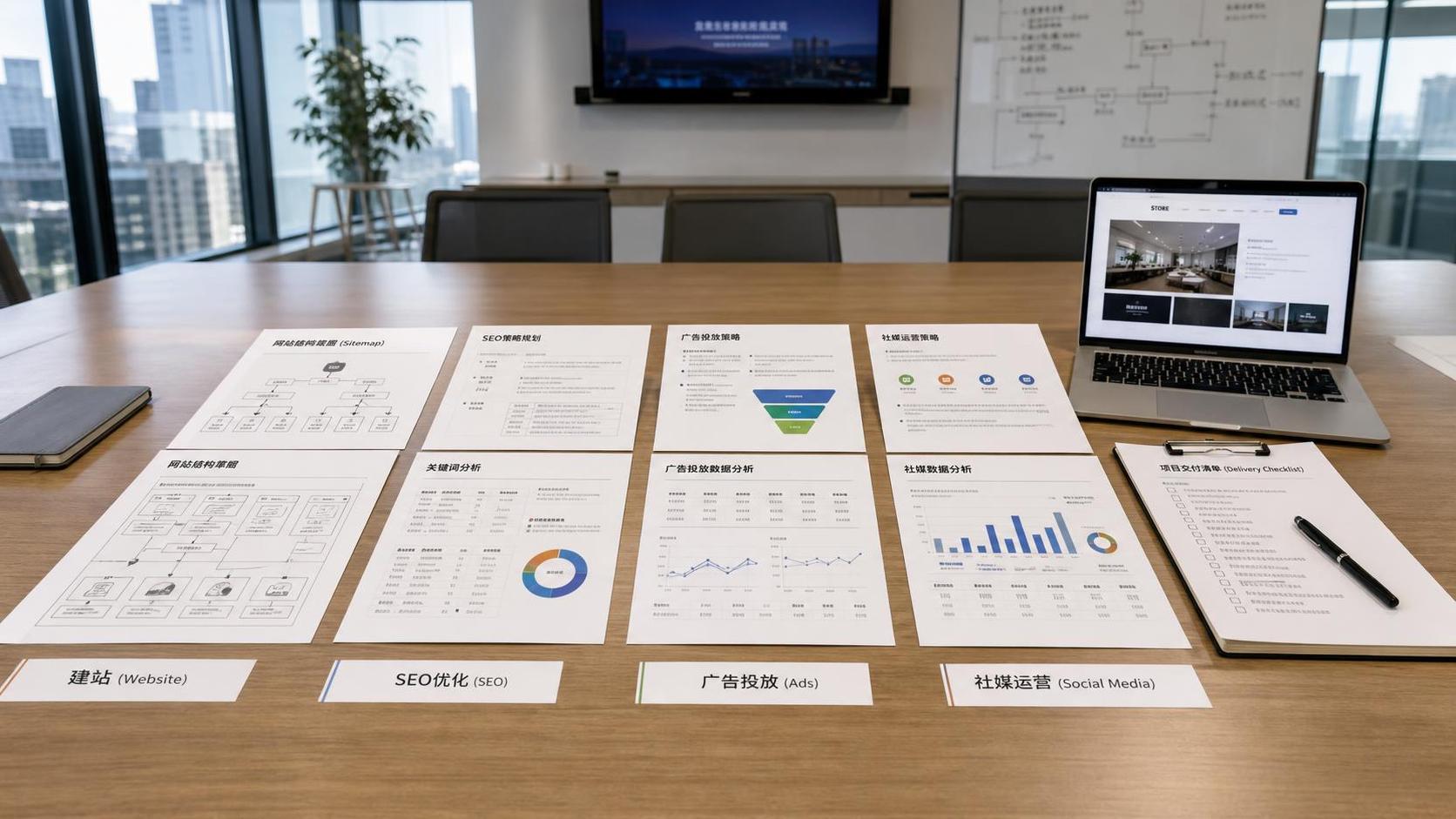
“Website development” needs to be broken down. Does it involve template-based development or support for customized pages? Is it a single-language website or a multilingual website? Does it include mobile adaptation, basic content entry, form configuration, and speed optimization?
“SEO optimization” also cannot be judged by the wording alone. Confirm whether it includes keyword research, technical optimization, page structure, content planning, link-building strategy, indexing monitoring, and monthly reviews.
Are the Deliverables Subject to Acceptance?
A good proposal clearly defines deliverables, such as website prototypes, the number of pages launched, advertising account structures, monthly reports, SEO task lists, and lead-tracking dashboards.
If the deliverables are described only as “continuous optimization” or “full-process operations,” they may sound comprehensive, but in practice they make it difficult to assess project progress.
Are Responsibilities Clearly Defined in Advance?
Who provides the content materials, who organizes the product information, who approves the advertising budget, who manages account permissions, and who handles translation and localization should all be clarified at the initial stage.
Many cooperation issues are not caused by a lack of capability, but by responsibilities not being agreed upon in advance, ultimately slowing down the execution schedule.
Do the Performance Metrics Match the Project Stage?
During the initial website development stage, greater attention should be paid to launch quality, indexing fundamentals, and conversion paths. In the early SEO stage, the focus should be on indexing, ranking trends, and content coverage. During the advertising stage, click costs, conversion costs, and lead quality should be evaluated.
If a digital marketing service provider promises an absolute number of inquiries at the very beginning of a project, the underlying conditions should instead be reviewed with greater caution.
Different Business Scenarios Require Different Areas of Focus
Even when looking for the same digital marketing service provider, the evaluation criteria for boundaries vary by scenario. The following distinctions are usually more meaningful than simply comparing the total price.
From this perspective, a digital marketing service provider is not necessarily better simply because it is more “all-capable.” The more clearly it can break down different scenarios and define realistic boundaries, the more worthy it is of further evaluation.
The Value of Integrated Services Lies in Reducing Gaps
There are three common gaps in the market. First, website development and promotion are handled by two separate companies, resulting in inconsistencies between page logic and advertising objectives. Second, channel execution and data analysis are separated: the reports can be viewed, but the decisions cannot be implemented. Third, content updates fail to keep pace, making it difficult to sustain both SEO and social media operations.
Therefore, the value of integrated website and marketing services is not merely saving communication effort, but reducing gaps in responsibility. The party that builds the website has a clearer understanding of how the pages should receive search and advertising traffic; the party responsible for optimization can more easily adjust the website structure and content direction based on data.
Taking 易营宝 as an example, its business is not simply the sale of a particular tool. Instead, it establishes a complete process around the growth of overseas independent websites. Its self-developed cloud intelligent website-building system, cross-border e-commerce system, AI advertising marketing system, and AI+SEO/GEO optimization system make it possible to understand website development, customer acquisition, and continuous optimization within the same framework.
This model is more suitable for projects that require long-term development in overseas markets. Particularly when expanding across North America, Europe, Southeast Asia, Japan and South Korea, and the Middle East, a unified technical foundation and localized execution capabilities make it easier to achieve continuous growth than fragmented outsourcing.
During the Actual Selection Process, Ask More Specific Questions
Instead of asking “Can you do it?”, ask directly how the deliverables will be implemented. The more specific the questions, the easier it is to determine whether a digital marketing service provider is mature.
- After the website goes live, how long will it take to complete the basic indexing configuration, and which technical items are included?
- Who plans the SEO content, and is there keyword segmentation and page mapping?
- Who sets up the advertising account, pixel, conversion tracking, and data dashboard?
- Does social media operation consist only of content publishing, or does it also include topic selection, creative materials, and interaction scheduling?
- Is GEO or AI search optimization included in the proposal, and how will it work together with existing SEO?
- Which data is reviewed monthly, and how are the causes of abnormal fluctuations identified?
These questions may appear detailed, but they are the most helpful in assessing the depth of a service. A truly mature digital marketing service provider will usually explain its processes, tools, schedules, and boundaries relatively clearly, rather than simply displaying impressive case studies.
Establish an Evaluation Framework Before Comparing Prices
Price is certainly important, but it should be based on equivalent delivery boundaries. When two quotations differ significantly, it is often not because one provider is more expensive, but because the depth of delivery is completely different.
A more reliable approach is to first break down your objectives into several questions: Do you need integrated website development and promotion? How many target markets are there? In the short term, are leads more important, or is long-term organic growth the priority? Which supporting tasks can your internal team take on?
With this framework in place, it becomes easier to distinguish which elements in a digital marketing service provider’s proposal are core investments and which are merely add-ons that appear comprehensive.
Ultimately, choosing a partner is not about comparing who describes the most comprehensive offering, but who explains the boundaries most clearly. Only after fully understanding the delivery boundaries should you compare system capabilities, execution experience, and regional suitability. This makes subsequent cooperation more stable and measurable, while bringing it closer to genuine growth objectives.
Related Articles
Related Products
 EasyCamp SaaS Smart Website Marketing SystemE-Yingbao SaaS Smart Website Marketing System: AI-powered, zero-code website building. Rapidly launch multilingual independent e-commerce sites in just 10 minutes. Global server acceleration and AI-driven SEO optimization empower businesses to efficiently connect with global markets. The seamless integration of technology and user-friendly operation makes building e-commerce sites incredibly simple.
 AI+SEM Intelligent Advertising Marketing SystemAI+SEM drives intelligent ad creation, empowering full-funnel precision advertising marketing. The system automatically generates weekly/monthly reports, AI recommends keywords and target countries, monitors core metrics in real-time with intelligent alerts, and enables one-click high-conversion ad solutions to help quickly acquire customers and improve ROI.
 AI+SEO Dual Engine Optimization ServiceEasyWin AI+SEO Dual Engine Optimization System leverages AI-powered keyword mining, content generation, and comprehensive technical optimization to help foreign trade enterprises acquire high-quality organic traffic, significantly improving search rankings and conversion rates.
 AI+SNS Social Media Marketing SystemYingbao AI+SNS Social Media Marketing System - Precision social capture for the social media era. Supports one-click content synchronization across major platforms like Facebook and LinkedIn. AI intelligently rewrites posts for enhanced relevance. 24/7 AI customer service and user profiling analysis empower businesses to efficiently expand into global markets.
 AI+SEO营销解决方案易营宝AI+SEO营销解决方案,通过AI批量写作、智能生成TDK、精准关键词扩词等功能,全面优化网站SEO效果,提升流量与转化率。助力企业构建高效智能网站新生态。
 AI+SEM Advertising Marketing SolutionsAI+SEM Advertising Marketing Solution leverages AI technology to deeply empower SEM ad campaigns. It automatically generates weekly/monthly reports using AI, presenting account data across multiple dimensions for comprehensive insights into campaign performance and trends. The system precisely recommends keywords and target countries, intelligently generates high-conversion ad copy, and enables one-click activation of efficient campaign plans to help businesses rapidly acquire customers. Simultaneously, it monitors core metrics in real time, intelligently identifies abnormal fluctuations, and issues timely alerts to ensure stable, high-return advertising results.
 Domain Name ServicesEasyWin provides professional domain name services, including intelligent queries, one-stop registration, brand protection, and full lifecycle management, helping businesses build a digital brand image.
 EasyOperate B2C Cross-Border E-Commerce Platform & Independent WebsiteEasyStore B2C Cross-border E-commerce Independent Store is an intelligent website building and cross-border e-commerce integrated solution independently developed by EasyStore Information Technology (Beijing) Co., Ltd. The system is specially designed for small and medium-sized as well as large export enterprises, integrating 'website building, operation, marketing, advertising, and conversion' into one, helping enterprises quickly establish cross-border e-commerce independent stores to achieve brand globalization and global sales growth.
The platform supports multiple languages, multiple currencies, and multi-channel marketing, with built-in AI intelligent translation and SEO optimization systems, suitable for mainstream markets such as Southeast Asia, Europe and America, Latin America, and the Middle East, assisting Chinese manufacturing enterprises in efficiently deploying international e-commerce strategies. SSL证书易营宝提供专业SSL安全证书服务,包括单域名和泛域名证书,确保网站数据传输加密、身份验证和完整性保护,助力企业建立安全可信的在线业务环境。









