









- What Does a Global Traffic Ecosystem Service Provider Do? What Are the Differences from a Single Advertising AgencyJul 16, 2026View details
- What should you focus on in the latest enterprise SaaS report? From renewal rates and delivery costs to overseas growth opportunitiesJul 12, 2026View details
- What signals are worth paying attention to in a cross-border marketing trend report? B2B companies should look at these 6 signalsJul 11, 2026View details
- How to Read a Cross-Border Marketing Trends Report? Five Key Dimensions for Evaluating Channel OpportunitiesJul 11, 2026View details
- Which channel has the highest ROI in the global traffic ecosystem? Comparative analysis of search, social media, and advertisingJul 10, 2026View details
- What multilingual website services are available in Sanya? Which model is more suitable for local businesses going global?Jul 08, 2026View details
Which Is More Suitable for Customer Acquisition: a Standalone Foreign Trade Website or Alibaba.com?
For most B2B foreign trade companies, an independent website and Alibaba.com are not simply an “either-or” choice, but customer acquisition tools suited to different stages and objectives. If you want to obtain platform traffic and inquiries more quickly, Alibaba.com is more direct to get started with; if you place greater value on brand accumulation, customer assets, and long-term low-cost growth, an independent foreign trade website is usually more suitable.
Therefore, when it comes to which is better for B2B foreign trade customer acquisition—an independent website or Alibaba.com—the key is not which one is absolutely stronger, but your product type, average order value, sales cycle, budget structure, and overseas expansion plans for the next three to five years. Choosing the wrong path often does not mean a lack of traffic, but rather difficulty converting traffic, retaining customer assets, and controlling increasingly heavy investment.
This article starts from search intent and directly answers several questions that business managers care about most: which approach makes it easier to generate inquiries, which is more suitable for long-term growth, how to assess return on investment, and how different types of companies can make a more reliable choice.
The conclusion first: choose platforms for rapid customer acquisition and independent websites for long-term growth
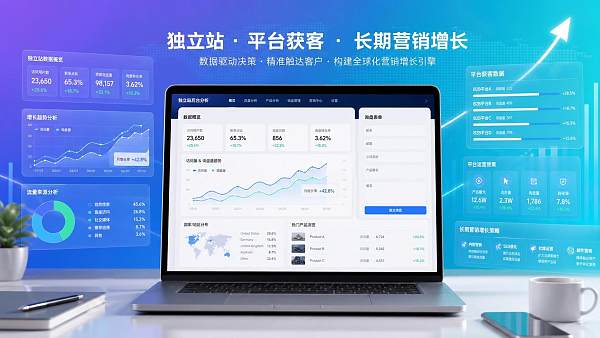
If what your company currently lacks most is sales leads and you hope to reach overseas buyers quickly through a mature platform, Alibaba.com is usually easier to launch. The platform already has buyer awareness and traffic entry points, helping companies new to foreign trade shorten the cold-start period.
However, if your company already has a solid product foundation, wants to reduce its dependence on platform traffic, and aims to build its own brand website, search visibility, and customer data system, investing in an independent foreign trade website is more worthwhile. It is not simply about building a website, but about creating a digital asset capable of generating customers sustainably.
The real concern for many companies is not whether to do it, but which one to do first. From a practical perspective, companies with limited budgets and an urgent need for inquiries can use a platform to gain initial traction; companies with long-term growth goals should plan their independent website as early as possible to avoid having to make up for lost ground later.
The first question companies care about most: which one can generate inquiries faster?
In terms of short-term customer acquisition efficiency, Alibaba.com has a relatively clear advantage. Since the platform itself has already gathered a large number of overseas buyers, companies have the opportunity to gain exposure and inquiries relatively quickly through product publishing, keyword optimization, advertising resources, and platform activities after joining.
The advantage of this model is its short path. Buyers come to the platform with purchasing intent, making their search, price comparison, and inquiry actions more concentrated. For teams that are just beginning to engage in foreign trade and lack overseas promotion experience, platform-based customer acquisition has relatively lower comprehension and execution barriers.
However, fast does not mean stable. Traffic on the platform belongs to the platform, and competition is highly concentrated. Competitors compare prices, rankings, and response speed on the same page, so the quality of inquiries companies receive is often inconsistent, with a considerable proportion coming from customers focused on low-price comparisons.
Inquiry growth for an independent website is usually slower because the early stages require website development, SEO, Google advertising, content operations, and landing pages. Traffic does not appear naturally as it does on a platform. However, once an independent website is operating effectively, inquiry quality is usually more controllable, and it is easier to identify truly suitable target customers.
The second key question: which one provides higher customer quality and conversion rates?
If your company sells standardized products with transparent prices, intense competition, and relatively simple purchasing decisions, Alibaba.com is more suitable. Buyers on the platform are accustomed to quickly comparing suppliers and submitting inquiries directly after confirming specifications and prices.
However, if your company offers customized, technical, or engineering-support products, or if the average order value is high and the sales cycle is long, an independent website often has greater advantages. Such customers do not look only at price; they pay greater attention to factory capabilities, certifications and qualifications, project experience, and delivery capabilities.
An independent website can support a more complete information structure. Companies can systematically present product solutions, application scenarios, successful cases, factory equipment, testing processes, certifications and qualifications, and service capabilities. These contents directly influence the purchasing party’s assessment of your credibility.
In other words, a platform is more like a “shelf,” suitable for rapid comparison and selection; an independent website is more like a “showroom plus sales consultant,” making it more suitable for complex decisions. For B2B companies that need to establish a professional image and industry trust, the conversion value of an independent website is often underestimated.
The third question: which one is more suitable for brand building and long-term accumulation?
This is the core advantage of an independent website. On Alibaba.com, even if a company invests a substantial budget, buyers often remember the platform rather than the company’s brand. Customer behavior, access paths, and communication processes also largely remain within the platform’s rules.
An independent website is different. The website domain name, content, SEO rankings, advertising landing pages, remarketing data, form leads, and user behavior data all belong to the company. As content accumulates and search indexing increases, the website gradually becomes a stable source of brand exposure and customer acquisition.
This is particularly important for manufacturing companies, factories, and cross-border sellers seeking to build overseas brands. As foreign trade competition has developed, many industries now compete not only on supply capabilities, but also on brand trust, professional communication, and long-term visibility in global markets.
Especially as Google search, social media, and AI search increasingly influence purchasing decisions, it is difficult for a company without its own independent website to establish sustained exposure outside platforms. In the long term, this affects brand premiums and limits the ability to expand customer acquisition channels.
The fourth question: how should investment costs and the return cycle be assessed?
Investment in Alibaba.com is usually more concentrated and direct. Companies need to pay onboarding fees, advertising and promotion costs, and certain personnel and operational expenses. Its characteristic is relatively fast results in the early stage, but continued customer acquisition generally requires ongoing payment, and costs rise as competition intensifies.
The investment structure of an independent website is more like “initial development plus ongoing operations,” including website development, multilingual content, SEO optimization, Google advertising, social media content, and data analysis. In the short term, it is more complex than simply joining a platform, but its marginal customer acquisition cost may decrease over the medium and long term.
For managers, the key to assessing return on investment is not simply which option is cheaper, but whether customer acquisition is sustainable. Once platform advertising stops, exposure drops significantly; if an independent website has established its SEO and content systems, it may continue generating inquiries even after the advertising budget is reduced.
Therefore, if a company wants to see leads within three months, a platform is more suitable; if it is pursuing global growth over a period of more than one year, an independent website is more worthwhile. The truly reliable approach is to design a customer acquisition structure that combines short-term conversion with long-term asset building based on cash flow and target timelines.
Which companies are more suitable for Alibaba.com, and which are more suitable for independent foreign trade websites?
If you are just starting in foreign trade, have a small team, lack overseas promotion experience, offer relatively standardized products, and urgently need to obtain your first batch of inquiries, Alibaba.com is more suitable as a starting tool. It can help you validate market demand and product competitiveness more quickly.
If you are a manufacturing factory, original equipment supplier, or customized service provider, or if you already have a certain customer base and want to improve your brand image, expand Google traffic, and accumulate customer data, an independent foreign trade website is generally more suitable as a core channel for long-term operations.
If your products have a high average order value, a long decision-making chain, and require cases and technical explanations to persuade customers, the value of an independent website becomes more evident. The sales of such businesses cannot be completed through platform rankings alone; they require complete content and a trust system for support.
If your budget allows, the more practical choice is often not an either-or decision, but phased combined use. The platform handles early-stage customer acquisition and market testing, while the independent website handles brand engagement, search growth, and customer asset accumulation, resulting in a healthier overall customer acquisition structure.
Why are more and more companies beginning to shift from platforms to independent websites?
The reasons are straightforward. First, platform competition is becoming increasingly intense, and traffic costs continue to rise. Second, buyer decision-making paths are changing. More and more people first learn about suppliers through Google, social media, and even AI tools, rather than comparing them only on a single platform.
Third, companies are placing significantly greater importance on customer assets and control over their brands. In the past, obtaining an inquiry was considered a success in foreign trade; today, global growth is more about building a traceable, optimizable, and reusable marketing system, with the independent website serving as the core carrier of that system.
In addition, an independent website can work together with SEO, Google Ads, Facebook advertising, short-video marketing, and AI search optimization to create a multi-channel customer acquisition loop. Compared with relying on a single platform, this approach is better able to withstand traffic fluctuations and is more suitable for long-term operations.
An AI-driven website development and overseas marketing service platform such as Yiyingbao essentially addresses this issue: it does not merely help companies build a website, but helps them turn the website into overseas customer acquisition infrastructure that can be promoted, indexed, and converted.
How should companies choose so they do not spend their budgets in the wrong places?
The most practical way to assess the situation is to ask yourself four questions first: Are your products standardized? Will your customers conduct detailed price comparisons? Do you need brand endorsement? Is your budget focused on short-term customer acquisition or long-term growth? The answers basically determine the direction.
If you care more about the number of short-term leads, start with a platform; if you care more about customer quality and brand accumulation, prioritize an independent website; if you need both current inquiries and future growth, adopt a combined strategy of “platform customer acquisition + independent website engagement + SEO and advertising amplification.”
It should be emphasized that an independent website is not finished once it has been built. A truly effective foreign trade website must have clear industry positioning, multilingual capabilities, a search-friendly structure, conversion-oriented page design, and ongoing operational capabilities; otherwise, it will be difficult to deliver its intended value.
This is why more and more companies are choosing integrated website development and marketing services. For B2B foreign trade customer acquisition, what truly works has never been a single tool, but the coordination of technology, content, traffic, and conversion capabilities.
Summary: there is no absolutely better channel, only a customer acquisition method that better suits the current stage
Which is better for B2B foreign trade customer acquisition: an independent website or Alibaba.com? In terms of short-term inquiry speed, Alibaba.com is more direct; in terms of brand accumulation, customer assets, and long-term growth, an independent foreign trade website is more worthwhile. The two do not solve exactly the same problems.
For business managers, what truly matters is not choosing channels based on trends, but making decisions according to product characteristics, sales models, budget cycles, and growth objectives. Platforms are suitable for rapid initial traction, independent websites are suitable for building long-term competitiveness, and combined use better meets the practical needs of most companies.
As competition in overseas markets continues to intensify, companies that establish their own global digital marketing presence earlier will have a better chance of reducing their dependence on a single platform and achieving more stable and sustainable foreign trade growth. This is the fundamental reason why more and more companies are beginning to prioritize independent website development.
Related Articles
Related Products
 EasyCamp SaaS Smart Website Marketing SystemE-Yingbao SaaS Smart Website Marketing System: AI-powered, zero-code website building. Rapidly launch multilingual independent e-commerce sites in just 10 minutes. Global server acceleration and AI-driven SEO optimization empower businesses to efficiently connect with global markets. The seamless integration of technology and user-friendly operation makes building e-commerce sites incredibly simple.
 AI+SEM Intelligent Advertising Marketing SystemAI+SEM drives intelligent ad creation, empowering full-funnel precision advertising marketing. The system automatically generates weekly/monthly reports, AI recommends keywords and target countries, monitors core metrics in real-time with intelligent alerts, and enables one-click high-conversion ad solutions to help quickly acquire customers and improve ROI.
 AI+SEO Dual Engine Optimization ServiceEasyWin AI+SEO Dual Engine Optimization System leverages AI-powered keyword mining, content generation, and comprehensive technical optimization to help foreign trade enterprises acquire high-quality organic traffic, significantly improving search rankings and conversion rates.
 AI+SNS Social Media Marketing SystemYingbao AI+SNS Social Media Marketing System - Precision social capture for the social media era. Supports one-click content synchronization across major platforms like Facebook and LinkedIn. AI intelligently rewrites posts for enhanced relevance. 24/7 AI customer service and user profiling analysis empower businesses to efficiently expand into global markets.
 AI+SEO营销解决方案易营宝AI+SEO营销解决方案,通过AI批量写作、智能生成TDK、精准关键词扩词等功能,全面优化网站SEO效果,提升流量与转化率。助力企业构建高效智能网站新生态。
 AI+SEM Advertising Marketing SolutionsAI+SEM Advertising Marketing Solution leverages AI technology to deeply empower SEM ad campaigns. It automatically generates weekly/monthly reports using AI, presenting account data across multiple dimensions for comprehensive insights into campaign performance and trends. The system precisely recommends keywords and target countries, intelligently generates high-conversion ad copy, and enables one-click activation of efficient campaign plans to help businesses rapidly acquire customers. Simultaneously, it monitors core metrics in real time, intelligently identifies abnormal fluctuations, and issues timely alerts to ensure stable, high-return advertising results.
 Domain Name ServicesEasyWin provides professional domain name services, including intelligent queries, one-stop registration, brand protection, and full lifecycle management, helping businesses build a digital brand image.
 EasyOperate B2C Cross-Border E-Commerce Platform & Independent WebsiteEasyStore B2C Cross-border E-commerce Independent Store is an intelligent website building and cross-border e-commerce integrated solution independently developed by EasyStore Information Technology (Beijing) Co., Ltd. The system is specially designed for small and medium-sized as well as large export enterprises, integrating 'website building, operation, marketing, advertising, and conversion' into one, helping enterprises quickly establish cross-border e-commerce independent stores to achieve brand globalization and global sales growth.
The platform supports multiple languages, multiple currencies, and multi-channel marketing, with built-in AI intelligent translation and SEO optimization systems, suitable for mainstream markets such as Southeast Asia, Europe and America, Latin America, and the Middle East, assisting Chinese manufacturing enterprises in efficiently deploying international e-commerce strategies. SSL证书易营宝提供专业SSL安全证书服务,包括单域名和泛域名证书,确保网站数据传输加密、身份验证和完整性保护,助力企业建立安全可信的在线业务环境。









