









- What stages does the cross-border services ecosystem include? How do website building, promotion, payment, and compliance work togetherJun 22, 2026View details
- How will email marketing costs change in 2026Jun 22, 2026View details
- The China-US tariff arrangement has reached a preliminary consensus, and the trade association will be establishedJun 15, 2026View details
- Should overseas brand marketing start with ads or contentJun 21, 2026View details
- What determines B2C cross-border e-commerce website development costs? A breakdown of features, interfaces, and deployment methodsJun 17, 2026View details
- China-Morocco zero-tariff access, a breakthrough in the cost of Moroccan goods exports to ChinaJun 11, 2026View details
What factors affect AI glossary pricing
What Factors Affect the Price of AI Keyword Expansion
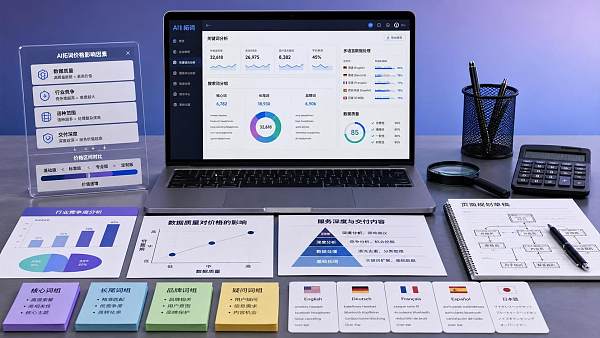
What factors affect the price of AI keyword expansion? When many companies are preparing budgets, the first reaction is often to look at the quotation. But when it comes to the approval stage, what ultimately determines whether it is worth it is often not the unit price, but the capability structure behind the price.
From the perspective of actual procurement, the price of AI keyword expansion is not a fixed number. Different service providers, different delivery methods, and different target markets all lead to significant cost differences. Only by understanding these variables can you avoid “buying cheap and using expensive”.
Especially in website development and integrated marketing scenarios, keyword expansion results directly affect content production, page layout, landing pages, and subsequent conversions. In other words, the essence of AI keyword expansion pricing is to buy growth efficiency, not just to pay for a keyword list.
First, let's be clear: why is there such a big price gap for AI keyword expansion
The solutions on the market range from a few hundred yuan to several thousand yuan or even higher. On the surface, they are all “keyword expansion”, but the actual delivery depth is completely different. Price differences usually come from five core dimensions: data, industry, language, delivery, and ongoing service.
If you only purchase a basic keyword database, the system may only perform simple associations based on public language data. This kind of AI keyword expansion is usually cheaper, but its usefulness is limited. Although there are many words, they may not necessarily guide page optimization, and it is even harder to support lead generation growth.
If the solution includes search intent recognition, competition analysis, long-tail opportunity screening, and page recommendations, the cost naturally rises. Because at that point it is no longer just “generating keywords”, but building a semi-strategic system.
1. Data sources determine the pricing floor
AI keyword expansion is first and foremost affected by data sources. If the data comes only from general language databases, generation is fast and cost is low, but the noise words are often numerous. For foreign trade websites or cross-border stores, such words can easily lead to incorrect judgments.
Higher-priced solutions usually combine search engine trends, industry page samples, competitor performance, and historical ranking factors. The closer the data is to the real search environment, the better the keyword results can support subsequent content and page layout.
Simply put, whether what you buy is “real market signals” directly determines the price of AI keyword expansion.
2. Industry competition determines analysis cost
The difficulty of keyword expansion varies greatly by industry. Industrial equipment, custom manufacturing, cross-border e-commerce, beauty and health, and other sectors all have different keyword competition structures. The more intense the competition, the more data service providers need to clean and screen.
For example, in the B2B corporate website scenario, the same product term may correspond to procurement terms, parameter terms, solution terms, and after-sales terms. Without in-depth categorization, even if many keywords are expanded, it is still hard to turn them into page conversions.
This is also why AI keyword expansion in highly competitive industries is usually more expensive, because what it needs to solve is not volume, but screening quality.
What really widens the cost gap is delivery depth
Many budgets go over because the unit price is high, but because only basic keyword expansion was purchased at the beginning, and then additions were needed continuously. It looks like money was saved, but the total actual cost is higher. A more stable approach is to clarify the delivery boundaries before procurement.
3. Language and market scope directly affect workload
For a single Chinese market, and for multilingual markets such as English, German, French, and Japanese, the price of AI keyword expansion is obviously not the same. The more languages there are, the more complex the localization work, and the higher the cost.
Especially in overseas business, direct translation is often not equal to real search terms. Users in different regions have obvious differences in wording, purchasing habits, and search intent. If service providers can perform localized keyword expansion, the price is usually higher, but the results are also closer to actual traffic.
4. Is the delivery a word list or an executable plan
One thing that is easiest to overlook when purchasing is the delivery format. Low-cost services mostly provide only keyword lists. Mid- to high-priced solutions, by contrast, include clustering, priority levels, competition level, page mapping, and even content recommendations.
If the keyword results can directly support website building and SEO execution, the value will increase significantly. For example, mapping core keywords to the homepage, category pages, product pages, and blog pages allows the team to implement them immediately after receiving them, saving a lot of secondary organization time.
In this kind of scenario, AI keyword expansion may seem more expensive, but after incorporating labor costs, it is actually more cost-effective.
5. Whether ongoing optimization capabilities are included
Keywords are not a one-time asset. Search trends change, competitors adjust, and page rankings fluctuate. If the service is only a one-time delivery, then the value will decay very quickly after the first procurement.
Some more complete solutions combine keyword expansion with content generation, ranking tracking, page optimization recommendations, and so on. For example, SEO optimization is better suited to website projects that require continuous growth.
Such systems can not only expand keywords, but also combine long-tail keyword mining, competition analysis, TDK generation, and multilingual localization, reducing the hidden cost of repeated purchases.
When approving, the focus should not only be on the quotation, but also on the total ownership cost
In procurement decisions, a common misconception is to only compare the first-round quotation. In fact, the price of AI keyword expansion should be viewed in terms of total ownership cost. The so-called total ownership cost includes procurement fees, execution fees, rework fees, and opportunity costs.
If the keywords produced by a low-cost solution cannot be directly used for content production, the team still has to rescreen, rework, and modify pages. This time is also a cost. If you miss the traffic window because of this, the loss will be even greater.
Focus on verifying these 4 items
- Does it provide search intent categorization instead of just word volume?
- Does it support multilingual and target-market localization judgments?
- Does it include page mapping, content direction, or optimization recommendations?
- Does it have continuous monitoring and subsequent update capabilities?
If none of these four are included, then comparing AI keyword expansion prices alone is often not very meaningful. Because after buying it back, you still need to continue making up for tools, manpower, and strategy.
How to judge whether the current quotation is reasonable
To determine whether the price of AI keyword expansion is reasonable, you can work backward from the “input-output ratio” rather than staring only at the numerical value. A more practical way is to see how many pages, how much content, and how many inquiry opportunities the keyword results can ultimately support.
If a solution can support category planning for a cross-border e-commerce independent site, and can also serve the content layout of a B2B corporate website, then the value it brings is not just a one-time keyword purchase, but an infrastructure for subsequent growth.
From recent changes, more and more companies are choosing to put keyword expansion into a unified optimization system. The reason is very realistic: keywords, content, pages, and rankings are inherently connected, and buying them separately is often more expensive.
A simple evaluation standard
- First confirm the keyword objective: is it traffic generation, inquiries, or content layout.
- Then confirm the delivery depth: is it only a word list or an executable strategy.
- Finally estimate the internal execution cost to avoid repeated rework later.
If the service provider can also synchronously provide original article creation, keyword recommendations, expansion, real-time metric monitoring, and recommendation reports, then the price of AI keyword expansion is often more explanatory, because it already covers a more complete growth path.
Spend your budget where it can truly drive growth
Back to the original question, what factors affect the price of AI keyword expansion? The answer is not complicated: data quality, industry competition, language scope, delivery depth, and ongoing service capabilities basically determine the quotation level.
But the more important point is that procurement should not only ask, “How much does this cost?”, but should also ask, “Can this investment reduce trial-and-error, improve efficiency, and support conversion?” Especially in overseas marketing and independent site operations, if the keyword expansion is done well, every subsequent step will be smoother.
For integrated service platforms like 易营宝, which focus on intelligent website building, SEO optimization, advertising, and overseas marketing, the value lies in putting keyword capabilities into a complete business scenario, rather than stopping at a single tool level.
Therefore, when evaluating the price of AI keyword expansion, the most stable approach is not to pursue the lowest quotation, but to prioritize solutions that can turn words into pages, pages into traffic, and traffic into customers. That way, the budget is truly well spent.
Related Articles

Related Products
 EasyCamp SaaS Smart Website Marketing SystemE-Yingbao SaaS Smart Website Marketing System: AI-powered, zero-code website building. Rapidly launch multilingual independent e-commerce sites in just 10 minutes. Global server acceleration and AI-driven SEO optimization empower businesses to efficiently connect with global markets. The seamless integration of technology and user-friendly operation makes building e-commerce sites incredibly simple.
 AI+SEM Intelligent Advertising Marketing SystemAI+SEM drives intelligent ad creation, empowering full-funnel precision advertising marketing. The system automatically generates weekly/monthly reports, AI recommends keywords and target countries, monitors core metrics in real-time with intelligent alerts, and enables one-click high-conversion ad solutions to help quickly acquire customers and improve ROI.
 AI+SEO Dual Engine Optimization ServiceEasyWin AI+SEO Dual Engine Optimization System leverages AI-powered keyword mining, content generation, and comprehensive technical optimization to help foreign trade enterprises acquire high-quality organic traffic, significantly improving search rankings and conversion rates.
 AI+SNS Social Media Marketing SystemYingbao AI+SNS Social Media Marketing System - Precision social capture for the social media era. Supports one-click content synchronization across major platforms like Facebook and LinkedIn. AI intelligently rewrites posts for enhanced relevance. 24/7 AI customer service and user profiling analysis empower businesses to efficiently expand into global markets.
 AI+SEO营销解决方案易营宝AI+SEO营销解决方案,通过AI批量写作、智能生成TDK、精准关键词扩词等功能,全面优化网站SEO效果,提升流量与转化率。助力企业构建高效智能网站新生态。
 AI+SEM Advertising Marketing SolutionsAI+SEM Advertising Marketing Solution leverages AI technology to deeply empower SEM ad campaigns. It automatically generates weekly/monthly reports using AI, presenting account data across multiple dimensions for comprehensive insights into campaign performance and trends. The system precisely recommends keywords and target countries, intelligently generates high-conversion ad copy, and enables one-click activation of efficient campaign plans to help businesses rapidly acquire customers. Simultaneously, it monitors core metrics in real time, intelligently identifies abnormal fluctuations, and issues timely alerts to ensure stable, high-return advertising results.
 Domain Name ServicesEasyWin provides professional domain name services, including intelligent queries, one-stop registration, brand protection, and full lifecycle management, helping businesses build a digital brand image.
 EasyOperate B2C Cross-Border E-Commerce Platform & Independent WebsiteEasyStore B2C Cross-border E-commerce Independent Store is an intelligent website building and cross-border e-commerce integrated solution independently developed by EasyStore Information Technology (Beijing) Co., Ltd. The system is specially designed for small and medium-sized as well as large export enterprises, integrating 'website building, operation, marketing, advertising, and conversion' into one, helping enterprises quickly establish cross-border e-commerce independent stores to achieve brand globalization and global sales growth.
The platform supports multiple languages, multiple currencies, and multi-channel marketing, with built-in AI intelligent translation and SEO optimization systems, suitable for mainstream markets such as Southeast Asia, Europe and America, Latin America, and the Middle East, assisting Chinese manufacturing enterprises in efficiently deploying international e-commerce strategies. SSL证书易营宝提供专业SSL安全证书服务,包括单域名和泛域名证书,确保网站数据传输加密、身份验证和完整性保护,助力企业建立安全可信的在线业务环境。









