









- What Does a Global Traffic Ecosystem Service Provider Do? What Are the Differences from a Single Advertising AgencyJul 16, 2026View details
- What should you focus on in the latest enterprise SaaS report? From renewal rates and delivery costs to overseas growth opportunitiesJul 12, 2026View details
- What signals are worth paying attention to in a cross-border marketing trend report? B2B companies should look at these 6 signalsJul 11, 2026View details
- How to Read a Cross-Border Marketing Trends Report? Five Key Dimensions for Evaluating Channel OpportunitiesJul 11, 2026View details
- Which channel has the highest ROI in the global traffic ecosystem? Comparative analysis of search, social media, and advertisingJul 10, 2026View details
- What multilingual website services are available in Sanya? Which model is more suitable for local businesses going global?Jul 08, 2026View details
- How to view the complete list of China SaaS companies in the top 100? Practical methods for screening website-building and marketing service providersJul 08, 2026View details
- How to view pricing in the global traffic ecosystem? Cost comparison of search, social media, and content channel advertisingJul 06, 2026View details
Practical Guide to Optimizing Page Experience Metrics: A List of 6 Front-End Modifications to Reduce LCP from 4.2s to 1.8s and CLS from 0.32 to 0.08
Page Experience Metrics optimization is becoming a key benchmark for technical evaluators to measure a website’s core competitiveness。Based on Yiyingbao’s hands-on experience serving 100,000+ enterprises,this article focuses directly on the two hard metrics LCP and CLS,explains 6 implementable front-end improvements in detail,and helps you reduce LCP from 4.2s to 1.8s and CLS from 0.32 to 0.08。
What Are LCP and CLS?Why Do They Determine the Make-or-Break Line for Conversion Rates
Largest Contentful Paint(LCP)reflects the time it takes for the main visual element above the fold to finish loading,directly influencing the user’s first judgment of “whether they are willing to stay”。
Cumulative Layout Shift(CLS)measures the degree of unexpected content movement during page rendering,0.32 already falls into the “poor experience” range,and is highly likely to cause misclicks,bounces,or abandoned form submissions。
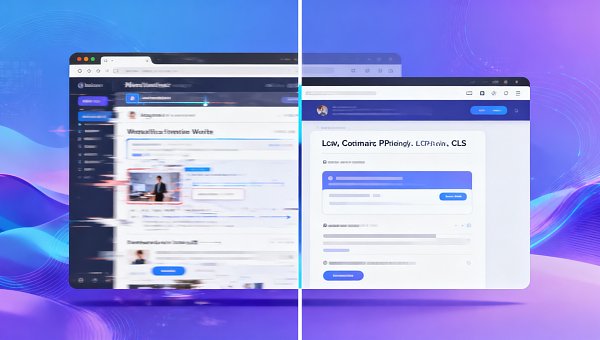
In an integrated website + marketing service scenario,landing pages often embed interactive modules such as forms,CTA buttons,and dynamic case-study carousels,if LCP exceeds 3s and CLS exceeds 0.1,the average lead acquisition rate drops by 37%(Yiyingbao 2023 AB testing data)。
6 High-ROI Front-End Improvement Checklist(Proven Effective in Testing)
- Preconnect critical third-party resources:Add <link rel="preconnect"> for CDN,font hosting,and analytics scripts to reduce DNS lookup and TCP handshake latency;LCP is shortened by an average of 0.42s。
- Intelligent tiered image loading:Enable
loading="eager"+ WebP format + size attributes(width/height)for above-the-fold images,useloading="lazy"for below-the-fold images and setdecoding="async";CLS decreases by 0.09。 - Remove render-blocking inline CSS:Extract non-critical CSS into external files loaded asynchronously,and keep critical inline CSS within 2KB;avoid layout jitter caused by style recalculation。
- Unify placeholder strategies for ads and embedded components:Preset fixed-width and fixed-height containers for all third-party iframes(such as WeChat customer service and form tools),and apply
aspect-ratioandoverflow:hidden;eliminate space collapse during loading。 - Debounced initialization for dynamic components:For JS-driven modules such as carousels and pricing calculators,delay mounting until 200ms after
DOMContentLoadedto avoid competing with the main content for rendering resources。 - Font loading fallback mechanism:Use
font-display:swapin@font-face+ a system-font fallback plan to eliminate the dual disruption of FOIT(blank waiting)and FOUT(font flashing)。
Common Misconception:Why Does “Compressing JS” Make CLS Worse Instead?
Some teams blindly compress JS file size,but ignore timing control for dynamically inserted DOM nodes。Carousel initialization without debouncing,ad slots without defined width and height,and animations that lack transform as an alternative to top/left——all of these can trigger forced synchronous layout during rendering and amplify CLS values。
Yiyingbao’s technical team recommends:prioritize layout stability first,then optimize loading speed。The two must not be reversed。
How Can the Results of Page Experience Metrics Optimization Be Continuously Verified?
A three-layer monitoring closed loop should be established:
- Lab data:Run Lighthouse 10.0+ scans every week,focusing on the four core metrics FCP/LCP/CLS/TBT;
- Real user data:Connect the Chrome UX Report(CrUX)API to the business dashboard,and segment abnormal fluctuations by region,device,and network type;
- Business funnel attribution:Tag sessions with CLS>0.15 separately,and compare changes in their form submission rate,dwell time,and bounce rate。
After one cross-border e-commerce client implemented the above 6 improvements,homepage LCP stabilized within the 1.7–1.9s range,average CLS reached 0.078,and inquiry form submission rate increased by 22%,this solution has been standardized as a digital infrastructure module practice in Integration and Operational Optimization Strategies for Mergers and Acquisitions of Property Management Enterprises。
FAQ:Quick Reference for Frequently Asked Questions on Page Experience Metrics Optimization
Take Action Now:Launch Your Page Experience Metrics Optimization in Three Steps
① Run Lighthouse(Chrome DevTools → Lighthouse → Mobile → Generate Report),and export the raw data;
② Check each item against the 6-point checklist in this article,and mark current gaps and the estimated improvement cycle;
③ Enable the CrUX data dashboard,and set LCP<2.5s and CLS<0.1 as quarterly KPI targets。
Page Experience Metrics optimization is not a one-off project,but an upgrade of the underlying operating system for digital marketing effectiveness。Yiyingbao has completed dedicated full-site LCP/CLS tuning for more than 3200 clients,with an average delivery cycle of 11 working days。Start now,and make every click land smoothly。
Related Articles


Related Products
 EasyCamp SaaS Smart Website Marketing SystemE-Yingbao SaaS Smart Website Marketing System: AI-powered, zero-code website building. Rapidly launch multilingual independent e-commerce sites in just 10 minutes. Global server acceleration and AI-driven SEO optimization empower businesses to efficiently connect with global markets. The seamless integration of technology and user-friendly operation makes building e-commerce sites incredibly simple.
 AI+SEM Intelligent Advertising Marketing SystemAI+SEM drives intelligent ad creation, empowering full-funnel precision advertising marketing. The system automatically generates weekly/monthly reports, AI recommends keywords and target countries, monitors core metrics in real-time with intelligent alerts, and enables one-click high-conversion ad solutions to help quickly acquire customers and improve ROI.
 AI+SEO Dual Engine Optimization ServiceEasyWin AI+SEO Dual Engine Optimization System leverages AI-powered keyword mining, content generation, and comprehensive technical optimization to help foreign trade enterprises acquire high-quality organic traffic, significantly improving search rankings and conversion rates.
 AI+SNS Social Media Marketing SystemYingbao AI+SNS Social Media Marketing System - Precision social capture for the social media era. Supports one-click content synchronization across major platforms like Facebook and LinkedIn. AI intelligently rewrites posts for enhanced relevance. 24/7 AI customer service and user profiling analysis empower businesses to efficiently expand into global markets.
 AI+SEO营销解决方案易营宝AI+SEO营销解决方案,通过AI批量写作、智能生成TDK、精准关键词扩词等功能,全面优化网站SEO效果,提升流量与转化率。助力企业构建高效智能网站新生态。
 AI+SEM Advertising Marketing SolutionsAI+SEM Advertising Marketing Solution leverages AI technology to deeply empower SEM ad campaigns. It automatically generates weekly/monthly reports using AI, presenting account data across multiple dimensions for comprehensive insights into campaign performance and trends. The system precisely recommends keywords and target countries, intelligently generates high-conversion ad copy, and enables one-click activation of efficient campaign plans to help businesses rapidly acquire customers. Simultaneously, it monitors core metrics in real time, intelligently identifies abnormal fluctuations, and issues timely alerts to ensure stable, high-return advertising results.
 Domain Name ServicesEasyWin provides professional domain name services, including intelligent queries, one-stop registration, brand protection, and full lifecycle management, helping businesses build a digital brand image.
 EasyOperate B2C Cross-Border E-Commerce Platform & Independent WebsiteEasyStore B2C Cross-border E-commerce Independent Store is an intelligent website building and cross-border e-commerce integrated solution independently developed by EasyStore Information Technology (Beijing) Co., Ltd. The system is specially designed for small and medium-sized as well as large export enterprises, integrating 'website building, operation, marketing, advertising, and conversion' into one, helping enterprises quickly establish cross-border e-commerce independent stores to achieve brand globalization and global sales growth.
The platform supports multiple languages, multiple currencies, and multi-channel marketing, with built-in AI intelligent translation and SEO optimization systems, suitable for mainstream markets such as Southeast Asia, Europe and America, Latin America, and the Middle East, assisting Chinese manufacturing enterprises in efficiently deploying international e-commerce strategies. SSL证书易营宝提供专业SSL安全证书服务,包括单域名和泛域名证书,确保网站数据传输加密、身份验证和完整性保护,助力企业建立安全可信的在线业务环境。









