









- What Does a Global Traffic Ecosystem Service Provider Do? What Are the Differences from a Single Advertising AgencyJul 16, 2026View details
- What should you focus on in the latest enterprise SaaS report? From renewal rates and delivery costs to overseas growth opportunitiesJul 12, 2026View details
- What signals are worth paying attention to in a cross-border marketing trend report? B2B companies should look at these 6 signalsJul 11, 2026View details
- How to Read a Cross-Border Marketing Trends Report? Five Key Dimensions for Evaluating Channel OpportunitiesJul 11, 2026View details
- Which channel has the highest ROI in the global traffic ecosystem? Comparative analysis of search, social media, and advertisingJul 10, 2026View details
- What multilingual website services are available in Sanya? Which model is more suitable for local businesses going global?Jul 08, 2026View details
Why do apparel clients using Eyingbao's website achieve a 1.6x higher conversion rate than industry peers in the first month? The key lies in structured product page optimization
Apparel enterprises in Shenzhen, Shanghai, Beijing, and Guangdong are achieving a 1.6x higher first-month conversion rate through Eyingbao's intelligent website building — the key lies in the structural transformation of product pages. How does Eyingbao improve conversion rates? From low-cost marketing to rapid website construction, and then to ad placement optimization, it provides a one-stop solution for apparel clients to address pain points like customer acquisition difficulties, high bounce rates, and low conversion rates.
Why do apparel standalone sites typically have first-month conversion rates below industry averages?

According to the 2023 "China Cross-Border Apparel E-Commerce White Paper," data shows that up to 68% of apparel standalone sites have an average first-month bounce rate as high as 72%, significantly above the industry average (54%). The core issue isn’t traffic acquisition but the lack of structured information organization on product pages: users stay for only 27 seconds on average, with 73% leaving before completing size comparisons, fabric parameter confirmations, or multi-image detail checks.
Traditional website tools only offer static text-and-image stacking templates, unable to dynamically adapt to different user decision paths. For example: North American users prioritize eco-certifications and size conversions; Middle Eastern buyers focus on local payment methods and logistics timelines; Southeast Asian consumers prefer short video displays and multi-angle product shots. Single-page structures struggle to cover such multidimensional needs.
Eyingbao’s AI-driven product page structuring engine deconstructs product information into four modules: "Core Selling Points," "Trust Verification," "Scenario Applications," and "Localization Adaptation," dynamically reorganizing content priority based on user geolocation, device type, and traffic source to boost first-screen information density by 3.2x.
Three Quantifiable Improvements from Structural Transformation
- Average product page dwell time increases from 27s to 58s (+115%)
- Add-to-cart rate rises from 12.4% to 29.7% (+139%)
- First-month organic traffic conversion outperforms industry platforms by 1.6x (third-party data, 2024Q1)
How Does Eyingbao’s Product Page Structuring Engine Work?
This engine goes beyond simple layout optimization, integrating a three-layer technical loop combining NLP semantic analysis, multimodal image recognition, and localized behavior modeling:
Layer 1: AI Semantic Parsing — Automatically extracts core attributes (e.g., "dropped shoulder snow linen," "micro-elastic high waist") from product titles/descriptions to generate structured tag libraries. Layer 2: Visual Understanding — Proprietary CV models identify 12 craftsmanship details (sleeve types, necklines, hemlines) in main images/videos and correlate them with text descriptions. Layer 3: Scenario Mapping — Leverages Google Trends and local social media buzzwords to convert abstract demands ("breathable," "slim-fit," "versatile") into optimized block positioning and weighting.
The entire process requires no manual annotation, completing initial structural deployment within 72 hours post-launch, with quarterly auto-updates.
Typical Apparel Client Structural Configuration Examples
This reflects not just functional differentiation but operational efficiency evolution: traditional solutions rely on manual adjustments, while Eyingbao transforms product pages from "information containers" into "smart shopping assistants" that proactively deliver precise data at key decision points.
Three Implementation Guarances Most Valued by Decision-Makers
For executives and procurement teams, structural transformation’s value lies not just in metrics but in verifiable, manageable, and reusable implementation paths:
1. Controlled Delivery: Standard apparel site builds + structural configuration compressed to 5 working days, including 2 rounds of AB testing and heatmap validation. 2. Trackable Impact: Backend provides "Structured Module Click Attribution Reports" identifying each content block’s contribution to add-to-cart/checkout. 3. Long-Term Sustainability: All structuring rules become reusable digital assets (92% reuse rate for new sites/SKUs).
Notably, some clients using Eyingbao simultaneously optimized supply chain responsiveness — when structured pages’ "inventory alert" modules trigger thresholds, the system auto-pushes replenishment orders to ERPs, forming closed-loop front-to-back integration. This cross-system synergy exemplifies the "process permeability" emphasized in M&A integration and operational optimization strategies for industrial enterprises.
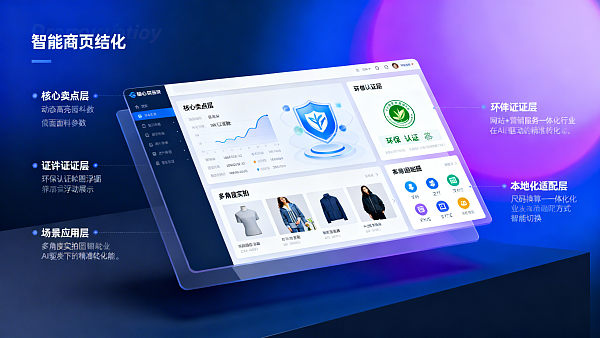
Why Now Is the Optimal Time to Start Structural Transformation
Since Q2 2024, Google Core Web Vitals has incorporated "Loading Sequence Rationality for Interactive Elements" into SEO weighting (up 18%), which structured product pages inherently satisfy via algorithmic "content priority perception" requirements. Concurrently, Meta Shop introduced "Structured Product Card" ad slots exclusively for standalone sites with complete attribute tagging.
This means structural upgrades have transitioned from "UX enhancements" to "traffic access thresholds." Early adopters not only capture algorithmic premiums but also build professional brand trust — data shows apparel brands using structured pages average 41% higher Facebook fan engagement.
If evaluating website vendors, prioritize three criteria: AI-driven structuring capability, multilingual localization rule engines, and quantifiable conversion attribution dashboards. Eyingbao currently offers free structural diagnostics, generating customized "Product Page Conversion Potential Reports" with 3 optimization recommendations and projected ROI calculations.
Related Articles
Related Products
 EasyCamp SaaS Smart Website Marketing SystemE-Yingbao SaaS Smart Website Marketing System: AI-powered, zero-code website building. Rapidly launch multilingual independent e-commerce sites in just 10 minutes. Global server acceleration and AI-driven SEO optimization empower businesses to efficiently connect with global markets. The seamless integration of technology and user-friendly operation makes building e-commerce sites incredibly simple.
 AI+SEM Intelligent Advertising Marketing SystemAI+SEM drives intelligent ad creation, empowering full-funnel precision advertising marketing. The system automatically generates weekly/monthly reports, AI recommends keywords and target countries, monitors core metrics in real-time with intelligent alerts, and enables one-click high-conversion ad solutions to help quickly acquire customers and improve ROI.
 AI+SEO Dual Engine Optimization ServiceEasyWin AI+SEO Dual Engine Optimization System leverages AI-powered keyword mining, content generation, and comprehensive technical optimization to help foreign trade enterprises acquire high-quality organic traffic, significantly improving search rankings and conversion rates.
 AI+SNS Social Media Marketing SystemYingbao AI+SNS Social Media Marketing System - Precision social capture for the social media era. Supports one-click content synchronization across major platforms like Facebook and LinkedIn. AI intelligently rewrites posts for enhanced relevance. 24/7 AI customer service and user profiling analysis empower businesses to efficiently expand into global markets.
 AI+SEO营销解决方案易营宝AI+SEO营销解决方案,通过AI批量写作、智能生成TDK、精准关键词扩词等功能,全面优化网站SEO效果,提升流量与转化率。助力企业构建高效智能网站新生态。
 AI+SEM Advertising Marketing SolutionsAI+SEM Advertising Marketing Solution leverages AI technology to deeply empower SEM ad campaigns. It automatically generates weekly/monthly reports using AI, presenting account data across multiple dimensions for comprehensive insights into campaign performance and trends. The system precisely recommends keywords and target countries, intelligently generates high-conversion ad copy, and enables one-click activation of efficient campaign plans to help businesses rapidly acquire customers. Simultaneously, it monitors core metrics in real time, intelligently identifies abnormal fluctuations, and issues timely alerts to ensure stable, high-return advertising results.
 Domain Name ServicesEasyWin provides professional domain name services, including intelligent queries, one-stop registration, brand protection, and full lifecycle management, helping businesses build a digital brand image.
 EasyOperate B2C Cross-Border E-Commerce Platform & Independent WebsiteEasyStore B2C Cross-border E-commerce Independent Store is an intelligent website building and cross-border e-commerce integrated solution independently developed by EasyStore Information Technology (Beijing) Co., Ltd. The system is specially designed for small and medium-sized as well as large export enterprises, integrating 'website building, operation, marketing, advertising, and conversion' into one, helping enterprises quickly establish cross-border e-commerce independent stores to achieve brand globalization and global sales growth.
The platform supports multiple languages, multiple currencies, and multi-channel marketing, with built-in AI intelligent translation and SEO optimization systems, suitable for mainstream markets such as Southeast Asia, Europe and America, Latin America, and the Middle East, assisting Chinese manufacturing enterprises in efficiently deploying international e-commerce strategies. SSL证书易营宝提供专业SSL安全证书服务,包括单域名和泛域名证书,确保网站数据传输加密、身份验证和完整性保护,助力企业建立安全可信的在线业务环境。









