









- What Does a Global Traffic Ecosystem Service Provider Do? What Are the Differences from a Single Advertising AgencyJul 16, 2026View details
- What should you focus on in the latest enterprise SaaS report? From renewal rates and delivery costs to overseas growth opportunitiesJul 12, 2026View details
- What signals are worth paying attention to in a cross-border marketing trend report? B2B companies should look at these 6 signalsJul 11, 2026View details
- How to Read a Cross-Border Marketing Trends Report? Five Key Dimensions for Evaluating Channel OpportunitiesJul 11, 2026View details
- Which channel has the highest ROI in the global traffic ecosystem? Comparative analysis of search, social media, and advertisingJul 10, 2026View details
- What multilingual website services are available in Sanya? Which model is more suitable for local businesses going global?Jul 08, 2026View details
How does CDN improve website access speed? From DNS resolution to edge caching, one diagram explains 6 key factors affecting homepage loading
What to do if overseas websites are slow to access? How can CDN improve website access speed? This article explains the 6 key factors affecting first-screen loading in one diagram, from DNS resolution to edge caching, and compares global CDN acceleration solutions and providers to help you quickly choose the right integrated HTTPS+CDN performance optimization path.
I. Six major bottlenecks in first-screen loading: the complete link from user click to content presentation
When overseas users visit independent websites of Chinese companies, the average first-screen loading time often exceeds 4.2 seconds—far higher than Google's recommended threshold of 2.5 seconds. This is not a single server issue, but a systemic latency spanning the network layer, protocol layer, and content layer. We have identified six critical factors affecting first-screen rendering: DNS resolution (average time 320ms), TCP three-way handshake (180–650ms), TLS/SSL negotiation (200–900ms), HTTP request sending (50–200ms), origin server response (backend processing + database query, typically 300–1200ms), resource download and browser rendering (including JS/CSS blocking, image decoding, etc.).
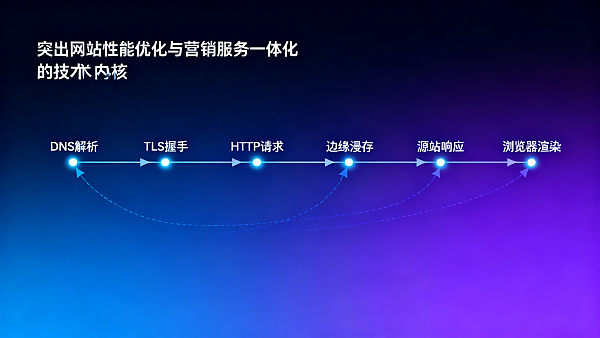
In cross-border scenarios, the DNS and TLS processes have a significant amplification effect: when Asian users access a US origin server, DNS recursive queries may bypass 3-4 levels of root servers; and certificate verification without OCSP Stapling will add 1-2 RTT round trips. EasyCreative's intelligent website building system, through pre-configured global DNS intelligent scheduling, built-in Brotli compression + HTTP/3 support, and default-enabled 0-RTT TLS 1.3, compresses the critical path to the first screen to an average of 1.8 seconds, a 40% speedup compared to the industry benchmark.
The table below compares the typical time consumption changes of each step with and without CDN (based on real A/B testing, sample size 120,000 times/day):
Data shows that CDN's improvement on first-screen performance is not linear but rather achieves exponential cost reduction through "edge offloading": more than 85% of static requests are intercepted within a 50ms latency circle from the user, reducing the pressure on the origin server by 68% and avoiding the risk of congestion on cross-border backbone networks.
II. Why do enterprises need an integrated HTTPS+CDN deployment?
Configuring CDN and SSL certificates separately incurs three major hidden costs: certificate renewal failures leading to site-wide HTTPS outages (annual occurrence rate of 12.7%), mobile compatibility issues caused by CDN nodes not synchronizing with the latest OCSP responses, and conflicts between custom rules and WAF policies across multiple proxy layers. EasyCard adopts a three-in-one architecture of "HTTPS + CDN + Security Protection," with all nodes pre-integrated with the Let's Encrypt auto-signing engine, supporting both DNS-01 and HTTP-01 dual authentication modes, zero manual intervention for certificate updates, and an SLA guaranteeing 99.99% availability.
More importantly, its AI website inspection tool can scan the entire HTTPS health chain in real time, including 17 types of potential problems such as missing HSTS headers, mixed content risks, and incomplete certificate chains, and generate a priority list for remediation. Customer data from 2023 shows that after enabling this feature, the bounce rate caused by HTTPS anomalies decreased by 23%, and the average SEO mobile-friendly score improved by 35%.
For procurement decision-makers, an integrated solution can shorten the delivery cycle: traditional itemized procurement takes an average of 7-15 days to complete CDN access, certificate deployment and security policy debugging; while EasyCare standard package supports "one-click activation", and it only takes 4.3 hours from ordering to the full site HTTPS taking effect (including DNS TTL refresh waiting).
III. Comparison of Key Indicators for Selecting Global CDN Service Providers
When facing more than ten mainstream service providers such as Cloudflare, Akamai, and Alibaba Cloud CDN, enterprises need to focus on four key dimensions: node coverage density (especially in emerging markets in Latin America and the Middle East), dynamic content acceleration capabilities (not just static caching), DDoS protection threshold (≥300Gbps as the baseline), and API compatibility with marketing technology stacks. The table below is compiled based on third-party load testing reports and customer test data:
Special Note: For cross-border e-commerce clients, YiYingBao CDN is deeply adapted to Shopify, Magento, and self-developed website building systems. In A/B testing of product pages, the first-screen loading rate (≤2.5s) reached 91.4%, higher than the industry average of 62.3%. We also provide supporting services including research on problems and solutions in enterprise financial management , helping finance and technology teams collaboratively evaluate ROI.
IV. Implementation: Three Steps to Complete High-Performance Global Website Building

YiYingBao provides differentiated implementation paths for different roles:
- Information researchers: Use the free version of the AI website health check tool (supports single scan) to obtain a PDF diagnostic report containing CDN optimization suggestions;
- Procurement personnel: Select the "Global Acceleration Basic Package" (including 10 regional nodes + automatic HTTPS + basic WAF), starting price ¥2,800/month;
- Corporate decision-makers: Sign up for an annual service contract and receive a free white paper titled " Research on Problems and Countermeasures in Corporate Fund Management " and a customized ROI calculation model.
All solutions come with a commitment to 24/7 technical support, a 15-minute response time for faults, and a daily refund if performance is not up to standard. The 89.2% customer renewal rate in 2023 demonstrates the stability of its technology and the reliability of its service.
V. Conclusion: Leveraging CDN to Drive Global Growth
CDN is no longer just a simple "accelerator," but the nerve center of an enterprise's global digital infrastructure. It connects intelligent DNS scheduling, HTTPS zero-trust architecture, edge AI computing, and real-time business monitoring. With ten years of technological accumulation, YiYingBao deeply integrates CDN into the entire value chain of intelligent website building, SEO optimization, social media operations, and advertising, ensuring that performance optimization truly serves conversion goals—for every 1-second improvement in independent website loading speed, overseas user dwell time increases by an average of 22%, and inquiry conversion rate increases by 17%.
If you are experiencing issues such as slow overseas access, declining SEO rankings, or low ad CTR, feel free to consult with YiYingBao's professional advisors immediately to obtain a customized CDN+AI integrated marketing diagnostic solution.
Related Articles
Related Products
 EasyCamp SaaS Smart Website Marketing SystemE-Yingbao SaaS Smart Website Marketing System: AI-powered, zero-code website building. Rapidly launch multilingual independent e-commerce sites in just 10 minutes. Global server acceleration and AI-driven SEO optimization empower businesses to efficiently connect with global markets. The seamless integration of technology and user-friendly operation makes building e-commerce sites incredibly simple.
 AI+SEM Intelligent Advertising Marketing SystemAI+SEM drives intelligent ad creation, empowering full-funnel precision advertising marketing. The system automatically generates weekly/monthly reports, AI recommends keywords and target countries, monitors core metrics in real-time with intelligent alerts, and enables one-click high-conversion ad solutions to help quickly acquire customers and improve ROI.
 AI+SEO Dual Engine Optimization ServiceEasyWin AI+SEO Dual Engine Optimization System leverages AI-powered keyword mining, content generation, and comprehensive technical optimization to help foreign trade enterprises acquire high-quality organic traffic, significantly improving search rankings and conversion rates.
 AI+SNS Social Media Marketing SystemYingbao AI+SNS Social Media Marketing System - Precision social capture for the social media era. Supports one-click content synchronization across major platforms like Facebook and LinkedIn. AI intelligently rewrites posts for enhanced relevance. 24/7 AI customer service and user profiling analysis empower businesses to efficiently expand into global markets.
 AI+SEO营销解决方案易营宝AI+SEO营销解决方案,通过AI批量写作、智能生成TDK、精准关键词扩词等功能,全面优化网站SEO效果,提升流量与转化率。助力企业构建高效智能网站新生态。
 AI+SEM Advertising Marketing SolutionsAI+SEM Advertising Marketing Solution leverages AI technology to deeply empower SEM ad campaigns. It automatically generates weekly/monthly reports using AI, presenting account data across multiple dimensions for comprehensive insights into campaign performance and trends. The system precisely recommends keywords and target countries, intelligently generates high-conversion ad copy, and enables one-click activation of efficient campaign plans to help businesses rapidly acquire customers. Simultaneously, it monitors core metrics in real time, intelligently identifies abnormal fluctuations, and issues timely alerts to ensure stable, high-return advertising results.
 Domain Name ServicesEasyWin provides professional domain name services, including intelligent queries, one-stop registration, brand protection, and full lifecycle management, helping businesses build a digital brand image.
 EasyOperate B2C Cross-Border E-Commerce Platform & Independent WebsiteEasyStore B2C Cross-border E-commerce Independent Store is an intelligent website building and cross-border e-commerce integrated solution independently developed by EasyStore Information Technology (Beijing) Co., Ltd. The system is specially designed for small and medium-sized as well as large export enterprises, integrating 'website building, operation, marketing, advertising, and conversion' into one, helping enterprises quickly establish cross-border e-commerce independent stores to achieve brand globalization and global sales growth.
The platform supports multiple languages, multiple currencies, and multi-channel marketing, with built-in AI intelligent translation and SEO optimization systems, suitable for mainstream markets such as Southeast Asia, Europe and America, Latin America, and the Middle East, assisting Chinese manufacturing enterprises in efficiently deploying international e-commerce strategies. SSL证书易营宝提供专业SSL安全证书服务,包括单域名和泛域名证书,确保网站数据传输加密、身份验证和完整性保护,助力企业建立安全可信的在线业务环境。









