









- Is Brand Globalization Marketing Consulting Worth Buying? At What Stage Should Companies Bring It InJul 01, 2026View details
- Cross-Border Marketing Trend Research: Why More and More Companies Are Starting to Deploy AI Search and GEO OptimizationJun 30, 2026View details
- Cross-Border Marketing Trend Research: How Independent Sites, AI Content, and Short-Video Customer Acquisition Are ChangingJun 30, 2026View details
- How Can a Brand Updates Page Be Made More SEO-Friendly? Analysis of Update Frequency, Content Structure, and Internal Linking StrategyJun 28, 2026View details
- What stages does the cross-border services ecosystem include? How do website building, promotion, payment, and compliance work togetherJun 22, 2026View details
- How will email marketing costs change in 2026Jun 22, 2026View details
- The China-US tariff arrangement has reached a preliminary consensus, and the trade association will be establishedJun 15, 2026View details
- Should overseas brand marketing start with ads or contentJun 21, 2026View details
How to Use an AI Writing Assistant for Daily Content Updates
After-sales maintenance work cannot be separated from continuous updates. Website announcements, service descriptions, frequently asked questions, and email replies all require content to be accurate, consistent, and timely. For integrated website and marketing service businesses, update speed also directly affects search performance, customer experience, and brand trust. With the help of an AI writing assistant, daily content production can be completed more efficiently while reducing repetitive work, allowing the team to focus more energy on issue assessment and service optimization.
The fundamental role and usage boundaries of an AI writing assistant
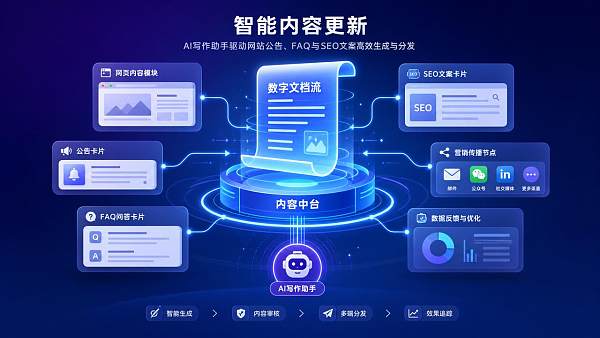
An AI writing assistant is essentially a tool used to generate, rewrite, organize, and optimize text. It is suitable for handling content tasks that are highly standardized, updated frequently, and require stable expression.
In website operations, an AI writing assistant is often used for drafting announcements, updating page copy, preparing draft responses to questions, organizing event descriptions, and expanding knowledge bases. For marketing service teams, it can also assist in generating SEO content frameworks, social media short copy, and ad testing copy.
However, it should be noted that an AI writing assistant is not the same as fully automated publishing. When it comes to price commitments, service terms, causes of technical failures, and compliance statements, manual verification is still required. The correct approach is not to “hand it over to the tool,” but to “let the tool complete the first draft, and then use the process to check it.”
Content update pressure in website and marketing service scenarios
In the integrated website + marketing service industry, content updates are not isolated tasks, but multi-channel coordination. A single service change often simultaneously affects website pages, landing pages, customer service messaging, email notifications, and social media descriptions.
Taking the digital marketing service field where EasyRank Information Technology (Beijing) Co., Ltd. operates as an example, smart website building, SEO optimization, social media marketing, and advertising placement are interconnected, and any update in one link requires the text to keep up quickly.
- There are many service items, making inconsistencies in messaging easy to occur.
- Updates are frequent, and writing item by item manually is obviously time-consuming.
- SEO pages need continuous supplementation with new content.
- Customer inquiry volume fluctuates greatly, and reply templates need to be adjusted at any time.
Therefore, the value of an AI writing assistant lies not only in “writing fast,” but also in helping teams establish unified expression standards, reduce content gaps, and allow information updates to serve website operations and marketing conversion more steadily.
The practical business value brought by an AI writing assistant
After integrating an AI writing assistant into the daily update workflow, the most obvious changes are usually reflected in three aspects: efficiency, standardization, and search friendliness.
If the content team also needs to take care of updating in-depth articles, an AI writing assistant can first generate an outline, and then human editors can add professional judgment. For example, for some industry knowledge manuscripts, you can refer to the organizational approach of topics like The practical difficulties and countermeasures for fintech in promoting innovative enterprise development, first build the structure, and then refine the viewpoints and cases.
Typical content scenarios suitable for prioritizing the use of an AI writing assistant
Not all content needs to be fully integrated at once. A more prudent approach is to start with tasks that are high-frequency, standardized, and highly repetitive.
1. Website announcements and service notifications
Such as maintenance announcements, feature upgrade reminders, holiday arrangements, and service change explanations. An AI writing assistant can quickly generate versions of different lengths based on fixed fields, adapting to the website homepage, help center, and email notifications.
2. FAQ and knowledge base updates
After-sales records often contain a large number of reusable questions. Organize high-frequency inquiries into a Q&A list, then let the AI writing assistant generate standard answers, so the FAQ page can be continuously enriched and the user self-service search experience improved.
3. Customer replies and internal messaging
When dealing with issues such as schedule delays, performance explanations, and permission clarifications, an AI writing assistant can first produce polite, clear, and well-structured reply drafts, and then staff can add specific details, reducing the time spent organizing language on the spot.
4. SEO content updates
An AI writing assistant can generate title suggestions, paragraph structures, long-tail keyword expansions, and summary content around keywords. For topics such as “how to use an AI writing assistant for daily content updates,” it can also help the website continuously cover search intent.
Workflow methods to make an AI writing assistant truly useful
Many teams have used an AI writing assistant but still feel the output is unstable. The problem usually lies not in the tool, but in the workflow design. To make content more usable, you can start with the following steps.
- First define the scenario. Clarify whether it is an announcement, FAQ, page copy, or customer reply.
- Then provide the fields. Including time, service name, cause of the issue, handling method, and contact information.
- Unify the tone. Set standards for formal, concise, friendly, or reassuring expression.
- Add constraints. Require avoidance of exaggerated promises and unconfirmed information.
- Finally review it. Business personnel should check accuracy, timeliness, and compliance.
In this process, an AI writing assistant is not just a writing tool, but can also become an executor of content standardization. Especially when website content needs to be maintained by multiple people, unified prompt templates are more important than simply pursuing literary polish.
Several issues to pay attention to when using an AI writing assistant
First, avoid copying directly. If content generated by an AI writing assistant is not verified, it can easily become generalized and fail to match the real business.
Second, avoid keyword stuffing. When doing SEO, an AI writing assistant should serve the reading experience rather than only pursuing keyword frequency, otherwise it will affect page quality evaluation.
Third, pay attention to data security. When customer data, account information, advertising budgets, and unpublished strategies are involved, the input content should be desensitized first.
Fourth, retain human experience. Complex complaints, public opinion responses, and explanations of major failures still require people familiar with the business to set the tone. An AI writing assistant is suitable for assistance, not for replacing judgment.
If you need to expand your ideas for in-depth content updates, you can also use structured topics like The practical difficulties and countermeasures for fintech in promoting innovative enterprise development as reference objects, learn from their approach to breaking down problems, and then transfer that method to website service content.
Implementation suggestions for daily updates
To truly integrate an AI writing assistant into work, you can first build a small content library. The content library includes common announcement templates, question categories, brand tone guidelines, sensitive word restrictions, and historically excellent replies.
Then prepare fixed prompts for different tasks. For example, “Please generate a website maintenance announcement based on the following fields” and “Please rewrite the following processing result into a customer-readable version”. This can make the AI writing assistant output more stable.
For website operations and marketing service teams, it is more advisable to integrate an AI writing assistant into a weekly update mechanism. Organize high-frequency inquiries, page changes, and search keyword trends each week, then generate content to be published in a unified way, and update efficiency will improve significantly.
From the perspective of practical execution, an AI writing assistant is best suited to first solve these three problems: “writing slowly, writing inconsistently, and inconsistent messaging”. After the basic process becomes mature, it can then be gradually expanded to in-depth content, page optimization, and coordinated multi-channel updates.
Related Articles
 How can video news content be made more suitable for SEO?Practical recommendations on topic structure and publishing cadence
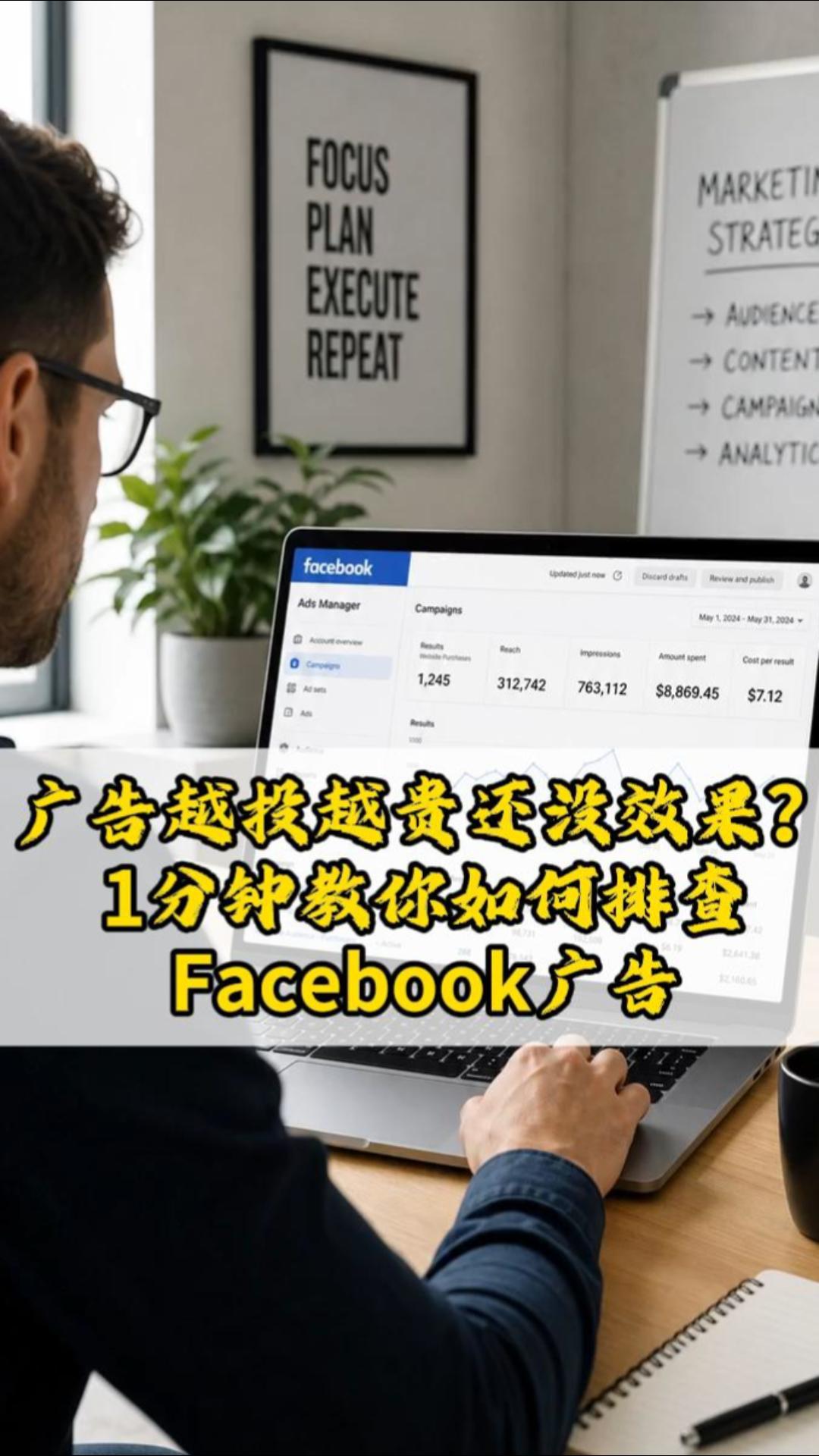
 Are your ads getting more expensive with no results?Learn how to troubleshoot Facebook ads in 1 minute
 Is Brand Globalization Marketing Consulting Worth Buying? At What Stage Should Companies Bring It In


Related Products
 EasyCamp SaaS Smart Website Marketing SystemE-Yingbao SaaS Smart Website Marketing System: AI-powered, zero-code website building. Rapidly launch multilingual independent e-commerce sites in just 10 minutes. Global server acceleration and AI-driven SEO optimization empower businesses to efficiently connect with global markets. The seamless integration of technology and user-friendly operation makes building e-commerce sites incredibly simple.
 AI+SEM Intelligent Advertising Marketing SystemAI+SEM drives intelligent ad creation, empowering full-funnel precision advertising marketing. The system automatically generates weekly/monthly reports, AI recommends keywords and target countries, monitors core metrics in real-time with intelligent alerts, and enables one-click high-conversion ad solutions to help quickly acquire customers and improve ROI.
 AI+SEO Dual Engine Optimization ServiceEasyWin AI+SEO Dual Engine Optimization System leverages AI-powered keyword mining, content generation, and comprehensive technical optimization to help foreign trade enterprises acquire high-quality organic traffic, significantly improving search rankings and conversion rates.
 AI+SNS Social Media Marketing SystemYingbao AI+SNS Social Media Marketing System - Precision social capture for the social media era. Supports one-click content synchronization across major platforms like Facebook and LinkedIn. AI intelligently rewrites posts for enhanced relevance. 24/7 AI customer service and user profiling analysis empower businesses to efficiently expand into global markets.
 AI+SEO营销解决方案易营宝AI+SEO营销解决方案,通过AI批量写作、智能生成TDK、精准关键词扩词等功能,全面优化网站SEO效果,提升流量与转化率。助力企业构建高效智能网站新生态。
 AI+SEM Advertising Marketing SolutionsAI+SEM Advertising Marketing Solution leverages AI technology to deeply empower SEM ad campaigns. It automatically generates weekly/monthly reports using AI, presenting account data across multiple dimensions for comprehensive insights into campaign performance and trends. The system precisely recommends keywords and target countries, intelligently generates high-conversion ad copy, and enables one-click activation of efficient campaign plans to help businesses rapidly acquire customers. Simultaneously, it monitors core metrics in real time, intelligently identifies abnormal fluctuations, and issues timely alerts to ensure stable, high-return advertising results.
 Domain Name ServicesEasyWin provides professional domain name services, including intelligent queries, one-stop registration, brand protection, and full lifecycle management, helping businesses build a digital brand image.
 EasyOperate B2C Cross-Border E-Commerce Platform & Independent WebsiteEasyStore B2C Cross-border E-commerce Independent Store is an intelligent website building and cross-border e-commerce integrated solution independently developed by EasyStore Information Technology (Beijing) Co., Ltd. The system is specially designed for small and medium-sized as well as large export enterprises, integrating 'website building, operation, marketing, advertising, and conversion' into one, helping enterprises quickly establish cross-border e-commerce independent stores to achieve brand globalization and global sales growth.
The platform supports multiple languages, multiple currencies, and multi-channel marketing, with built-in AI intelligent translation and SEO optimization systems, suitable for mainstream markets such as Southeast Asia, Europe and America, Latin America, and the Middle East, assisting Chinese manufacturing enterprises in efficiently deploying international e-commerce strategies. SSL证书易营宝提供专业SSL安全证书服务,包括单域名和泛域名证书,确保网站数据传输加密、身份验证和完整性保护,助力企业建立安全可信的在线业务环境。









