









- What should you focus on in the latest enterprise SaaS report? From renewal rates and delivery costs to overseas growth opportunitiesJul 12, 2026View details
- What signals are worth paying attention to in a cross-border marketing trend report? B2B companies should look at these 6 signalsJul 11, 2026View details
- How to Read a Cross-Border Marketing Trends Report? Five Key Dimensions for Evaluating Channel OpportunitiesJul 11, 2026View details
- Which channel has the highest ROI in the global traffic ecosystem? Comparative analysis of search, social media, and advertisingJul 10, 2026View details
- What multilingual website services are available in Sanya? Which model is more suitable for local businesses going global?Jul 08, 2026View details
- How to view the complete list of China SaaS companies in the top 100? Practical methods for screening website-building and marketing service providersJul 08, 2026View details
- How to view pricing in the global traffic ecosystem? Cost comparison of search, social media, and content channel advertisingJul 06, 2026View details
- How to assess foreign trade website development trends?Looking at 2026 changes from multilingual,AI content to conversion pathsJul 04, 2026View details
Can an AI Writing Assistant Improve Content Delivery Efficiency
At a time when project timelines are accelerating and content demands continue to grow, AI writing assistants are becoming an important tool for improving delivery efficiency. They can not only shorten the content production cycle, but also help project managers coordinate the implementation of website and marketing services more efficiently.
Why project delivery is becoming increasingly reliant on AI writing assistants
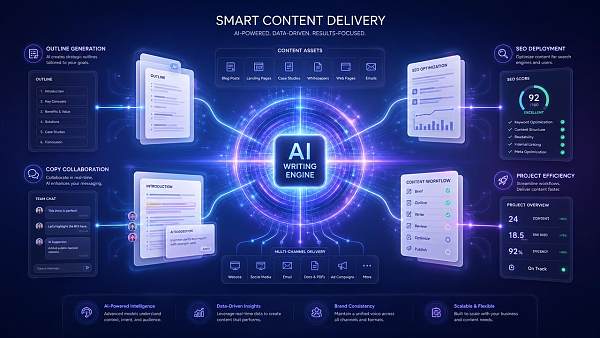
For project managers and engineering project leads, content is no longer just promotional material, but a key deliverable in website launches, landing page production, SEO deployment, advertising campaigns, social media distribution, and overseas market outreach. Once content is delayed, page testing, campaign pacing, and lead collection will all be affected as well.
The value of AI writing assistants does not lie in simply replacing manual writing, but in compressing high-frequency and repetitive steps such as requirement sorting, outline generation, first-draft creation, version iteration, and semantic consistency into a shorter time frame, allowing teams to focus more energy on project judgment and business collaboration.
In the integrated website + marketing services industry, this efficiency improvement is even more evident. A page often does not exist independently; it must simultaneously serve search visibility, brand expression, conversion guidance, and ad campaign support. If content teams, design teams, technical teams, and media buying teams lack a unified production mechanism, projects are highly prone to rework.
The three most common content bottlenecks on project sites
- Frequent requirement changes: campaign themes, page structures, and keyword directions are often adjusted, making manual rewriting cycles long.
- Inconsistent cross-team communication: technical language, marketing language, and sales language are not aligned, resulting in fragmented page information.
- Parallel delivery across multiple scenarios: official website, campaign pages, ad copy, email content, and social media copy are advanced simultaneously, creating heavy pressure on manual scheduling.
Therefore, an AI writing assistant is not a single-point tool, but an accelerator in the project delivery chain. For managers responsible for schedule, budget, and results, it is more like a standardized, reusable, and collaborative content production component.
What delivery efficiencies can AI writing assistants improve
If AI writing assistants are understood only as “automatically generating articles,” their actual value will be underestimated. What truly impacts project efficiency is often the entire chain from requirement confirmation to launch and publishing, rather than a single writing action.
The table below is better suited to a project management perspective, helping determine the specific roles AI writing assistants play in website and marketing delivery.
As can be seen from the table, AI writing assistants are best suited to solving the problem of “content delivery chain efficiency,” rather than simply the problem of writing speed. For those responsible for coordinating milestones, this improvement is directly reflected in rework rates, schedule controllability, and launch stability.
Which website and marketing scenarios are more suitable for prioritizing AI writing assistants
Not all content requires the same depth of manual creation. What project managers should focus more on is: in which scenarios should AI writing assistants be introduced first, where the input-output ratio is highest, and where standardized processes can be formed most easily.
Scenarios suitable for priority implementation
- Official website section development: such as product pages, solution pages, industry application pages, and FAQ pages, where structured content matrices need to be formed quickly.
- Campaign microsite launches: promotional nodes, exhibition nodes, and brand event nodes often require short launch cycles, and AI writing assistants help compress first-draft time.
- SEO content expansion: bulk-generate semantically related pages around core business keywords to strengthen website topical relevance and content coverage.
- Cross-market content adaptation: when enterprises expand global business, unifying master content and standardizing expression logic is more efficient than rewriting piece by piece separately.
From the service logic of Yiyingbao Information Technology (Beijing) Co., Ltd., website development, SEO optimization, social media marketing, and advertising campaigns are inherently interconnected. If an enterprise optimizes only one of these links, the final efficiency improvement is limited; AI writing assistants, by contrast, can serve precisely as the middle layer connecting content production and marketing execution.
For example, in global business promotion, once page content increases, traffic fluctuations will also be amplified accordingly. To ensure that marketing activities and infrastructure resources are matched, some enterprises simultaneously plan traffic costs and site load capacity. At this point, it can be combined with website traffic packages to more steadily lock in outbound traffic spending before promotional nodes.
How to determine whether an AI writing assistant is truly suitable for your project
Many teams are not unwilling to use AI writing assistants; they simply do not know how to choose or evaluate them. What project managers need to examine is not the promotional language, but whether it can fit into existing processes, reduce management costs, and ensure controllable delivery.
The selection table below is suitable for direct use during internal reviews or vendor discussions.
For engineering project leads, the safest approach is not a one-time full replacement, but to first pilot content modules with a high degree of standardization, high revision frequency, and tight launch cycles, and then decide whether to expand the scope of application.
How AI writing assistants and human teams should divide the work
An efficient team is not one that “hands everything over to AI,” but one that establishes a clear division of labor. AI writing assistants are suitable for handling high-frequency, structured, and reusable tasks; human teams are responsible for judgment, quality control, strategy, and deep business expression. Only when the two work together can efficiency truly be unlocked.
Recommended collaboration approach
- The project lead provides unified input on objectives, audience, page purpose, and launch milestones to avoid distortion of requirements at the source.
- The AI writing assistant generates outlines, module descriptions, first-version copy, and frequently asked questions, forming a draft base for discussion.
- Marketing personnel refine value proposition expression, conversion paths, and keyword placement to ensure the content serves promotional goals.
- Technical or product personnel review parameters, functions, and process descriptions to prevent distortion of business information.
- The project manager conducts final acceptance, focusing on delivery milestones, version consistency, and page publishability.
This division of labor is especially suitable for the integrated projects served by Yiyingbao. When enterprises advance intelligent website building, SEO optimization, social media marketing, and advertising campaigns in parallel, if they lack centralized content capabilities, collaboration costs will rise rapidly. The significance of AI writing assistants lies precisely in turning fragmented production into process-based production.
Should cost, resources, and supporting capabilities be evaluated together
The answer is yes. Project management cannot look only at content generation speed; it must also consider post-launch operations and promotional costs. Especially in scenarios such as major e-commerce promotions, media content distribution, and global business, content publishing often brings concentrated traffic, which in turn affects resource consumption, budget estimation, and system stability.
If an enterprise uses a prepaid model to manage traffic spending and hopes to connect more smoothly with website building systems and data analysis workflows, it can pay attention to supporting products that offer automatic deduction of outbound traffic, balance monitoring alerts, API procurement, and BI data integration. For teams that need unified management of multiple accounts, such capabilities help reduce budget fluctuations and operations communication costs.
This is also why some enterprises simultaneously configure website traffic packages when expanding content scale. It does not directly generate content, but it can provide a more controllable cost foundation for site visits after marketing volume increases, especially for projects that are sensitive to campaign nodes and cross-border visits.
Common misconception: after using an AI writing assistant, why hasn’t efficiency improved significantly
After deploying the tool, some teams instead feel that processes have become more chaotic. The reason usually lies not in the tool itself, but in how it is used. If an AI writing assistant lacks rules, objectives, and review mechanisms, it may indeed increase the cost of secondary organization.
- Misconception 1: treating AI output as the final draft. Without human review, parameters, logic, and tone can easily deviate from business requirements.
- Misconception 2: no unified prompt framework. Different team members write in their own way, resulting in mixed styles that are difficult to integrate.
- Misconception 3: focusing only on generation speed, not the publishing process. If website building, review, and media buying stages do not improve simultaneously, the overall cycle will not shorten significantly.
- Misconception 4: ignoring data feedback. If time on page, bounce rate, and conversion paths are not analyzed after pages go live, prompts and templates cannot be continuously optimized.
The truly effective approach is to incorporate AI writing assistants into project standards and form four steps: standardized input, standardized review, standardized publishing, and standardized retrospective analysis. Only then can efficiency improvement be replicated, rather than remaining limited to the effect of a single trial.
FAQ: several questions project leads care about most
What types of projects are AI writing assistants suitable for?
They are suitable for projects with continuous content demand, clear delivery milestones, and a relatively large number of pages, such as official website revamps, batch launches of campaign pages, content rollout for overseas sites, SEO content development, and iteration of advertising landing pages. If a project has very little content or relies heavily on original expert insights, then it is more suitable to use them as an auxiliary tool.
What should be confirmed first during procurement?
Confirm three things first: first, whether it fits the integrated website + marketing service scenario; second, whether it supports multi-user collaboration and version management; third, whether it is easy to integrate with existing website building, campaign delivery, and analytics workflows. What project leads fear most is not that the tool is poor, but that it cannot enter the existing delivery system.
Will AI writing assistants increase content risk?
As long as human review and publishing permissions are established, the risks are controllable. It is recommended to focus on checking business facts, parameter descriptions, compliant wording, sensitive terms, and brand tone. For content aimed at different markets, secondary confirmation should also be made in accordance with local data regulations and advertising rules.
How long does it usually take to see efficiency changes?
Usually, after completing the first round of prompt standardization, template accumulation, and collaborative division of labor, changes in first-draft speed and rework frequency can be observed within 1 to 2 project cycles. If this is further combined with integration across website building systems, data systems, and campaign delivery workflows, the effect will be more obvious than isolated use.
Why choose us
Since its establishment in 2013, Yiyingbao Information Technology (Beijing) Co., Ltd. has continuously used artificial intelligence and big data as its core driving forces, serving key areas such as website development, SEO optimization, social media marketing, and advertising campaigns. For project managers, this means there is no need to repeatedly coordinate among multiple vendors, but instead it is easier to obtain integrated support from website building to promotion to content collaboration.
If you are evaluating whether an AI writing assistant is suitable for your current project, or hope to simultaneously sort out website architecture, keyword layout, page content production workflows, delivery cycles, and traffic resource allocation, you can further discuss the following matters: project goal breakdown, page module planning, AI content collaboration mechanisms, promotional node scheduling, supporting resource selection, pricing ranges, and implementation recommendations.
For projects with tight delivery timelines, complex scenarios, and budget sensitivity, the earlier parameter confirmation, selection judgment, and implementation path planning are completed, the more stable subsequent launch and promotion will be. Rather than waiting until content congestion, traffic fluctuations, and rework increase before trying to remedy them, it is better to establish a more efficient content delivery plan at the project initiation stage.
Related Articles



Related Products
 EasyCamp SaaS Smart Website Marketing SystemE-Yingbao SaaS Smart Website Marketing System: AI-powered, zero-code website building. Rapidly launch multilingual independent e-commerce sites in just 10 minutes. Global server acceleration and AI-driven SEO optimization empower businesses to efficiently connect with global markets. The seamless integration of technology and user-friendly operation makes building e-commerce sites incredibly simple.
 AI+SEM Intelligent Advertising Marketing SystemAI+SEM drives intelligent ad creation, empowering full-funnel precision advertising marketing. The system automatically generates weekly/monthly reports, AI recommends keywords and target countries, monitors core metrics in real-time with intelligent alerts, and enables one-click high-conversion ad solutions to help quickly acquire customers and improve ROI.
 AI+SEO Dual Engine Optimization ServiceEasyWin AI+SEO Dual Engine Optimization System leverages AI-powered keyword mining, content generation, and comprehensive technical optimization to help foreign trade enterprises acquire high-quality organic traffic, significantly improving search rankings and conversion rates.
 AI+SNS Social Media Marketing SystemYingbao AI+SNS Social Media Marketing System - Precision social capture for the social media era. Supports one-click content synchronization across major platforms like Facebook and LinkedIn. AI intelligently rewrites posts for enhanced relevance. 24/7 AI customer service and user profiling analysis empower businesses to efficiently expand into global markets.
 AI+SEO营销解决方案易营宝AI+SEO营销解决方案,通过AI批量写作、智能生成TDK、精准关键词扩词等功能,全面优化网站SEO效果,提升流量与转化率。助力企业构建高效智能网站新生态。
 AI+SEM Advertising Marketing SolutionsAI+SEM Advertising Marketing Solution leverages AI technology to deeply empower SEM ad campaigns. It automatically generates weekly/monthly reports using AI, presenting account data across multiple dimensions for comprehensive insights into campaign performance and trends. The system precisely recommends keywords and target countries, intelligently generates high-conversion ad copy, and enables one-click activation of efficient campaign plans to help businesses rapidly acquire customers. Simultaneously, it monitors core metrics in real time, intelligently identifies abnormal fluctuations, and issues timely alerts to ensure stable, high-return advertising results.
 Domain Name ServicesEasyWin provides professional domain name services, including intelligent queries, one-stop registration, brand protection, and full lifecycle management, helping businesses build a digital brand image.
 EasyOperate B2C Cross-Border E-Commerce Platform & Independent WebsiteEasyStore B2C Cross-border E-commerce Independent Store is an intelligent website building and cross-border e-commerce integrated solution independently developed by EasyStore Information Technology (Beijing) Co., Ltd. The system is specially designed for small and medium-sized as well as large export enterprises, integrating 'website building, operation, marketing, advertising, and conversion' into one, helping enterprises quickly establish cross-border e-commerce independent stores to achieve brand globalization and global sales growth.
The platform supports multiple languages, multiple currencies, and multi-channel marketing, with built-in AI intelligent translation and SEO optimization systems, suitable for mainstream markets such as Southeast Asia, Europe and America, Latin America, and the Middle East, assisting Chinese manufacturing enterprises in efficiently deploying international e-commerce strategies. SSL证书易营宝提供专业SSL安全证书服务,包括单域名和泛域名证书,确保网站数据传输加密、身份验证和完整性保护,助力企业建立安全可信的在线业务环境。









